Manetho counted eight kings of the First Dynasty. The same number is given in the Abydos King List (13th century BC).1Wilkinson 1999, 55 And it is the number of kings listed on the seal impression found in the tomb Qa’a which we looked at in a previous entry. If we allow 25 years on average for each reign, then the First Dynasty lasted for approximately 200 years. However, after surveying other ancient king lists, the archaeologist and philologist, William Albright, concluded that 15 years was a more realistic estimate.2Albright summarizes his findings as following: “Fourteen kings of the dynasties of Upi and Kish receive 205 years (3200-3000), an average of 15 years apiece; sixteen kings of Isin rule 225 1/2 years, 14 years each. Fourteen rulers of Larsa reign 265 years, or 19 years each.” (Albright 1920, 99) If we go with Albright’s estimate then the number of years assigned to the First Dynasty is reduced to approximately 120 years.
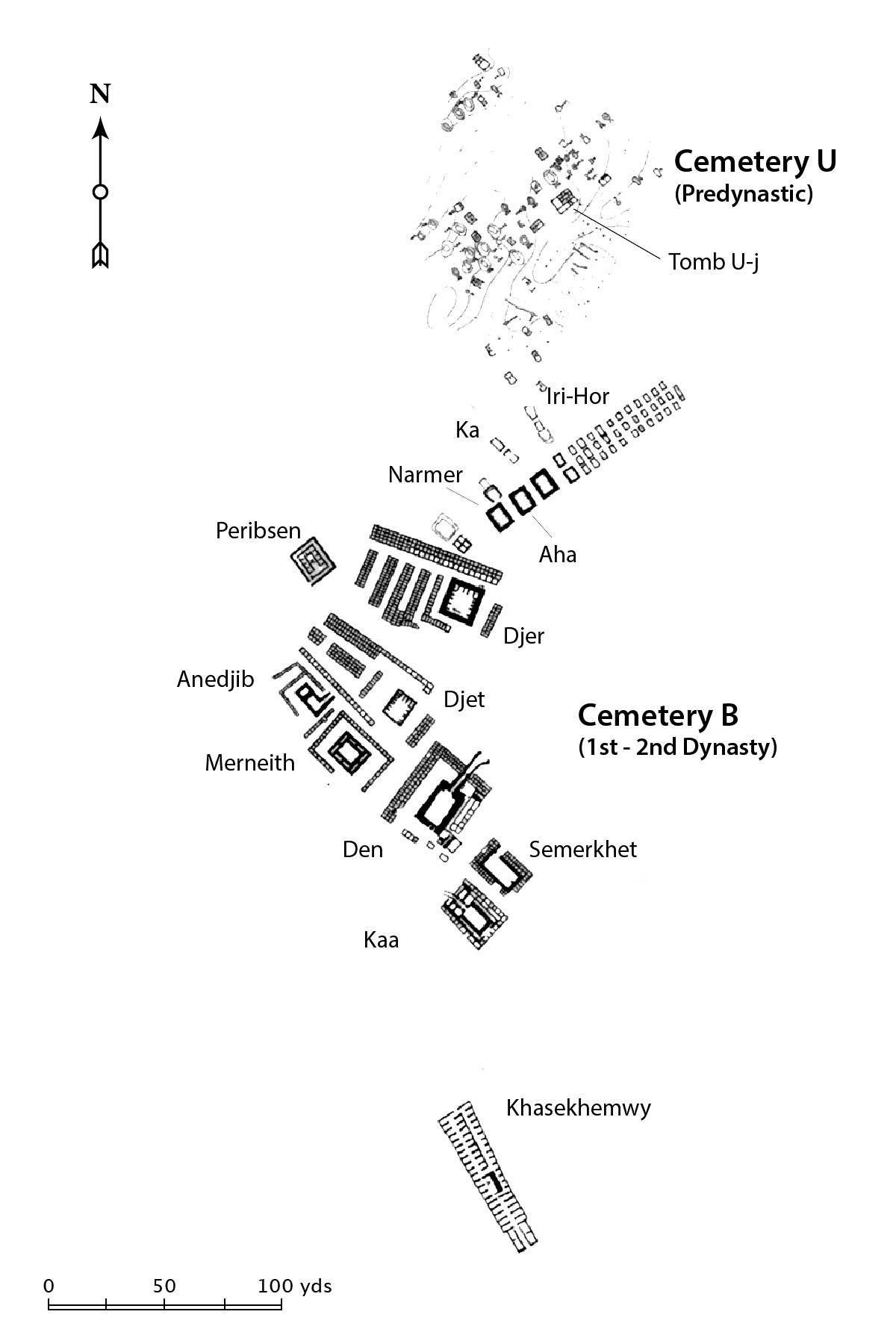
The tombs of the kings of the First Dynasty were found in Cemetery B. The tombs are considerably larger than Tomb U-j.
The kings of the First Dynasty were buried in Cemetery B of Umm el-Qa’ab near Abydos. They were accompanied by their servants to the grave like the predynastic rulers buried at Hierakonpolis and the kings and queens of Ur. Each servant had their own small mudbrick chamber situated next to the central burial chamber reserved for the king, or in the case of Merneith, the queen. The tomb of Hor-Aha, the second king of First Dynasty, is surrounded by 36 attendant burials while the tomb of his successor, Djer, is surrounded by the incredibly large number of 318 attendant burials.3Teeter 2011, 251 The practice of sacrificing dozens or even hundreds of servants with a deceased king or queen appears to have been limited to the First Dynasty of Egypt. After Djer, the number of attendant burials tapers off until, by the end of the First Dynasty, the practice disappears altogether. Similarly, in Mesopotamia there is no evidence for retainer sacrifice after the period represented by the Royal Cemetery at Ur (Early Dynastic II and beginning of the Early Dynastic III).
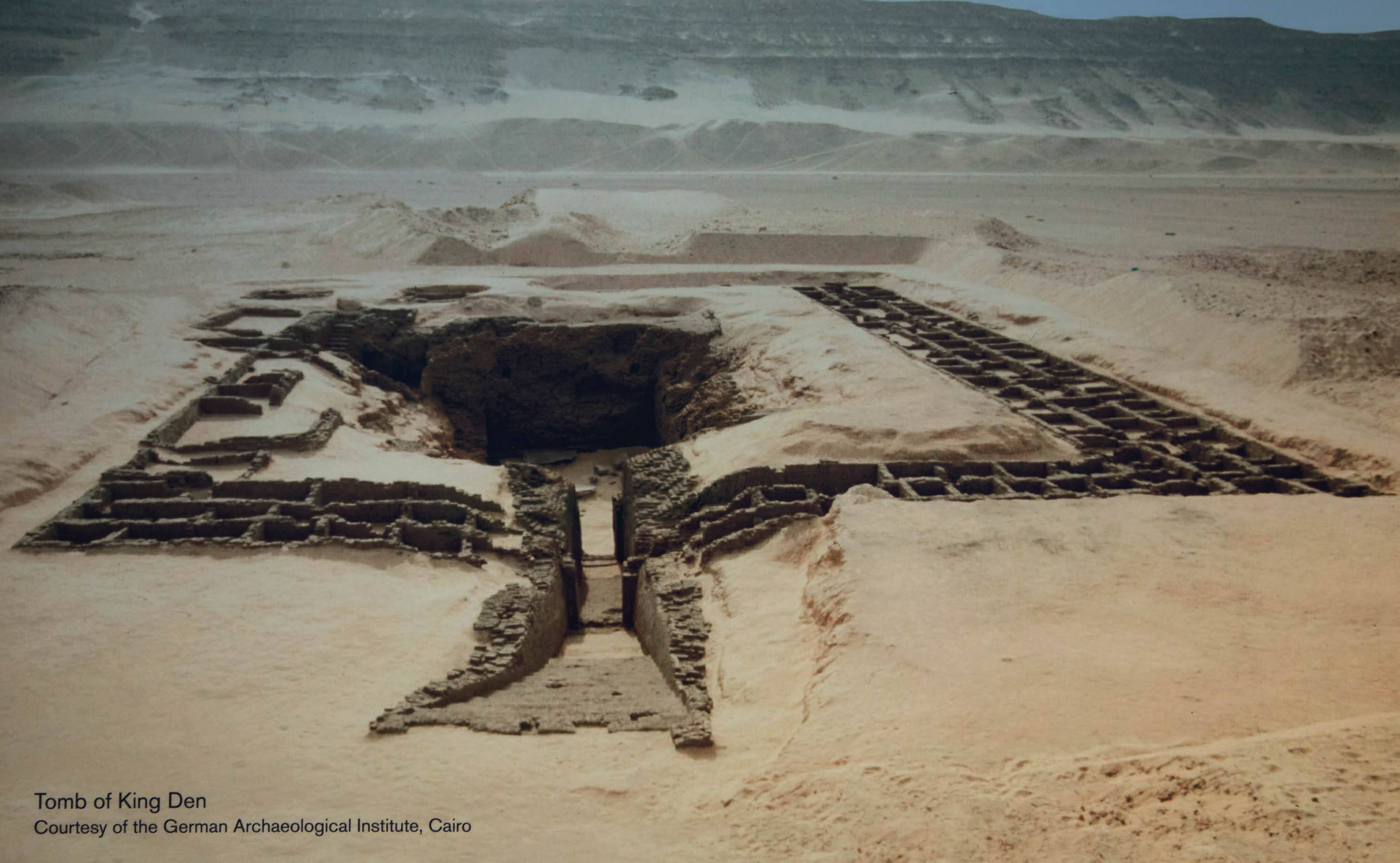
The large burial chamber in the center was surrounded by many smaller attendant burials, each of which took the form of a small “cubicle.” The tomb of Djer was constructed on a similar principle.
Unlike the royal tombs in the cemetery at Ur, which were buried twenty or more feet below ground, the Egyptian tombs were constructed near the surface, which made them easy pickings for tomb robbers. Petrie’s excavations in the cemetery nevertheless recovered objects of copper and gold, although none of silver. The absence of silver is probably due to the distance separating Egypt from the nearest silver mines in Anatolia.
The copper tools recovered from the cemetery were of a simple type easily produced by pouring metal in an open mold and then hammering it into shape. The process of repeatedly heating and hammering the copper, known as annealing, was probably used to harden the copper, which is otherwise too soft to be used as a tool. Many of the copper objects were engraved with the serekh of the king.


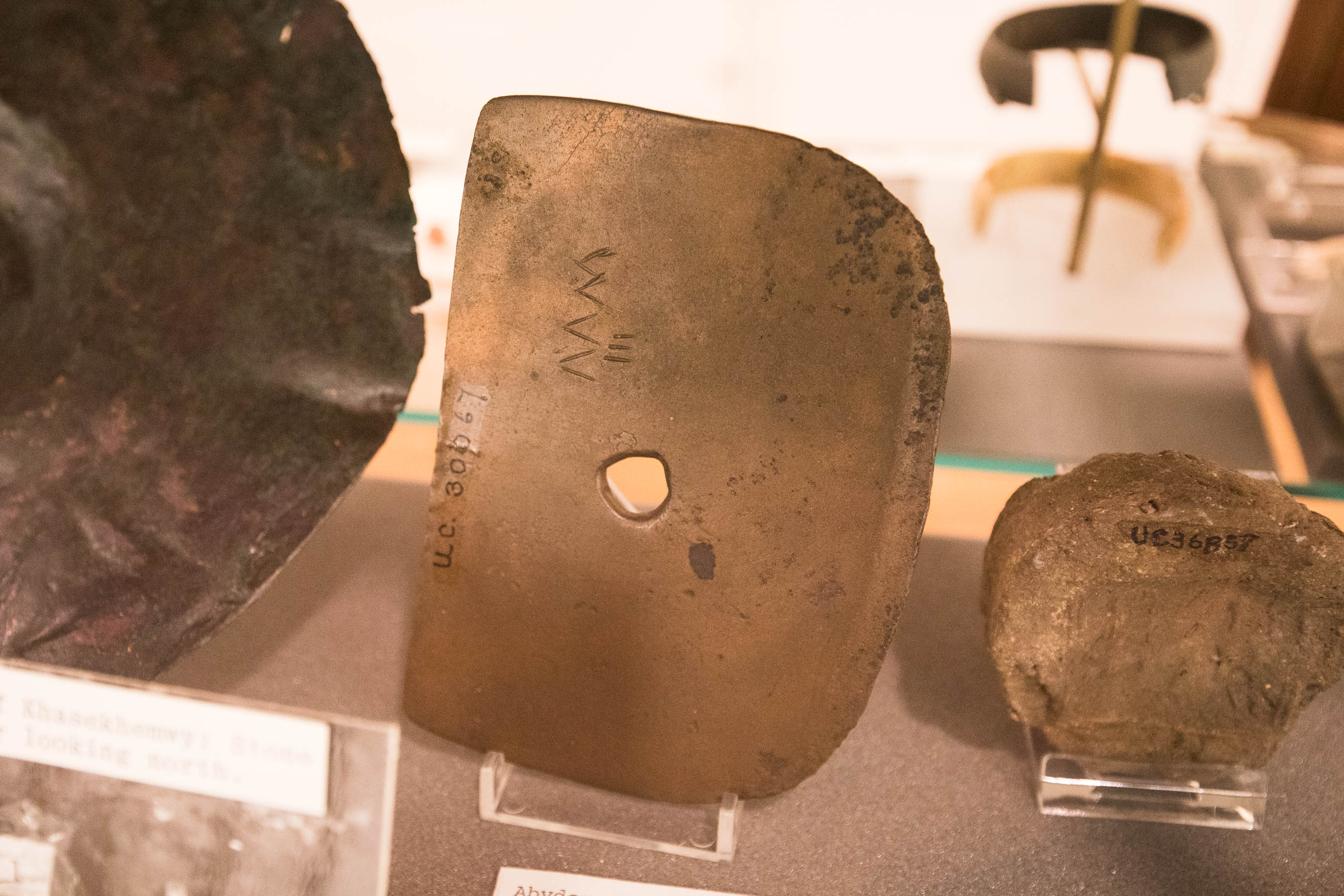
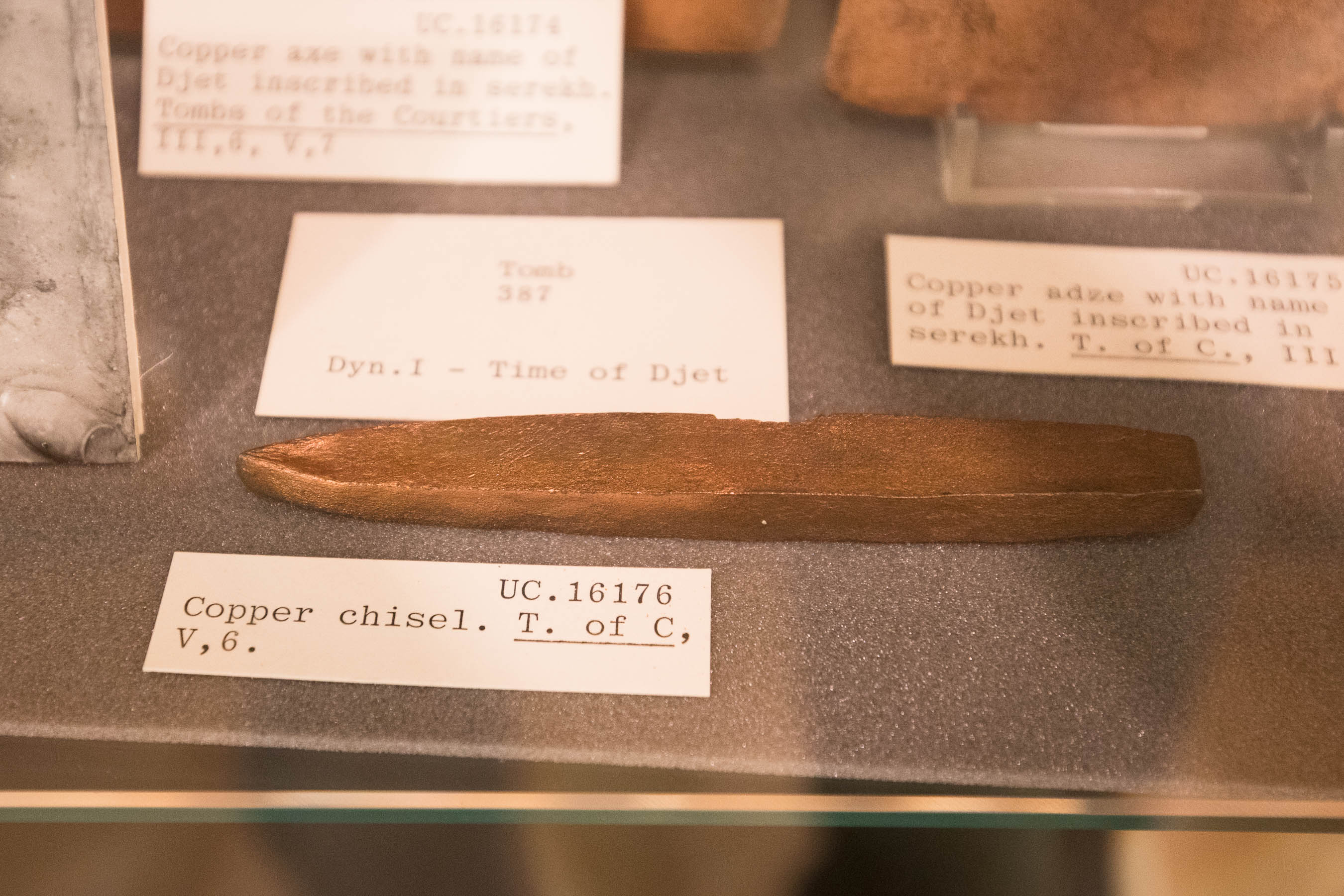
Copper axes, adzes, and chisels such as these were found in the royal tombs of the First Dynasty. Some of them were inscribed with the kings name (ie. “Djet”). Copper tools identical to these were found in the Royal Cemetery of Ur.
Although nothing was found at Umm el-Qa’ab to rival the discoveries made at Ur, enough was found to indicate that these tombs were also richly furnished. One of the most remarkable finds from the cemetery was made by workmen while they were clearing the entrance to the tomb of Djer. Stashed in the wall of the tomb was a mummified arm missed by the tomb robbers. Having discovered the arm, they triumphantly brought it to Petrie. That evening Petrie removed the rough cloth wrapping the arm in the presence of the men who had found it. To everyone’s astonishment, four finely crafted bracelets made from gold, lapis lazuli, amethyst, and turquoise, were revealed beneath the rough cloth wrapping the arm. Such jewelry was worthy of a queen. Petrie tentatively identified her as the wife of King Djer. As was his policy, Petrie paid the workmen with gold sovereigns equal to the weight of the bracelets.
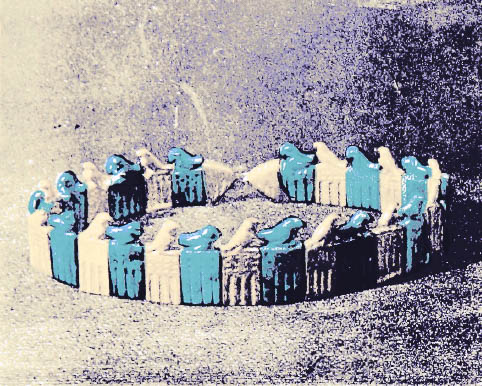
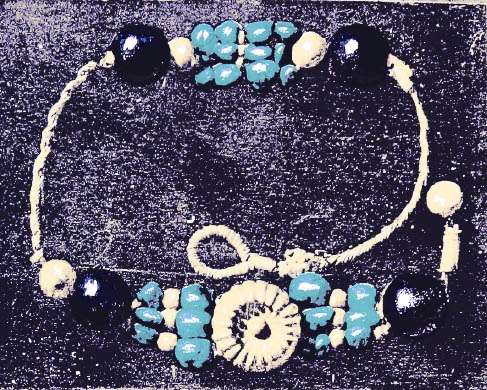
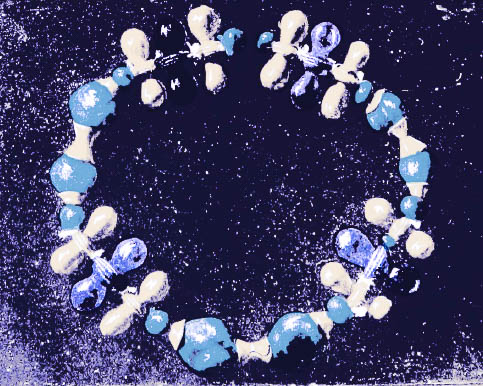
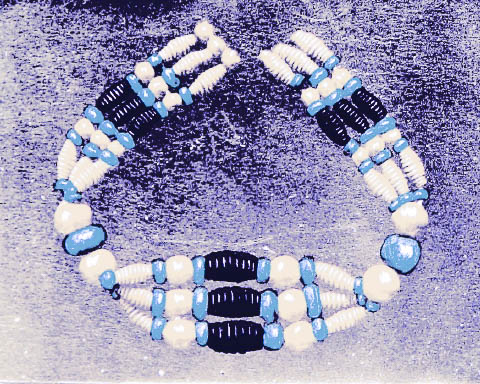
Bracelets from the mummified arm of a queen found in the Tomb of Djer.
Lapis Lazuli
It was not uncommon to find beads or small objects made from lapis lazuli in predynastic and early dynastic tombs of Egypt. However, after the reign of Djer, lapis lazuli disappears altogether from the cemeteries of Egypt and does not appear again for several hundred years. Even when lapis lazuli reappears, during the Fourth Dynasty, it will never be found in the same quantities as before.4Payne 1968, 59-61 One must be careful not to build a theory around the absence of evidence. On the positive side, the presence of lapis lazuli in Egypt during the Predynastic period points to extensive trade across great distances at a time when the Egyptian state was just beginning to take shape.
The only known ancient source of this mineral was Badakhshan in eastern Afghanistan where lapis lazuli mines have been located in the high and inaccessible mountains of the region. Despite extensive geological survey work conducted in recent years, only two other sources of the mineral are known to exist anywhere in the world, one in Tajikistan and the other in Siberia. A medieval report also mentions that there were sources of lapis lazuli in Iran but if they did exist, they have long since been worked out and their location is no longer known.5Hamd-Allah Mustawfi of Qazvin (early 1300’s) states that “The best mines of this stone are in Badakhshan, but there are mines also in Mazanderan, and others at Dizmar in Azerbaijan, and there is also one in Kerman. See Hermann 1968, 27 The Persian king, Darius the Great, boasted of quarrying lapis lazuli in the province of Sogdia—which is ancient Badakhshan. It is likely that this was the only accessible source for this precious mineral in ancient times.6Hermann 1968, 22 & 28 Medieval Arab geographers describe Badakhshan as a “very pleasant” land and a “resort of merchants.” In his travelogues, Marco Polo refers to the lapis lazuli located in this region.
There is also in the same country another mountain, in which azure if found: ’tis the finest in the world and is got in a vein like silver.7Hermann 1968, 22

This figurine, which probably represents a goddess, was found in the Main Deposit at Hierakonpolis and probably dates to the Late Predynastic period.
This vein of “azure” mined from the metamorphic rocks of Badakhshan was coveted by predynastic Egyptian craftsmen who used it to make beads, just as it was by Renaissance artists, who ground the lapis lazuli into powder and used it to create the brilliant blue paint known as “ultramarine.” Ultramarine was also ultra-expensive and was therefore used sparingly, except by the famous Dutch master, Johannes Vermeer, who liked ultramarine so much it ruined him financially.
Vermeer was in love with the qualities of the paint, especially with the way it reflected light. Vermeer used genuine ultramarine in every painting, not only in the deep-colored objects, but also in portions of white drapery, ceramic jugs, black marble tiles, green foliage, white-washed walls, and even in the shadows of the brilliant orange gown in The Wine Glass.8Diana 2023


One of Vermeer’s masterpieces, the painting shows a man in the shadows eagerly pouring the woman a drink, with the intent ion of getting her drunk. A painting of pitch-blackness framed by gold is hanging from the wall behind him whereas the figure of temperance is in the stained glass window in front of the woman, reminding her of the path that leads to the city of God.
“Lapis Lazuli – A Pigment More Precious Than Gold.” Daily Art Magazine. . January 29, 2024. Link
Herrmann, Georgina. “Lapis Lazuli: The Early Phases of Its Trade.” Iraq 30, no. 1 (1968): 21-57. Link
Kemp, B. J.
Ancient Egypt : Anatomy of a Civilization.
New York: Routledge, 2006. Link
Payne, Joan Crowfoot. “Lapis Lazuli in Early Egypt.” Iraq 30, no. 1 (1968): 58-61. Link
Teeter, Emily .
Before the Pyramids : the Origins of Egyptian Civilization, edited by E Teeter.
Chicago, Ill: Oriental Institute of the University of Chicago, 2011. Link