Very little in the way of urban architecture is known from the EB IV—MB I period in the southern Levant. The broken down temple of Stratum XIV at Megiddo hardly qualifies. Most of what archaeologists know about the period comes from several small sites in the Transjordan and from clusters of shaft tombs distributed across a broad swath of Syria and the southern Levant. We’ve seen this type of tomb at Bab edh-Dhra. Most the shaft tombs excavated in the cemetery of Bab edh-Dhra date to the first half of the Early Bronze period although a certain number date to its latter half. Many more would be excavated by Kathleen Kenyon at Jericho, all of them dating to the EB IV—MB I.
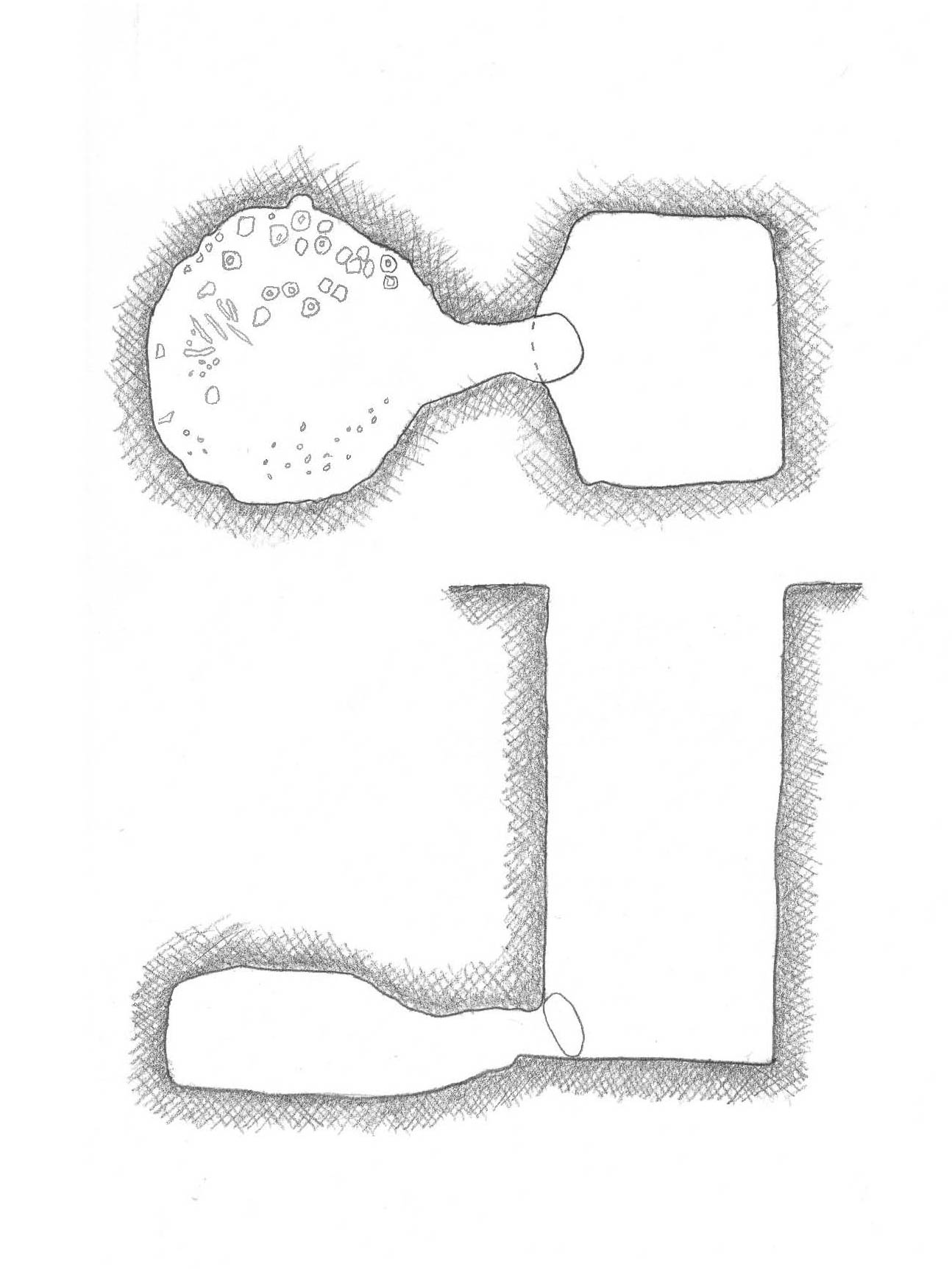
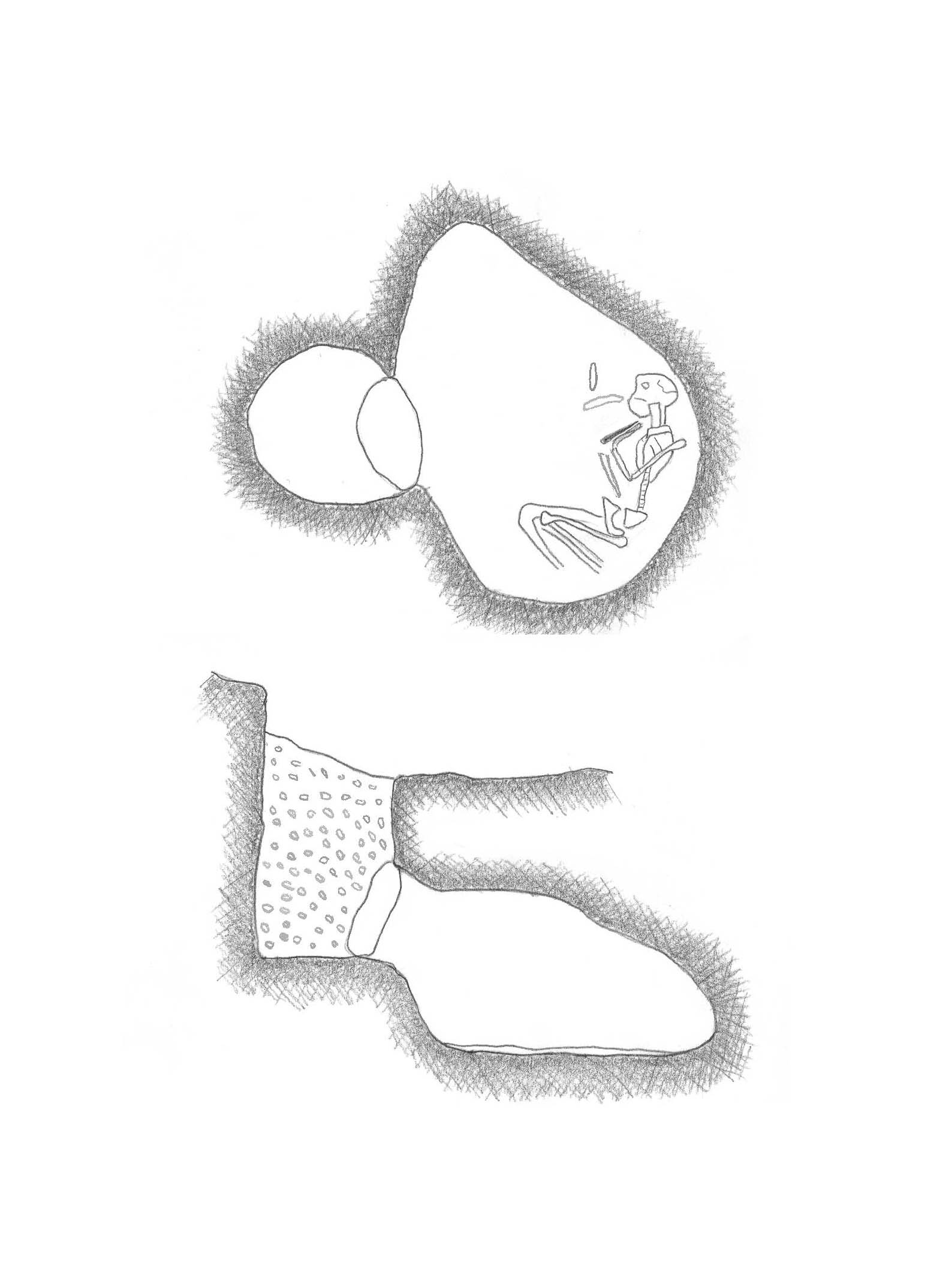
Two types of shaft tombs excavated by Kenyon at Jericho.
Adapted from Kenyon, Amorites and Canaanites.Shaft Tombs of Jericho
Kenyon excavated several hundred shaft tombs at Jericho, which, although roughly contemporary, differ in terms of their method of construction and contents. Kenyon identified four major types.
1. “Dagger Type”—The simplest shaft tombs contained just one or two bodies and a few simple grave goods, such as a dagger or pin depending on the gender of the deceased. No pottery was found in these tombs. Kenyon found 105 tombs of this type at Jericho.
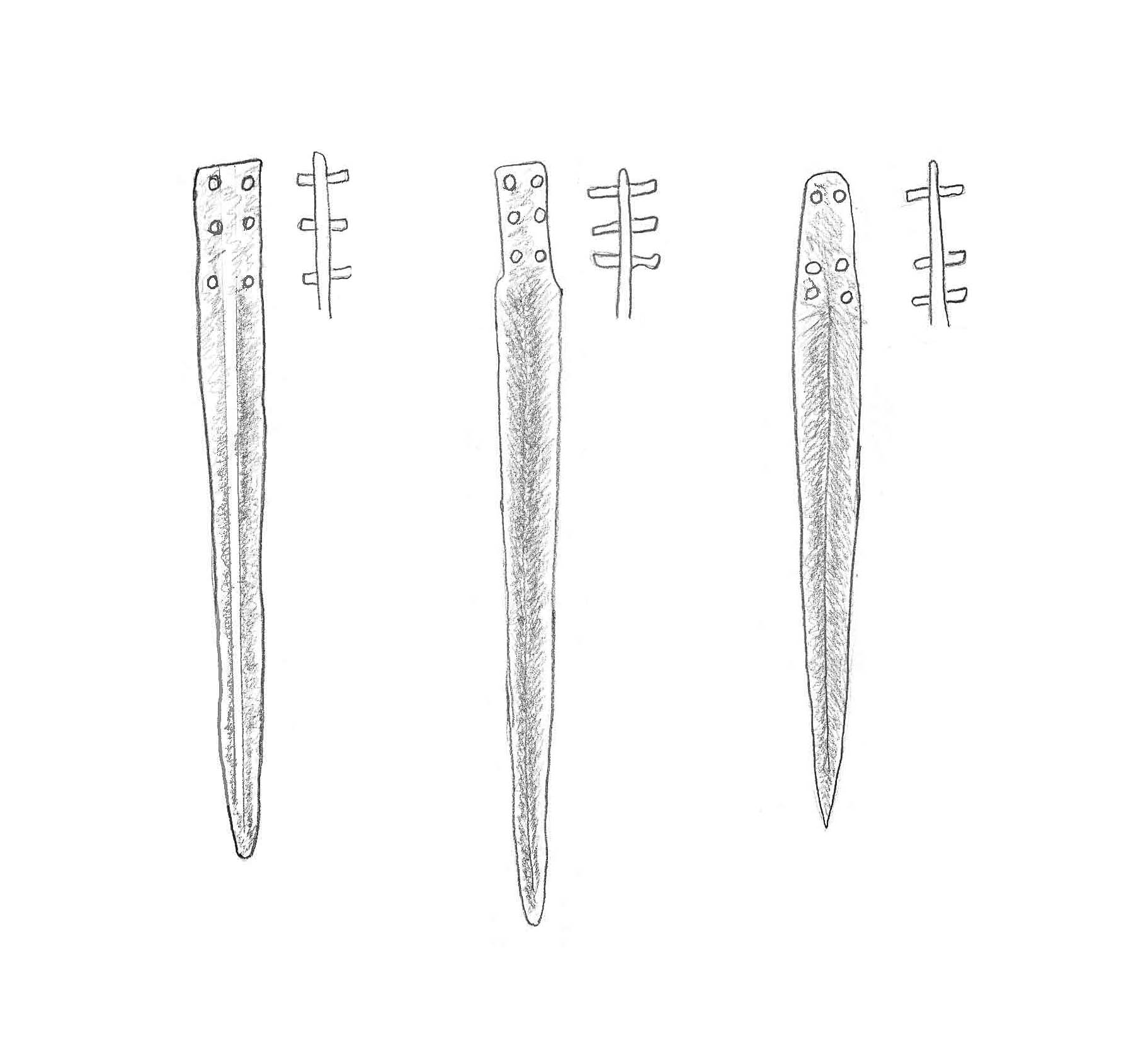

Typical weapons of the EB IV – MB I period found in the shaft tombs at Jericho. Note the bent tang on the spearheads. This was used to attach the spearhead to the shaft.
2. “Pottery Type”—These tombs were identical to the Dagger type except they contained pottery instead of weapons. This was the most numerous type with 161 examples. A niche was cut into the wall of the tomb chamber for a four-spouted lamp. We will look more closely at the pottery from these tombs in the next section.

Four-spouted lamps found in shaft tombs dating to the EB IV – MB I period.
3 & 4. “Outsize Type” and “Square-shaft Type”—These were characterized by large square shafts and tomb chambers. Both contained pottery but only the latter contained weapons. These did not number more than ten or twenty each.
Although the shaft tombs appear to belong to several different burial traditions, they share several important characteristics in common: 1) they were cut from rock, 2) they were generally made for just one or two individuals. In contrast, the tombs of the preceding Early Bronze III period were typically caves or mudbrick charnel houses which were often found to contain twenty or more individuals and lots of pottery, but rarely weapons.1Kenyon 1966, 12-15

The Amorites
Kenyon argued that the shaft tombs excavated at Jericho belonged to Amorite pastoralists from the desert fringes of Syria, known in Akkadian cuneiform texts as the amurru (Sumerian martu). The amurru or “westerners” are generally depicted in Sumerian texts as a primitive people who did not even know what was in their bread.
Wheat is prepared with (?) gu-nunuz-grain as a confection; the martu eat it but know not what it contains,”2Kramer 1963, 287
This is the attitude of an urbanite towards a cowboy who does not know what is in his sushi roll. The amurru were pastoralists who relied upon their herds and flocks for milk, cheese, yogurt, and meat. These provided most of their sustenance. In order to sustain their flocks in the summer months, pastoralists moved with their flocks in search of grazing. This movement was typically vertical: winter was spent in the low desert and summer in the cooler uplands.

Shepherds bring their flocks to the low desert for grazing during the winter when a little rain makes the desert blossom with new life.
The Amorites probably did grow grain, contrary to the Sumerian proverb, on marginal land that may or may not receive sufficient rainfall to grow a crop. This marginal land may be found on a map by tracing the 8 inch (200 mm) isohyet line (Greek iso “equal,” huetós “rainfall”) which functions like a contour line on a topographical map except it maps average rainfall instead of elevation. As a general rule, land that receives less than 8 inches per year is too dry for growing cereal crops without irrigation.
Those who have observed land use patterns in Iraq today note that marginal land is not usually farmed by settled populations who rely on a consistent harvest, but by bedouin pastoralists who are willing to risk the chance of crop failure since they do not rely on it for sustenance, nor do they pay tax or rent on the land. If there is sufficient rainfall that year, and the land produces a crop, it is theirs. But if it does not produce a crop, they may still graze their flocks on whatever growth is there.3Adams 1965, 20
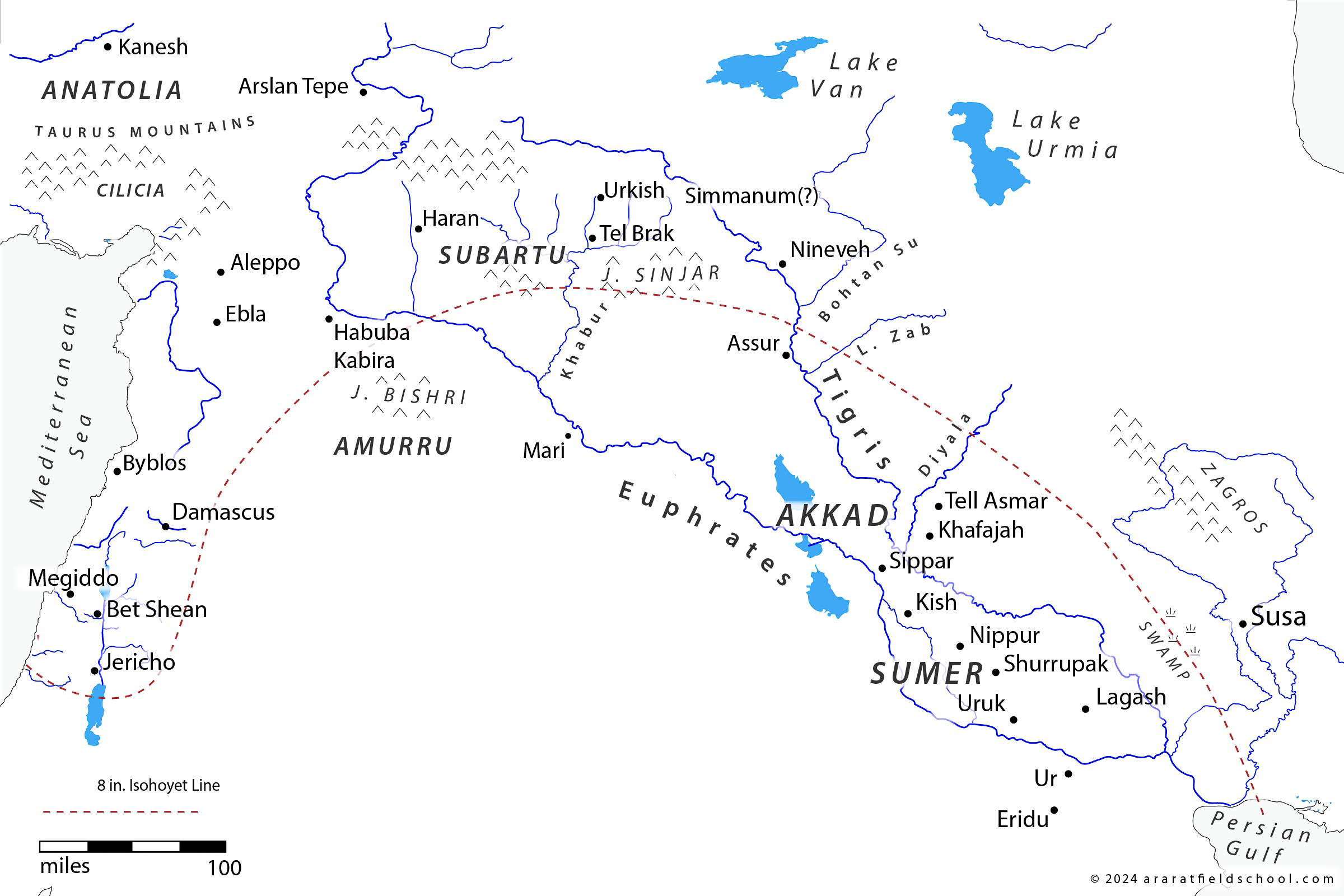
Land above the ishoyet line may generally be relied upon to produce a harvest, thus earning for it the name “fertile crescent.” This line has shifted back and forth 150 miles in just the last 30 years. See here.
Invasion?
Archaeologists debate whether the shaft tombs at Jericho belong to Amorite “invaders” who came from the Syrian steppe, or to groups of pastoralists who have always lived on the fringes of settled land in the southern Levant. Kenyon pointed to the shaft tombs found next to Syrian cities such as Ras Shamra and Qatna which contained the same pottery, pins, beads, and weapons as those which she excavated at Jericho. She further notes that the appearance of these shaft tombs in Syria and the southern Levant coincided with the widespread destruction or abandonment of the cities in these regions. Thus Kenyon argued that the shaft tombs belonged to Amorite invaders from the desert fringe who brought urban civilization to an end for a period of time.4Kenyon 1963, 34; cf. Bright 1981, 44 The Amorite invasion might be compared to other famous invasions by nomadic or semi-nomadic groups: the Huns, Arabs, Vikings, Seljuk Turks, Mongols, etcetera.
Arguing against this view, William Dever notes that shaft tombs have long been a fixture of the southern Levant and that they date to all periods of the Early Bronze Age, not just to its end. Dever points to the shaft tombs of Bab edh-Dhra as an example. The shaft tombs belonged to pastoralists who have always lived on on the fringes of settled populations in the southern Levant.5Dever 1973, 56 ff. According to Dever, the increase in the number of shaft tombs in the settled regions of Canaan at the end of the Early Bronze period does not necessarily imply an Amorite “invasion,” but the resettlement of the land by semi-nomadic groups from the Transjordan after the cities had already been largely depopulated. The shaft tombs, therefore, do not belong to foreign invaders but to people who have always lived on the margins of civilization in the southern Levant. These may have included some Amorites from the Syrian steppe but this does not make them an invading force.
If Dever is correct, and there was no Amorite invasion, then what happened to the cities of the southern Levant and Syria at the end of the Early Bronze period? No one disputes that the cities went into decline, and in many instances, were completely abandoned at this time. One possibility, which we discussed in the previous entry, is that a prolonged drought resulted in the abandonment of urban life for a period of time. We also cannot discount the destructiveness of the campaigns waged by Pepi I and Sargon of Akkad in the southern Levant and Syria.
The destruction of Mari, Armi, and Ebla can all be attributed to the campaigns waged by the kings of Akkad. The loss of these cities must have resulted in major dislocations in Syria. Although Ebla and Mari would be rebuilt, neither regained the prosperity they had before. There is no indication that Armi was ever rebuilt.6Astour 2002. Note: The destruction of the great Early Bronze city (Mardikh IIB1), may be attributed to Sargon of Akkad although Astour attributes the destruction to Lugalzagesi. Ebla was destroyed a second time several hundred years later, perhaps by the Hurrians. This destruction marks the end of the Early Bronze civilization at Ebla (Mardikh IIB2). The city that followed (Mardikh IIIA) was rebuilt on a completely different plan, with a completely different material culture. It marks the beginning of the Middle Bronze period in Syria. The decline and fall of these cities must have filled the ranks of Amorite nomads.
Looking south, we encounter a similar situation. Egyptian armies made repeated incursions into Canaan during the whole of Pepi I’s long reign. As you may recall, one of Pepi’s generals, Weni, claimed to have led a large Egyptian army comprised of “tens of thousands” of Egyptian troops and Nubian mercenaries into Canaan, not once but five times. These attacks appear to have penetrated as far north as Mount Carmel and to have targeted both cities and settled lands. Although the severity of these attacks is impossible to gauge, Weni’s account suggests that more than a few cities in Canaan were destroyed. It may be incorrect, therefore, to blame the destruction and abandonment of cities in Syria and the southern Levant solely, or even partially, on the climate or on the Amorites, given the severity of the attacks perpetrated by Egypt and Akkad.
Back to the Land
Until now, we have treated “pastoralists” and “city-dwellers” as separate groups with their own distinct cultures. This is a valid distinction well attested in the literature of the period. However, it was not always maintained in practice, especially during hard times, as may be seen from the writings of the Israelite prophet, Isaiah, who warned the people of Jerusalem that their alliance with the Assyrians would ultimately lead to their invasion by the Assyrians and a return to a nomadic lifestyle.
In that day, a person will keep alive a young cow and two goats. And because of the abundance of the milk they give, there will be curds to eat. All who remain in the land will eat curds and honey. (Isa. 7:21-22 NIV)
This was not a promise of good times to come, when the inhabitants of Jerusalem would enjoy milk and honey—the rich food of the court—as some commentators maintain. To the contrary! Curds and honey were the food of adversity. A cow or goat may graze on land that has reverted to thorns and thistles and their milk drunk straight from the udder. And the honey gathered from wild honeycombs could be gathered and eaten immediately. Whereas a significant upfront investment in time and money was required before the juice could be squeezed from the grape and oil from the olive.
But the period of nomadic existence did not need to last very long. Even a ruined orchard will provide a little fruit, and with a little care it can be restored.
“This year you will eat what grows by itself, and the second year what springs from that. But in the third year sow and reap, plant vineyards and eat their fruit. (Isa. 37:30 NIV)
In theory, the cities of Canaan should have been able to recover from the incursions of the Egyptians.7There are other instances of ANE kingdoms which were laid waste and quickly recovered. The territory of Hazael, king of Aram, was laid waste by the Assyrian king, Shalmaneser III, who boasted in his 18th year of having killed 16,000 Aramean soldiers and capturing 1121 chariots and 470 cavalry horses. Again, in his 21st year, Shalmaneser claimed to have conquered four major Aramaean cities belonging to Hazael. Booty from Aram has been found in Assyria that at least partially confirms the claims of the Assyrian king. Thus, for five years (ca. 841–836 BC) Hazael was fending off an invasions by the Assyrians that left him penned up in Damascus. However, in the years following these attacks, Hazael successfully carried the battle into Israel and Judah all the way to the gates of Jerusalem. There are several reasons for the quick turnaround of Aramaean fortunes after their devastating losses to the Assyrians. Firstly, destroyed capital in ancient societies could quickly be replaced. Secondly, despite the loss of life, the void in manpower was quickly replaced as those who fled the settled areas returned from their hideouts. Judah, in particular, was well suited for this tactic, in as much as much of the populated area borders a vast wasteland. This could explain how Hezekiah became a major power in the region despite suffering devastating attacks by the Assyrians. Perhaps the most devastating act of an invading army was cutting down trees and orchards. But they did not. The EB IV–MB I was characterized by a prolonged period of decline. Perhaps a drought delivered the coup de grâce, an earthquake, an Amorite invasion, or any combination of the above. We cannot know for sure since the Early Bronze cities of Canaan did not produce any texts, nor did the cities of Syria following the destruction of the Ebla (Mardikh IIB1) and its archive.
The Amorites Again
The Amorites undoubtedly emerged as a potent fighting force during this period. Already, during the reign of Shar-Kali-Shari, the last important king of the Akkadian dynasty, we encounter the following year name: “the year he overcame the Amorite in Basar.” If Shar-Kali-Shari won a victory at Jebel Bishri over the Amorites, it was short-lived. He was was never able to claim kingship over more than Akkad and the Akkadian empire dissolved shortly thereafter. When the Amorites appear again in the Ur III period, they constituted a sufficient threat that that the penultimate king of Ur, Shu-Sin, built an “Amorite wall… for keeping out the westerners.” If the Amorites penetrated into southern Mesopotamia, eventually occupying all of that land, they must also have gained control of Canaan. The problem is, we do not know how the “Canaanites” would have viewed the “Amorites” since neither group was monolithic. It may not even be possible to distinguish an Amorite from a Canaanite during this period. Both were western semitic speaking peoples. In the Bible, the terms may sometimes be employed interchangeably whereas in other places, the Canaanites are associated with coastal regions and valleys whereas the Amorites are located in the mountains and hill country.
Whatever happened to the cities of Canaan during the EB IV–MB I period, it resulted in lasting and significant change. When the cities were rebuilt on the ruins of the old ones, they were constructed on a completely different plan and display a very different material culture—the Middle Bronze II.
Astour, Michael C.
“A Reconstruction of the History of Ebla (Part 2),” in Eblaitica : Essays on the Ebla Archives and Eblaite Language, Volume 4, edited by C. H Gordon, Gary Rendsburg.
Winona Lake, Indiana: Eisenbrauns, 2002.
Bright, J.
A history of Israel.
Philadelphia: Westminster Press, 1981. Link
Dever, William. “The EB IV-MB I Horizon in Transjordan and Southern Palestine.” Bulletin of the American Schools of Oriental Research, no. 210 (1973): 37–63. Link
Kenyon, Kathleen.
Amorites and Canaanites.
London: Oxford University Press, 1966.
Kramer, S. N.
The Sumerians: Their History, Culture, and Character.
Chicago: University of Chicago Press, 1963. Link
Lapp, Paul.
The Tale of the Tell: Archaeological Studies.
Pittsburgh: Pickwick Press, 1975. Link
Mazar, Amihai.
Archaeology of the Land of the Bible.
New York: Doubleday, 1992.
McC. Adams, Robert.
Land Behind Baghdad: A History of Settlement on the Diyala Plains.
Chicago, Ill: University of Chicago, 1965. Link