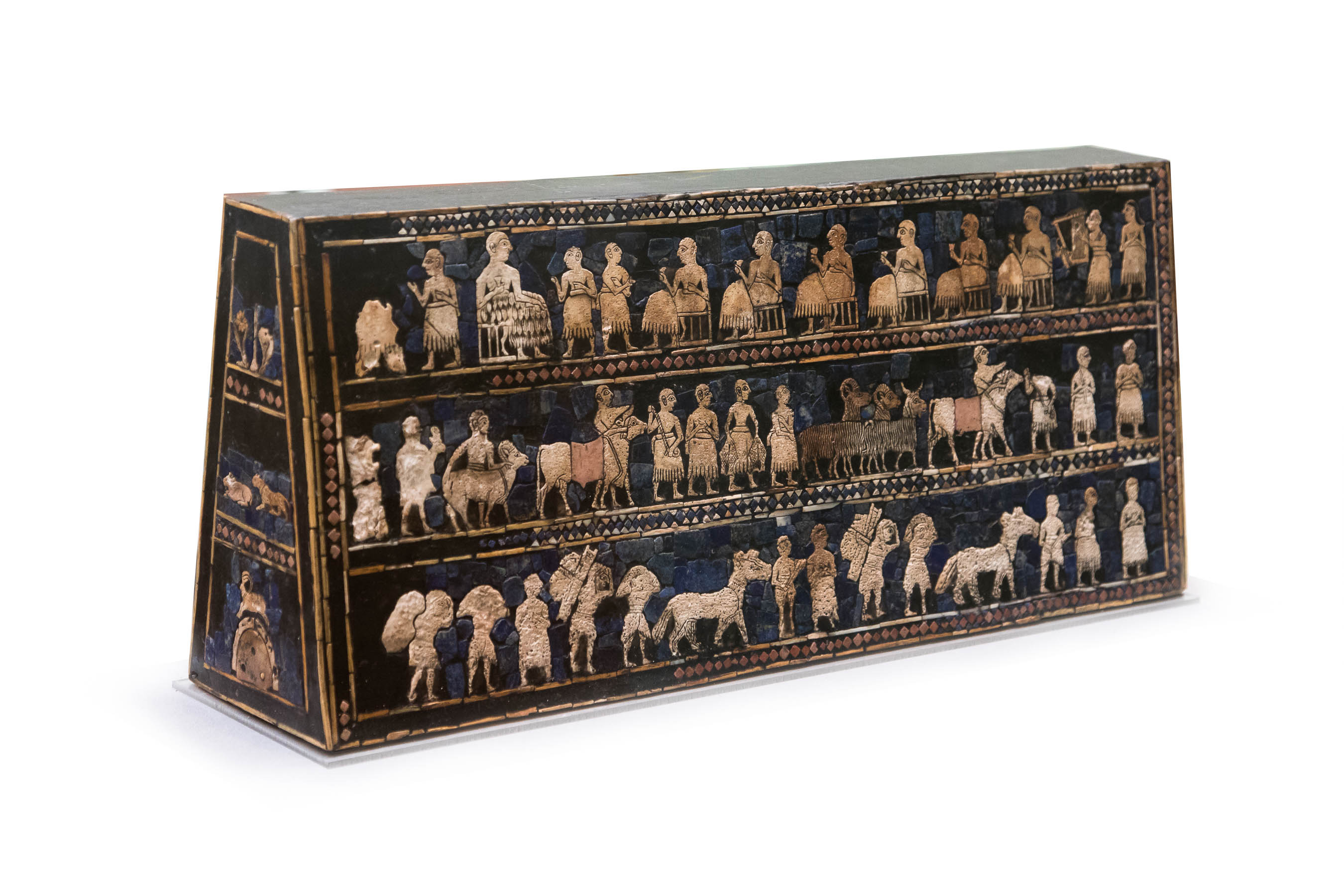
Perhaps the most famous object from the Royal Tombs of Ur. The box stands 8 inches tall and is 18 inches long. It is decorated on four sides with lapis lazuli, shell, and red limestone set in bitumen.
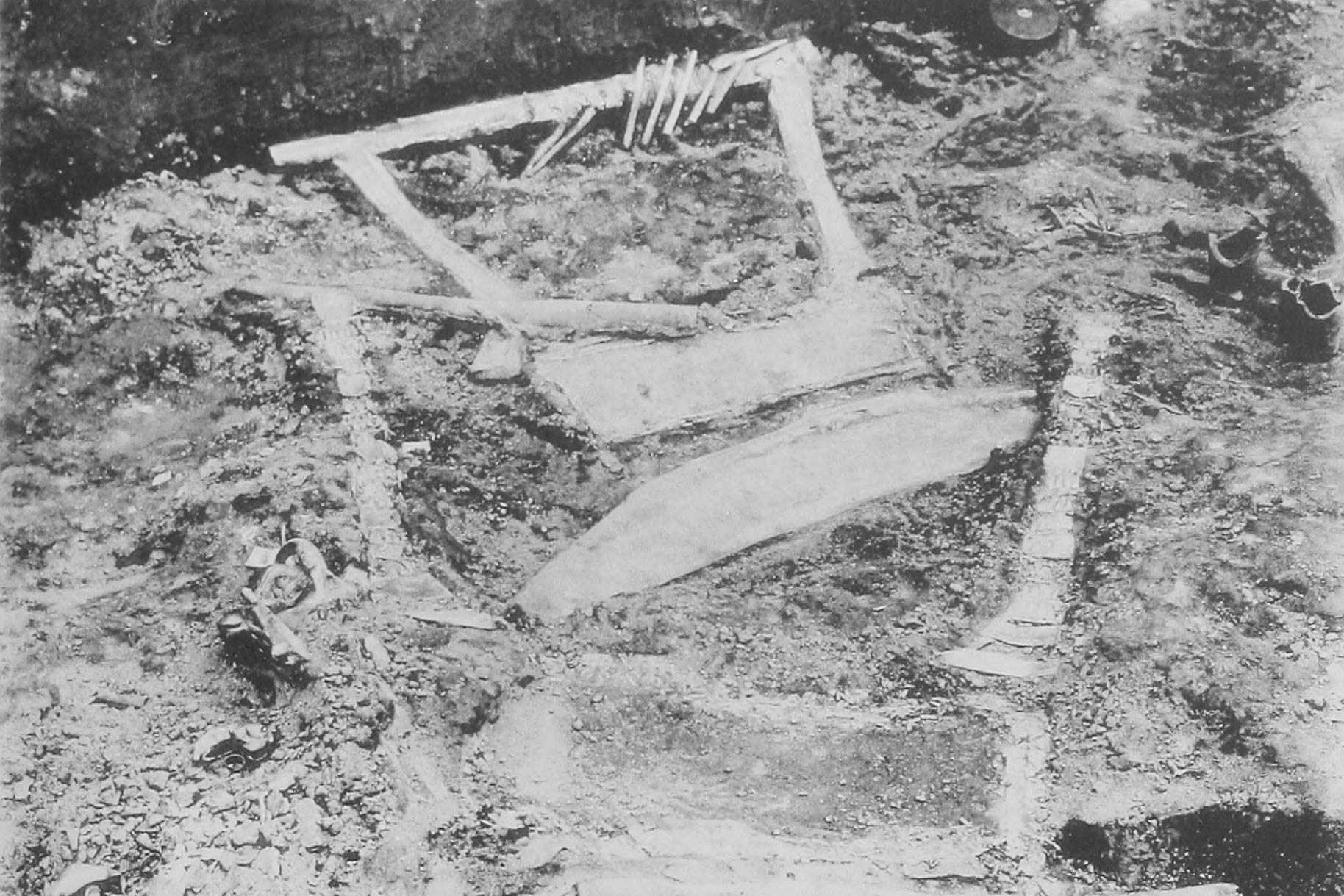
One of the most famous discoveries made in the Royal Cemetery of Ur came from PG 779, probably one of the oldest tombs in cemetery. This tomb may have belonged to Ur-Pabilsag (c. 2500 BC in the short chronology). It has been suggested that he was the father of Meskalamdug, and therefore the grandfather of Mesannepada.1Hamblin 2006, 49 Inside the tomb Woolley found a wooden box inlaid with lapis lazuli, shell, and red limestone. He could tell that the inlayed pieces formed a mosaic, although of what exactly, he could not determine. It was like finding an assembled jigsaw puzzle buried upside down in the sand. Any movement of the puzzle would result in the whole thing coming apart. And since Woolley had no way of knowing what picture it formed, there was no way he could reassemble it later.
A true pioneer in his field, Woolley devised a brilliant method for preserving the mosaic. He uncovered a panel, bathed it in wax, and lifted it from the ground in one piece. The mosaic was restored by placing it face down on a piece of glass which was subsequently heated until the wax grew soft enough that the pieces of the mosaic lay flat on the glass. No reassembly was necessary.
Thanks to Woolley’s careful work, a remarkably vivid and colorful picture of Sumerian court life was preserved for posterity. One side shows shows men clad in military gear, marching into battle; the other shows men seated at a banquet celebrating a victory. Woolley thought the box may have been mounted on a pole and carried as a standard since it was found next to the shoulder of a young retainer. Thus he named it the “Standard of Ur.” The name has stuck although no one really knows if that is how the box was used.

PG 779 was one of the largest tombs in the cemetery. The standard was found in the chamber marked number 3.
The War Side
The War Side of the box preserves the earliest known representation of chariot warfare.2There are scenes of individual chariots on pottery jars and archaic cylinder seals which predate the Standard of Ur slightly (perhaps), but no other depictions of warfare. “War cart” is a better term than “chariot” for the vehicles the Sumerian rode into battle. They were relatively heavy vehicles, fitted with four solid wooden wheels (spoked wheels were not invented until the beginning of the 2nd millennium BC), that did not pivot. The cart could not have been easy to maneuver.
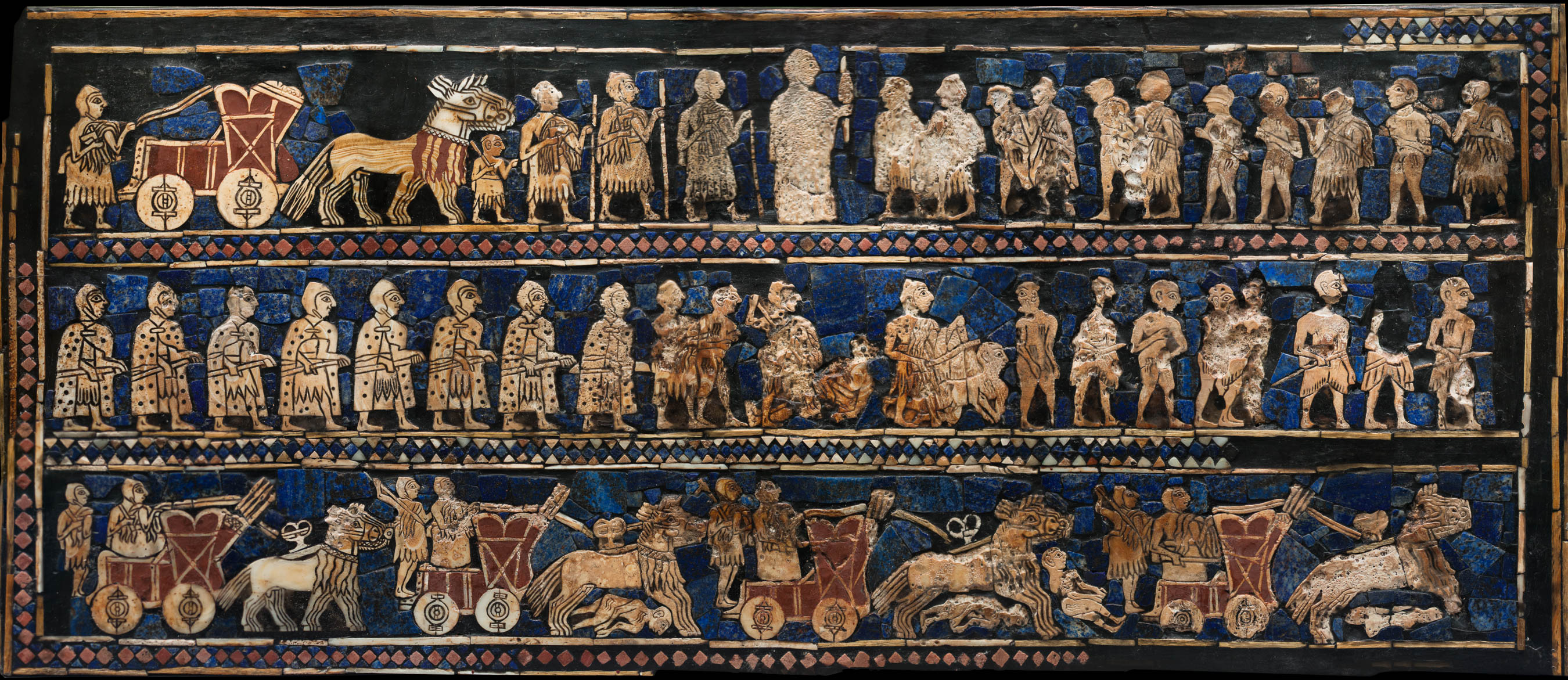
The most important source of military history for the Early Dynastic period, this inlaid panel depicts the moment of victory and the aftermath of battle. The identity of the enemy combatants is unknown.
The war-carts were drawn by what appears to have been four wild asses. Of course, this is oxymoronic since any asses pulling a cart into battle cannot be wild. Therein lies the mystery. The animals really do look like wild Asian asses (see below), known also as onagers (Greek onos “ass” and ger “wild”). The English word “ass” comes from the Latin asinus and the Greek ónos. Both terms appear to be derived from the Sumerian word for wild ass: AN.ŠU.3Parpola and Janhunen 2011, 61 The Greek general, Xenophon (born c. 430 BC), claimed that the Asian wild ass was swifter than a horse and endowed with incredible endurance. More recent scientific studies have documented wild asses running at sustained speeds of around 45 mph for 6 miles without flagging. A female wild ass was chased for three-quarters of an hour at speeds averaging 28 mph!4Groves 1986, 38; see also Parpola and Janhunen 2011, 65 The mature wild ass has a vicious nature, like a zebra. The Indian army unsuccessfully attempted to use them as pack animals but quickly discovered that they were all but untamable. One early traveler in Asia, writing in the late 19th century, recounts having seen domesticated wild asses that had been caught as foals.
Though some of the captures [wild asses] remained excessively vicious, others became quite tame, and were ridden and driven just like tame donkeys. The young ones are as tame as dogs, and extremely fond of being fondled and played with.”5Quoted in Tegetmeier and Sutherland 1895: 26-27; see also Parpola and Janhunen 2011, 66
It has also been suggested the Sumerian asses were a cross between a wild ass and a donkey. These hybrids are supposed to have fetched a price forty times that of a normal donkey.6Hamblin 2006, 130 Whatever their origin, the breeding and taming of these animals is an impressive achievement. That four of them were hitched to a cart and driven into battle is quite astonishing. The animals were not controlled by a bit and bridle, but by nose rings which were attached to reigns that passed through reign guides.

This shell inlay found at Mari provides a detailed look at the reign rings, surmounted by a bull, and the nose rings used to control the asses. We will look more closes at the findspot of this inlay in our discussion of Mari.
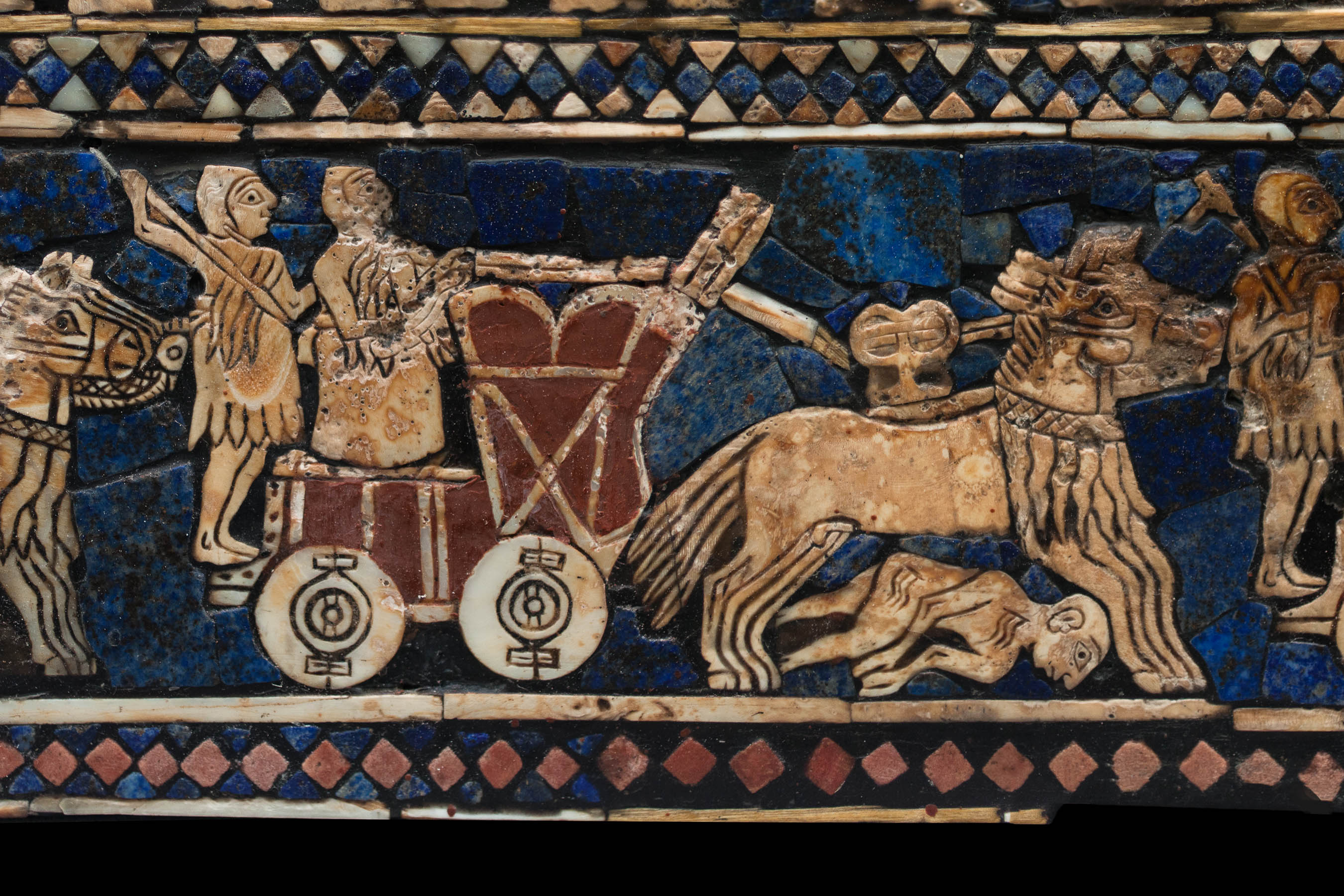
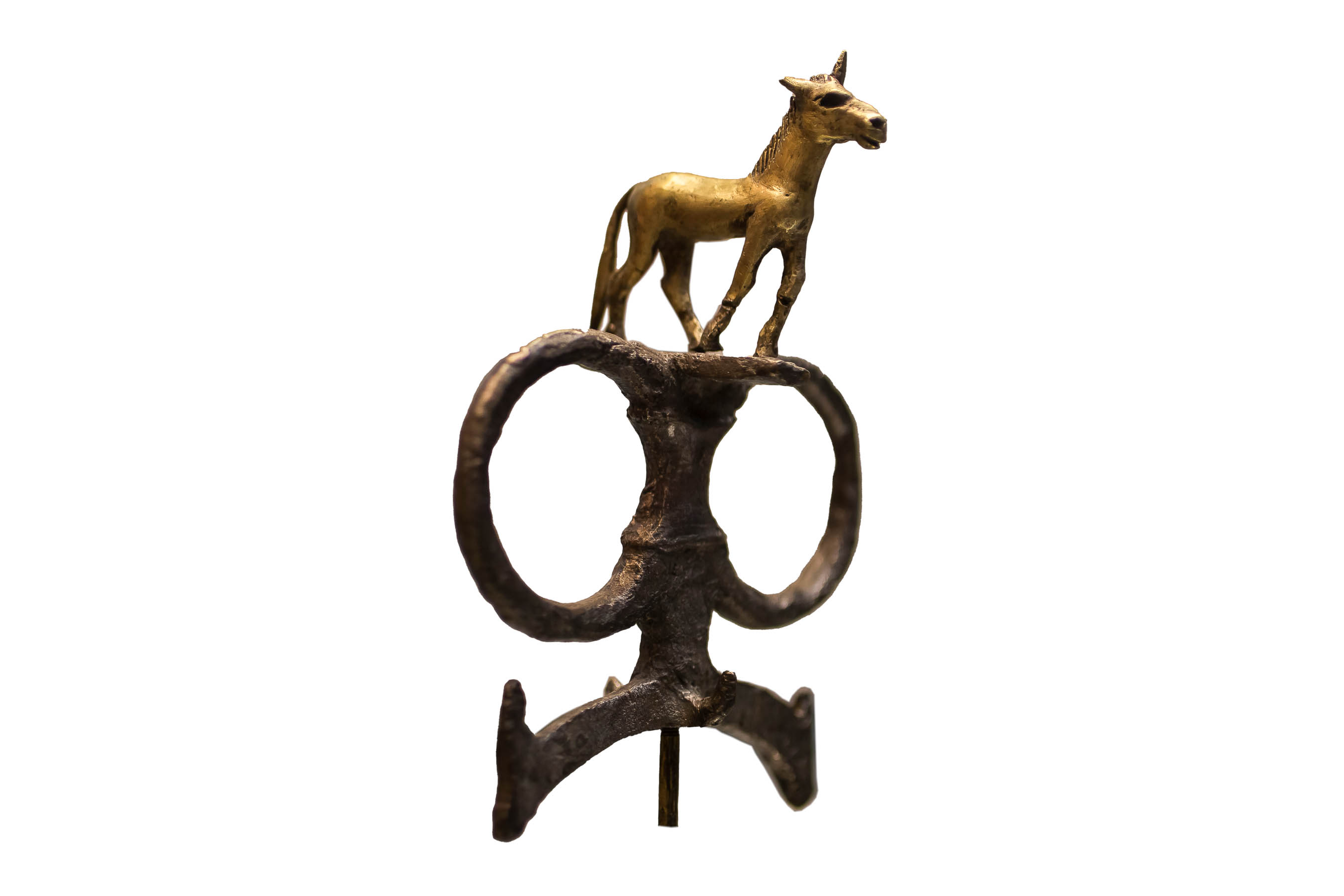
Left: A four-wheeled war chariot drawn by four onagers. The reign guides are clearly visible on their backs. Right: A reign guide from one of the tombs in the Royal Cemetery at Ur surmounted by a superb model of a wild ass made of electrum.
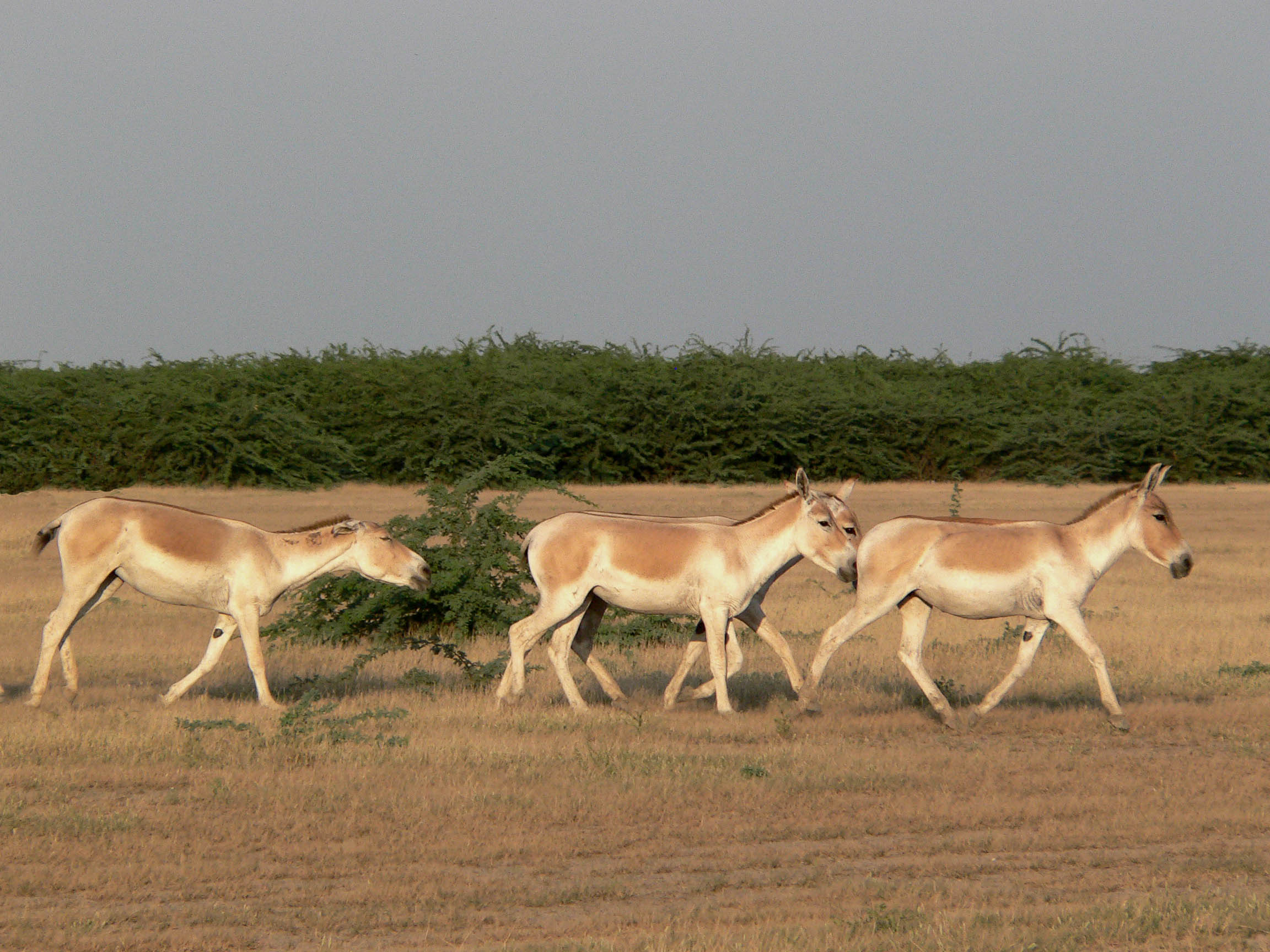
The wild ass or onager once roamed broadly across Asia, North Africa, and the Levant. It is now almost extinct. The depictions of asses used by the Sumerians to pull their war carts bear all the hallmarks of these wild asses.
Despite their lack of maneuverability, the war cart must have been a formidable weapon on the battlefield. We know it served as a mobile platform for throwing javelins since depictions of the carts always display a multiple javelins mounted to the front of the cart. The carts could also be used as a vehicle for breaking enemy lines. The sequence of images in the bottom register of the Standard of Ur appear to show a war cart in each stage of a charge: from walk, to trot, to full gallop, trampling the enemy underfoot as it passes through the enemy lines. The last image in the series shows the asses coming to a rearing halt.
The textual evidence suggests that Sumerian kings were able to field a considerable numbers of chariots. One text, composed during the reign of Entemena, king of Lagash (c. 2200 BC), says that the king captured sixty war-carts in battle—that is no small number!7Hamblin 2006, 140 There is no evidence that the wild ass (or hybrid) was ever used for battle, or for any other purpose, after the Sumerians.
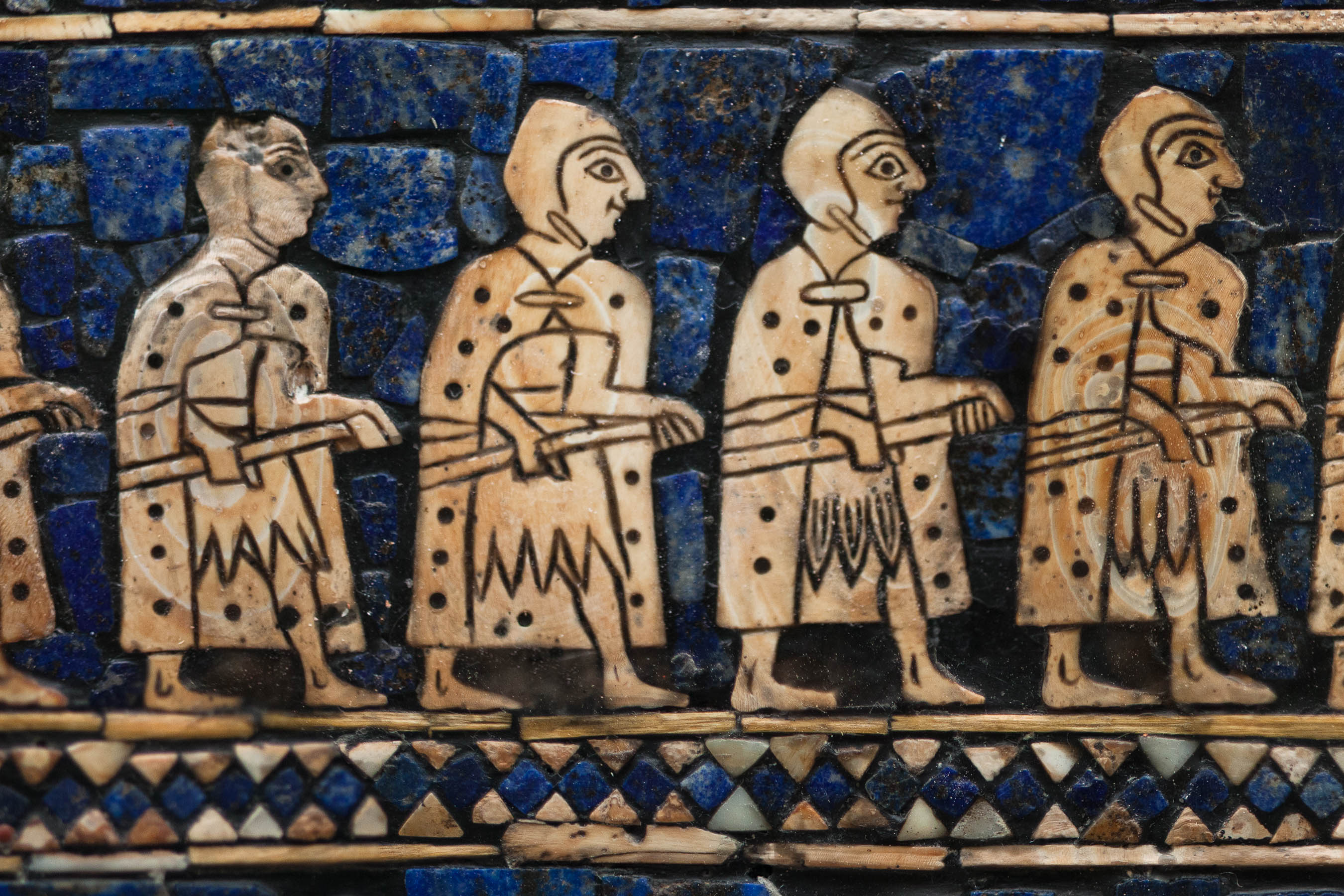

Left: Sumerian infantry carrying short thrusting spears. (Note the spearhead is shown overlapping the cape of the soldier in front of him. The soldiers are wearing helmets, possibly made of copper of leather, and a cape. It may be wondered if the spots do not represent a leopard skin. Right: A copper spear head and four javelin heads from the Royal Cemetery at Ur.


Left: Elders carry a staff and a battle axe. Right: Identical battle axes were found in the Royal Cemetery of Ur.
The Peace Side
The “Peace” side of the box records a victory feast celebrated in the presence of the king. All of the figures are male with the possible exception of a female singer (depicted in the upper right corner standing next to the harpist). If so then it is unusual since women are not normally shown partially nude in Sumerian art. The king is shown larger than life in the upper left-hand corner of the box. Each of the banqueters holds a conical cup in their right hand. They are served by men of slightly smaller stature. Thus the scale of the figures is directly related to their status, with the king at the top, his head bumping up against the border of the register. The two lower registers celebrate the bounty of the land. The overall scheme does not differ greatly from the Warka Vase.


The upper register depicts the feast following the battle. The bottom two panels show Sumerians bringing livestock and produce to the banquet.


Left: The banqueters hold conical drinking cups in their right hand. Right: Silver tumblers from the Royal Cemetery at Ur. Their shape looks to have been inspired by Solid Footed Goblets.

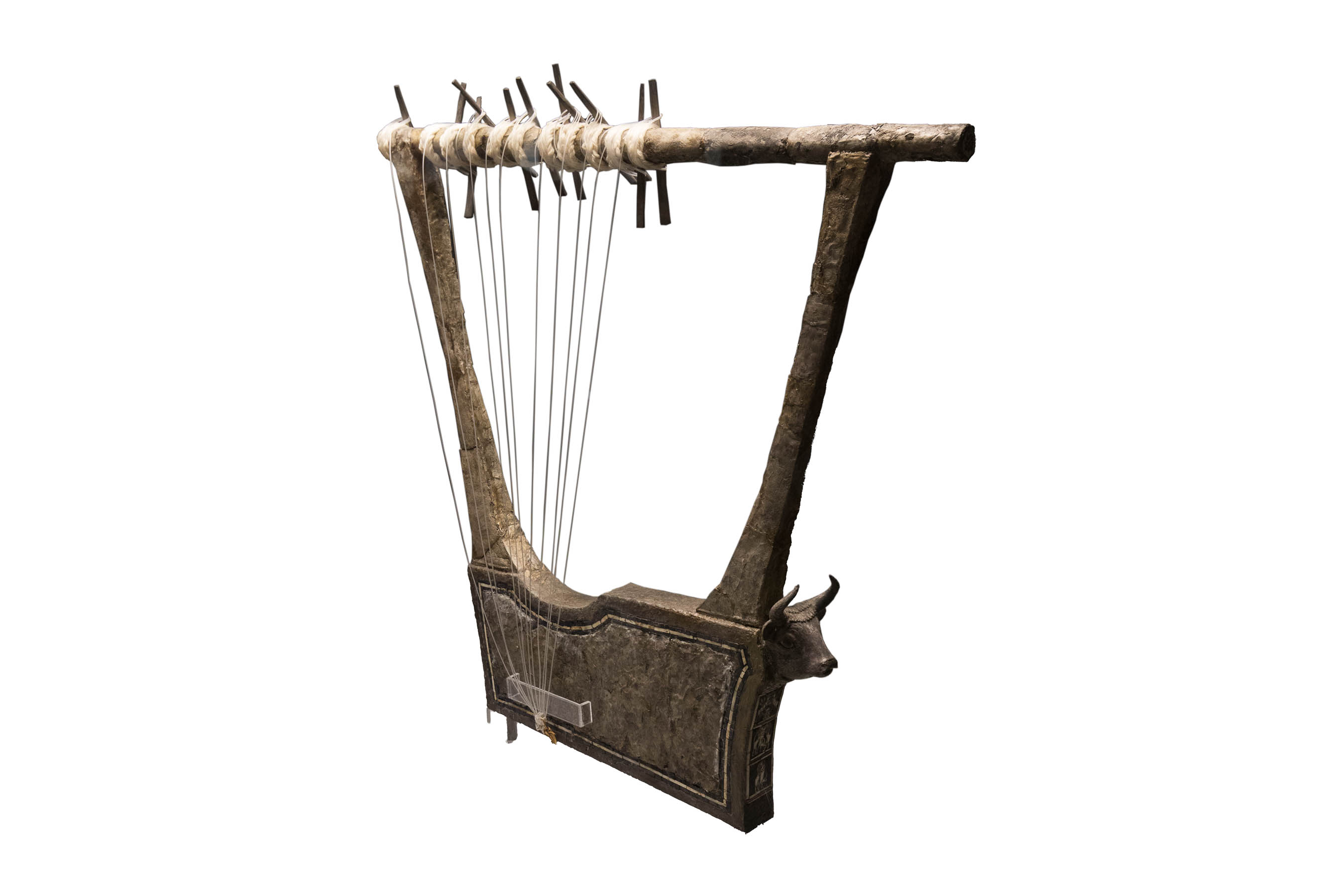
Left: A female singer is accompanied by a male harpist. This is the only woman depicted on the Standard. Right: Known as the “Silver Lyre,” it is one of four found in PG 1237, the “Great Death Pit.”
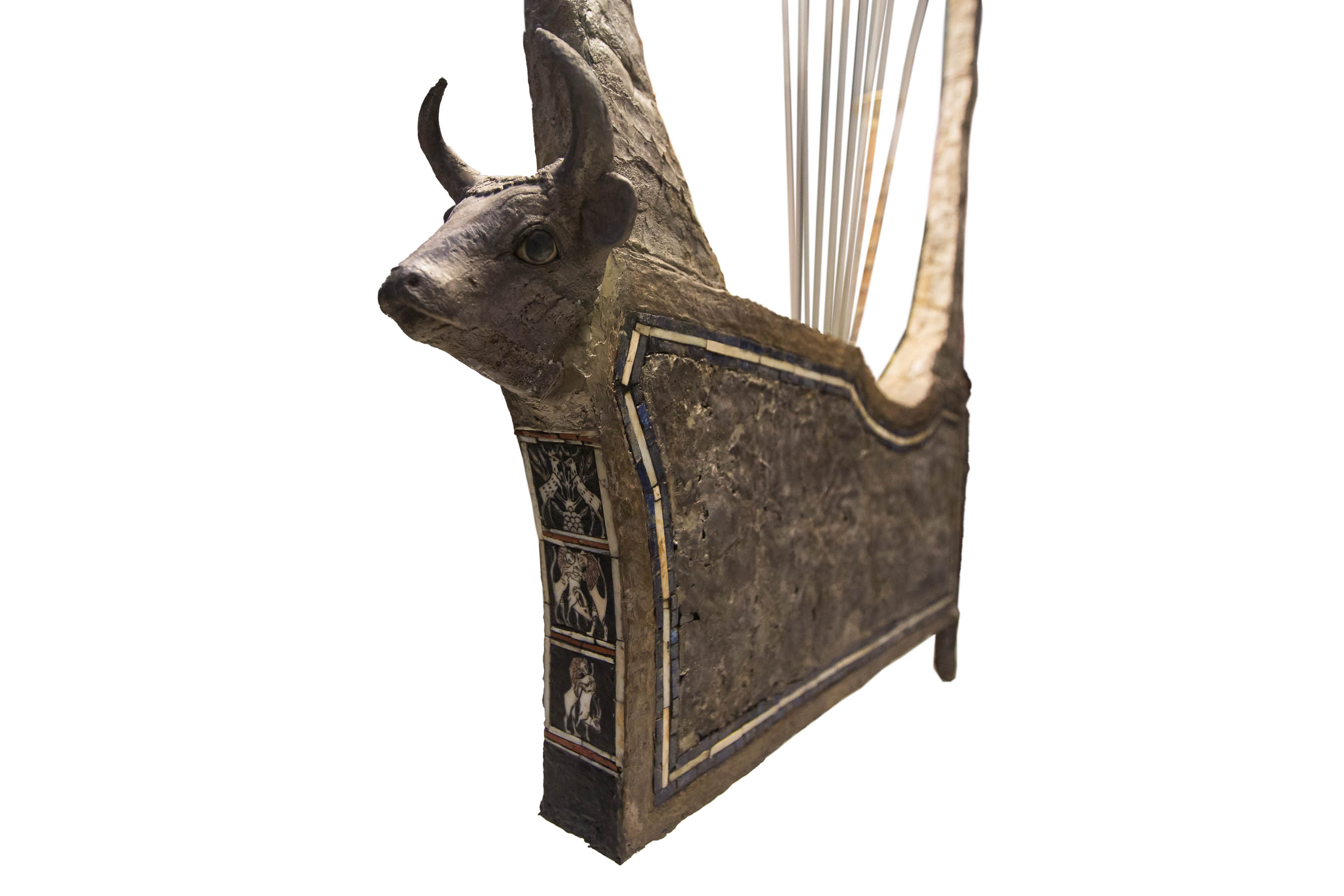
Left: Although the wood was decayed to powder, Woolley was able to preserve the shape of the lyre by pouring plaster into the impression left behind by the wooden frame. The lyre is now on display at the British Museum. The wood of the lyre has been restored but the bull’s head, silver gilding, and shell inlay are all original. Right: The Silver Lyre as it was found.
Hamblin, W. J.
Warfare in the Ancient Near East to 1600 BC: Holy Warriors at the Dawn of History.
London ; New York: Routledge, 2006. Link
Parpola, A, J Janhunen.
On the Asiatic Wild Asses and Their Vernacular Names Linguistics, Archaeology and the Human Past.
Kyoto, Japan: Research Institute for Humanity and Nature, 2011. Link
Woolley, Leonard.
Ur Excavations: The Royal Cemetery (Plates).
Oxford: The University Press, 1934. Link
Woolley, Leonard.
Ur Excavations: The Royal Cemetery (Text).
Oxford: The University Press, 1934. Link
High resolution zoomable images of the war side and of the peace side of the Standard of Ur.