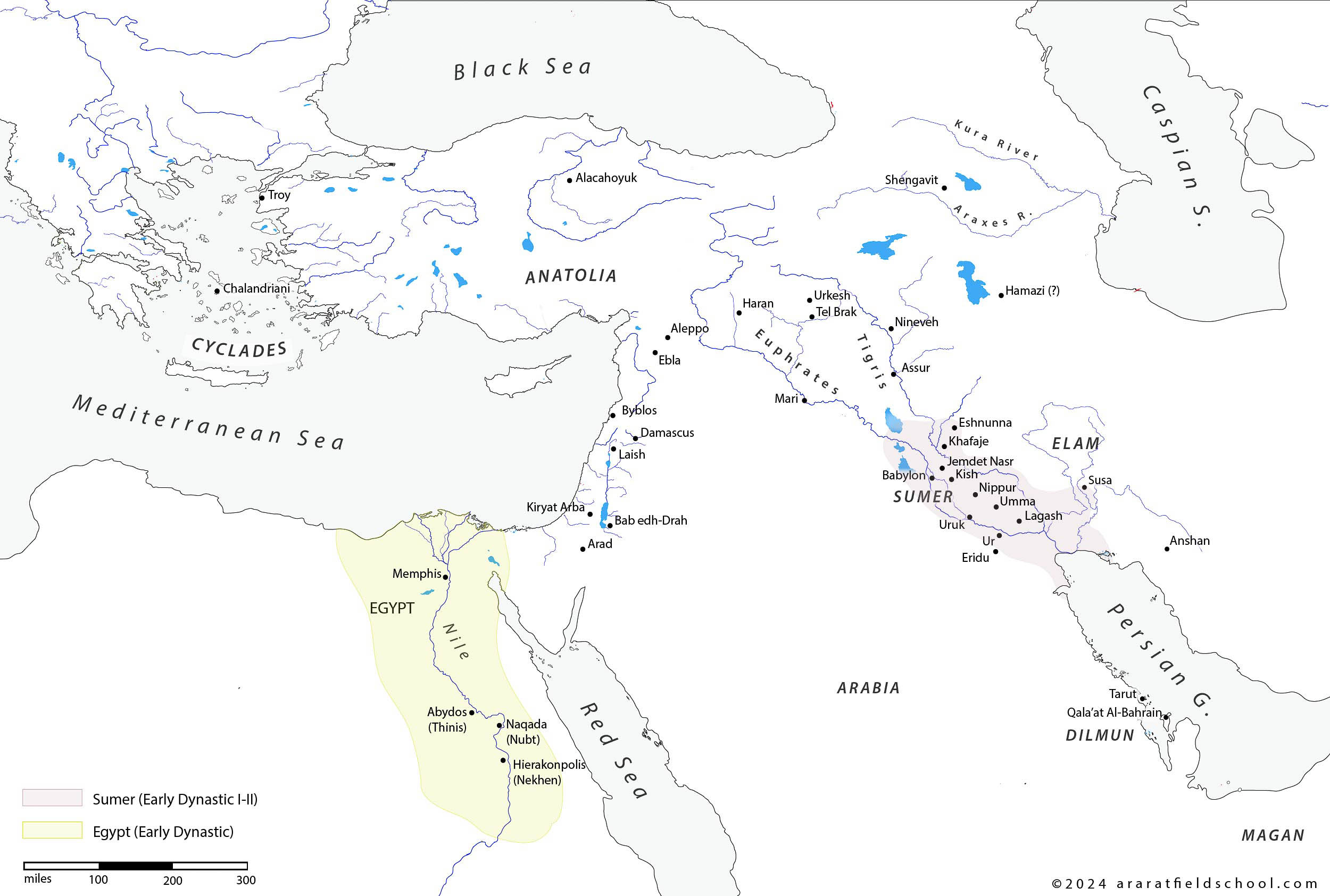
The contours of Egyptian civilization, only faintly visible during the Predynastic period, takes definite shape during the ensuing Early Dynastic period, beginning with Menes, who is credited with unifying Upper and Lower Egypt.
Cities arose on the southern plain of Mesopotamia which competed with and ultimately surpassed Uruk. Though on opposite ends of the plain, Khafajah and Ur nevertheless shared a common culture which may rightly be described as Sumerian. Famous Sumerian kings such as Agga of Kish, Mesannapeda of Ur, and Gilgamesh of Uruk should probably be dated to this period, as well as the earliest tombs in the Royal Cemetery of Ur.
In Canaan, also, cities with impressive fortification walls begin to appear. These conducted extensive overland trade with Egypt during Egypt’s First Dynasty. This trade ceased when Egypt fell into internal conflict, a period which seems to have lasted for most of its Second Dynasty. It ended with the accession of Khasekhemwy, and the reunification of Upper and Lower Egypt.
Texts produced in Mesopotamia during this period begin to exhibit proper syntax and grammar necessary for communicating ideas and stories rather than mere accounts. Most of the texts from this period are nevertheless accounting tablets.
The following are some of the places, artifacts, architecture, and literature covered in this section.
Places:
- Khafajah and Ur
- Abydos and Memphis
- Megiddo and Arad
Artifacts:
- Narmer Palette
- Tell Asmar Statues
- Puabi’s Jewelry
- Piedmont and Early Dynastic Cylinder Seals
- Kfar Monash Hoard
- “Intercultural” Chlorite Vessels
- Scarlet Ware
- Abydos Ware
- Bronze Ewer
Architecture:
- Sin Temple of Khafajah
- Royal Cemetery of Ur
- Shunet el-Zebib
- Great Temple of Megiddo
Texts:
- Perforated Relief of Ur-Nanshe
- Instructions of Shuruppak
- Seal of Seth-Peribsen
Technology:
- developments in writing
- ship building
- the utilization of gold, silver, and precious gems for jewelry
- the casting and smelting of copper and bronze
- cutting hard stone
Chronology
| Period | Standard | Ararat | Significant Event |
|---|---|---|---|
| Chalcolithic | 4800 - 3300 BC | 3500 (?) - 3000 BC |
|
| EB I | 3300 - 2900 BC | 3000 - 2750 BC |
|
| EB II | 2900 - 2600 BC | 2750 - 2500 BC |
|
| EB III | 2600 - 2350 BC | 2400 - 2200 BC |
|
| EB IV | 2350 - 2150 BC | 2200 - 2050 BC |
|
| MB I | 2150 - 2000 BC | 2050 - 1900 BC |
|
| MB IIA | 2000 - 1750 BC | 1900 - 1700 BC |
|
Geography