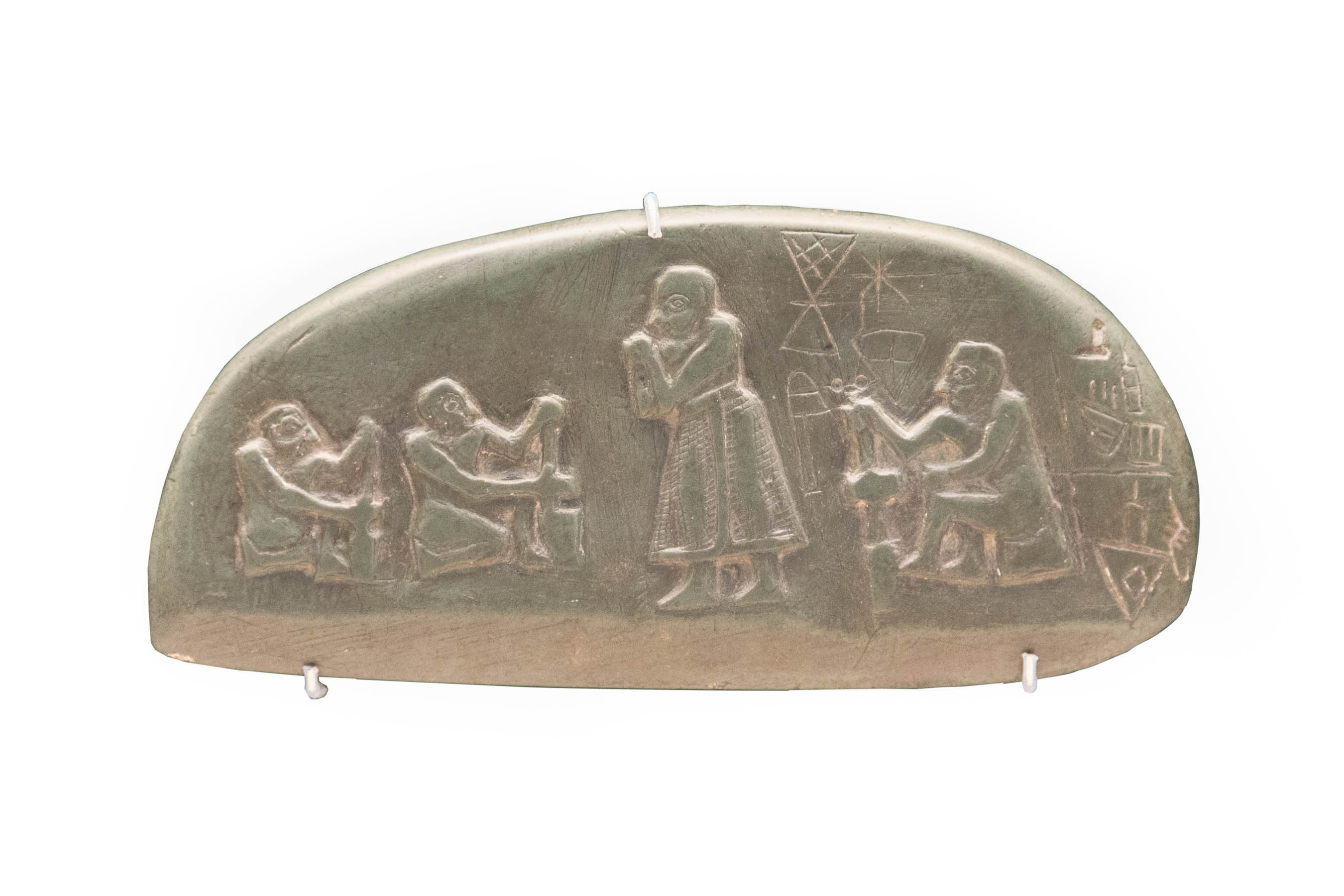
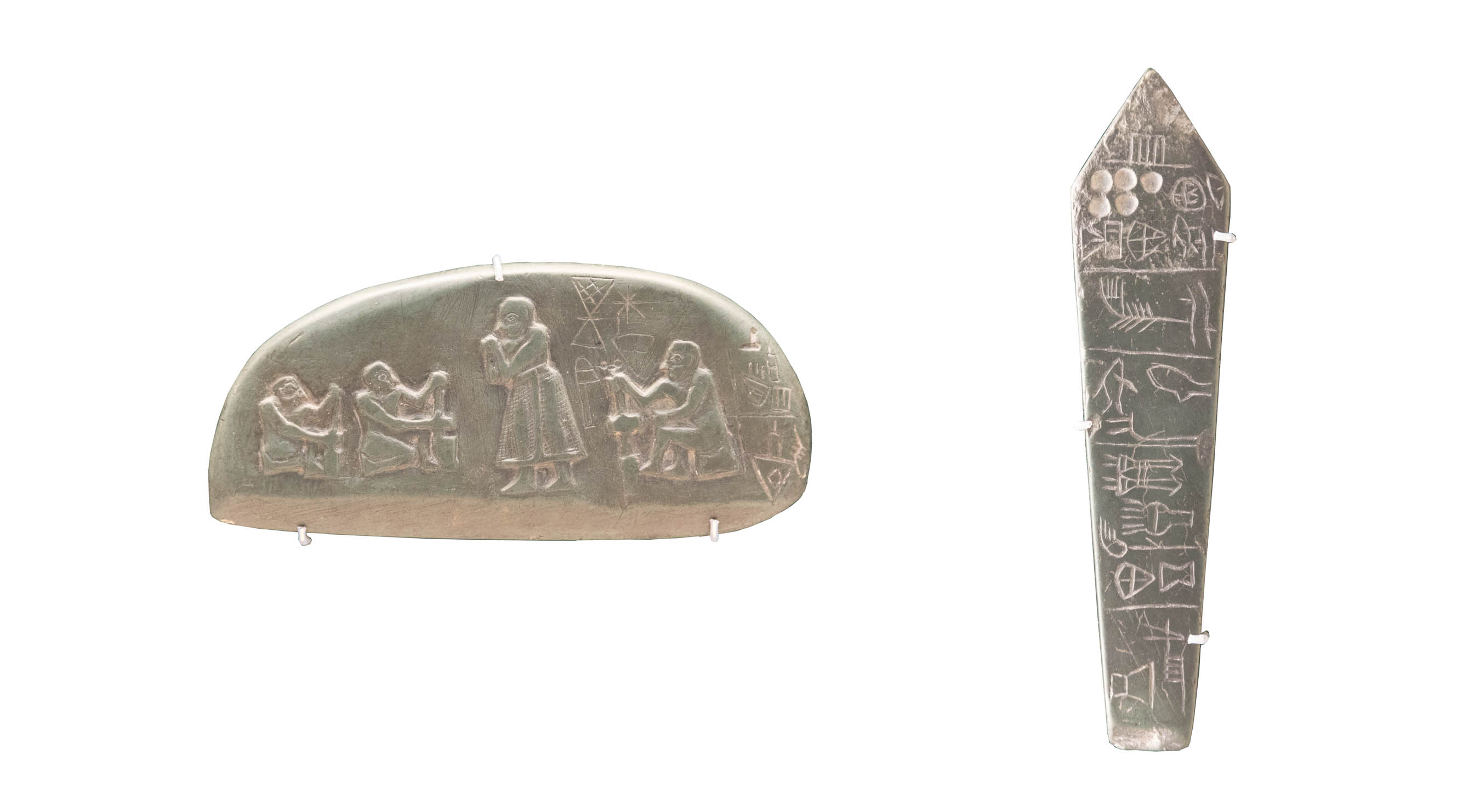
These stone objects are engraved with archaic writing. The one on the left measures approximately six inches wide. They are carved from bluish-green schist.
The Blau Monuments are two polished green stones, not more than six inches long in either direction, engraved with an archaic script. They were purchased by Dr. A. Blau in 1892 on the antiquities market in Iraq. The stones were originally thought to be forgeries since nothing like the archaic script had been seen before. However, since then more objects have been found inscribed with the same archaic script so that now the stones are universally regarded as authentic. The script on the Blau monuments may be dated to the Jemdet Nasr period.
Interpretation
An expert on the stones, Ignace Gelb, warns that the text inscribed on the stones “abounds with difficulties” rendering any interpretation “highly tentative.”1Gelb 1991, 40 Gelb suggests the stones may have recorded a land purchase since one of the lines of text refers to 5 bur of land (approximately 76 acres).2Gelb 1991, 40 ff. Other items mentioned on the tablets include silver, wool, oil, various types of cloth, and loaves of bread. There is also a reference to one slave. It appears as though these stones are kudurrus, that is commemorative boundary markers which were used to commemorate the sale of land. The stone show naked men pounding grain in a mortar and pestle while another figure is holding up an animal. Presumably these were preparations for a feast that was eaten in order to ratify the contract. This is always how deals have been done.
The primary figure on the stone is a bearded man, wearing a cap with a rolled-up brim, and holding a cylindrical object in his hands, the meaning of which is unknown. The woman standing next to him may perhaps be his wife or daughter. Presumably they are the primary beneficiaries of the sale.
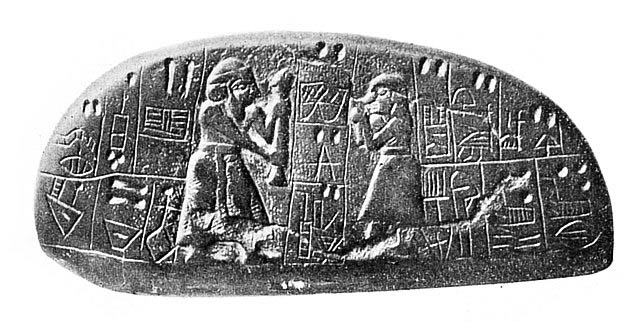
The Ensi is pictured on the stele wearing a thick cap with a rolled-up brim. He is bare chested and wears a long skirt. The text lists 1 kug of silver, 1 slave, vessels of oil, measures of cloth, quarts of grain, pots of beer, etc.1Gelb 1991, 42
Gelb, Ignace J, P. Steinkeller, R. M. Whiting Jr..
Earliest Land Tenure Systems in the Near East: Ancient Kudurrus. OIP 104 vols.
Chicago: The Oriental Institute, 1989. Link