
A standard from Grave BM at Alacahoyuk.
As noted previously, copper and bronze standards were found in the royal tombs of Alacahoyuk. They were made to be mounted to the end of a pole or perhaps something more substantial. Often referred to as “sun disks,” all of them incorporate a circular disk or wreath flanked by horns. There is nothing to actually link these directly to the sun although some of the discs have “rays” which might support a solar connection. Others are decorated with “knobs” more suggestive of plant-life although their meaning is otherwise quite unknown. Bulls and stags are the two animal most frequently depicted inside the discs.


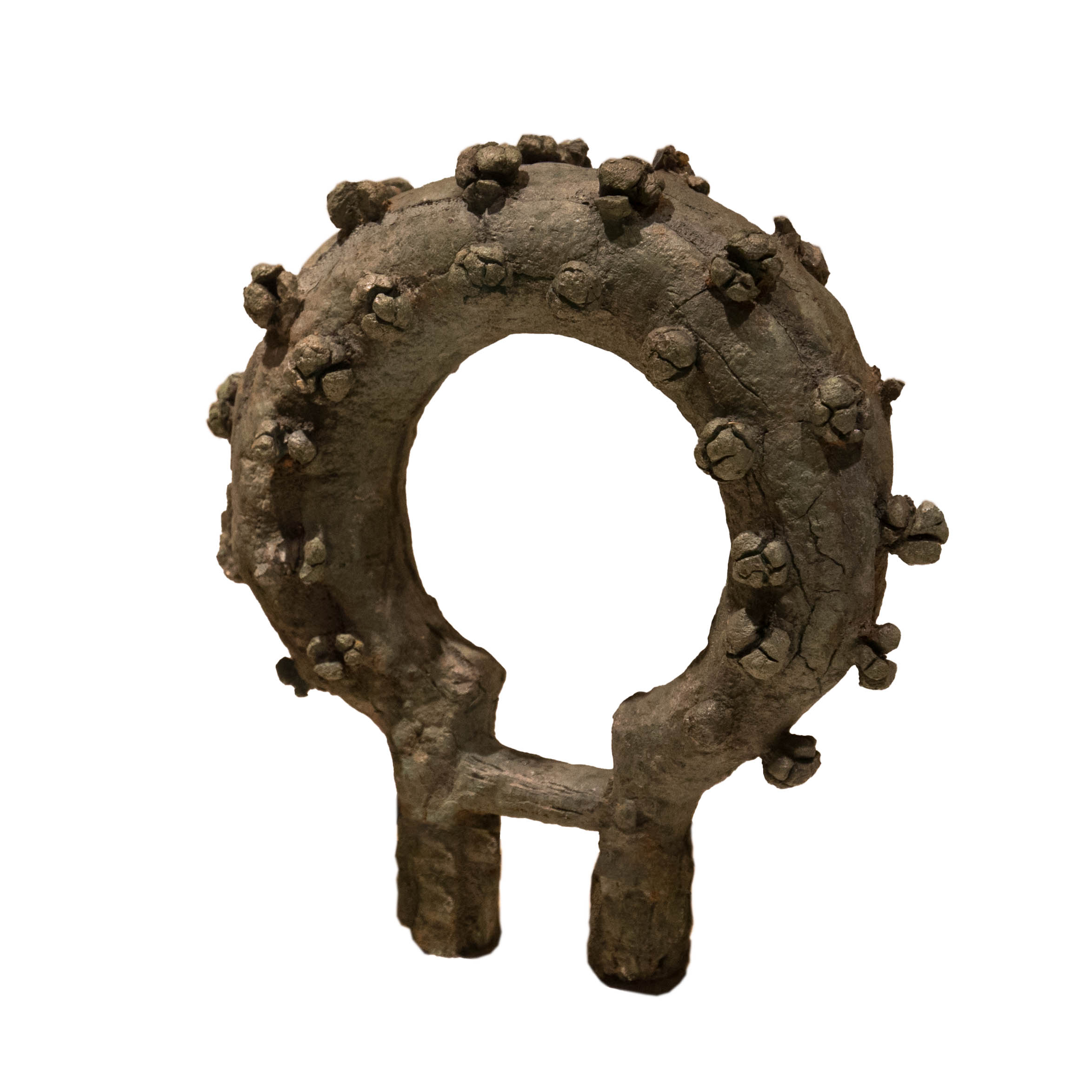

Some of the discs display a grid pattern. All of them are circular in shape and have horns except frot the bottom two, which are exclusively decorated with knobs. In addition to stags and bulls, a donkey is represented in one of the discs.
Another type of standard recovered from the tombs took the form of an animal, most often a stag or bull, but with abstracted features. Based on what is known of later Hittite deities, the bull represented the storm god whereas the stag was associated with the god of the open country and the hunt.


Both animals can be identified as products of early bronze Anatolian craftsmen by their long cylindrical noses and barrel shaped bodies.
The animal standards were cast from tin bronze or arsenical copper. The exaggerated size of their horns and their long, cylinder-shaped noses make them easily identifiable products of an early bronze Anatolian culture. On rare occasions the bronze castings were inlaid with silver and embellished with circle-dot patterns. Very similar standards have been found in connection with the Maikop culture of the northern Caucasus.1Akurgal draws a connection between these standards and those produced by the Maikop culture of the northern Caucasus (Akurgal 2001, 14). The animal standards discovered at the Late Bronze site of Lchashen in Armenia also present an interesting comparison.
The red deer will also feature prominently on Hittite artifacts of the Late Bronze Age. The famous Silver Stag Rhyton (14th-13th century BC), for example, connects the stag deity to a successful hunt, symbolized by an eagle perched on the arm of what appears to be a seated goddess.2Serkan 2023, 63 ff. This must be among the earliest known examples of the use of birds of prey for hunting.


Produced during the Hittite Imperial period, this drinking cup illustrates the importance of the stag for the Hittites. These rhytons would continue to be produced in one form or another until the medieval period!
Although herds of red deer may still be encountered in many places in Europe and in the pine and fir forests of the Ilgaz mountains of northern Anatolia, they once ranged broadly across Anatolia and the Caucasus as well. Their size varies depending on location. The island of Malta was home to a miniature species whereas the region around the Black and Caspian seas harbored red deer that were almost the size of elk. Such animals were undoubtedly an important game animal for people living in central Anatolia.
Nahal Mishmar and Alacahoyuk
It has long been theorized that the ceremonial objects from Nahal Mishmar which we discussed in a previous entry were produced by Anatolian metalsmiths. At the very least, archaeo-metalurgists point to a source in Eastern Anatolia or the Caucasus for the arsenical copper used to cast the ceremonial objects in Nahal Mishmar hoard.3Tadmor 1995, 143 It has even been suggested that the Ghassulian culture itself originated in regions to the north. The similarities between the objects from Nahal Mishmar and Alacahoyuk do indeed suggest a common metalsmithing tradition even though a considerable span of time separates them.
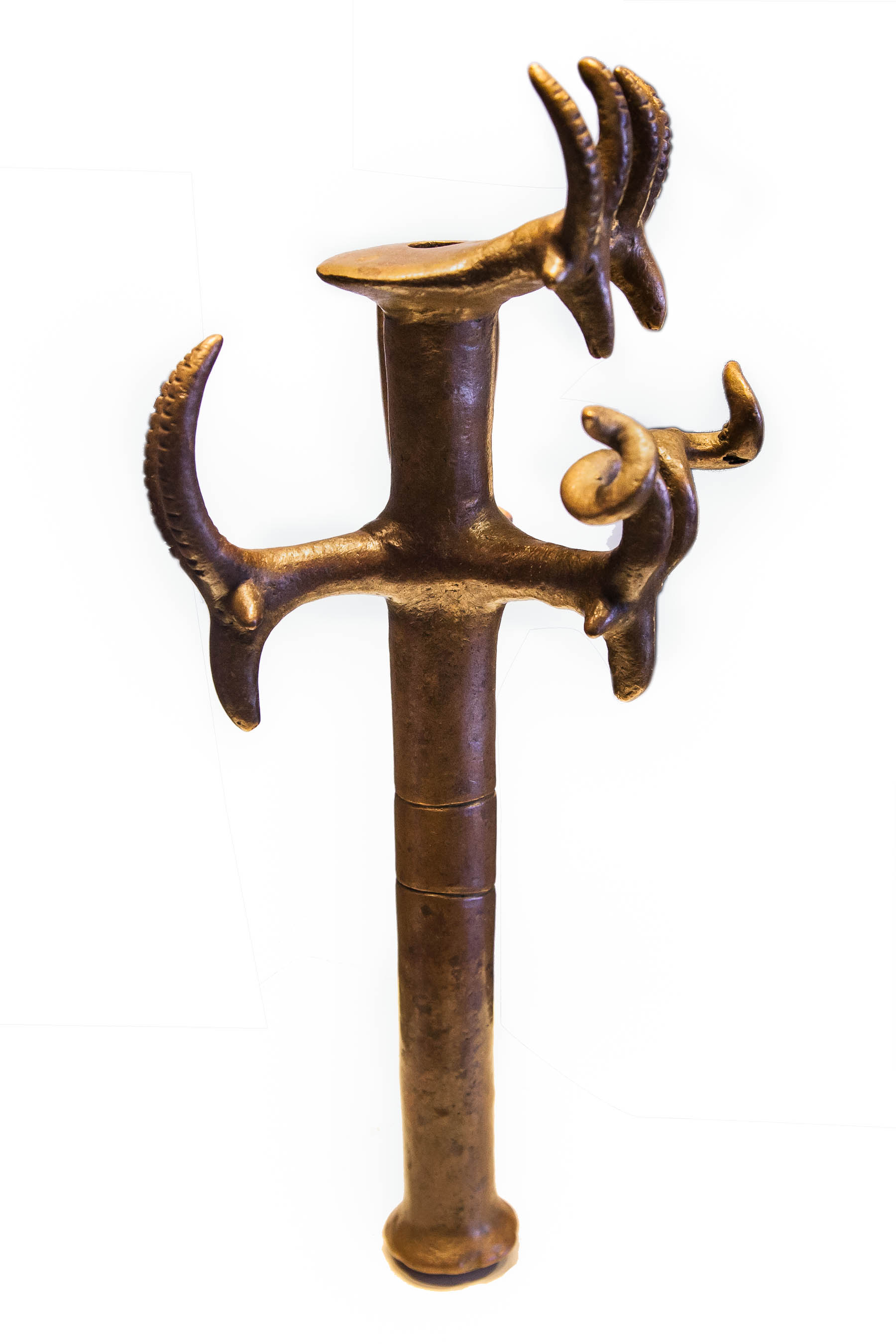

Both cultures produced copper standards with schematic representations of animals.


Mace Heads decorated with knobs and spikes are found in both regions, and also at Susa.


An unusual feature is the spiral fluting displayed on objects from Nahal Mishmar and Alacahoyuk.

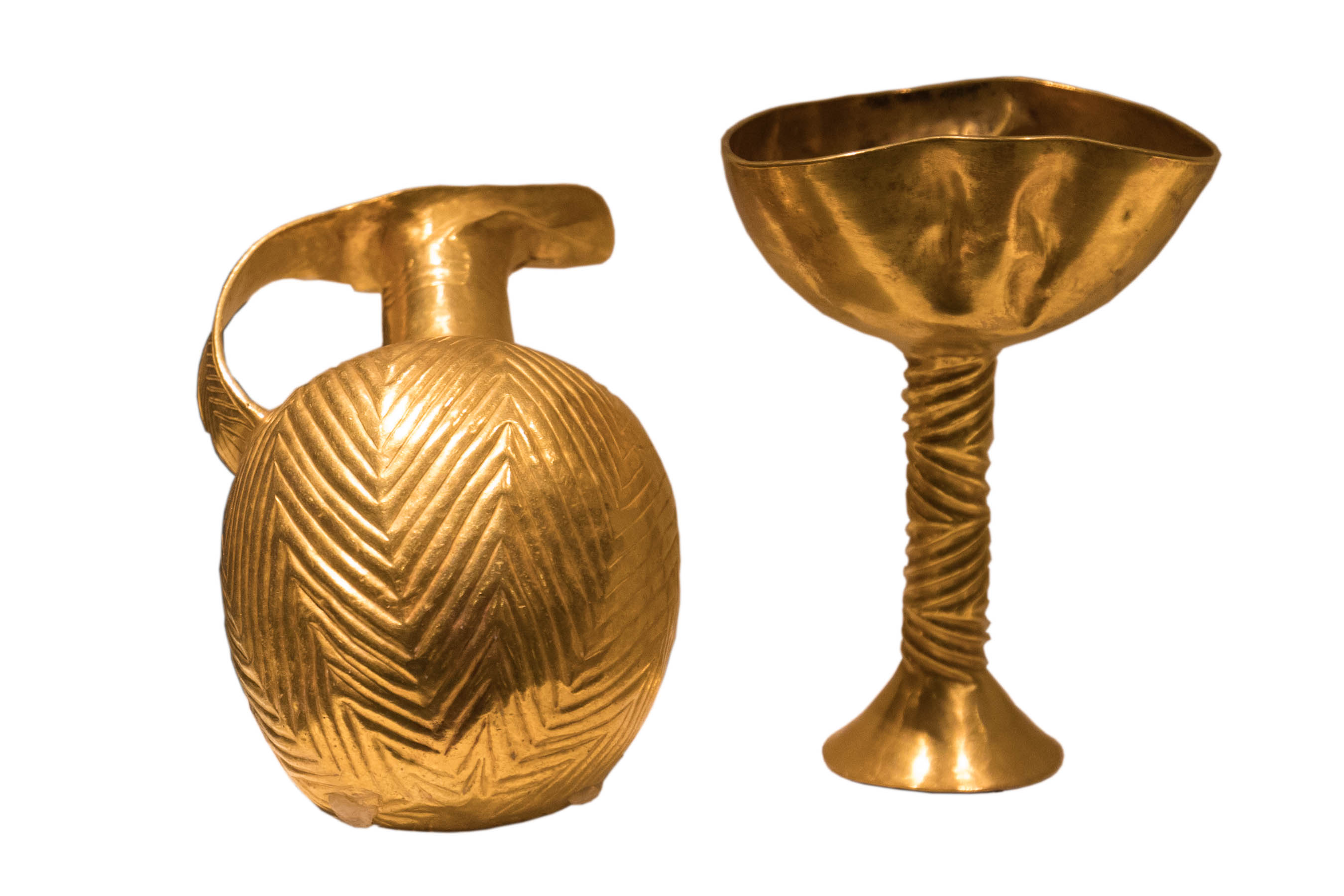
Vessels are decorated with bands of incised angular lines.

Many objects from Alacahoyuk display peculiar “knobs” characteristic also of objects from Nahal Mishmar.
Akurgal, Ekrem.
The Art of the Hittites.
New York: H.N. Abrams, 1962.
Akurgal, Ekrem.
The Hattian and Hittites Civilizations.
Ankara: Publication of the Republic of Turkey, 2001.
Demirel, Serkan. “Interpretation of Some Possible Depictions of the Hittite Tutelary Deity of the Countryside.” Tarih İncelemeleri Dergisi XXXVIII -1, 2023, 61-80, no. 1 (2023): 61-80. Link