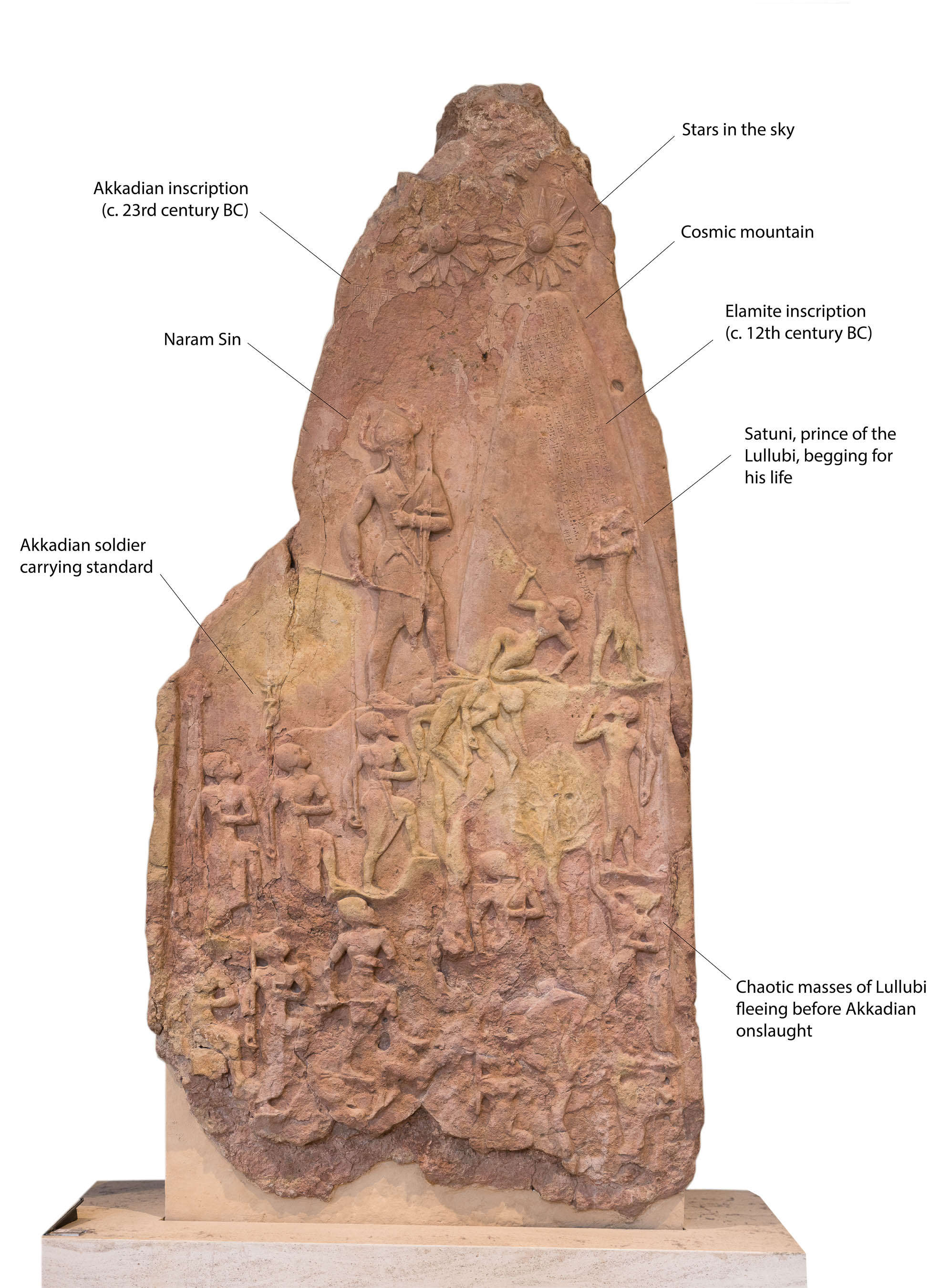
The stele stands a little over six feet tall and is carved from pink limestone.
The “wild mountaineers” of the Zagros were Akkad’s fiercest foe. A campaign conducted by Naram-Sin against one such group, the Lullubi, was commemorated on a pink limestone stele and placed in Sippar where it stood until the Elamite king, Shutruk-Nahunte (1184-1055 BC), carried it back to Susa as war booty, almost a thousand years later.
Unlike Sumerian reliefs, such as the Vulture Stele, which were arranged in horizontal registers, the action on this stele moves vertically from bottom to top. The dynamism displayed by the serried ranks of Akkadian soldiers marching to war presents a marked contrast to the static, lifeless qualities characteristic of Sumerian art. At the apex of the scene, Naram-Sin strides confidently forward, carrying a bow in one hand, and an arrow in the other, while cradling a chisel-headed battle axe in his arm.
The clothing of the bare-chested Lullubi is limited to animal skins. Their long braided hair reaches half way down their back. One of them lies prostrate at the feet of Naram-Sin, clutching an arrow that has pierced his throat, presumably shot from Naram-Sin’s bow. Satuni, the prince of the Lullubi, is on the edge of the scene, shown in the unlikely pose of begging for his life and running from the field of battle at the same time—a double indignity!

showing the locations of Sippar, Lullubi and Susa.
The Divine King
Naram-Sin is shown ascending a mountain wearing the horned cap traditionally reserved for the gods. The cosmic mountain, depicted as a smooth cone, symbolizes the earth, whereas the stars above it represents the heavenly domain. The stele vividly illustrates the words spoken by the prophet Isaiah to the king of Babylon many centuries later:
You said in your heart, ‘I will ascend to heaven; above the stars of God I will set my throne on high; I will sit on the mount of assembly in the far reaches of the north; I will ascend above the heights of the clouds; I will make myself like the Most High.’ (Isa. 14:13-14 ESV)

Naram-Sin is shown twice the size of the enemy. The animal skin clothing of the Lullubi must have appeared barbaric to the Akkadians, who wore woven kilts.
Inscription
The stele has two inscriptions of which only the first belongs to the original stele. Although mostly broken, a few lines of the original inscription are still readable.
Naram-Sin the powerful . . . . Sidur and Satuni, princes of the Lulubi, gathered together and they made war against me.1<a href=”https://en.wikipedia.org/wiki/Victory_Stele_of_Naram-Sin”>Wikipedia</a>
The second inscription was commissioned by the Elamite king, Shutruk-Nahunte, in the 12th century BC to commemorate his own conquests, including Sippar.
I am Shutruk-Nahhunte, son of Hallutush-Inshushinak, beloved servant of the god Inshushinak, King of Anshan and Susa, who has enlarged the kingdom, who takes care of the lands of Elam, the Lord of the land of Elam. When the god Inshushinak gave me the order, I defeated Sippar. I took the stele of Naram-Sin and carried it off, bringing it to the land of Elam. For Inshushinak, my god, I set it as an offering.2<a href=”https://en.wikipedia.org/wiki/Victory_Stele_of_Naram-Sin”>Wikipedia</a>
The capture of the stele must have had great propaganda value for Shutruk-Nahunte. The irony could not have been lost on anyone looking at the stele, now standing in the temple of Inshushinak in Susa, where it celebrated the victory of the mountaineers over the valley people.
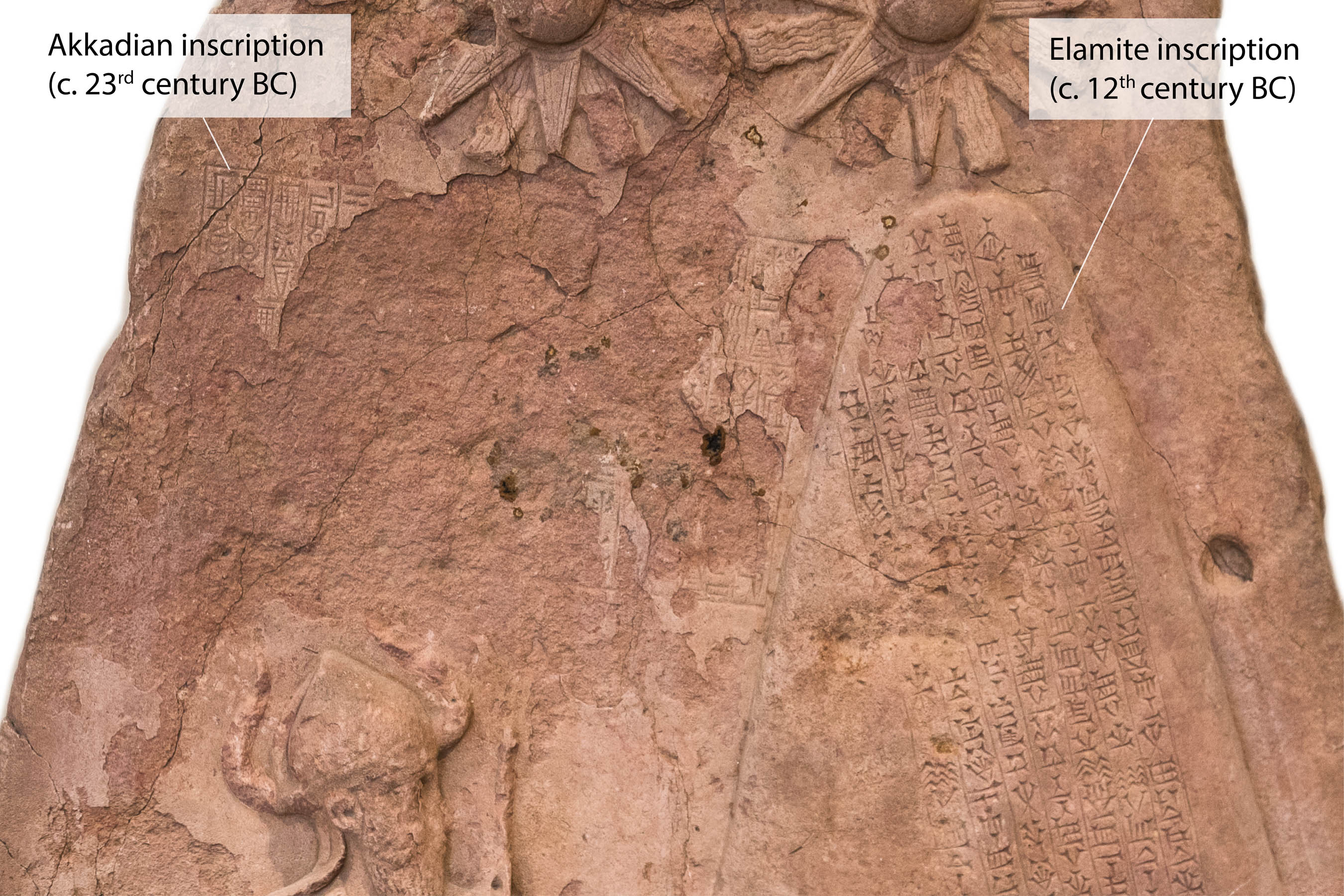
The two inscriptions are separated by more than a millennium. One can see how the script developed during the intervening years.
Composite Bow(?)
The Israeli archaeologist, Yigal Yadin, argued that that one of the reasons for the Akkadian’s military success was their adoption of the composite bow. As the name suggests, these bows utilized the qualities of different types of wood and horn, bound together by sinew and glue to form a much more powerful bow with an effective reach of 300 or 400 yards. Here is how one 15th century AD Arab author describes these bows:
The structure of the composite bow is not unlike that of man. The human body is made up of four basic element-bones, flesh, arteries, and blood. The composite bow has the same four counterpart elements: wood-its skeleton; horns-its flesh; tendons-its arteries; glue-its blood. Man has back and belly. So has the bow. And just as man can bend forward but is likely to damage himself by bending too far backward, so with the operation of the bow.3Yadin 1963, 7
One of the hallmarks of a composite bow was its short length and “recurve” shape, both of which accurately describe the bow carried by Naram-Sin. A shell inlay found at Mari also appears to depict one of these weapons.


Left: The bow held by Naram-Sin was likely a prestige weapon adopted in towards the end of the Early Dynastic or beginning of the Akkadian period.
Right: A remarkable depiction of a shield bearer armed with a spear, and an archer armed with a bow employed in long distance volleys. The curved shield protected the archer from return volleys. The “barbs” on the arrow are best understood as fletching needed to stabilize the arrows flight.
The ability of bowmen to shoot “over the horizon” as it were represented a real game changer on the battlefield. Millennia later, the English would use their longbows to similar effect, conquering large parts of France by standing afar off and sending volleys of arrows to which the enemy had no reply. The weakness of archers was their lack of defense, since they could not shoot and hold a shield at the same time. Nor did they have a short-range weapon with which to ward off attack. The shell inlay from Mari clearly shows how the army adapted to the needs of the bowmen by combining a spearman who carried a tall, inward curving shield designed to protect against the return volleys of the enemy.
There has been some question whether these bows were in fact used in the Early Bronze period since the technology required for their production represents a major hurdle. The composite bow does not otherwise appear to have entered into widespread use until much later. It must admitted, however, that Akkadian and Marioite bows have a recurve shape such as can only be produced by lamination. What materials were used, and whether it was actually a composite bow, is a matter of debate. (Hamblin thinks not.) But it was not a simple bow.
Collapse
Having extended the boundaries of the Akkadian empire to their furthest extent, Naram-Sin laid claim to the titles: “King of the Four Quarters of the World” and “King of the Universe.” Like the Assyrians of a later age, the Akkadians extracted as many resources and treasure from their subjects as possible. The empire was, therefore, beset by constant rebellion, culminating finally in total collapse during the reign of Naram-Sin’s son, Shar-kalli-shari. Responsibility for the collapse is usually attributed to another group of highlanders, known as the Guti, although, as Hallo and Simpson point out, the door to conquest was opened by internal struggles. Gutian control of the lowlands, which was never more than sporadic, lasted forty or fifty years.
Speiser argues that the Guti should be identified with “the Kurti” mentioned later, in Assyrian texts.4Speiser 1930 The same group appears in Greek texts as “the Karduchoi.” According to the Greek general, Xenophon, the Karduchoi lived in well provisioned villages in the Hamrin mountains of northern Iraq. They were able to use their slings and arrows to such effect that Xenophon considered the seven days spent traversing their country more trying than the whole of their time fighting the Persians in Iraq. The name is likely preserved by the Kurdish peoples who reside in the mountains of northern Iraq, Iran, Syria, and eastern Turkey.
Naram-Sin and the Cuthean Legend
Although references to the city of Akkad (“Agade”) appear in Mesopotamian texts until the Persian period, its exact whereabouts is no longer known; a reminder that even a capital city, probably not much inferior to Babylon in all of its splendor, may be lost to archaeology. The legacy of the Akkadians would nevertheless be felt for generations to come. Their language was destined to become the lingua franca of the Ancient Near East for over a millennium. And they bequeathed to the world the idea of world conquest.
But the conquests of the Akkadian kings were not universally acclaimed. In the years following the collapse of their empire, there arose another genre of literature which viewed the rapid rise and collapse of the Akkadian Empire as a warning to all would-be world conquerors. One of these texts, known as the Cuthean Legend, described Naram-Sin as the archetypal empire builder, ferocious and amoral, driven by naked ambition and will to power.
Speaking to myself, thus I said,
“What lion observed divination?
What wolf consulted a dream interpreter?
I will go, as I like, like a brigand,
I will cast off what belongs to the gods,
I will hold fast (only) to myself!”5Foster 2005, III.3 Lines 80-84
The Cuthean Legend ends with the invasion of Akkad by hordes of foreign troops. Endowed by Enlil with supernatural strength, they destroy Naram-Sin’s army and humble the proud king. The name of these mysterious invaders, the Umman Manda, literally means “the horde from who knows where.” Perhaps the story preserves a vague recollection of the Gutians, Hurrians, and Amorites who descended upon the lowlands at the end of the Early Bronze period. The first literary reference to the Amorites comes from the reign of Naram-Sin’s son, Shar-Kalli-Shari, who conducted a campaign to Mount Bashar, the “mountain of the Amorites,” in southern Syria. The Guti begin to make an appearance in Mesopotamian literature around the same time. It has been suggested, therefore, that the Cuthean Legend, which does not predate the early 2nd millennium BC, telescopes the reigns of Naram-Sin and his son, Shar-Kalli-Shari, whose reign ended with the collapse of the Akkadian empire and its overrun by the Gutians. It is also possible that Naram-Sin’s long reign ended with some kind of calamity, as the Cuthean Legend suggest, since Shar-Kalli-Shari seems to have inherited an already diminished empire. He never claimed kingship over anything more than Akkad.
Foster, B. R.
Before the muses : an anthology of Akkadian literature.
Bethesda, Md.: CDL Press, 2005.
Frankfort, H.
The Art and Architecture of the Ancient Orient.
Harmondsworth, Middlesex : Penguin Books, 1954.
Hamblin, W. J.
Warfare in the Ancient Near East to 1600 BC: Holy Warriors at the Dawn of History.
London ; New York: Routledge, 2006. Link
Speiser, Ephraim.
Mesopotamian Origins: The Basic Population of the Near East.
Philadelphia: University of Pennsylvania Press, 1930. Link
Yadin, Yigael.
The Art of Warfare in Biblical Lands in the Light of Archaeological Study.
New York: McGraw-Hill, 1963.