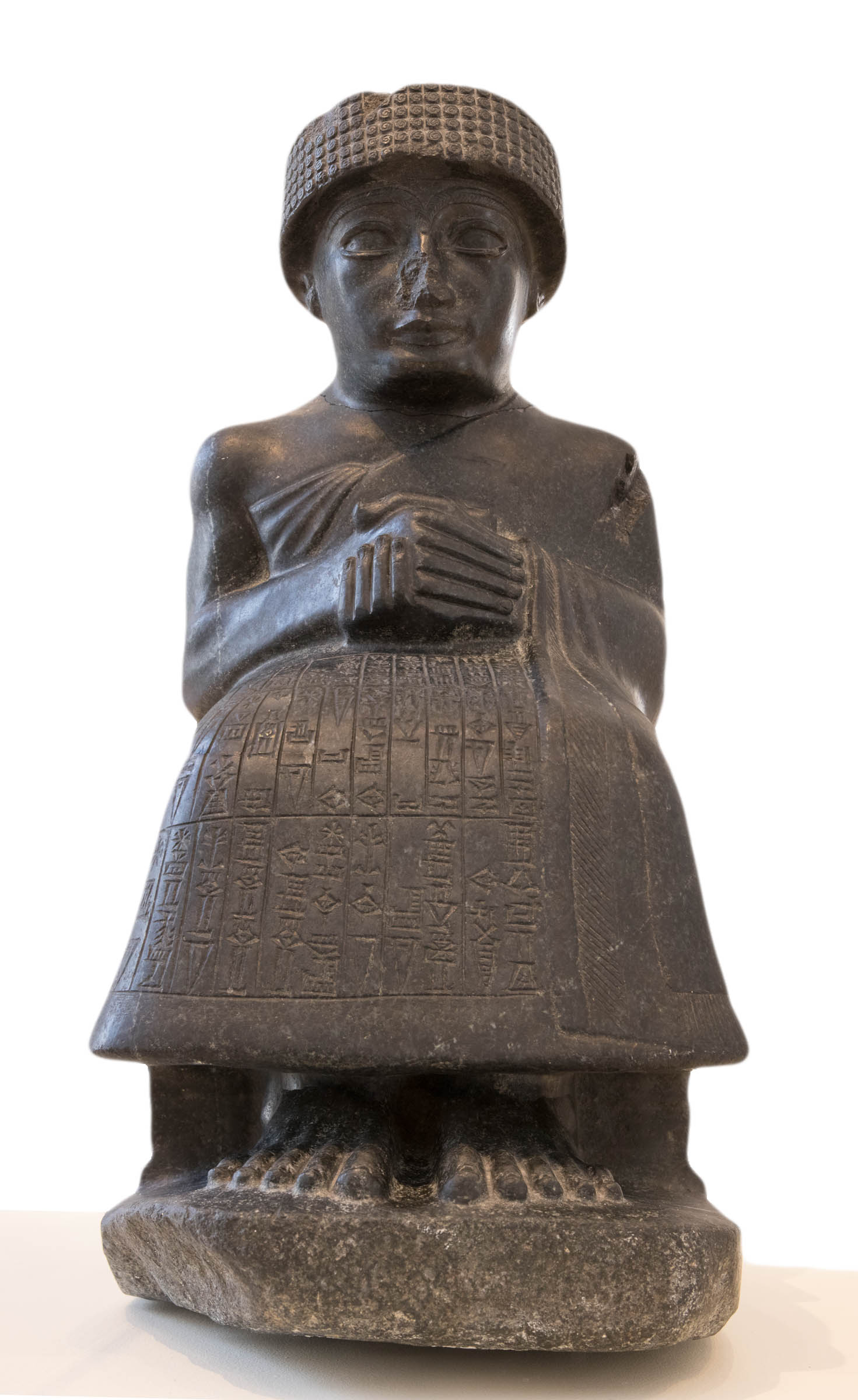
This statue, carved from hard diorite, stands approximately 18 inches tall.
“Of this statue, neither in silver, nor in alabaster, nor in copper, nor in tin, nor in bronze let any one undertake the execution! Let it be of hard stone!” — Inscription on Statue B of the Louvre – Column VI
The Sumerian King List offers the following pithy assessment of the political situation in Sumer following the collapse of the Akkadian Empire and the invasion of the Gutians:
Who was king? Who was not king? Igigi, the king; Nanum, the king; Imi, the king, Elulu, the king—the four of them were kings but reigned only three years.”1Hamblin 2006, 102
For half a century Gutian warlords from the Zagros mountains ravaged the plain of Sumer. These years were remembered by the Sumerians as a Dark Age filled with injustice and violence.
“The snake, the scorpion of the mountain who does violence to the gods, who dragged the monarchy away from Sumer to far distant lands and allowed injustice and violence to set foot in the land.”2Utu-Hegal Triumph Inscription; from Nissen 1990, 186
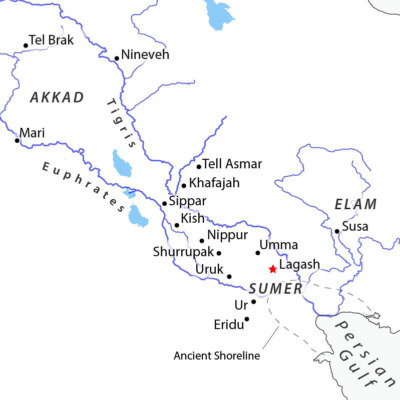
The texts cited above leave us with the impression that all of Sumer was controlled by the Guti and that the years of Gutian control of the lowlands were filled with unremitting hardship. But this does not seem to have been the case. The city-state of Lagash managed to retain its independence and even flourish for most of the period. But you wouldn’t know it by reading the Sumerian King List, which does not even mention Lagash, apparently for political reasons. Our knowledge of Lagash comes from the large number of cuneiform tablets and inscriptions discovered at Girsu. These tablets suggest that already in the days of the Lagashite king, Ur-Baba (also Ur-Bau), Lagash had won its independence from Akkad and retained it during the Gutian period which followed. The Second Dynasty of Lagash may be traced to Ur-Baba or a little earlier.
One of Ur-Baba’s daughters married Gudea, who arose to the throne of Lagash upon Ur-Baba’s death. Inscriptions from this period record the importation of large beams of cedar and cypress from Urshu, “the mountain of Ebla,” wood from Meluhha, and stone and copper from Magan. Dilmun is curiously absent from Gudea’s inscriptions. There is only one record of a military campaign during the reign of Gudea, recorded laconically in a single line.
Gudea defeated the cities of Anshan and Elam and brought the booty from there to Ningirsu in his Eninnu.3Hamblin 2006, 105
The overall picture painted by Gudea’s inscriptions is of a prosperous and mostly peaceful kingdom.

This room in the Louvre is filled with statues of the kings of Lagash, mostly of Gudea (the one that is front-left is of Ur-Baba). Carved from hard diorite, most of them were apparently intentionally decapitated, the head being the only part of the statue breakable without a great deal of effort!
The Statue
A visitor to the Hall of Gudea in the Louvre is immediately struck by the sheer number of statues of Gudea on display. No other Mesopotamian king can compete with Gudea for the number of portraits produced in a single reign, all of them carved from diorite, the hardest of stones! The king wears a stoic expression, his hands clasped before him in a gesture of quiet confidence, and without sandals, a gesture of respect since the statue was intended to be placed in a temple. His statues were inscribed with a simple prayer along with a reminder of what the king had done on behalf of the the god.
Let the life of Gudea, who built the house [temple], be long!
Gudea’s attire marks a departure from the fleecy kaunakes of his Sumerian predecessors. We will not see the kaunakes again, except on rare occasions, and only in cultic contexts.4The kaunakes appears on a fresco in Zimri-Lim’s palace (MB II) and maybe elsewhere. In Zimr-Lim’s palace it is reserved for the gods. Gudea wears a long woven garment instead. The garment is decorated with an elaborate fringe, like those worn by his Akkadian predecessors, but unlike them he is clean shaven and is wearing a tuque, perhaps as an intentional throwback to the hats worn by the early kings of Uruk. The absence of warlike depictions of Gudea or of inscriptions recounting his military exploits also represents a sharp break from the warlike propaganda of the Akkadian kings.
Most of the statues are carved from diorite, an extremely hard, black rock prized in Mesopotamia and Egypt for its near indestructability and fine grain, which is capable of taking a high polish. Other famous diorite monuments include the Code of Hammurabi and the Statue of Khafre. Gudea’s inscriptions name Magan as the place where the diorite was obtained.
From the mountains of the country of Magan a hard stone he has imported. For his statue he has caused it to be cut.
No deposits of diorite capable of producing large blocks of stone have been found in Oman. However, deposits of this type have been found in southern Iran (northeast of Bandar Abbas) so perhaps it was from this area of Magan that Gudea quarried diorite.5Lombardi 2015, 27 That being said, Manishtushu explicitly states that he crossed the sea to Oman to quarry diorite from there. The ultimate source of this diorite must therefore remains unresolved.
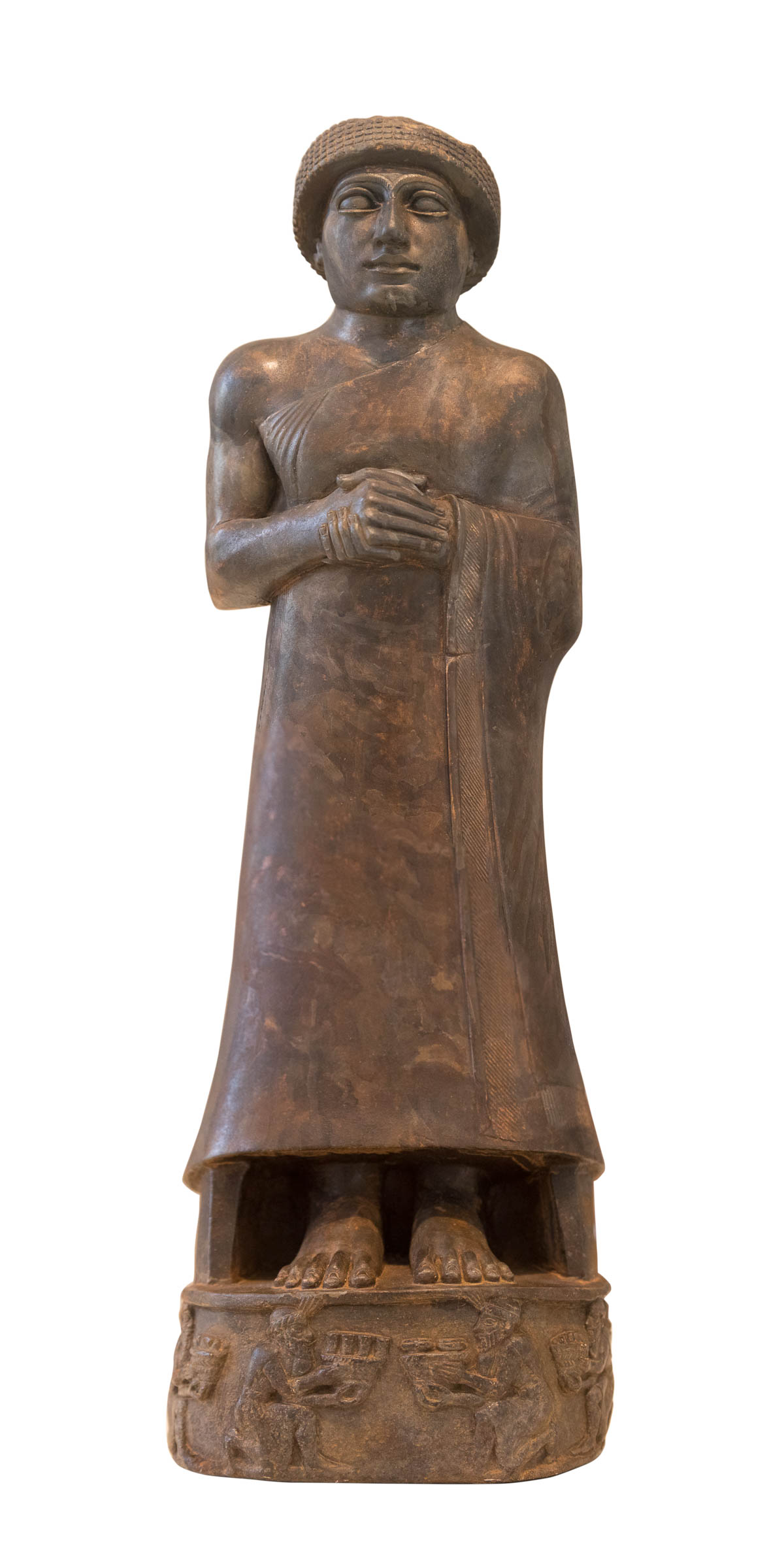
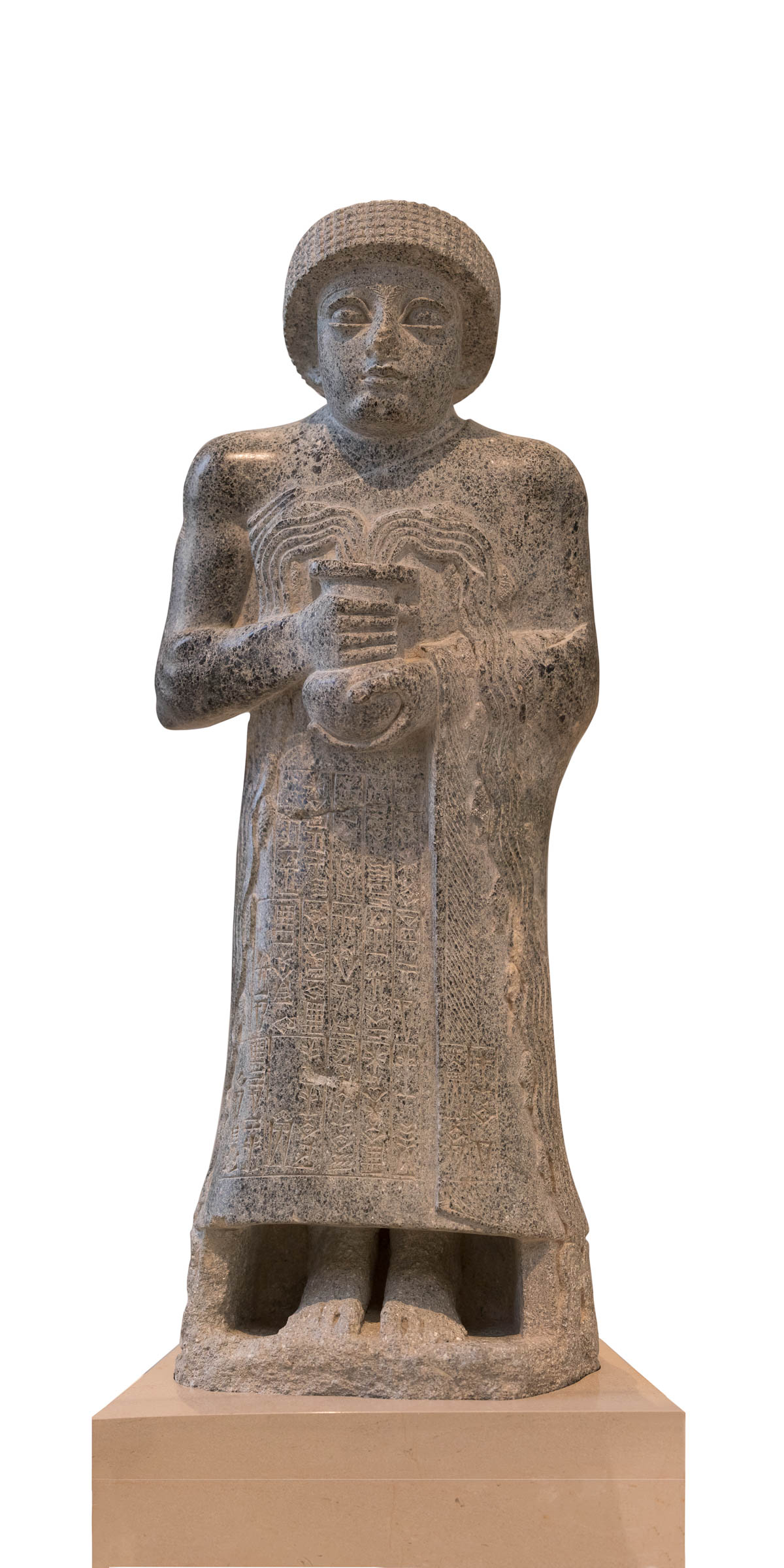
Lagashite sculpturers eschewed abstract, schematic representations of the human body for the natural. Note, for example, the realistic musculature of the arm, and the portrait-like quality of the face.
Kramer, S. N.
The Sumerians: Their History, Culture, and Character.
Chicago: University of Chicago Press, 1963. Link
Lombardi, Alessandra.
“rom Magan to Qade,” in In the heart of Oman. The castle of Salut, , edited by A. Avanzini.
: Roma, 2015. Link
Nissen, H. J. R.
The Early History of the Ancient Near East, 9000-2000 B.C..
Chicago: University of Chicago Press, 1988. Link
Price, I.M. “The Topography of the Gudea Inscriptions.” Journal of the American Oriental Society 43 (1923): 41-48. Link