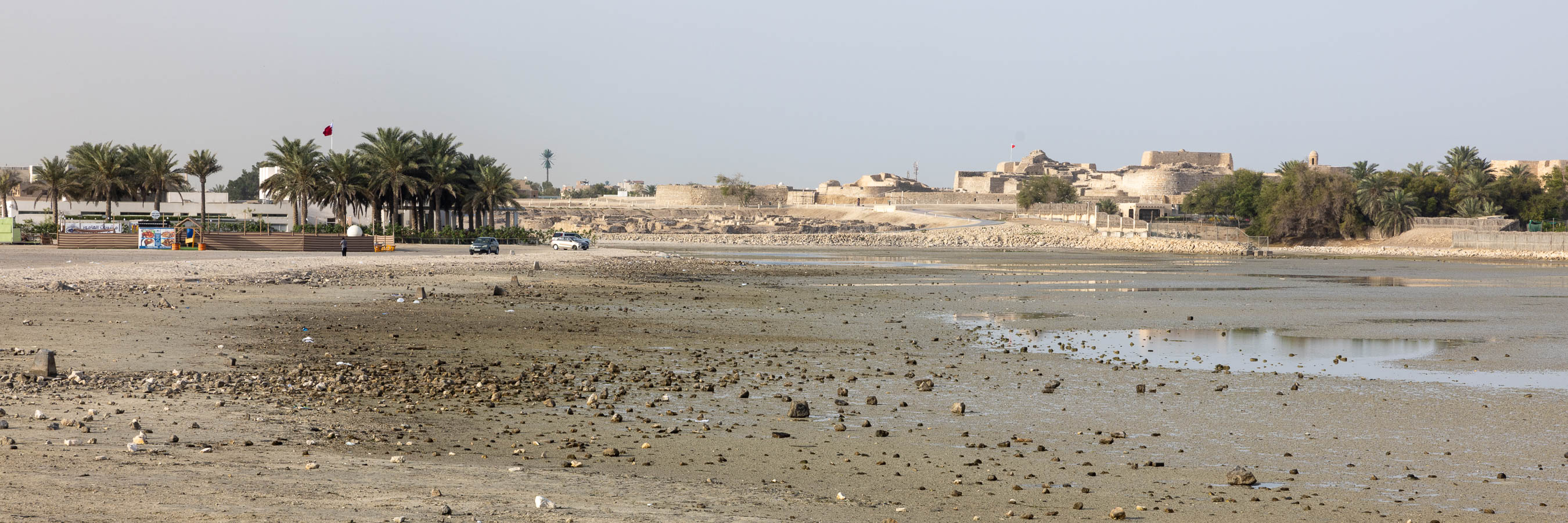
A Portuguese fort was constructed on top of an ancient city mound. Although now silted up, the bay once served as a harbor for ships.
“The island is silver, the sea is pearl…”
Journal of William Durand (1879)
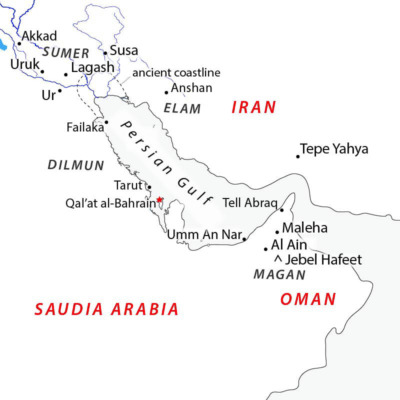
Bahrain is a relatively small island, surrounded on three sides by the Arabian coast. Situated in the warm, shallow water of the Persian Gulf, the name “Bahrain” means literally “the two seas.” The name comes from the mixing of fresh and salt water due to the presence of freshwater springs that bubble up from the seafloor off its northern coast. The famous Arab cartographer Ahmad ibn Mājid wrote, “A man can dive into the salt sea with a skin and can fill it with fresh water while he is submerged in salt water.”1Geocaching Captain William Durand, who explored Bahrain in 1878, also wrote about the remarkable submarine springs in the area,
The water itself is so clear that you can see far down into the coral broken depths, and possesses springs of fresh water that bubble up through the brine, both near the entrance of the harbour, and at several other places round the line of the coast.2Durand 1879, 24
The island was known to the Greeks as Tylos, and for those living in a more remote age, as Dilmun.
Pearls of Great Price
The warm, shallow shoals around Bahrain provide an ideal habitat for oysters. Although ancient references to pearls are few and far between, they are likely the “fish eyes” that appear in lists of items exported from Dilmun in the 2nd millennium BC. Writing at a much later date, Pliny (1st century AD) briefly mentions an island in the Persian Gulf named Tylos that was famous for its pearls. Much sought after by well-to-do Roman women, Pliny thought their ostentatious display was a sure sign of moral decay.3Withey 2013 In the New Testament, the kingdom of heaven is compared to a pearl of great price for which a merchant might sell everything in order to purchase (Matt. 13:45-46). From the Roman period until recent times, pearls and dates would be the island’s two most important exports. A census from the early 1900’s shows that 17% of Bahrain’s population of 100,000 people still dove for pearls. However, the industry collapsed in 1916 with the invention in Japan of cultured pearls. It seems that no one could tell a cultured pearl from a natural one.
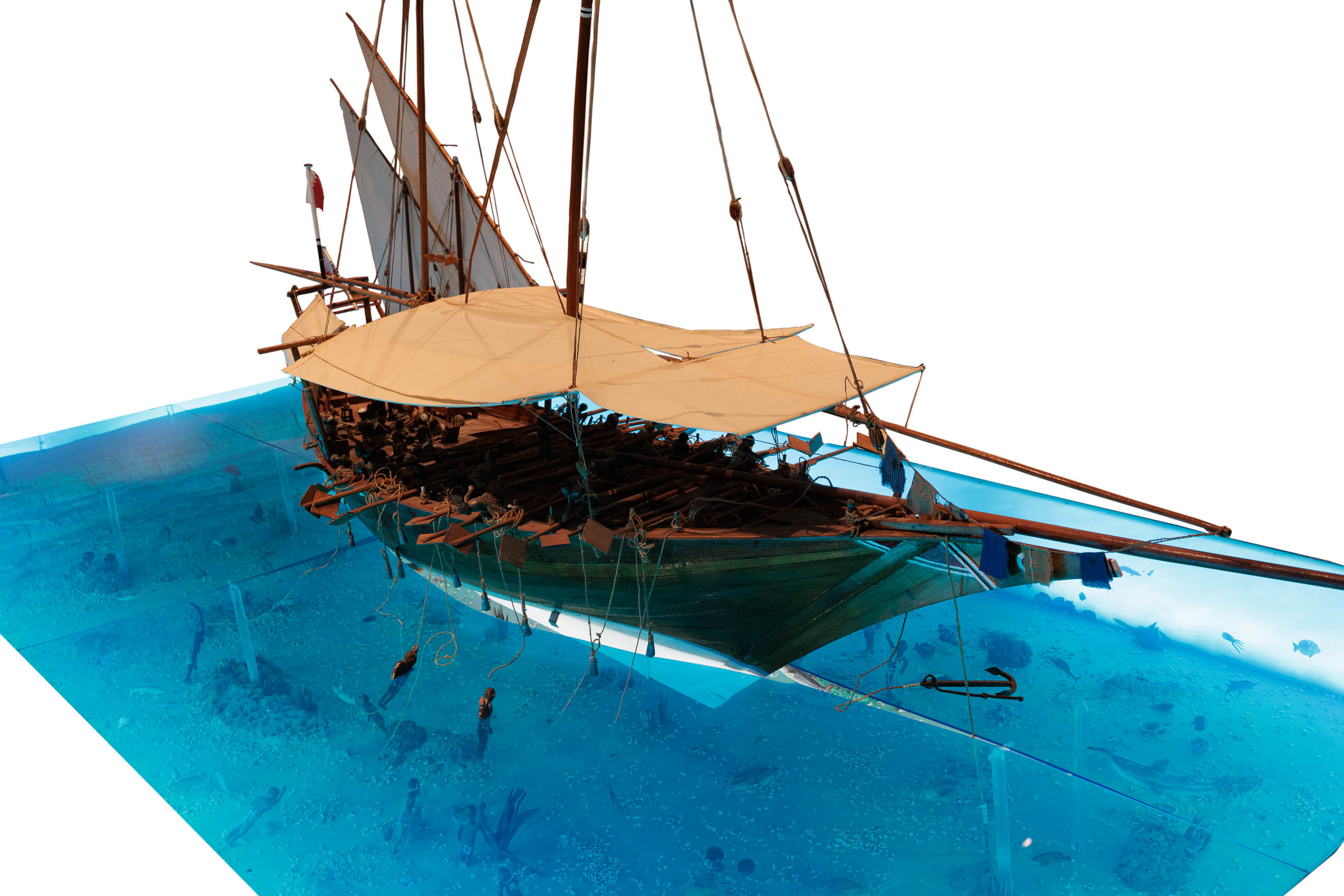
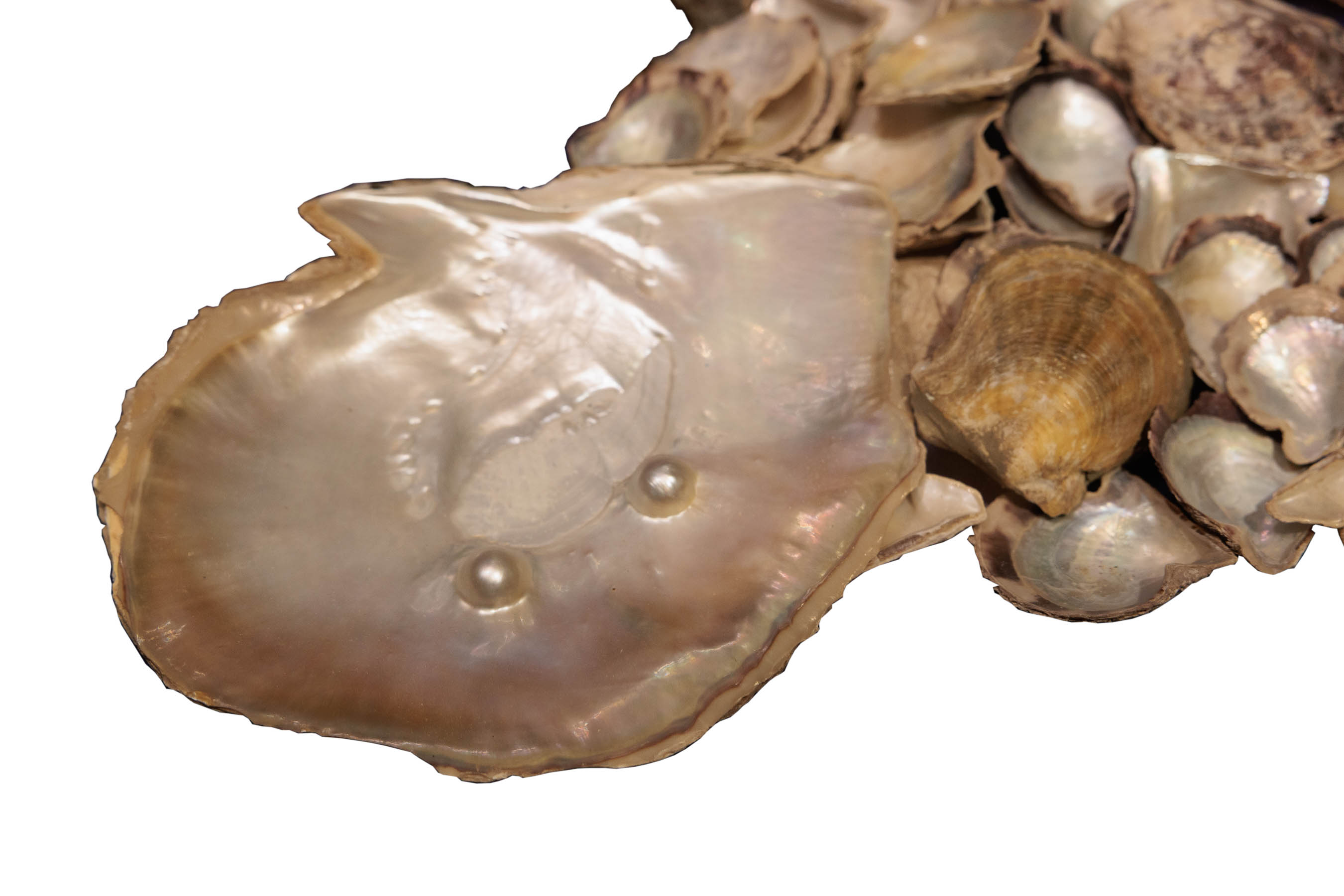
Left: A diorama in the Bahrain National Museum showing what a pearling expedition looked like during the heyday of pearl diving off the coast of Bahrain. Right: Pearls grow around a tiny irritant which lodges itself in the soft interior of a pearl oyster. Hundreds of oysters must be processed to find just one pearl.
Gilgamesh the Pearl Diver?
Remarkably, something like pearl diving is described at the conclusion of the Gilgamesh Epic when, having watched the death of his friend, Enkidu, the king of Uruk embarked on a quest for immortality. Gilgamesh’s journey carried him across many seas and mountain ranges until he reached the shores of Dilmun—the home of Utnapishtim and his wife, who were the sole survivors of the Great Flood. The gods had decreed immortality for the pair, and placed them on Dilmun. Gilgamesh therefore implored them to share with him the secret of immortality. Utnapishtim agreed but only if Gilgamesh could pass a test; he must stay awake for six days and seven nights. If he fell asleep he would lose his shot at immortality. Gilgamesh strained to stay awake, but alas, he drifted off to sleep almost immediately to do exhaustion and slept for 7 days straight. It was a humiliating defeat for the man who was already two-thirds god.
As Gilgamesh prepared to leave the island, Utnapishtim’s wife took pity on him and rebuked her husband for being so hard-hearted. Utnapishtim finally relented and revealed to Gilgamesh the means of attaining immortality.
I will disclose, O Gilgamesh, a hidden thing,
and [a secret of the gods I will] tell thee:
This plant, like the buckthron is [its…].
Its thorn will pr[ick thy hands] just as does the rose.
If thy hands obtain the plant, [thou wilt find new life].4Pritchard 1958, 73
Thereupon Gilgamesh tied a stone weight to his ankles and plunged into a “water pipe” that carried him to the bottom of the sea. There he found the plant just as Utnapishtim described. The story ends with Gilgamesh’s triumphant return to Uruk only to have the plant stolen from him by a serpent while he bathed in a spring. The serpent, having smelled the pleasing aroma of the plant, snatched it away and disappeared into the earth, sloughing its skin as it went.
The ability of the serpent to regenerate its skin has traditionally made it a symbol of immortality. Conversely, its slithering tongue, cold pitiless eyes, and fatal bite, have made it a fitting symbol of evil, chaos, and death. Both aspects of the serpent are present in this story.
The Plant Which Makes Man Young Again
Many attempts have been made to identify the plant which Gilgamesh plucked from the bottom of the sea. The text affords several clues: 1) the plant has thorns like a rose, 2) it produces a sweet aroma, and 3) it is found on the bottom of the sea. It has been suggested that this is a reference to the sharp and prickly oyster and that the pearl was a symbol of immortality. However, pearls do not seem to have been highly coveted in the ancient world. Surprisingly, no pearls were found in Sumerian tombs even though coral and mother-of-pearl were often used by Sumerian craftsmen to make jewelry. Nor are pearls found in Egypt until the classical period. They are rarely found, even in Bahrain and Oman. Thus it has been suggested that the plant mentioned in the Gilgamesh Epic was black coral instead. This coral grows as a single fan or bush on the bottom of the sea floor, smells like myrrh when boiled, stings when touched, and is much sought after for its medicinal properties.5Caspers 1983, 23-24
Of greatest significance from a geographical perspective is the possible connection between the submarine springs off the coast of Bahrain and the “water pipe” used by Gilgamesh to reach the bottom of the sea. Perhaps these springs which eject great plumes of fresh water into the sea were perceived as portals to the abzu, the underworld domain of Enki, and the source of the freshwater that flows from springs. In this interpretation is correct, then Gilgamesh did not find the plant on the bottom of the sea, but beneath the sea, in the underworld.
The Tell
Although sometimes Dilmun appears in Sumerian texts as a garden paradise free from death and disease, it is more often portrayed as a wealthy civilization that conducted a vigorous sea trade. At least since Assyrian times, it has been associated with Bahrain. Thus when the Danish archaeologists, P. V. Glob and Geoffrey Bibby arrived in Bahrain in the mid 1950’s, they hoped to find some remnants of this ancient civilization.6Bibby was originally an Englishman who married a Danish woman and took a teaching position in Denmark. The initial focus of their excavations was a medieval fort named Qal’at al-Bahrain (“Fort of Bahrain”) constructed by the Portuguese in the 1520’s on the northern coast of Bahrain. This part of the island is amply supplied with fresh water from springs and has a small bay—now silted up—that provided a harbor for ships.
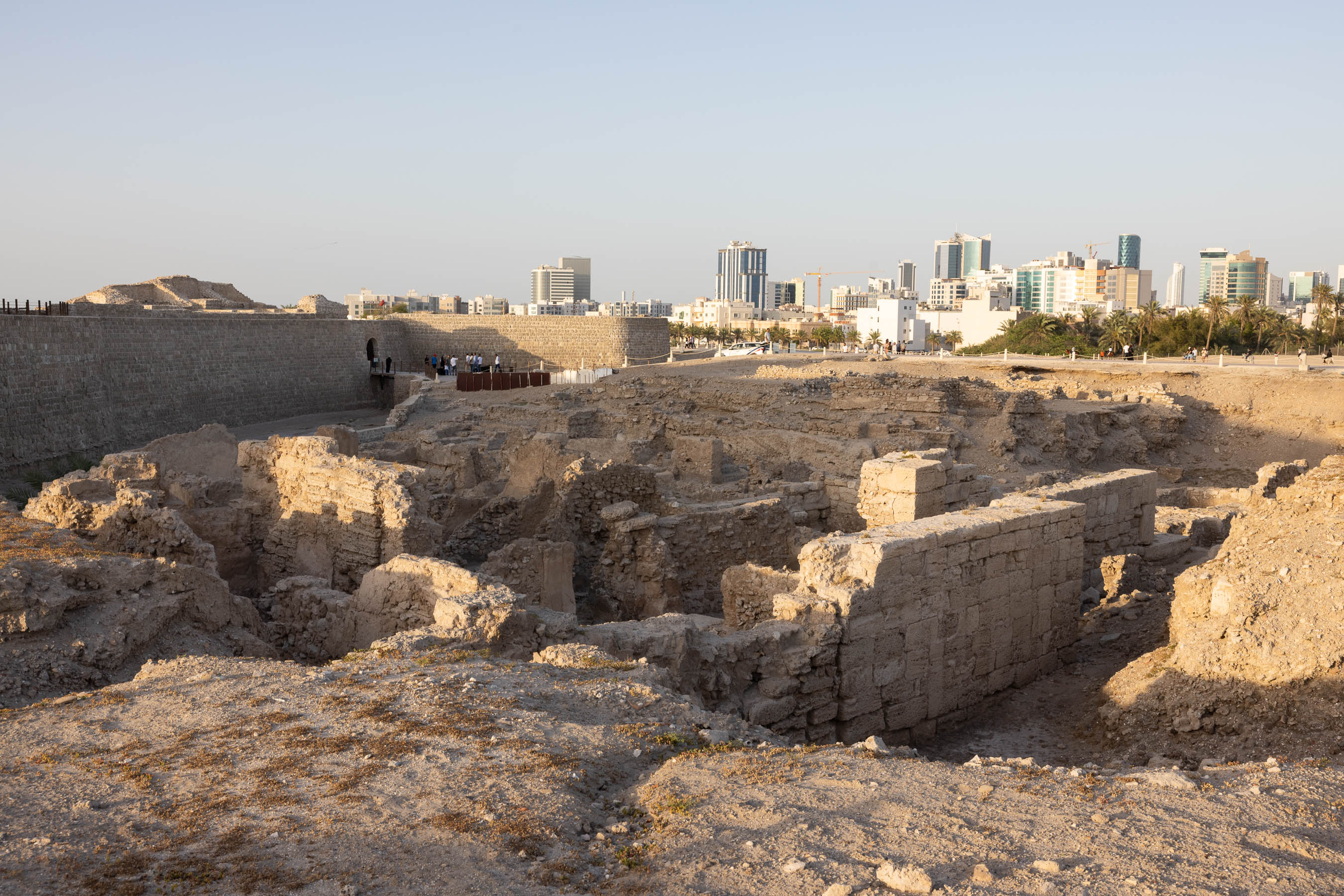
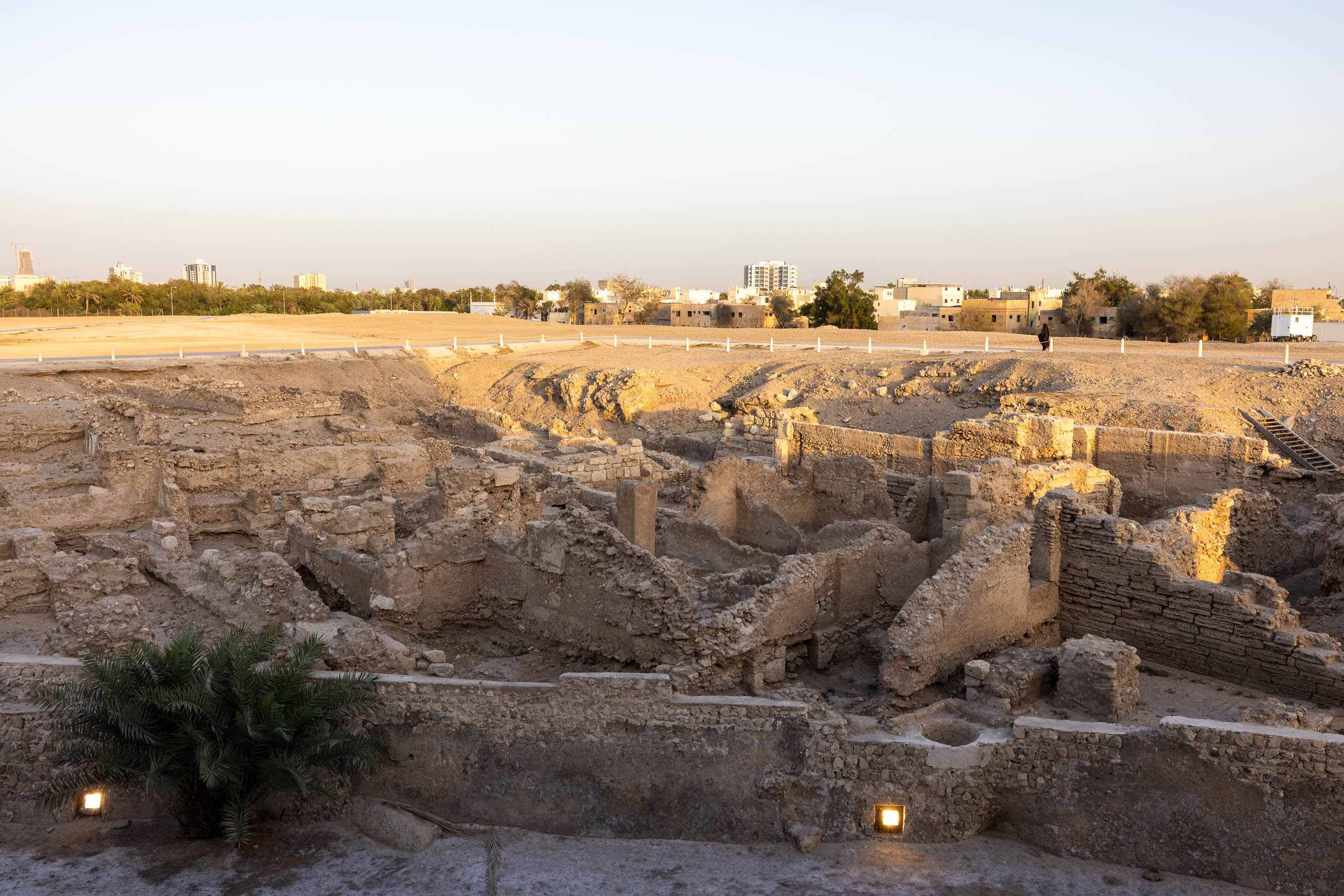
Excavations outside of the fort revealed the walls of an ancient city.
P. V. Glob was the first to notice that the fort was constructed on an ancient mound. A trial probe near the center of the mound exposed a large, squared stone, three and one half feet thick. Further excavations revealed the stone to be part of a massive wall which Glob and his team followed down fifteen feet before finally hitting a floor. This was followed by a second and a third floor. The wall itself was large and well built, with stones measuring upwards of six feet long. They would have to dig twenty-eight feet deep before finally hitting bedrock. Further excavations revealed a large city which covered an area of approximately 40 acres.7Bibby 1984, 99-107 The city clearly enjoyed a long period of occupation, which Bibby thought likely extended back to the beginning of the 3rd millennium BC. The excavations conducted by Bibby and Glob at Qala’at al-Bahrain proved that the island had a long and glorious past, but was it ancient Dilmun?
Caspers, Elisabeth. “Corals, Pearls and Prehistoric Gulf Trade.” Proceedings of the Seminar for Arabian Studies 13 (1983): 21-29. Link
“Notes on the Island of Bahrain and Antiquities by Captain E. L. Durand.” Qatar Digital Library. March 22, 2024. Link
“Freshwater Submarine Springs of Bahrain.” Geocaching. March 21, 2024. Link
Højlund, Flemming, Hellmuth Andersen.
Qala’at al-Bahrain Vol. 1. The Northern City Wall and the Islamic Fortress, edited by Peder Mortensen, translated by Peter Crabb. Jutland Archaeological Society Publications XXX:1 vols.
Moesgaard, Aarhus: Aarhus University Press, 2021. Link
Potts, D. T.. “Review of Reflections on the History and Archaeology of Bahrain by Serge Cleuziou, Pierre Lombard, Jean-Francois Salles, Monik Kervran, Arlette Negre, Michelle Pirazzoli t’Sertsevens, Moawiyah Ibrahim, et all.” Journal of the American Oriental Society 105, no. 4 (1985): 675–710.
Pritchard, J.B.
The Ancient Near East; An Anthology of Texts and Pictures.
Princeton: Princeton University Press, 1958. Link
“Pearls and Status in the Roman Empire.” Jewelpedia. Princeton University Press. March 22, 2024. Link