
This statue is carved from steatite, a soft stone more commonly known as “soapstone”. It stands approximately 7 inches tall.
One of the most remarkable discoveries from Mohenjo-daro was a steatite statue dubbed the “Priest-King of Mohenjo-daro.” Standing approximately seven inches tall, it displays some Mesopotamian influence, such as the full beard and shaved upper lip, and the hair pulled back with a fillet or “head-band.” Although it does not display the “royal bun” worn by Sumerian rulers, other statue heads discovered at Mohenjo-daro also exhibit this distinctive hairstyle.

A head discovered at Mohenjo-daro displaying the royal bun.
The Sky Garment
Another important detail to note is the “trefoil” pattern (three-leaf clover shape) on the cloak of the Priest-King. The hollow interior of the trefoil was filled with a red glass paste of which only traces remain. Bovine figurines etched with the same trefoil pattern have been found at Uruk and Lagash, and are also depicted on an “Intercultural” style chlorite vessels. The trefoil motif would persist in Mesopotamia from the Jemdet Nasr to the Ur III period. Its appearance in the Indus Valley points to some cultural interchange between the two.
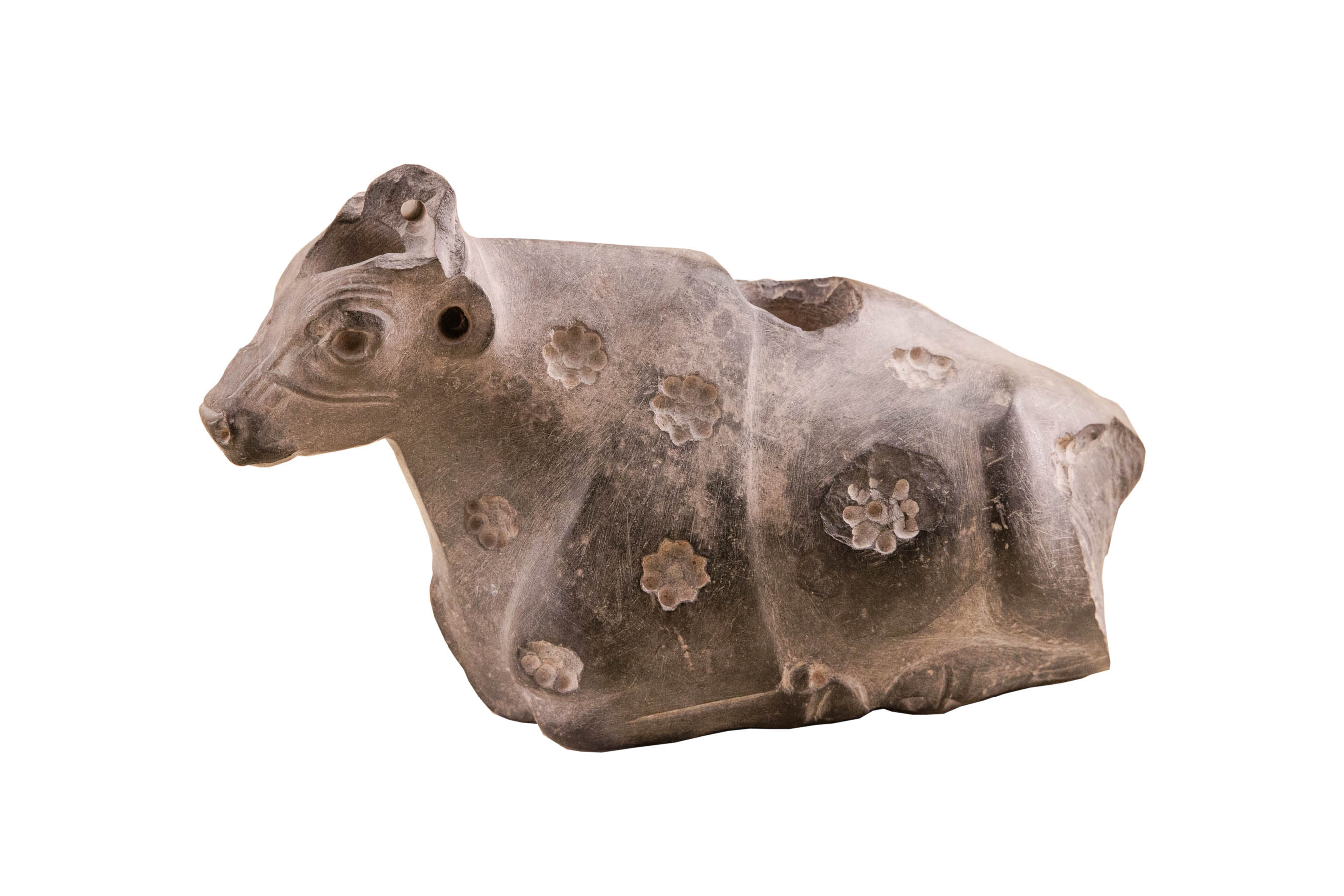

These objects are decorated with patterns of trefoils or rosettes (the two seem to be related). They probably represent stars in the night sky.
Asko Parpola, an Indologist from the University of Helsinki, observes that it was common for West Asian gods and divine kings to wear “festive clothes with golden stars, rosettes and so forth sewn on to them. These were known in Sumerian and Akkadian texts as “sky garments.”1Parpola 2015, 231 The custom persisted into later periods. Thus the Greek poet, Nonnos, refers to a Syrian deity “clad in a patterned robe like the sky” who is named Starclad “since by night starry mantles illuminate the sky.”2Parpola 2015, 231 Parpola notes also that in Vedic texts (the oldest texts of Hinduism) there is a type of “sky garment” known as the tarpya that was worn by Varuna, the divine king in the Hindu pantheon, who was also associated with the night sky. This same garment was worn by Indian kings during their investiture. Vedic texts describe the garment as having images of “sacrificial fireplaces” sewn onto it which were said to be the heavenly fireplaces of pious ancient sages.3Parpola 2015, 231; It is curious to note the similarity between the the trefoil shape and the pottery hearths of the Kura Araxes culture. No doubt this was a practical and common shape for a hearth. The cloak worn by the Priest-King of Mohenjo-daro should probably be interpreted as one these tarpya or “sky garments.” If so, then we are confronted with an important question. To what degree may the Rigveda be used as a guide for interpreting the history and culture of the Indus Valley Civilization?
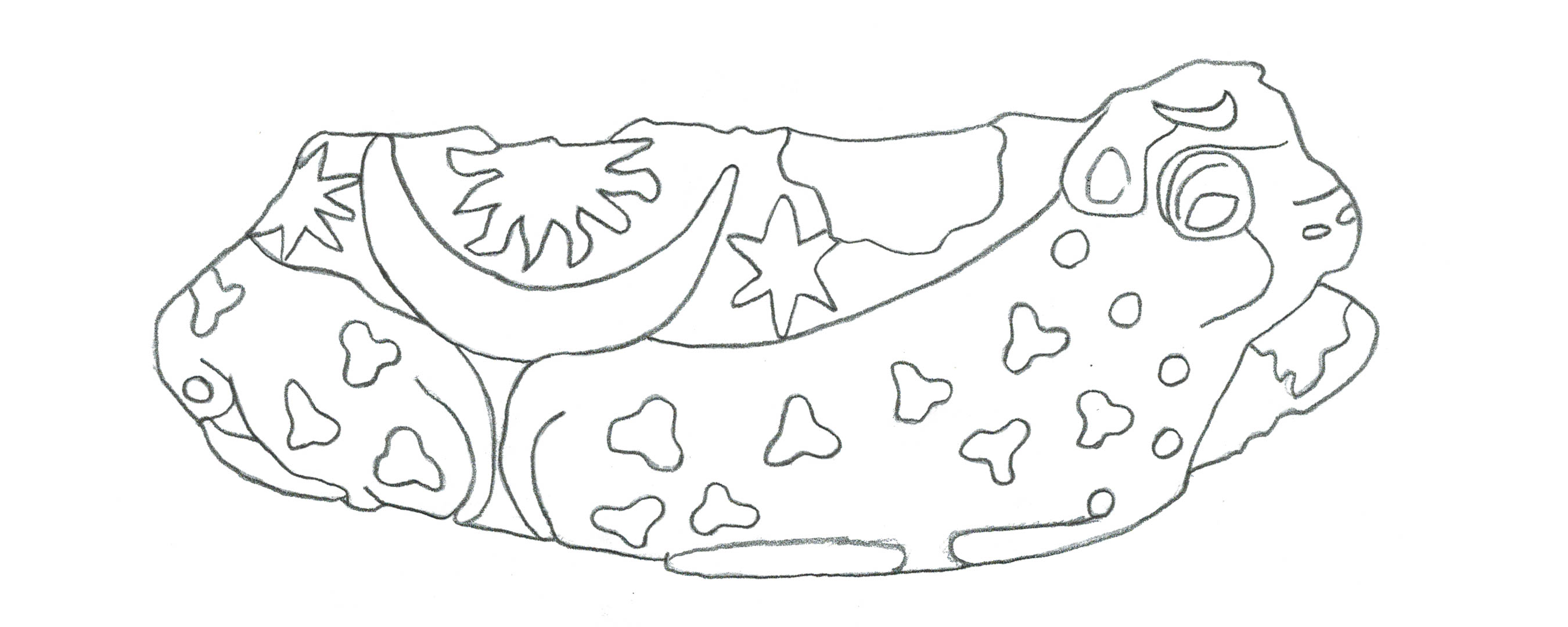
The connection between the trefoil pattern and the night sky is particularly evident on a fragment of an Intercultural Style chlorite vase found at Ur (Early Dynastic III) which shows cows emblazoned with these the trefoil patterns along with the crescent moon, sun, and two stars.
The Rigveda
The Rigveda is the oldest sacred text of Hinduism. Unlike Classical Sanskrit, which was codified in the 5th century BC and hasn’t change since, the style and vocabulary of Vedic Sanskrit varies considerably. One of the foremost scholars of Sanskrit, M. B. Emeneau, dates the Rigveda from approximately 1200-1000 BC. Renfrew notes however that this is only a guess and an “earlier date is perfectly possible.”4Renfrew 1987, 179 Neither Vedic nor Classical Sanskrit are spoken today.
The Rigveda is composed of ten books which fill approximately one thousand pages in modern translation. The best known Hindu gods such as Vishnu, Shiva, and Brahma rarely appear in the Rigveda, if at all. Instead we encounter the storm god, Indra, the fire god, Agni, and the sky god, Varuna. Indra is especially prominent in the Rigveda, oftentimes in connection with a mysterious substance named soma.
O Indra, drink the Soma juice pressed out with stones, poured from the reservoir, as an ox drinks the spring, a very thirsty bull the spring.
The precise identity of soma is unknown although its consumption by warriors before going into war indicates a stimulant drug such as ephedra.
| Name | Titles |
|---|---|
| Indra | thunder |
| Aditi | boundless, fertility, mother |
| Agni | fire |
| Varuna | guardian of the moral order |
| Mitra | light |
| Surya | sun |
| Asvins | the two horsemen, heralds of the dawn |
| Maruts | storm gods |
Important gods named in the Rigveda. Indra will continue to be worshiped as one of the gods of the Hindu pantheon but he assumes a lesser role in later periods.
Indo-Europeans
The brilliant linguist and jurist, Sir William Jones (1746-1794), was a pioneer in Sanskrit research. Since his discoveries have a direct bearing on our understanding of the Rigveda, and have broader implications for how we understand the Harrapan civilization, it is worth our while to get to know him. His mother, a widow of modest means, perceived that her son had a natural gift for languages. At great personal expense she enrolled him at Harrow where he received a classical education. Jones would go on to study at Oxford where he became a master of Greek, Latin, Hebrew, Arabic, and Persian. He cemented his reputation as a scholar with his translations of early Persian and Arabic texts.
William Jones became friends with Benjamin Franklin and was sympathetic to the American Revolution. Such sentiments did not help further his career, although they may perhaps have helped him win the heart of Anna Maria Shipley, the eldest daughter of Bishop Jonathan Shipley, one of the few members of the British parliament who took the side of the colonists during the American Revolution. Having studied law, William Jones managed to gain an appointment as a judge on the Supreme Court of India. With his financial prospects secure, he married Anna Maria and they embarked together for Calcutta shortly thereafter.
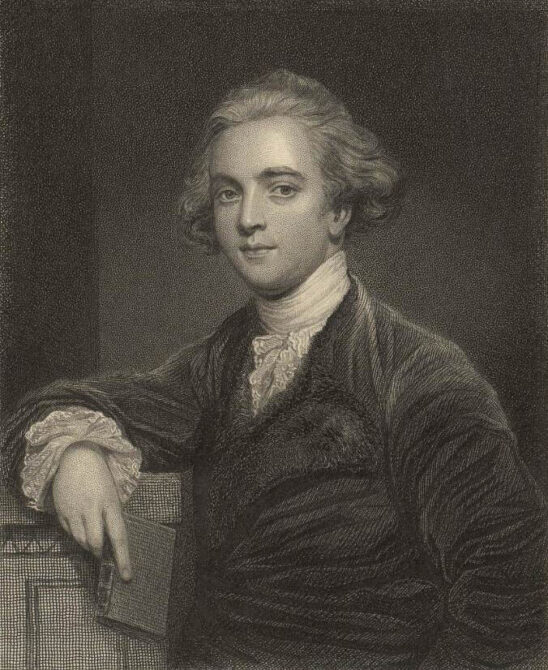
A gifted lingust, Jones popularized the idea that Sanskrit was related to Greek, Latin and Persian.
The choice of Calcutta was serendipitous. Immediately upon arrival, Jones began to apply himself to learning Sanskrit with the goal of compiling a treatise on Hindu and Islamic law. As Jones studied the language, he began to notice the many striking similarities between Sanskrit, Greek, and Latin. In his famous “Third Annual Discourse” made before the Asiatic Society in 1786, Jones argued that,
“… no philologer could examine them all three, without believing them to have sprung from some common source.”
Jones argued that Persian, German, and Celtic should also be included with these others in a single language family—Indo-European. It was a momentous discovery, for it meant that people who lived in India spoke a language related to that which was spoken in Europe, despite their being separated by so great a distance and culture. Historians would eventually devise an explanation for this apparent anomaly; Indo-European speaking peoples migrated from the Eurasian steppes, one settling in Europe and the other in Iran and India. Many variations of this theory have been proposed, with the date for the migration (or wave of migrations) estimated at anywhere from 7000 BC to 1200 BC.


The Indo-European family is the largest language group. It has been argued that Dravidian was the language spoke in the Indus Valley before the arrival of the Indo-Europeans.
The Indo-Europeans and the Indus Valley
The Rigveda alludes to the migration of an Indo-European into “the land of the seven rivers”—which is modern day Punjab. Unlike Homer’s Iliad—another Indo-European text—the Rigveda does not narrate events but is comprised exclusively of hymns and ritual prescriptions. Although its value for historical research is limited, Possehl argues that some historical clues may nevertheless be gleaned from the text. The heroes of the Rigveda, the Aryas, are depicted in the Rigveda as invaders who have entered a “new land filled with non-Aryan peoples” named the Dasyus.5Possehl 1996, 65
Traditionally, the conflict between the Aryas and Dasyus has been understood in terms of an invasion of the Punjab by a war-like group of Indo-European speaking peoples equipped with chariots and horses. The Asyus displaced the native Dasyus, who are described in the Vedas as a “dusky skinned people.” Sir Mortimer Wheeler argued that the Dasyus were Harappans and that the many references in the Rigveda to fortified cities are none other than the impressive Early Bronze cities of the Harappans, recently discovered. Thus Wheeler writes,
In the Rigveda, the invasion constantly assumes the form of an onslaught upon the walled cities of the aborigines. For these cities, the term used is pur, meaning a “rampart”, “fort”, “stronghold”. One is called “broad” (prithvi) and “wide” (urvi). Sometimes strongholds are referred to metaphorically as “of metal” (ayasi)… Forts “with a hundred walls” are mentioned. The citadel may be of stone (asmamayi): alternatively, the use of mud-bricks is perhaps alluded to by the epithet amd (“raw”, “unbaked”). Indra, the Aryan war-god, is puramdara, “fort-destroyer”. He shatters “ninety forts” for his Aryan protege, Divodasa.6Wheeler 1953, 90
Wheeler asks, “Where are—or were—these citadels?” If they are not the great cities of the Harappans then where are they?
The scholarly consensus today is that there is no connection between the Indus Valley Civilization and the Dasyus of the Rigveda since the Harappan civilization is generally thought to have disappeared from the Indus Valley by around 1900 BC whereas the entry of the Indo-Europeans into the region occurred at least 500 years later, c.1400-1200 BC.7Parpola 2015, 106 Such a large time gap precludes any possibility of a connection between the Harappan civilization and the invasion of the Aryas described in the Rigveda. But then we are left with the original question raised by Wheeler. Where are the fortified cities of the Dasyus which are so often mentioned in the Rigveda? No ancient cities have been found in the Punjab besides Harappan ones.
One is forced to conclude that either that the fortified citadels of the Dasyus are a literary fiction, or look for them elsewhere.8Keay observes that the Sanskrit term ‘pur’ may not have meant city or stronghold in Vedic literature, but may be translated ‘settlement’ or ‘village’ (Keay 2010, 23). Alternatively, Parpola transfers the conflict between the Dasyus and the Indo-European tribes from the Punjab to the BMAC (Bactria-Margiana Archeological Complex) of Afghanistan, where fortresses have been found which date to c. 1900 BC. Parpola therefore equates the Dasyus (shortened to Dasa) with the early Scythians who inhabited that region (Parpola 2015, 98 ff.). It seems to me that Wheeler’s identification of the Dasyus with the Harappans cannot be completely discounted, especially if the end of the Harappan civilization can be lowered somewhat, to the middle of the 2nd millennium BC.
Parpola, Asko.
The Roots of Hinduism: The Early Aryans and the Indus Civilization .
Oxford: Oxford University Press, 2015.
Possehl, Gregory.
The Indus Civilization : A Contemporary Perspective.
Walnut Creek, California: AltaMira Press, 2002.
Renfrew, Colin.
Archaeology and Language : the Puzzle of Indo-European Origins.
New York: Cambridge University Press, 1988.
Wheeler, Sir Mortimer.
“The Indus Civilization,” in The Cambridge History of India.
Cambridge: The University Press, 1953.