

These ivory figurines were found at Chalcolithic / EBI sites in the Beersheva Valley in Israel. The male figurine was found at Bir es-Safadi and stands ~13 inches tall. The provenance of the female figurine is unknown. She stands ~12 inches tall.
Ivory figurines such as the ones pictured above were locally produced at sites in the Beersheva Valley, an arid region located in southern Israel. Although sparsely populated today, it was home to many Ghassulian villages during the Early Bronze I period. One of the distinguishing characteristics of the figurines are their unusually long noses, which have earned for them the name “Pinocchio Figurines.” Typical of archaic statuary, their arms are positioned strait by their sides, but still separate, with only the hands attached. They lack clothing except the male figurines wear a phallic sheath attached to a string belt. This minimalist attitude towards clothing is reminiscent of the warriors depicted on the Gebel el-Arak Knife, who are similarly (un)dressed.
Ivory
Ivory is a valuable material derived from the tusks of elephants or the teeth of hippopotamuses. The ivory objects found in the southern Levant are generally thought to have originated in Egypt or Syria.1Populations of the large Asiatic elephant (Elephas maximus) are known to have existed in Syria until the Iron Age. However, it is also possible that Ghassulian craftsmen sourced ivory locally since the hippo is thought to have once inhabited the coastal rivers of the southern Levant. Although no more than seasonal streams today, these rivers must have once run deep enough to provide habitat for the hippopotamus. Evidence comes from hippopotamus bones which have been found at sites along the Levantine coast.2Horwitz and Tchernov 1990, 72
A more arid climate and rising sea levels probably led to the extinction of the hippo in the Levant, perhaps towards the beginning of the Early Bronze period.3Horwitz and Tchernov write, “Although not all studies concur as to the exact timing and duration of the environmental changes, the fluctuation of arid and wetter periods would have had a direct effect on the extent of the marshy areas available to hippopotamus populations. It is probable that during the Upper Palaeolithic to the Chalcolithic period, the hippopotamus population diminished as their habitat shrank with changes in climate, culminating in almost total desiccation of this biotope when our current, more arid climate set in subsequent to the Chalcolithic period(Goldberg and Rosen 1987)” (Horwitz and Tchernov 1990, 72). The favorable conditions which contributed to flourishing hippopotamus populations in the southern Levant likely means that the Beersheva Valley also did not experience the desert-like conditions found there today. This would explain the number of Ghassulian villages found in the region.

Ivory Figurines from Egypt
Predynastic ivory figurines found in Egypt share many of the same features as the Pinocchio figurines, such as the arms held straight by the side, and the string belt attached to a phallic sheath. A particularly large cache of these ivory figurines were found at Hierakonpolis in the “Main Deposit.”4Perrot thought the Ghassulian figurines dated to the turn of the 5th to 4th millennia BC, drawing parallels between the Ghassulian and Badarian culture of Egypt.(Perrot 2006) It seems to me that there are more and better parallels with the Naqada II-III.


Left and Middle: Predynastic ivory figurines from Egypt. Right: A “Pinocchio Figurine” from Gilat in the Beersheva Valley.

This stash of ivory figurines was found next to the Main Deposit at Hierakonpolis.
The Nose
One of the characteristic features of the Ghassulian ivory figurines is their prominent nose. This phenomena extends to other types of Ghassulian artifacts, such as basalt stands, burial urns, and the Procession Fresco discovered at Teleilat el-Ghassul. The holes drilled into the lower half of the male figurine’s face must have been used to attach a beard.


Left: Fresco from Teleilat el-Ghassul. Center: Basalt Offering Stand from Gilat. Right: Ivory Figurine from Bir es-Safadi.
These objects display unusually prominent noses. Also note the ‘horns’ protruding from the head of the basalt offering stand and the similarly shaped horns on the mask of the leading figure in the Procession Fresco from Teleilat el-Ghassul.
Meaning?
We noted in a previous entry that Perrot found two basalt bowls at Bir es-Safadi buried in a pit with several ivory “wands” and a Pinocchio figurine. These objects give the appearance of having been used for divination. The Pinocchio figurine, in particular, may be compared to the “teraphim” which are mentioned in the Bible, usually with a negative connotation, in connection with divination.5One exception seems to be 1 Sam. 9:13 where the word appears to have the meaning of “carved image” without any cultic significance.
Moreover, Josiah put away the mediums and the necromancers and the household gods [teraphim] and the idols (2 Ki. 23:24 ESV)
For the king of Babylon stands at the parting of the way, at the head of the two ways, to use divination. He shakes the arrows; he consults the teraphim; he looks at the liver. (Ezek. 21:21 ESV)
For the household gods [teraphim] utter nonsense, and the diviners see lies; they tell false dreams and give empty consolation. Therefore the people wander like sheep; they are afflicted for lack of a shepherd. (Zech. 10:2 ESV)
Something of the size, weight, and importance of the teraphim may be discerned from the account in Genesis of Jacob’s escape from his father-in-law Laban. Apparently, on her way out, Jacob’s wife, Rachel, stole her father’s teraphim and hid them in her saddlebag (Gen. 31:19). In this case, the teraphim could not have been very large. They were clearly of great importance since Rachel was willing to risk her father’s wrath to steal them, and Laban was ready to kill to get them back. One may surmise from this text that the teraphim functioned as household gods, and that is, in fact, how the term is usually translated in the Bible.
It has been suggested that the term was borrowed from the Hittite stem “tarpi-” which appears to have been used in Hittite texts to translate the Akkadian term sedu.6Hoffner 1968, 63ff. Since the latter term was used to to refer to underworld spirits, it is likely that Hittite “tarpi” and Hebrew “teraphim” have a similar meaning.7Also, the Hebrew “shedim” is a direct translation of Akkadian “sedu.” “Shedim” is used interchangeably in the Bible with the more common term “rephaim.”
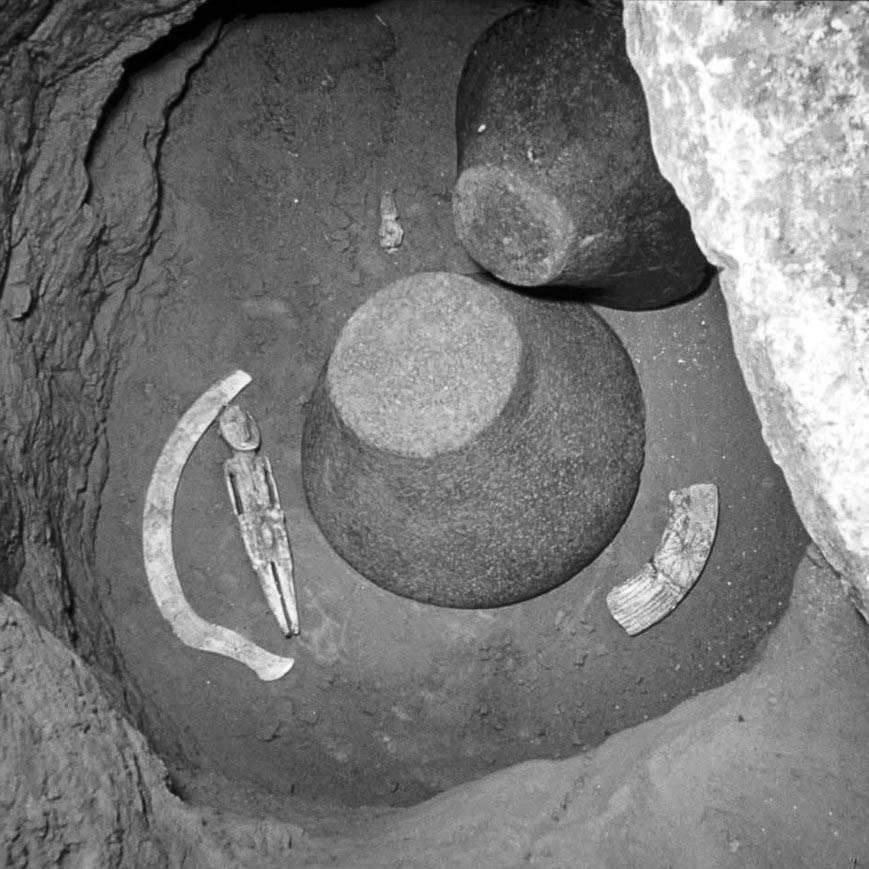

The Pinocchio figurine displayed above comes from Bir es-Safadi, a Chalcolithic village located in the Beersheba Valley. It was found buried in a pit next to two ivory “wands” and two basalt bowls.
Cult figurines were nearly ubiquitous in the ancient world. In ancient Rome, for example, every home and shop had a niche in the corner of the room, or even an entire wall, where figurines of the lares and penates, the gods of the hearth and storeroom, were kept. They represented divine ancestors who brought prosperity and good luck to the household. The Pinocchio figurines may have had a similar function as magical talismans. But the divine ancestors who brought good luck also had special insight into the future. Thus the the connection between teraphim and divination.
Hoffner, H. A. “Hittite Tarpi and Hebrew Teraphim.” Journal of Near Eastern Studies 27, no. 1 (1968): 61-68. Link
Horwitz, L. K, E Tchernov. “Cultural and Environmental Implications of Hippopotamus Bone Remains in Archaeological Contexts in the Levant.” Bulletin of the American Schools of Oriental Research, no. 280 (1990): 67-76. Link
Perrot, Jean. “Les Ivoires de la 7c Campagne de Foilles a Safadi pres de Beersheva.” Eretz-Israel Archaeological, Historical and Geographical Studies 7 (1964).
Perrot, Jean. “Autour des ivoires de Beersheba.” Syria 83 (2006): 159-165. Link