

Although only fragments remain, this finely executed alabaster relief shows Akkadian soldiers carrying away booty from a western campaign.
Lo, the king who wants to equal me, where I have gone, let him also go!1“Sargon, the Conquering Hero” in Westenholz 1997, 77
This boast was placed on the lips of Sargon of Akkad by the Old Babylonian text, Sargon, the Conquering Hero, one of many such stories known collectively as the Res Gestae Sargonis (Latin. res gestae, “things done”). Another text in this genre, Sargon, King of Battle, is an account of Sargon’s campaign against Purushanda, a city in central Anatolia which should probably be identified with Acemhöyük (see map below). According to this account, Akkadian merchants pleaded with Sargon to secure the roads and protect them from the depredations of a certain king of Purushanda, named Nur-Daggal.2Westenholz 1997, 102 ff. The degree to which these later, literary accounts can be trusted is unclear.
However, the kings of Akkad were accustomed to recording their exploits on stelae and statue bases. Most of these have been lost but the inscriptions themselves were copied down by scribes on tablets and thus preserved. According to one of these royal inscriptions, Sargon claims to have conquered all the way to the “Cedar Forest” and the “Silver Mountains.” Both locations should probably be located in south-central Anatolia.
Sargon, the king, bowed down to the god Dagan in [his temple in the city of Tuttul [seeking oracular confirmation for his plan to conquer Syria]. He [the god Dagan, through an oracular pronouncement] gave to him [Sargon] the Upper Land [Syria], [including the cities of] Mari, Yarmuti, and Ebla as far as the Cedar Forest [of Lebanon] and the Silver [Taurus] Mountains.3Douglas Frayne, “The Royal Inscriptions of Mesopotamia, the Early Periods, Vol. 2” (Toronto: University of Toronto Press, 1993) cited in Hamblin 2006, 76
Sargon’s grandson, Naram-Sin, also claimed to conquer as far as the Cedar Forest and Silver Mountains. And a certain Pamba, king of “the land of Hatti,” is recorded among a list of kings who rebelled against him. Unfortunately, the only source that mentions Pamba comes from a Hittite cuneiform text found at Hattussa which dates from the 16th to the 14th centuries BC. It may be that Hittite scribes took the liberty to write themselves into the history books, but it is also possible that Pamba and Nur-Daggal were historical kings who fought against the Akkadians in the north, just as the Lullubi would in the east.
Some of the tombs discovered at Alacahoyuk probably date to the Akkadian period. We’ve seen that the tombs belonged to powerful and well-armed warriors capable of opposing the Akkadians.
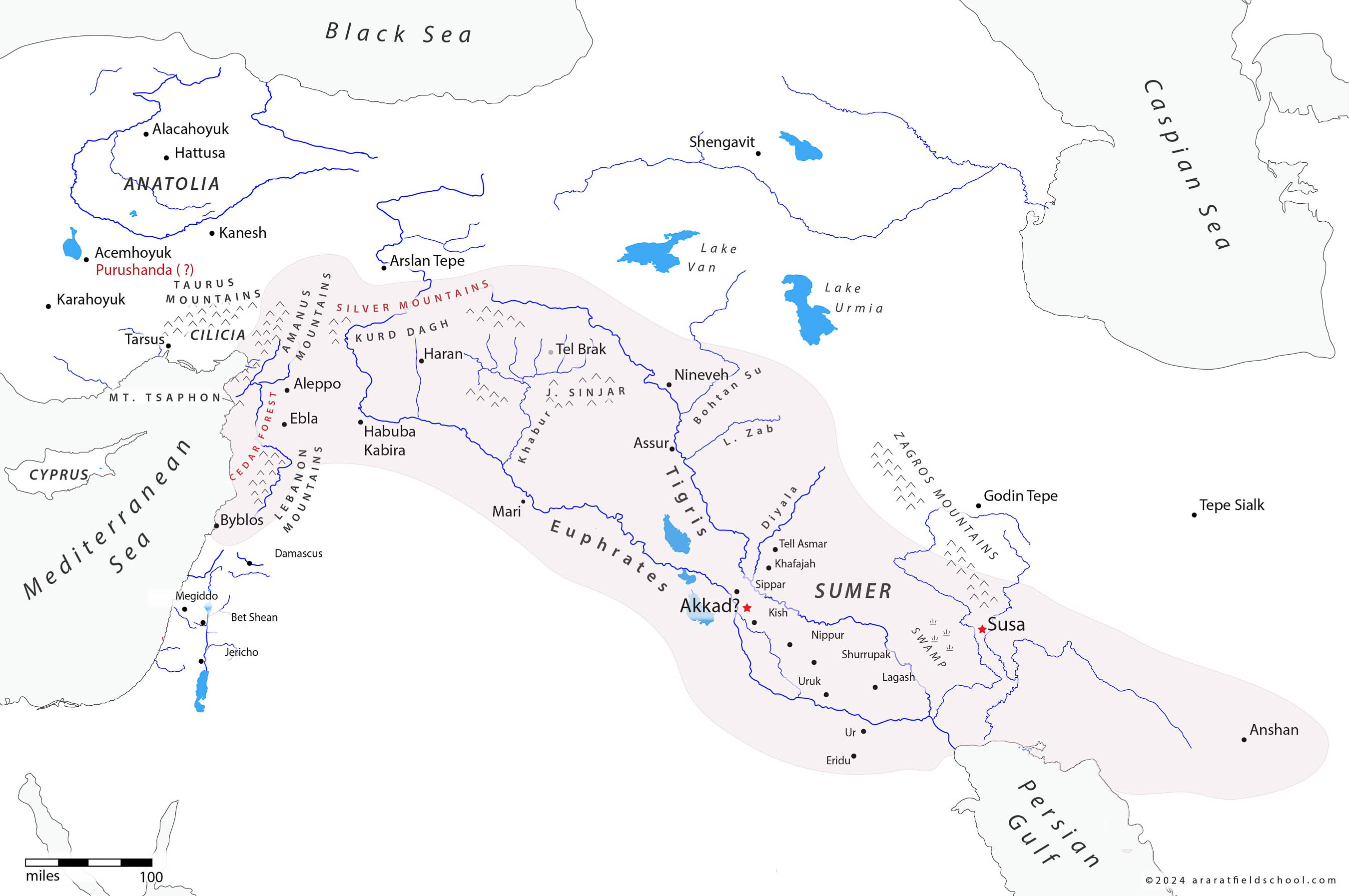
The exact area controlled by the Akkadians is difficult to determine and the degree to which they actually controlled it. Nor is there agreement as to the location of the “Silver Mountains” and the “Cedar Forest.” The locations indicated on this map are from Moorey 1994.
In addition to the textual evidence cited above, the Nasiriyah Victory Stele also appears to commemorate a western campaign conducted by the Akkadians which may have penetrated into southcentral Anatolia. Although only fragments survive, it preserves a detailed picture of Akkadian soldiers carrying captured booty, including a typical Anatolian two-handled cup and a dagger resembling a type found in Lebanon. The Nasiriyah Victory Stele has been dated on stylistic grounds to the reign of Naram-Sin, the grandson of Sargon, and thus probably commemorates his western campaign.
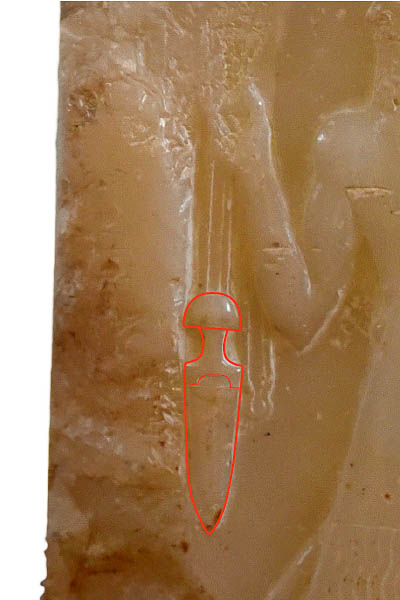

Left: An Akkadian soldier carries a dagger as booty. Right: A dagger found in the Temple of Obelisks at Byblos in Lebanon. Although the dagger dates to the Middle Bronze period, the shape of its pommel and blade, together with its sheath, are nearly identical to the one depicted on the Nasariyah Victory Stele.
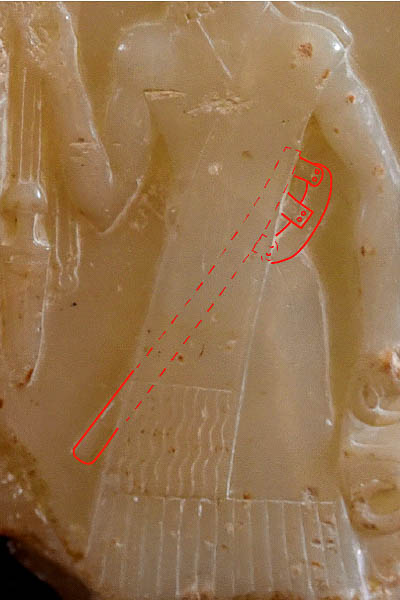

Left: An Akkadian soldier carrying a broad axe. It is more common for Akkadians to be shown carrying a chisel axe. This axe may therefore represent a weapon captured as booty. Right: A broad axe belonging to the EB III from the cemetery of Amarneh (Til Barsip) near modern Aleppo in Syria.1The Amarneh broad axe is not quite identical to the type of axe carried by the Akkadians since the Akkadian axes utilize rivets to attach the blade to the shaft. It is also worth pointing out the similarities between these weapons from the Amarneh cemetery and the weapons from the Kfar Monash Hoard. Both were made from copper, tin-bronze not being in common usage until the end of the Early Bronze Age. We’ve seen axes of this type in the Royal Cemetery of Ur and the Kfar Monash Hoard.
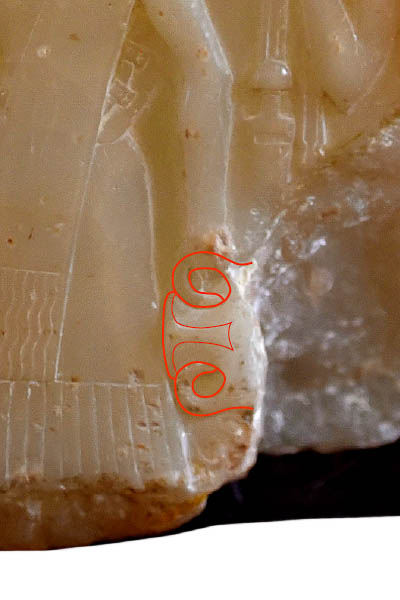


Left: A two handled cup carried by an Akkadian soldier. Right: A two-handled cup of a type recovered from Troy II-V. The terracotta cup was an imitation of an identical vessel made from silver or gold, which is probably what is shown being carried away as booty by the Akkadian soldier.
Bound and naked, a train of prisoners march together with their necks in a stock. The image illustrates the words of an Akkadian royal inscription: “Enlil instructed [Sargon to conquer the world] and he showed mercy to no one.”2Douglas Frayne, “The Royal Inscriptions of Mesopotamia, the Early Periods, Vol. 2” (Toronto: University of Toronto Press, 1993) cited in Hamblin 2006, 76
Hamblin, W. J.
Warfare in the Ancient Near East to 1600 BC: Holy Warriors at the Dawn of History.
London ; New York: Routledge, 2006. Link
Moorey, P. R. S.
Ancient Mesopotamian Materials and Industries.
Oxford: Clarendon Press, 1994.
Westenholz, Joan Goodnick.
Legends of the Kings of Akkade : The Texts.
Pennsylvania: Pennsylvania State University Press, 1997.