
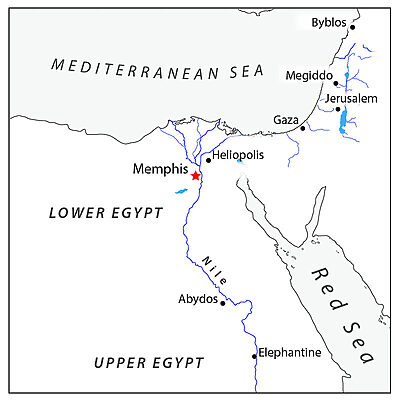
The site of Memphis is located approximately 7 miles south of Cairo. The visible ruins of the city represent less than ten percent of the original city.
Situated at the place where the Nile divides into six, Memphis has been the capital of Egypt for most of its history. Manetho credits Menes with they city’s founding while noting also that it was named “white walls.” The city derived its name from its immense temple constructed with white-washed walls, named Hek-ka-ptah (“mansion of the spirit of Ptah”). The Greeks pronounced he name of this temple “Aegyptos,” a name which of course eventually came to be applied to the whole land.
Although Memphis was the largest city in Egypt, very little remains; its ruins having long since been uprooted and used to build the nearby city of Cairo. What was left has gradually sunk below the water table and out of reach of archaeology. Indeed, by the 7th century of our own era, the whereabout of Memphis was all but forgotten until European travelers began looking for it in the 16 and 17th centuries.1Redford 2001, “Memphis” The first excavations were conducted by Giovanni Battista Caviglia in 1820 in the gate of the temple of Ptah where a giant statue of Ramsess II was discovered. Its enormous weight prevented it from being shipped to Italy or Britain for display. It still rests in the place where it was found and is now the primary attraction for those who visit the site today.
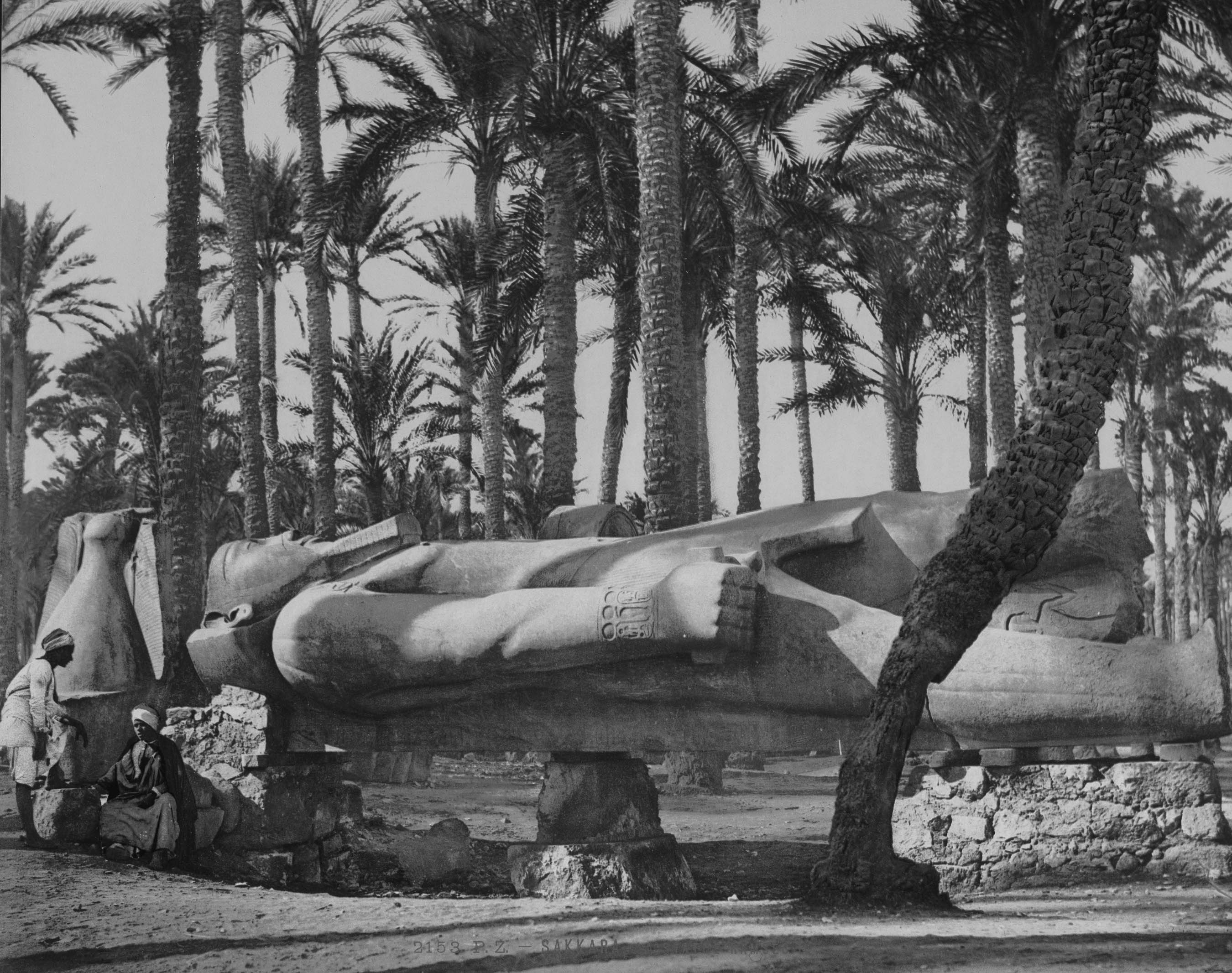
This colossal statue once stood next to the Temple of Ptah in Memphis.
Ptah
Covering approximately 70 acres in the center of the city, the temple of Ptah was itself the size of a large city. Ptah was the Egyptian creator god identified in later periods with the Greek god, Hephaistos. Both of them could be represented as dwarfish figures and dwarfs were employed as craftsmen in the temple of Ptah. Herodotus even tells a curious story about the Persian king, Cambyses, who, upon seeing a statue of Ptah in the form of dwarf, commanded that it be destroyed.

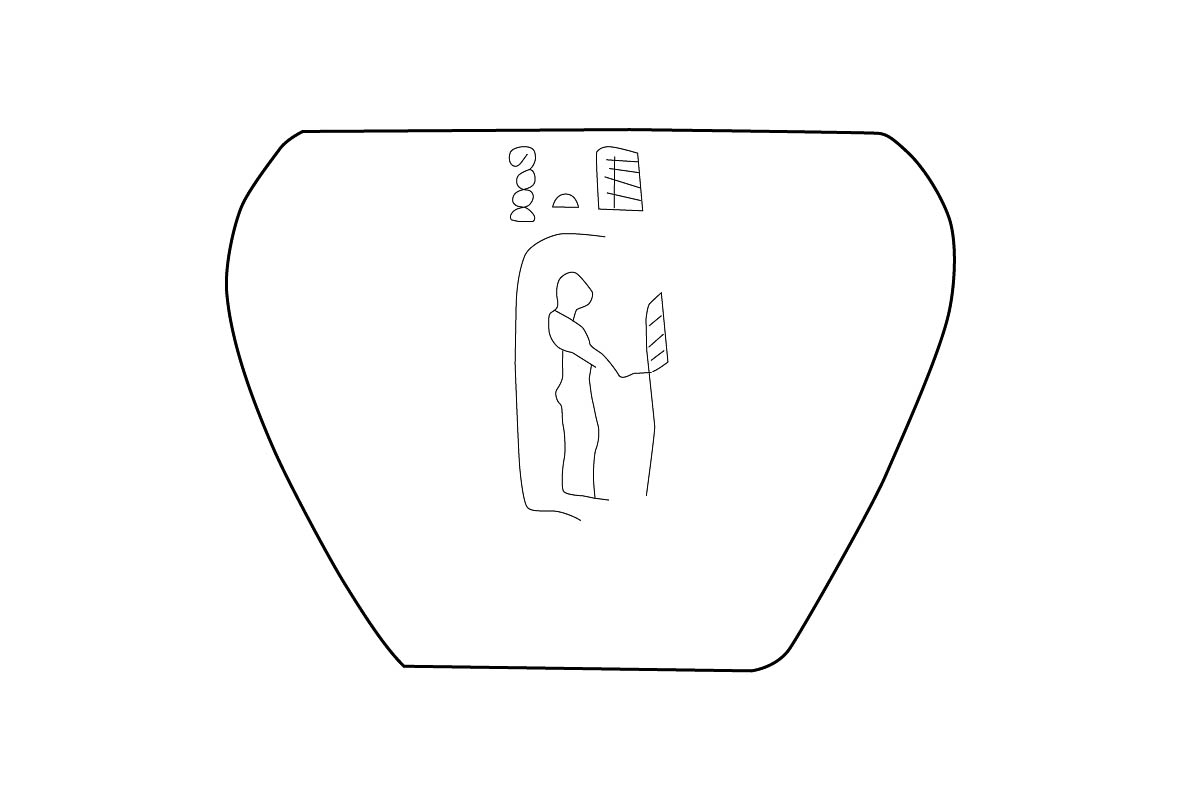
An alabaster bowl from Tarkhan with the earliest known representation of Ptah. It dates to the reign of Den, a ruler of the First Dynasty.
Despite the importance of Ptah, very little is known of his origins. The earliest representation of him comes from an alabaster vase discovered in a Early Dynastic tomb in the cemetery at Tarkhan, about 40 miles south of Memphis. In later periods Ptah would hold the highest place in the Egyptian pantheon alongside Ra and Amun. He is almost always shown holding a ‘was‘ staff, forked on one end, while the other terminates in an unidentifiable creature, usually referred to simply as the “Seth-animal.” It looks like a cross between a jackal and an Egyptian hunting dog. The ‘was‘ scepter represents “dominion” in the hieroglyphic script.

This gilded statue of Ptah was found in the Tomb of Tutankhamen. It shows the god standing upon the earth (black pedestal), his body is the air (covered in feathers), and his head is the sky (blue skullcap). Ptah is holding a staff which combines the ‘was’, ‘djed’, and ‘ankh’ symbols, which signify ‘dominion’, ‘stability’, and ‘life’ respectively.
Redford, D.B.
The Oxford Encyclopedia of Ancient Egypt.
Oxford, New York: Oxford University Press, 2001. Link