The crumbling walls and broken down temples tell the story; Megiddo met with some misfortune at the end of the Early Bronze period. It wasn’t the only city to fall on hard times. Mazar suggests that nearly all the cities of the southern Levant reverted to unwalled villages during the period known alternatively as the “Intermediate Bronze Age,” “Early Bronze IV,” “Middle Bronze I,” or “EB IV—MB I.”1According to Mazar, “only at a few major tells did a scanty occupation level follow the end of the EB III (Hazor, Megiddo, Beth-Shean, Jericho)” (Mazar 1992, 152). The multiplicity of nomenclatures betrays the ambiguous nature of the archaeological record in the southern Levant during the transition from the Early Bronze to the Middle Bronze. The task is easier in Mesopotamia where the EB IV roughly corresponds to the Akkadian period and the MB I to the Ur III period.2The Akkadian period in Syria has been assigned to the EB IVB for reasons unbeknownst to me. Likewise in Egypt the EB IV corresponds to the Sixth Dynasty and the MB I to the First Intermediate Period. But it is difficult to make such clear cut divisions for the southern Levant. For this reason, I’ve chosen to follow Mazar and use the designation “EB IV—MB I” for this transitional period in the southern Levant. Mazar assigns the better part of three centuries to the period. Dunayevsky and Kempinski assign it one hundred years “or even less.”3Dunayevsky et al. 1973, 175. Dunayevsky and Kempinski equate Stratum XIV at Megiddo with the MB I. Their MB I appears to be equivalent to Mazar’s EB IV—MB I.
As you may recall, three temples stood in the sacred place of Megiddo (Area BB) in Stratum XV. Of these, only Temple 4040 was left standing in Stratum XIV, and just barely. Its porch and entry columns were gone; its crumbling walls were shored up by an inner wall while the podium itself was reduced to a shelf at the back of the shrine. The round altar adjacent to the temple nevertheless seems to have remained in use during this period. Temple 4040 does not appear to have been destroyed so much as abandoned. We may imagine Megiddo at this time to have been clusters of huts interspersed among the crumbling ruins of its temples and fortifications.
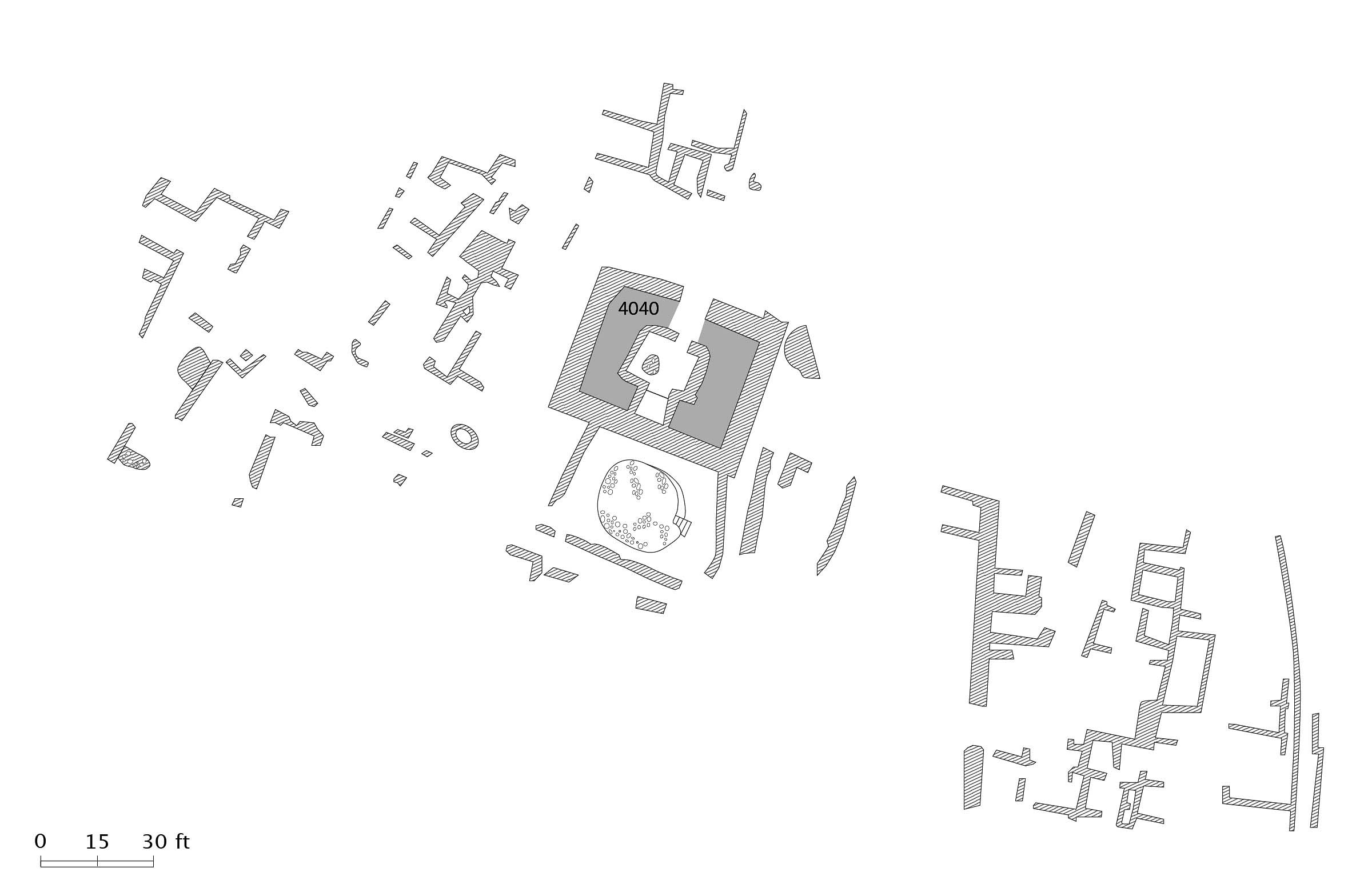
Temple 4040 is all that remained of the temples which stood on the high place of Megiddo.
What Happened?
A few possible explanations may be given for the urban decline observable in the EB IV—MB I. One explanation is that the famine which afflicted Egypt during the First Intermediate Period was felt even more keenly in Canaan. Cities require surpluses of grain to maintain their ruling elite, servants, administrators, warriors, priests, craftsmen, and the various hangers-on at court. However, prolonged periods of scarcity created by a hard drought or extended winter would have made the sustenance of even a leaned-down bureaucracy difficult to maintain. Lacking stores of grain with which to pay workers, city administrators were unable to perform needed repairs to crumbling infrastructure. Skilled craftsmen abandoned the city for the countryside to look for food while pastoralists brought their herds and flocks into settled regions in search of pasture. The potential for conflict was undoubtedly heightened during these periods.
As noted previously, there is a great deal of literary evidence from Egypt which points to a severe drought in the region during the First Intermediate Period. The Bible also makes reference to several droughts, one in the lifetime of Abraham and another in the days of Jacob and Joseph. The drought in Joseph’s day is described as being particularly severe, impacting not just Egypt but “all the earth.”
Moreover, all the earth came to Egypt to Joseph to buy grain, because the famine was severe over all the earth. (Gen. 41:57 ESV)
If Abraham lived in the last century of the 3rd millennium BC, then it may be possible to correlate the droughts recorded in the patriarchal narratives with those attested in Egypt during the First Intermediate Period (MB I).
It is generally agreed among climatologists that the end of the Early Bronze period was marked by a period of prolonged aridity—known as the “4.2 kiloyear event” (ie. it happened 4,200 years ago or around 2200 BC ). The ambiguity of the name belies the general lack of agreement as to what it was or what caused it.4Brooke notes that the 2200 BC drought does not line up with the millennium cycle of Siberian highs which he argues has largely shaped world history (Brooke 2014, 294, also 278-279). The archaeological evidences suggests that by the end of the 3rd millennium BC, regions of Syria, North Africa, the Sinai, the Negev, and Arabia were no longer capable of supporting the populations that had lived in the regions during the first half of the Early Bronze period. All that remains of these civilizations are the abandoned “wreath cities” and vast networks of stone circles, kites, and rectangles which, thanks to the advent of satellite imagery, are being found in increasing numbers in some of the most desolate parts of the ancient world. In Egypt, the transition to a more arid climate may be gauged by the disappearance of the giraffe, elephant, and ostrich from Egyptian iconography. A similar phenomena may be observed in the Indus Valley.
Perhaps there was some new factor at play that triggered the so-called “4.2 kiloyear event,” or perhaps it was the natural outcome of a prolonged trend which began much earlier in the Early Bronze period. In either case, it is a fact that arid regions which once harbored large settled populations during the first half of the Early Bronze period no longer did so by the period’s end.
Brooke, John L.
Climate change and the Course of Global History : a Rough Journey.
Cambridge: Cambridge University Press, 2014.
Carney, Mark.
Value(s).
United States: Signal, 2021.
Dunayevsky, Immanuel, Aharon Kempinski, I. Dunayevski. “The Megiddo Temples.” Zeitschrift Des Deutschen Palästina-Vereins 89, no. 2 (1973): 161–87. Link
Finné, Martin , Inga Labuhn.
“Hydro-climate in the Aegean from 700 BC to AD 300,” in Going Against the Flow: Wells, Cisterns and Water in Ancient Greece, edited by Patrik Klingborg.
Stockholm: Swedish Institute at Athens, 2023. Link
Kenyon, Kathleen.
Amorites and Canaanites.
London: Oxford University Press, 1966.
Loud, Gordon.
Megiddo II: Seasons of 1935-39, Plates.
Chicago, Illinois: University of Chicago Press, 1948. Link
Loud, Gordon.
Megiddo II: Seasons of 1935-39, Text.
Chicago, Illinois: University of Chicago Press, 1948. Link
Mazar, Amihai.
Archaeology of the Land of the Bible.
New York: Doubleday, 1992.