
This jar was found in the earliest strata of Megiddo (EB I). Jars like these were also found in Egypt, thus providing an important synchronism between the two regions. Engberg and Shipton noticed a development in the style of the ledge handle (i.e. straight vs. wavy) which made the jars a potentially useful chronological marker.
Although unglamorous, the ledge handle jar is one of the most important types of pottery produced in the southern Levant during the Early Bronze period.1Although once thought to be an exclusively early bronze form, the ledge-handle pot is now understood to have originated in the southern Levant during the Chalcolithic period. Braun 2011, 166 ff. As you may recall, large numbers of these jars were found in Tomb U-j at Abydos. Chemical analysis of the residue inside the jar reveals that the jars contained wine produced from grapes harvested from Canaanite vineyards. A sunny Mediterranean climate and cool highland temperatures made Canaan an ideal location for growing grapes. Although visitors to the region today are often struck by the harsh climate and sparse vegetation of the region, this is not how the ancient Egyptians perceived it. Here, for example, is how Canaan is described in The Tale of Sinuhe.
It was a good land, named [Araru?]. Figs were in it, and grapes. It had more wine than water. Plentiful was its honey, abundant its olives. Every (kind of) fruit was on its trees. Barley was there, and emmer. There was no limit to any (kind of) cattle.2ANET p 19, Aharoni 1967, 14
The large number of ledge handle jars imported into Egypt from Canaan are a testament to the widespread cultivation of the grape in Canaan at an early period. Further analysis of the wine residue preserved in the jars reveals that it was spiced with coriander, a herb cultivated by the Egyptians to treat stomach ailments. Other herbal additives include balm, senna, germander, mint, sage, savory, and thyme. Resin from the terebinth or pine was used to prevent certain bacteria from ruining the wine by turning it into vinegar.3McGovern et al. 2009, 734-735

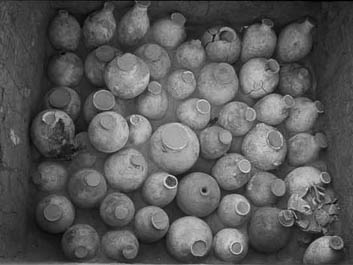
A large number of wine jars imported into Egypt from Canaan were found in the chambers of tomb U-j at Abydos.

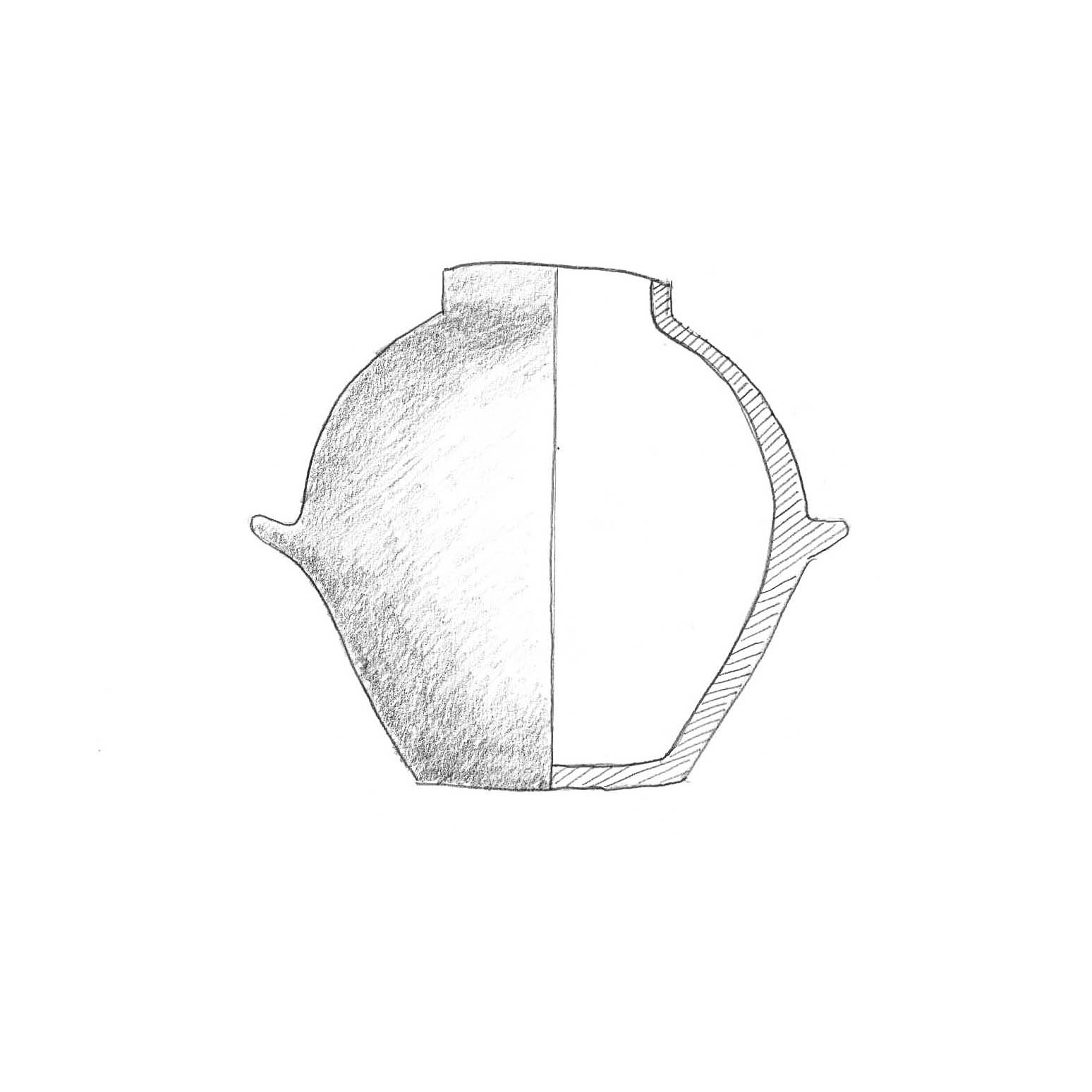
Left: A highly schematic cros-section of the wall discovered on the Eastern Slope of Megiddo. The brackets indicating period and strata have been added by the author and were not a part of the original illustration. Right: An example of the type of Ledge Handle Jar found in Stages VII-IV (Stratum XX – XVIII) according to Engberg and Shipton.
Left: Adapted from Engberg and Shipton, Notes on the Chalcolithic and Early Bronze Age Pottery of Megiddo, Fig. 1. Link
Aharoni, Yohanan.
The Land of the Bible: A Historical Geography, translated by A. F. Rainey.
London and Beccles : William Clowes and Sons, 1967.
Braun, Eliot.
“The Transition from Chalcolithic to Early Bronze I in the Southern Levant: A “Lost Horizon” Slowly Revealed,” in Culture, Chronology and the Chalcolithic: Theory and Transition, edited by J. L. Lovell, Y. M. Rowan. Levant Supplementary Series Vol. 9 vols.
: Oxbow Books, 2011. Link
Engberg, R. M, G. M. Shipton.
Notes on the Chalcolithic and Early Bronze Age Pottery of Megiddo.
Chicago, Ill.: The University of Chicago press, 1934. Link
McGovern, Patrick E., Armen Mirzoian, Gretchen R. Hall. “Ancient Egyptian Herbal Wines.” PNAS 106 , no. 18 (May 2009): 7361-7366. Link