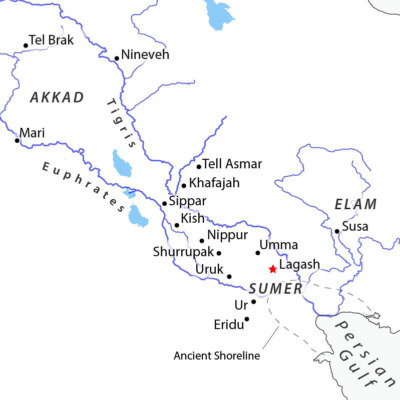
By the middle of the 3rd millennium BC there were, according to some estimates, twenty Sumerian city-states. Some of these cities rose to prominence at an early stage in Mesopotamia’s history. We’ve had an opportunity to look at several of them, such as Uruk, Ur, and Tuttul (Khafajah). The city-state of Lagash, on the other hand, does not appear to predate the Early Dynastic period. Lagash has been identified with the place known today as Tel el-Hiba. Rather confusingly ‘Lagash’ may also be used to refer to an entire region which encompassed the neighboring cities of Girsu (Tello) and Nina (Tel Surghal) as well. Lagash and its sister cities were welded together to form a single political entity, like Minneapolis-St. Paul. Lagash’s location on the Tigris River, near the Persian Gulf, made it a strategically important city comparable to Ur, which occupied a similar place on the Euphrates. However, the religious and cultural capital of the region was not Lagash (Tel el-Hiba) but Girsu (Tello) where the Frenchman, Ernest de Sarzec, working in the late 1800’s, uncovered the remnants of an impressive city.
what was at the time a completely unknown civilization—the Sumerians!

The Temple of Ningirsu was discovered on “Tell K”.
Ernest de Sarzec
In 1872 Ernest de Sarzec was appointed French vice-consul to Bosrah, what was then a far-flung corner of the Ottoman empire, which was described by one traveler to the region as “one of the hottest and most unhealthy places in the whole Turkish empire.”1Hilprecht 1904, 216 But de Sarzec was not looking for comfort. Having already spent time in Egypt and Ethiopia, he was well acquainted with the harsh climate of the region. Now forty years of age, he was keen to explore southern Iraq and the shores of the Persian Gulf in hopes of making some new discovery.
Nearly fifty years had passed since Emile Botta and Henry Layard dug the ruins of the Assyrian palaces in northern Iraq where they discovered the colossal bull-men and magnificent reliefs that shocked and amazed the world. Surprisingly, southern Iraq remained largely unexplored in the intervening years. Now with his appointment to Bozrah, de Sarzec saw an opportunity to remedy the situation. Thus M. de Sarzec would write in the preface of his book,
I resolved to take advantage of my stay in this country to travel the lower reaches of the Tigris and Euphrates and to attempt there, if the occasion arose, archaeological research. Several years spent in Egypt had kept alive an interest in the monuments and ruins of ancient times. Later, a mission carried out near the Negus of Abyssinia had familiarized me with the life of the desert and with explorations where the unexpected, which does not always go without peril, only serves to increase one’s curiosity.2Loose translation from De Sarzec 1900, 3
A local guide led de Sarzec to the site of Tello, located approximately 100 miles northwest of Bosrah, on a plain that was a desert for one half the year and a swamp for the other half.3Hilprecht 1904, 216 It was not the sort of place one would expect to find a city, but as de Sarzec walked across the sandy wastelands, he was struck by the sheer quantity of inscribed cones and bricks that littered the surface of the site. In one place, at the foot of a high mound, he could see the base of a diorite statue recently exposed by erosion. Clearly the mound had secrets to tell.
Despite the remoteness of the site—he had to cross a vast swamp to get there—de Sarzec determined to excavate it. But for the endeavor to meet success he would need financial and political support. He found both both in person of Leon Heuzey, the curator of Oriental Antiquities at the Louvre in Paris. The two formed a partnership that remained steadfast through thirty years of excavating at Tello and publishing their finds. De Sarzec was was also assisted by Madame de Sarzec—whom he married shortly after he was appointed to Bosrah. She would insist on living with him at their encampment near Tello despite the difficult and sometimes dangerous conditions in the region.

Excavations at Tello
De Sarzec would conduct excavations at Tello for eleven season, each averaging three to four months in length. These stretched over a period of thirty years from 1870 to 1900. De Sarzec immediately began to find cuneiform tablets. Their translation revealed the ancient name of the site to have been Girsu, the holy city of Ningirsu (“Lord of Girsu”), a storm and fertility god like Abu, whose temple was excavated at Tell Asmar. As you may recall, the largest statue discovered beneath the floor of the Square Temple at Tell Asmar was inscribed with an image of the lion-headed bird, Imdugud, whose flapping wings created the moisture-laden north wind. This creature, which figures so prominently in the iconography of ancient Sumer, was conceived of as the “attack animal” of Ningirsu, manifested by the thunder and lightening carried by the storm.

Ningirsu was the offspring of Enlil and Ninhursag.
De Sarzec focused most of his energy on Tell K, where he found the Maison des Fruites (literally, “House of Fruit”). The building received its name from the fact that it was constructed with double walls coated with bitumen and lacked a doorway, features which de Sarzec and Heuzy interpreted as belonging to an underground storehouse. Such a building, they reasoned, would have been entered through its roof while its waterproof double-walls kept the contents of the building cool and dry.4Hilprecht 1904, 245-246 The building is now generally identified as the the temple of Ningirsu, named the Eninnu (“Temple of Fifty”), after the fifty powers which Enlil bestowed upon Ningirsu. The artifacts which de Sarzec recovered from the Eninnu gave the world its first glimpse of Sumerian civilization. Their exhibition at the Louvre created a sensation second only to the giant bull-men recovered by Botta thirty-eight years prior. For this reason de Sarzec has rightly been declared the “father of Sumerian archaeology.”5Hilprecht 1904, 226

Plan showing the temple and artifacts discovered in the surrounding area. Note the Mesilim macehead, bottom left, and the fragments of the Stele of the Vultures scattered across the courtyard.

The highlighted stratum dates to the reign of Ur-Nanshe (Early Dynastic III). Beneath this stratum are levels which probably date back to the Early Dynastic I-II periods.


These copper figurines, shaped like “pegs,” date to two different periods. De Sarzec found them buried beneath the foundations of important buildings at Tello, such as the Eninnu (see the red dots marked on the plan above). The purpose of the pegs was to figuratively “stake” the building to the earth, ensuring its permanence.
Adapted from De Sarzec and Heuzey, Discoveries in Chaldea, Plate II. LinkRulers of Lagash
During the latter half of the Early Dynastic period Lagash grew to become one of the largest and most powerful city-states in Sumer. It is surprising, therefore, to discover that none of its rulers are listed in the Sumerian King List (SKL). Rather than this being an indication of Lagash’s lack of importance, the reason for its exclusion probably has to do with political rivalries that existed during the period when the SKL assumed its final shape. It has nevertheless been possible to reconstruct a list of kings of Lagash from the large number of tablets and royal inscriptions discovered at Tello. One of the earliest of these is a large macehead that was discovered in the precincts of the Eninnu. It was inscribed:
“Mesilim, king of Kish, builder of the temple of Ningirsu, brought [this mace head] for Ningirsu, Lugalshaengur [being] prince of Lagash”
The macehead names a king of Kish and a prince of Lagash. Unfortunately neither can be located within the broader framework of Mesopotamian history since neither are listed in the SKL and neither name has been found inscribed on other datable artifacts.

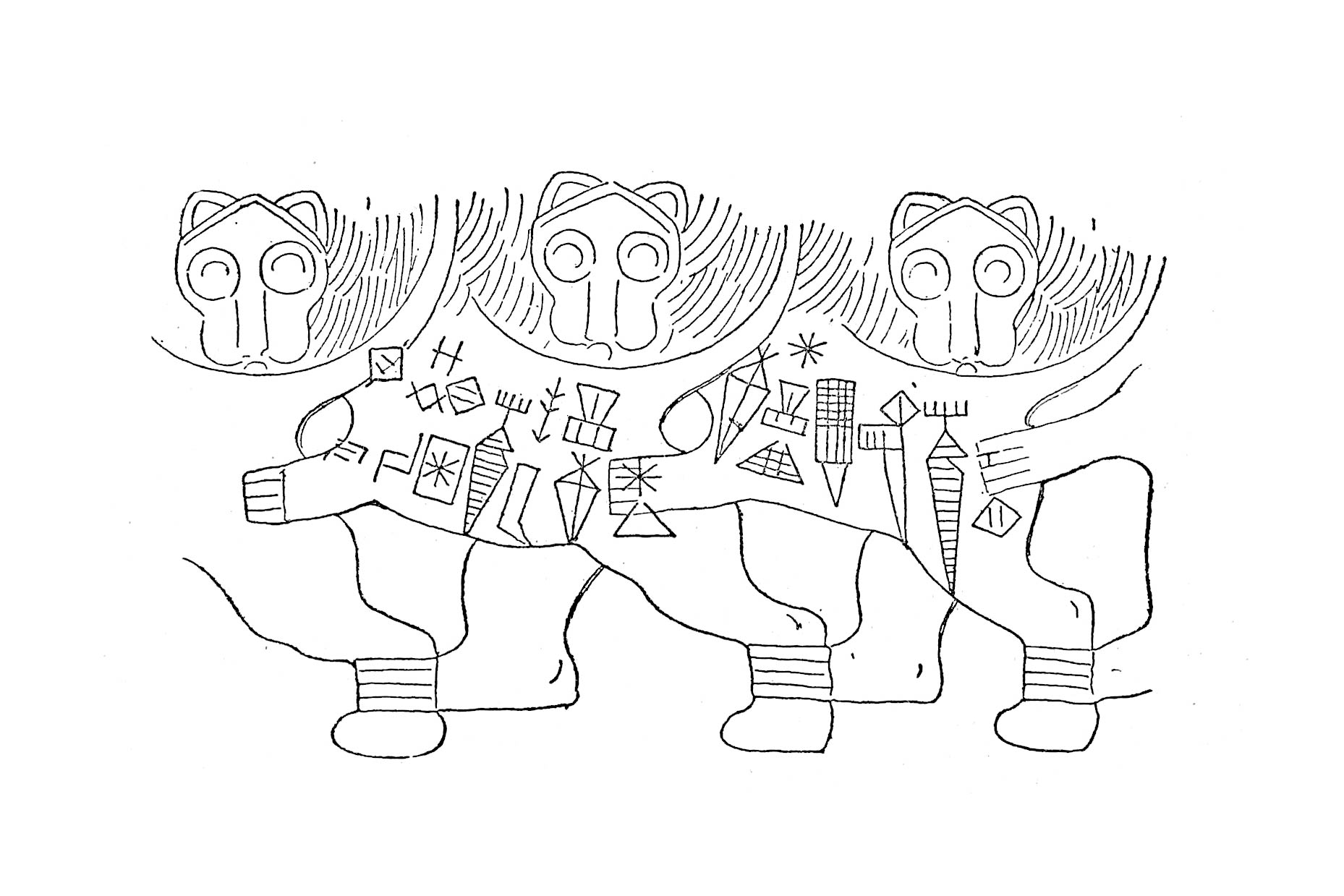
The inscription on the mace head makes reference to Mesilim, a king of Kish. Unfortunately, this name does not appear in the SKL.
Mesilim claims to be a “king of Kish” but it unclear whether he actually ruled from there. Kish seems to have functioned like Camelot in the Arthurian legend cycle. According to the SKL it was where kingship descended from heaven after the Flood. Thereafter kings who rose to preeminence in Sumer laid claim to the title “king of Kish” even though they ruled from some other city. Thus Meskalamdug and Mesannepeda, kings of Ur, claimed to be kings of Kish on their seal inscriptions. The possibility cannot be ruled out, however, that Mesilim was indeed a king of Kish since this city did control Sumer during certain periods.
According to another inscription from Girsu, Mesilim brokered a peace treaty between Lagash and the neighboring city of Umma in a dispute over a particularly valuable piece of agricultural land named Gu-Edenna. Mesilim’s intervention seems to have purchased peace for his time but the conflict would flare up again and continue for many generations. The following table provides a general overview of the kings of Lagash and some of the important events which occurred during their reigns.
| Name | Standard | AFS | Events |
|---|---|---|---|
| En-hegal | c. 2570 BC | En-hegal is a vassal of the king of Kish. | |
| Lugal-shag-engur | c. 2500 BC | Lugal-shag-engur is a vassal of Mesilim, king of Kish. Meslilim attempts to settle border dispute between Umma and Lagash. | |
| Ur-Nanshe | c. 2490 BC | c. 2415 BC | Ur-Nanshe establishes Lagash as a powerful, independent city-state. |
| Akurgal | c. 2465 BC | c. 2385 BC | Dispute over ownership of the Gu'edenna continues with Umma now controlling. |
| Eannatum | c. 2455-2425 BC | c. 2365-2335 BC | Eannatum defeats Umma and gains control over the Gu'edenna. He commemorates his victory on the Vulture Stele. |
| Eannatum I | c. 2425 BC | Eannatum I, brother of Eannatum, loses control over the Gu'edenna. | |
| Entemena | c. 2400 BC | c. 2325 BC | Entemena fought to regain control over the Gu-edenna from Umma. |
| Eannatum II | Lagash ruled by a series of short-lived kings. | ||
| En-entarzi | |||
| Lubalanda | |||
| Urukagina | c. 2370 BC | c. 2220 BC | Urukagina initiates reforms. He is defeated by Lugalzagesi of Umma. |
Hilprecht, H. V.
The Excavations in Assyria and Babylonia.
Philadelphia: A. J. Holman & Company, 1904. Link
Kramer, S. N.
The Sumerians: Their History, Culture, and Character.
Chicago: University of Chicago Press, 1963. Link
Rey, S.
For the Gods of Girsu: City-state formation in Ancient Sumer.
: Archaeopress, 2016.
De Sarzec, Ernest, Leon Heuzey.
Discoveries in Chaldea.
Paris: Ernest Leroux, 1884-1900. Link