
The fortress of Kastri is at center. The cemetery of Chalandriani is spread across the hillside behind Kastri, on the right.
Archaeologists point to a precipitous decline in the population of the Cyclades at the end of the Early Bronze Age, during the Early Cycladic III period (c. 2200-1900 BC). The evidence of decline is largely negative—the archaeological record for this period is mostly a blank.1Broodbank writes, “Indeed, the lack of a demonstrable continuous stratigraphic sequence between EC II and the Middle Bronze Age at a single Cycladic site, and the changes in customs summarized above, have contributed to the identification of a “gap” in the Cyclades during EC III, at least in terms of our knowledge, if not in reality. (Broodbank 2008, 68) Of course, the chronological gap may also be the product of an overly long chronology for the Early Bronze Age, but this does not exclude the possibility also that the Cyclades may also have fallen prey to a period of unrest.
Colin Renfrew draws a parallel between this period and the early decades of the 19th century AD when Greek villagers on the islands were forced to flee their homes due to the threat of attack from Turkish pirates. Here is how Renfrew describes the situation in the Cyclades at that time:
At both Naxos and Siphnos there was such a lack of men that many women were unable to find husbands… at Seriphos, so rich forty years earlier, nothing but calamity: the people passed their lives like brutes and were in constant fear, day and night, lest they should fall into the hands of the Infidels. Syra, destined in modern times to be the most flourishing of all the islands, was then comparatively of no account: the islanders fed on carobs and goats’ flesh and led a life of continual anxiety… The people of Paros were in the same plight, the principal town of Paroika had few citizens while pirates frequented the big bay at Naoussa. Antiparos and Sikinos were abandoned to eagles and wild asses, and most of the other islets were deserted.2Renfrew 2011, 263
Kastri
The construction of Kastri, a fortified outpost on Syros, towards the end of the Cycladic II, points to the growing unrest on the islands at this time.
Located not more than a mile north of Chalandriani, the walls of Kastri were constructed from small stones reinforced with circular bastions. The site is not very large, with room for just forty or fifty people. The whole site appears rather more like an encampment than a well planned city, and does not seem to have lasted very long.


The fort featured a hexagonal tower and a wall

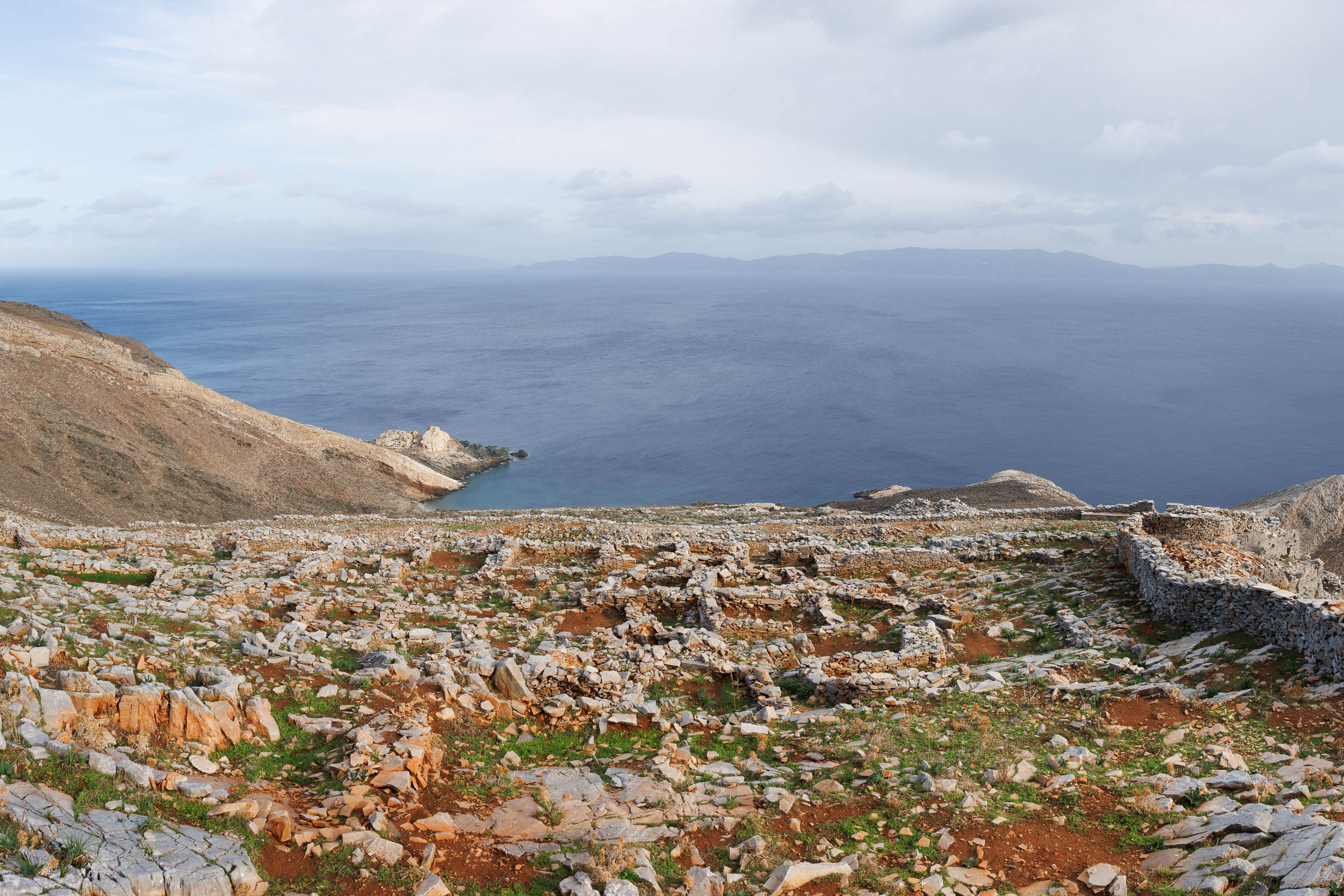
Constructed on a hilltop with a fortified wall and circular bastions, Kastri illustrates the rising insecurity felt by the inhabitants of the Cyclades towards the end of the Early Cycladic II period.
A number of important artifacts were excavated at Kastri, including several bronze daggers which probably originated from western Anatolia. The pottery found at Kastri is also Anatolian. The fortress may therefore have been constructed by people from western Anatolia who came to the island either as settlers or invaders and whose occupation of the island largely postdates the cemetery at Chalandriani.


Bronze axes, spear tips and daggers from Kastri which likely originated from Anatolia.


Anatolian pottery forms were found at Kastri, including the depas and sacuceboat. We will see these again at Troy.
Broodbank, C.
“The Early Bronze Age in the Cyclades,” in The Cambridge Companion to the Aegean Bronze Age, edited by C. W. Shelmerdine.
Cambridge, New York: Cambridge University Press, 2008. Link
Renfrew, C.
The Emergence of Civilisation : The Cyclades and the Aegean in the Third Millennium BC.
Oxford Oakville, CT: David Brown Book Co., 2011. Link