Following on the heels of the Uruk period, the Jemdet Nasr represents a relatively short period of time from 3100 – 2900 BC in the Standard Chronology or 2750-2650 BC using the shorter chronology adopted here. The period is named after a site, located approximately 50 miles north of Uruk, where Stephen Langdon under the aegis of Oxford University excavated for several seasons in the late 1920’s. Although not a very large site, it proved to be an important chronologically due to the discovery of slightly more advanced accounting tablets in a large administrative building at at the site. These tablets represent the next step in the development of writing in Mesopotamia following the Uruk IV tablets. Langdon also found colorful “polychrome” pottery and distinctive cylinder seals in the administrative building next to the tablets. These objects have come to define the period known as the “Jemdet Nasr.”
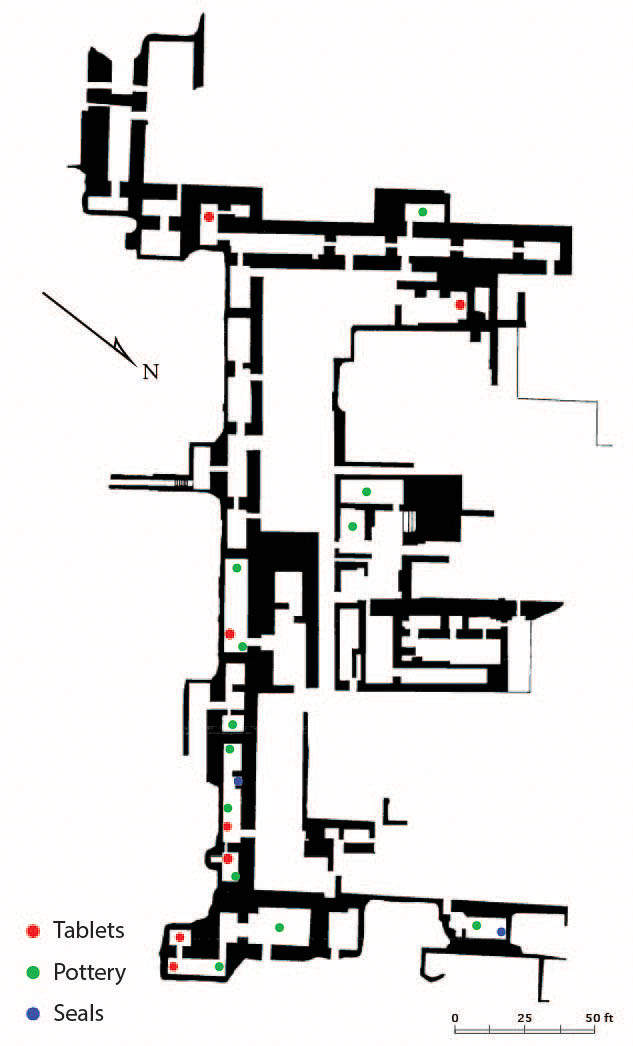
This plan of the administrative building excavated at Jemdet Nasr shows the findspots of pottery, tablets, and seals.
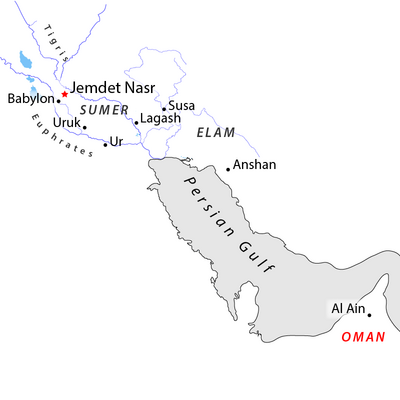
Uruk During the Jemdet Nasr Period
Hans Nissen suggested that the alluvial plain of Sumer was populated by small villages during the Uruk period, with the megalopolis of Uruk acting as a hub. This settlement pattern began to change towards the end of the Uruk period as people congregated into smaller cities, each controlling a certain amount of irrigated land around it. Thus while Uruk’s network of colonies and outposts faced little competition in former times, Uruk now had to compete with other city-states for control of agricultural land and trade-routes. As Uruk’s power relative to these other city-states declined, it was unable to retain control of its colonies, which were either destroyed and occupied by newcomers, or abandoned.1Algaze 2005 This is at least one possible explanation for why Uruk’s trade network collapsed speedily and suddenly, probably in the latter half of the Uruk period, although not at its very end since the tablets found at Uruk period settlements appear to be of an archaic, less advanced type than the tablets attributed to Eanna IV, such as the Kushim Tablet.
The Jemdet Nasr period is represented by Eanna III at Uruk. Surprisingly no monumental architecture can be attributed to this level. This is in contrast to the underlying strata (VI-IV) which preserve the ruins of many impressive buildings. It does not seem as though Uruk was abandoned at the conclusion of the Late Uruk period, for we know from later Sumerian texts that Uruk remained the seat of powerful ruling dynasties during the Early Dynastic period, but very little has been preserved at the site from this period.2Frayne 2009, 54 The archaeology of Uruk serves as a reminder of how patchy and unreliable the archaeological record (or its interpretation!) can be at times.
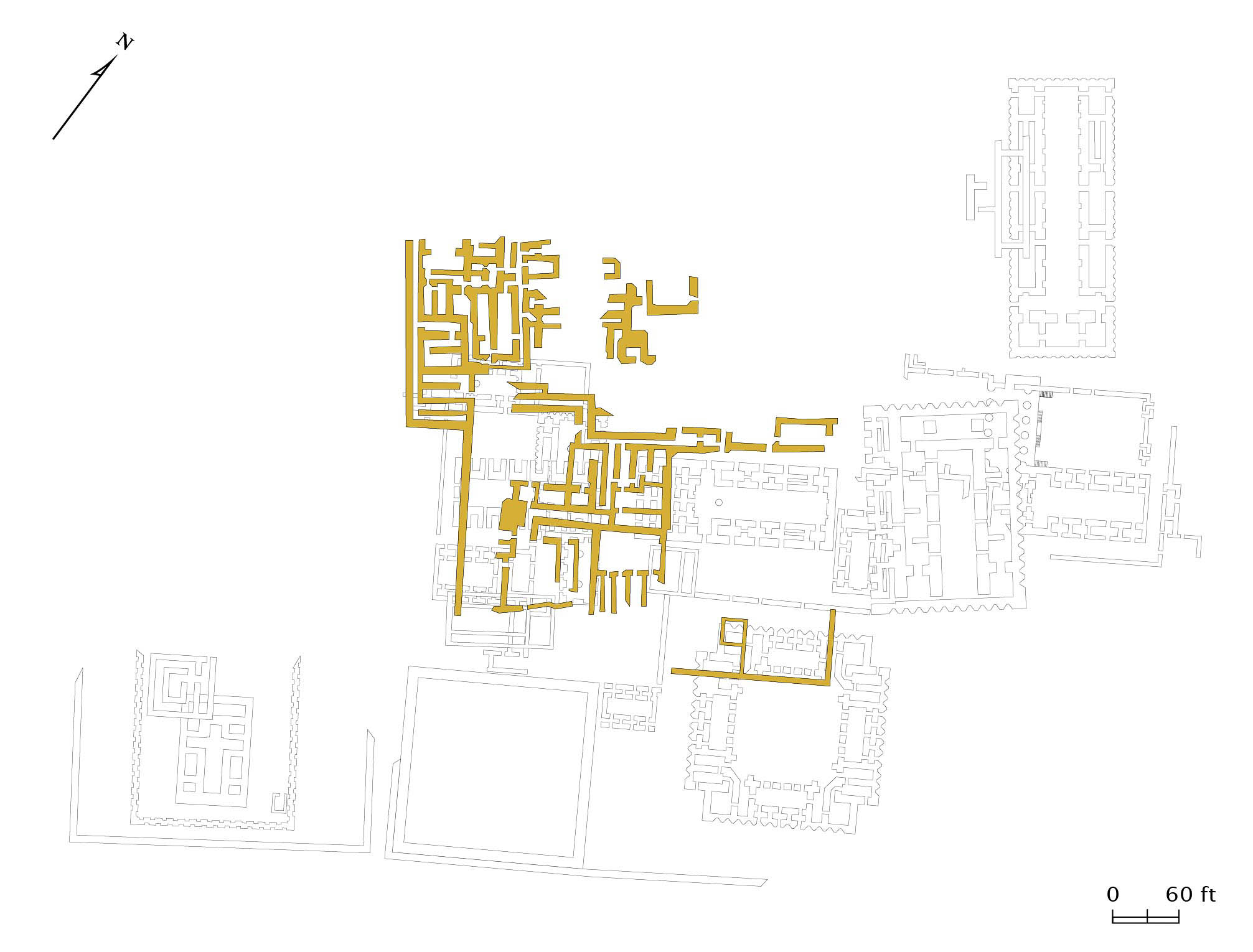

Eanna III represents a radical reconfiguration of the Eanna at Uruk.
Chronology
| Period | Standard | Ararat | Significant Event |
|---|---|---|---|
| Chalcolithic | 4800 - 3300 BC | 3500 (?) - 3000 BC |
|
| EB I | 3300 - 2900 BC | 3000 - 2750 BC |
|
| EB II | 2900 - 2600 BC | 2750 - 2500 BC |
|
| EB III | 2600 - 2350 BC | 2400 - 2200 BC |
|
| EB IV | 2350 - 2150 BC | 2200 - 2050 BC |
|
| MB I | 2150 - 2000 BC | 2050 - 1900 BC |
|
| MB IIA | 2000 - 1750 BC | 1900 - 1700 BC |
|
The absolute dates for this period are no better than educated guesses. The two chronologies presented here rely on different dating criteria. The Standard Chronology relies on C14 dating. The chronology adopted for this course (AFS) is based on the estimated amount of time required for strata to accumulate and pottery styles to change. The Sumerian King List may also serve as an approximate guide.
Algaze, Guillermo.
The Uruk World System: The Dynamics of Expansion of Early Mesopotamian Civilization (2nd Edition).
Chicago, IL: The University of Chicago Press, 2005.
Frayne, Douglas. “The Struggle for Hegemony in “Early Dynastic II” Sumer.” The Canadian Society for Mesopotamian Studies, no. 4 (Fall 2009): 37-76. Link
Hallo, W.
The World’s Oldest Literature : Studies in Sumerian Belles-lettres. .
Leiden, Boston: Brill, 2010.
Matthews, R. J. “Defining the Style of the Period: Jemdet Nasr 1926-28.” Iraq 26, no. 54 (1992): 1–34. Link
Nissen, H. J. R.
The Early History of the Ancient Near East, 9000-2000 B.C..
Chicago: University of Chicago Press, 1988. Link