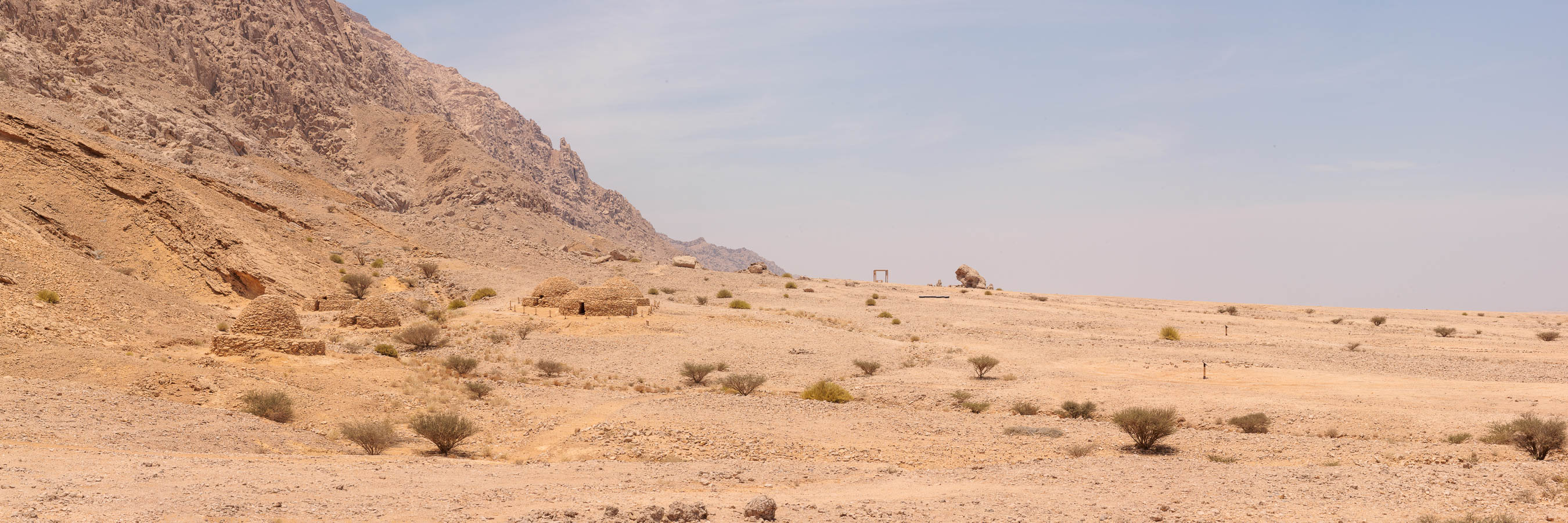
Thousands of beehive tombs have been found in the mountains of Oman and Abu Dhabi. The greatest concentration of tombs lies at the base of the mountain known as Jebel Hafeet, located on the border between Abu Dhabi and Oman.
Before we leave the topic of the painted polychrome jars discovered at Jemdet Nasr, we should mention a curious fact about this pottery. Although the pottery is primarily found in Mesopotamia, a not insiginificant number of these jars were found in tombs in the Hajar Mountains of Abu Dhabi and Oman, especially in the beehive tombs around Jebel Hafeet. These peculiar tombs were made by dry-stacking rocks to create a dome that has the appearance of a beehive. Variations of this tomb type are found across the whole of the Hajjar mountain range, which stretches along the whole length of the Oman peninsula, from Jebel Hafeet to Ras al-Jinz. According to one estimate, the tombs number in the “tens of thousands.”1Bortolini 2015, 67 No period in the history of Oman or Abu Dhabi has produced so many tombs and yet no settlements from this period have been found anywhere in Oman or the United Arab Emirates.
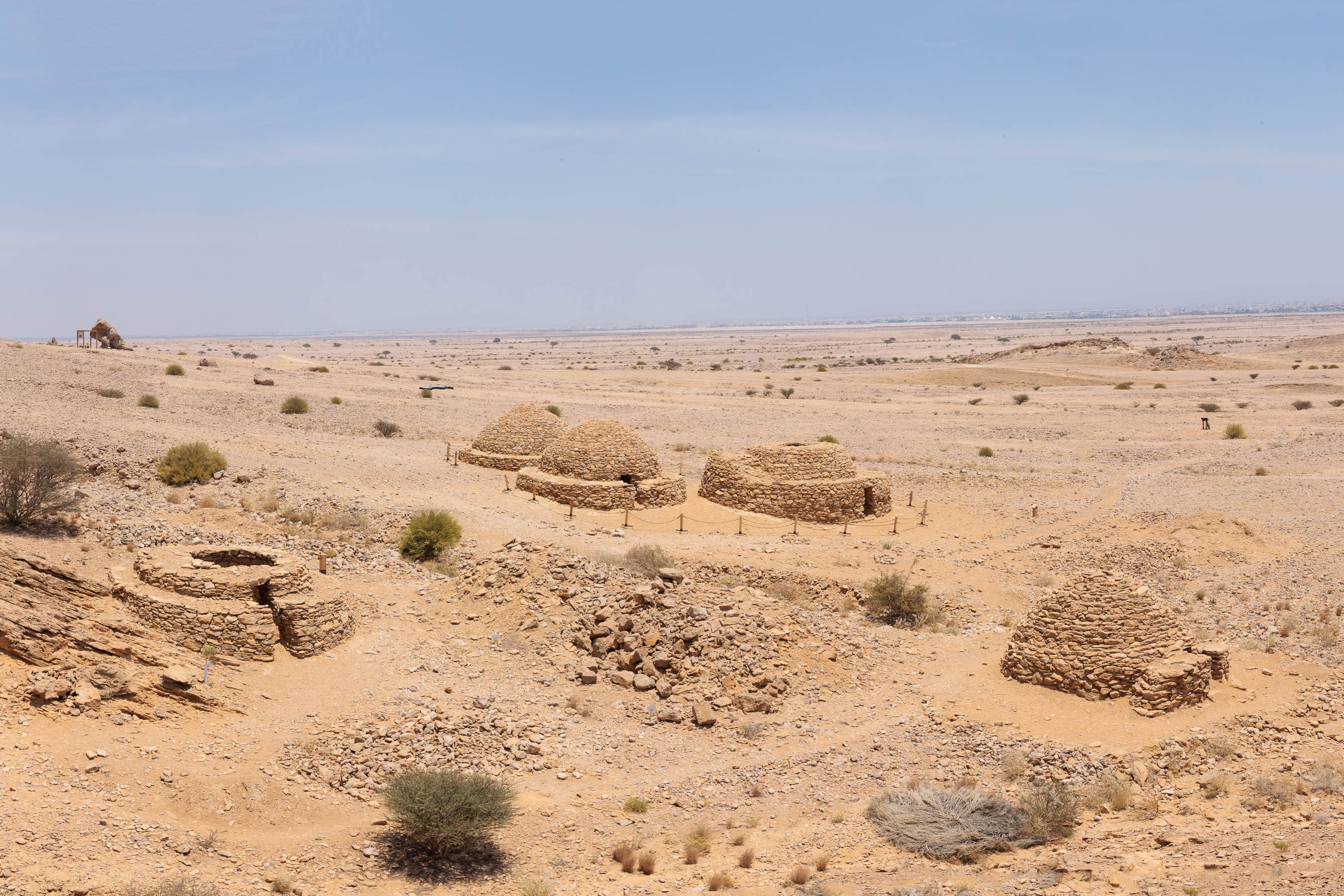
These distinctive tombs lie at the foot of Jebel Hafeet, between modern Oman and Abu Dhabi. The large oasis known as Al Ain is barely visible on the horizon.
A Danish expedition excavated 23 beehive tombs in the vicinity of Jebel Hafeet (Arabic. jebel, “mountain”). We will have more to say about this expedition in the future. For now, it is worth noting that the excavators found considerable quantities of Jemdet Nasr painted pottery in the tombs.2Frifelt 1970, 378. All but one of the tombs were robbed of their valuables in antiquity with the exception of one, which contained a sword of a well known type, produced in the mountains of northwestern Iran and dateable to c. 1500 BC, along with several bronze bowls, a steatite bowl, and a shell belt buckle. There is a chronological gap between these objects and the Jemdet Nasr Ware which suggests that the objects excavated in the unrobbed tomb were stashed there at a later date. The question naturally arises as to how this pottery found its way into southern Arabia? At the very least, its presence there suggests that there were relations between Arabia and Mesopotamia during the Late Uruk or Jemdet Nasr periods.

Maritime Connection?
It has long been theorized that Mesopotamian traders or colonists reached Egypt by sea around the southern end of the Arabian peninsula during the Uruk period. A common objection to this theory is that the distances involved are simply too great for the types of boats used at the time. But as the director of excavations at Jebel Hafeet, K. Frifelt observed, with the discovery of Mesopotamian pottery in Oman, “the sea route between Mesopotamia and Egypt round Southern Arabia does not seem quite so long and improbable… when ships could call at trading posts for important goods on the way.”3Frifelt 1970, 380

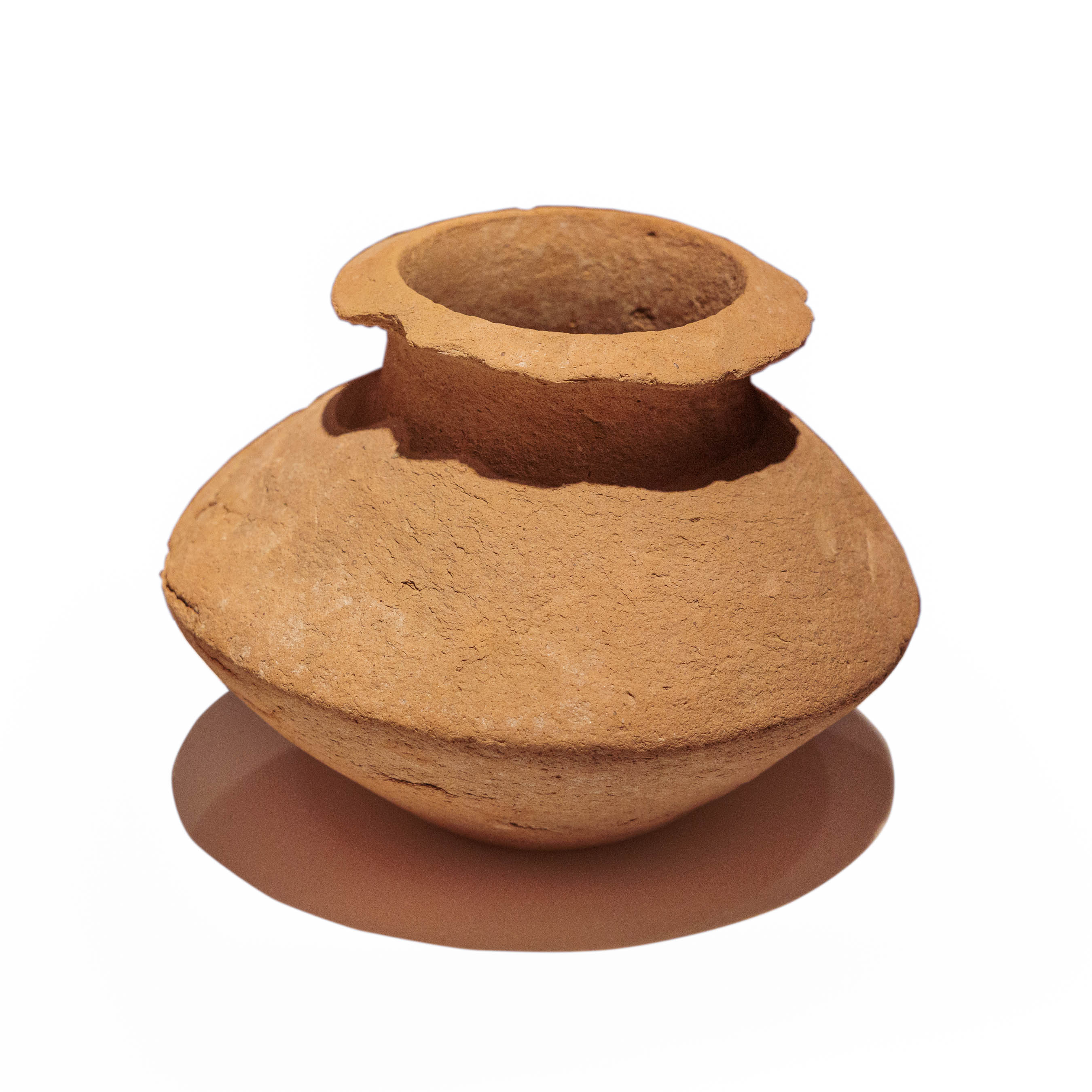
Left: A jar from a Hafeet tomb near Al Ain, Abu Dhabi. Right: A jar from Oman. Jars from tombs south of Jebel Hafeet tend to be plain and unpainted.
Bibby, Geoffrey.
Looking for Dilmun.
Great Britain: Penguin, 1984.
Bortolini, Eugenio, Olivia Munoz .
“Life and Death in Prehistoric Oman: Insights from Late Neolithic and Early Bronze Age Funerary Practices (4th – 3rd mill. BC),” in The Archaeological Heritage of Oman: Unesco Paris September 7, 2012 Symposium .
: Ministry of Heritage & Culture Sultanate of Oman, 2015. Link
Frifelt, K. ” Jamdat Nasr fund fra Oman.” Kuml 20, no. 20 (1970): 355–384. Link
Lal, B. B, S. P. Gupta (eds.).
Frontiers of the Indus Civilization : Sir Mortimer Wheeler Commemoration Volume.
New Delhi: Indian Archaeological Society, 1984.