As you may recall, the earliest temple excavated by Gordon Loud and his team at Megiddo was Temple 4050 in Stratum XIX. Another group of temples was found higher up the slope, in Stratum XV. Since these temples were well preserved, Loud decided to leave them in place. Apart from a few small probes, nothing more was known about what lay beneath the temples of Stratum XV until excavations were renewed from 1992 – 2010 by a team from the Tel Aviv University.
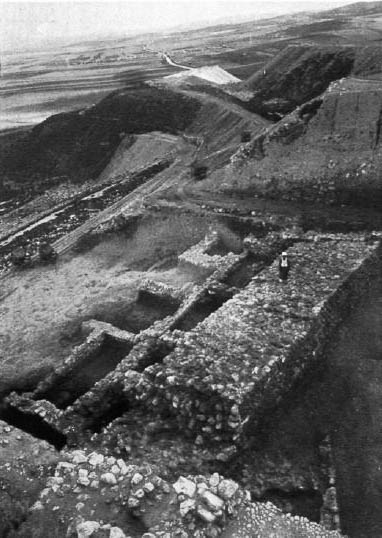
Through careful probing they discovered an entirely new temple beneath the Stratum XV temples, in Stratum XVIII of the tell. It came as something of a surprise to discover that the walls of this temple rank among the largest discovered so far in the southern Levant. Although they were unable to lay bare the entire structure due to the same limitations Loud faced—they did not want to remove the Stratum XV temples—they were nevertheless able to discern its overall dimensions. Dubbed the “Great Temple,” it measured approximately 155 feet long by 72 feet wide. Its walls measured approximately 12 feet thick. Although the “Great Temple” much larger than “Temple 4050” of Stratum XIX, both were constructed using the same “broadroom” plan.
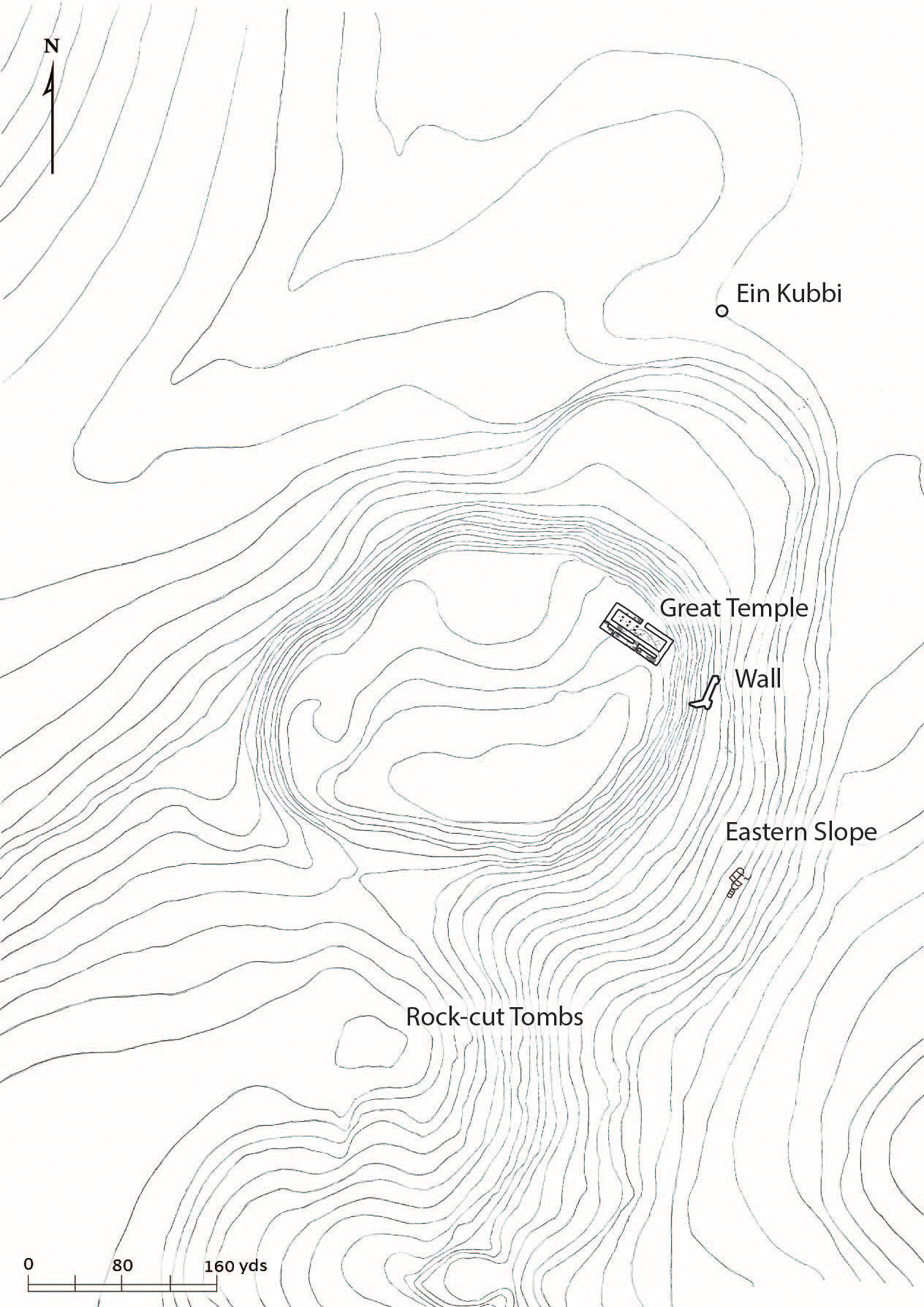
This composite plan shows approximate location of major architectural features belonging to Stratum XVIII.

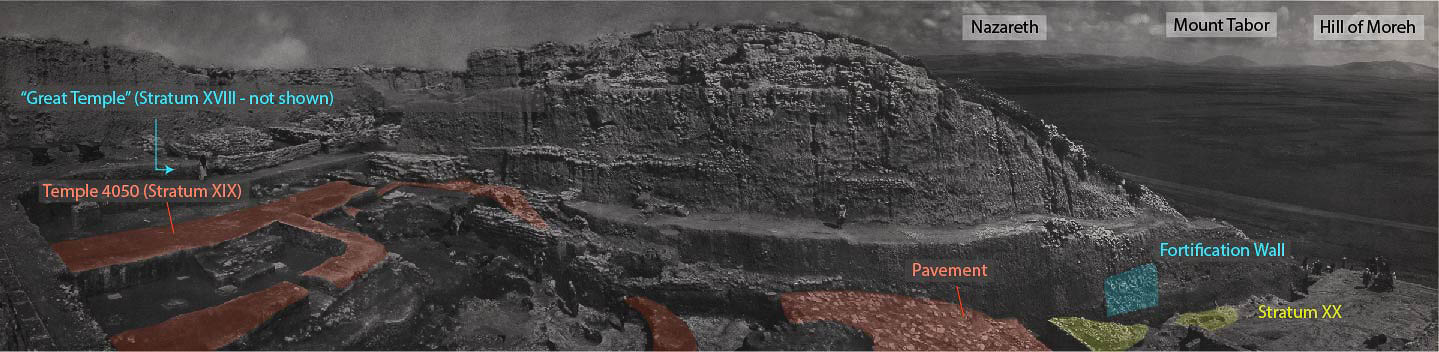
Highlighted in this section of Area BB are the strata discussed so far in this course. Loud removed the fortification wall leaving only its section visible in the bulk.
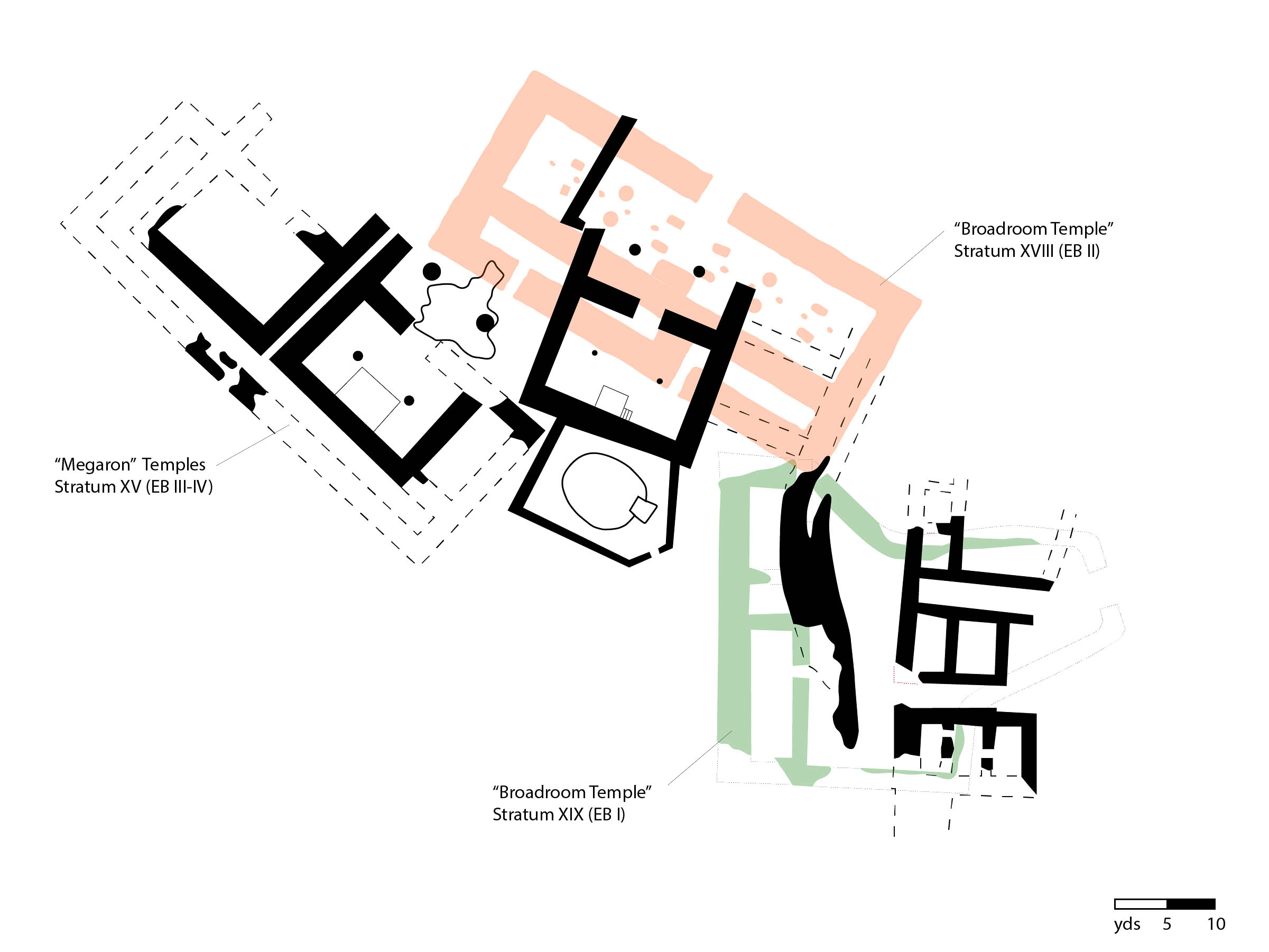
By probing between the walls of the three temples in Stratum XV (black), archaeologists discovered the massive walls of the Great Temple in Stratum XVIII (red). The smaller “broadroom” temple of Stratum XIX (green) is the earliest discovered so far at Megiddo.
The dotted lines represent the layout of the temple as determined by Finkelstein, Ussishkin, and Adams. The stones represent those parts of the walls which were actually excavated.
The entrance to the temple was located at the center of its long wall. A low platform situated directly across from the entrance must have served as its altar. Two rows of finely worked basalt stones set in the floor likely served as offering tables.1Adams et al. 2014, 296-297 Although only seven of these basalt stones were uncovered, the total number is estimated to have been 12 altogether (2 rows of 6). The largest measures a little over 5 feet in diameter by 8 inches thick and weighs about a ton. For an unknown reason, the shape of these stones alternates between rectangular and round. Another row of smaller stones runs down the center of the chamber. These probably served as bases for wooden posts supporting the roof.
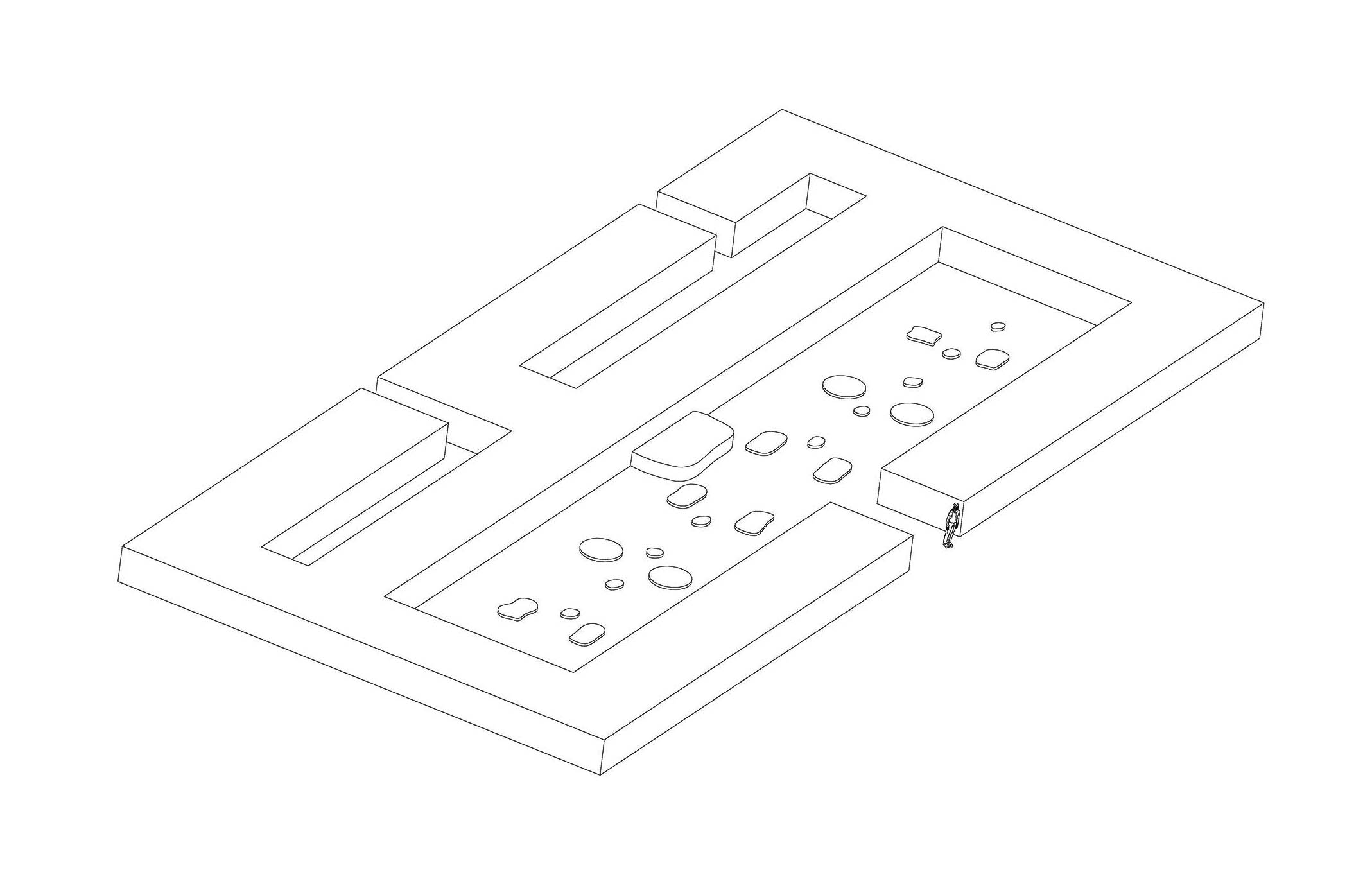
This proposed reconstruction of the building’s foundations provides some idea of the temple’s footprint. A man standing in the entryway adds perspective.
The Canaanite City
The village which existed in Stratum XIX was replaced by a fortified city in Stratum XVIII. Loud and his team found a section of this fortification wall at the bottom of the trench in Area BB which they assigned to Stratum XVIII. Unfortunately, he decided to remove the wall, for reasons that are by no means clear. All that remains of it today is its outline in the sides of the trench. If Stratum XVIII dates to the EB II, then this wall would have been contemporary with Egypt’s First and Second Dynasties.
A section of wall excavated at the bottom of the trench in Area BB. It should probably be placed in Stratum XVIII, along with the Great Temple.
Unfortunately, very little pottery was recovered from the Great Temple, making it difficult to date.2The Tel Aviv expedition, which used a different numbering system than the one employed by the Chicago expedition, assigned the Great Temple to strata J-6, which they date to the EB IB. This would make it contemporary with the end of the Predynastic period in Egypt. They date the Stratum XIX temple to the same period—EB IB. According to Adams et al. (2014), the area was subsequently abandoned for the whole of the EB II period. They arrived at this chronology based upon pottery analyses (latest pottery is EB IB, no EBII pottery) and three C14 dates which returned dates ranging from 3090–2910 B.C.E. (Adams et al. 2014, 285) However, they also admit that very little datable pottery was found in the structure. Rast and Schaub notes that some of the pottery from Temple of Stratum XIX (Temple 4050) suggests an EB II date. Rast and Schaub write, “Consequently the Megiddo structure may be another example of a sanctuary with pillar bases and columns during EB II.” (Rast and Schaub 2003, 165)If Rast and Schaub are correct, then the Great Temple must belong to the latter half of the Early Bronze II period. It is unlikely that Megiddo was abandoned during the whole of the EB II period, as Adams et al. (2014) suggest, considering the flourishing trade that existed between the southern Levant and Egypt for most of the First Dynasty (first half of the EB II period). It seems likely, however, that it was constructed at around the same time as the EB II fortification wall of Stratum XVIII. Certainly both structures were constructed on an equally impressive scale.
The discovery of such a large temple and fortification wall at Megiddo reveals the importance attained by this city at an early period. Its development parallels that of other early bronze cities in the southern Levant, including Arad, Beth Yerah, Bab edh-Dhra, and Tell Rumeida (Hebron). We will look more closely at these cities in future entries. The rise of cities in the southern Levant marks the beginning of what may be considered Canaanite civilization, renowned for its impressively fortified cities, its seafarers and merchants, and the purple dye produced from shells found along its southern coastline. The semitic root “qanaan” and its Greek equivalent “phoinikia” both seem to be related to the color “purple” extracted from the murex shell native to the region.


Mountains of murex shells are found on the coast of Lebanon from the production of purple dye.
The term “qanaani” appears in Egyptian texts from the time of Amenophis II (mid to late 15th century BC) with reference to a special class of merchants.3Maisler 1946, 9 The term is used in the same way in the Bible (“Canaanite”). Thus the prophet Isaiah refers to the Phoenicians as a people “whose merchants were princes, whose traders were the honored of the earth…” (Isa. 23:8 ESV). Canaan’s position on a land bridge linking Egypt with Anatolia and Mesopotamia, and with ports on the Mediterranean, made it a natural hub for trade.
The land of Canaan was never united under a central power such as we find in Egypt, but was made up of independent city-states instead, after the pattern of Sumer. We don’t know what language or languages were spoken in Canaan during the Early Bronze period since no texts belonging to that period have been discovered there. Presumably, most of the population spoke a west semitic language, what might be termed “Proto-Canaanite,” although other languages must also have been spoken since the region has traditionally been a melting pot of different languages and cultures.
Adams, Matthew J., Israel Finkelstein, David Ussishkin. “The Great Temple of Early Bronze I Megiddo.” American Journal of Archaeology 118, no. 2 (2014): 285-305. Link
Loud, Gordon.
Megiddo II: Seasons of 1935-39, Plates.
Chicago, Illinois: University of Chicago Press, 1948. Link
Loud, Gordon.
Megiddo II: Seasons of 1935-39, Text.
Chicago, Illinois: University of Chicago Press, 1948. Link
Maisler, Benjamin. “Canaan and the Canaanites.” Bulletin of the American Schools of Oriental Research 102 (1946): 7–12. Link
Rast, Walter, Thomas Schaub.
Bāb edh-Dhrāʻ : Excavations at the Town Site (1975-1981).
Winona Lake, Indiana: Eisenbrauns, 2003.