A distinctive type of metallic-grey pottery known as Grey Burnished Ware was found in Stratum XIX and XVIII on the tell of Megiddo and in Stages VII-IV on the Eastern Slope. The most distinctive feature of Grey Burnished Ware is the line of carination on the shoulder of the vessel, and knobs incorporated into the rim of the bowl or more subtly incorporated into the line of carination—a feature known as “sinuous carination.”
Characteristics
- often carinated, sometimes with knobs
- flat bottom
- well levigated clay
- gray slip burnished to a high metallic lustre
- handmade or turned on a wheel

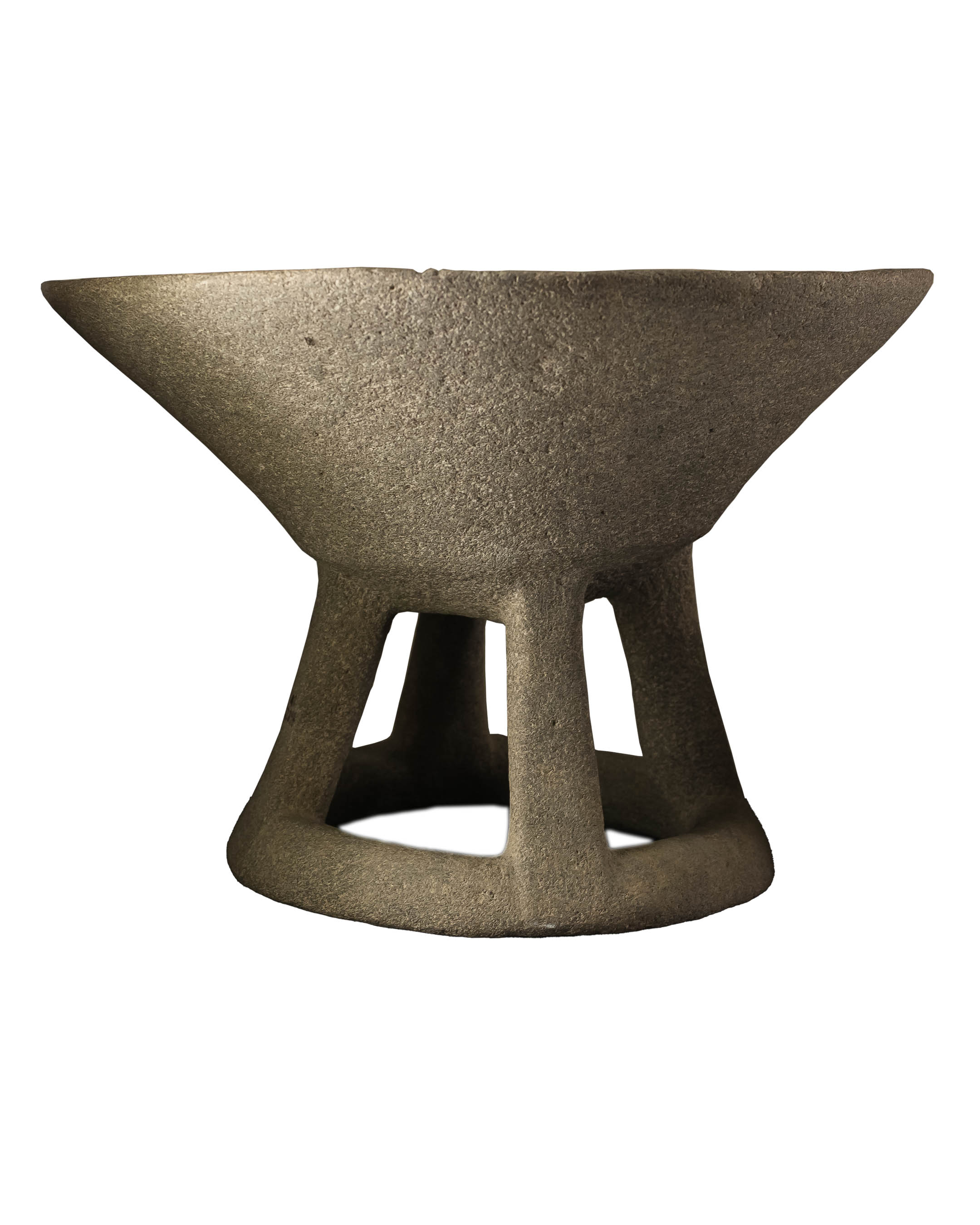
This fenestrated pottery stand from Tell el-Farah was given a bright, metallic grey finish. Note the way it subtly incorporates knobs into the line of carination.


Grey Burnished Pottery may be further divided into various types. The following typology was created by Wright. Type 3 and 4 were found in the earliest stages of the Eastern Slope of Megiddo (Stages VII-IV).
Grey Burnished Ware is primarily found in the northwest region of the southern Levant.1Braun 2013, 73 Ernest Wright, the first archaeologist to make a close analysis of Grey Burnished Ware, argued that the appearance of this pottery in the southern Levant marked the beginning of the Early Bronze I period in the region. Wright made a clear distinction between the village culture of the Chalcolithic period, represented by Ghassulian sites such as Teleilat el-Ghassul and Gilat, and the urban culture of the Early Bronze I which produced the Grey Burnished Ware.2Wright 1958 However, the evidence from Megiddo defies clear distinctions of this sort.
Were the Ghassulians at Megiddo?
The chronological relationship between the earliest strata at Megiddo and the Ghassulian culture has generated considerable debate over the years. Robert Engberg and Geoffrey Shipton, the archaeologists who published the early pottery from Megiddo, pointed to fragments of cornets which they found in Stratum XX and XIX of Megiddo as evidence of a Ghassulian presence there.3Shipton 1939, §148; See also Engberg and Shipton 1934, 47-51


Fragments of cornets from Stratum XX and XIX of Megiddo and a whole cornet from Teleilat el-Ghassul.
Furthermore, Engberg and Shipton thought that the Grey Burnished pottery which they found on the Eastern Slope and in the earliest strata of the tell must overlap chronologically with the Ghassulian culture. This view is not widely accepted by archaeologists today, as Eliot Braun notes in his study of the material from the Eastern Slope,
Today it is universally accepted… Teleilat el-Ghassul, was abandoned early in the fourth millennium (Bourke et al. 2004, 2007), prior to the beginning of Early Bronze Age I, and that all the cultural material associated with Engberg’s and Shiptons Stages I-VII, should be ascribed to the Early Bronze Age.4Braun 2013, 6. Braun’s lengthy monograph on the transition between the Chalcolithic and EB I periods (Braun 2011) makes no reference to Megiddo or to the fragments of cornets found there. I am not sure how he interprets their presence in Stratum XIX and XX on the tell.
However, as Dunayevsky and Kempinski observed some years ago in their study of the Megiddo temples, the fragments of cornets found in Stratum XIX together with Grey Burnished Ware suggests that there were a “number of cultures existing simultaneously” in the southern Levant during the Early Bronze I period.5Dunayevsky et al. 1973, 172 This is essentially what Engberg and Shipton argued.6Although Engberg and Shipton thought that Stratum IV at Teleilat el-Ghassul may have persisted into the Middle Bronze period, a view which probably none hold today. It is possible for a village culture and and a city culture to coexist and maintain their distinctive material culture, such as occurred at Bet Yerach during the EB III where we find Khirbet Kerak Ware and local pottery in the same strata. It does not seem like a stretch, therefore, to argue that Temple 4050 of Stratum XIX at Megiddo was at least partially contemporary with the Ghassulian temple at En Gedi and that both temples belong to the EB I.
A Unique Basalt Stand
A basalt stand was recovered from a tomb at Megiddo which looks like a Ghassulian basalt stand except it incorporates a hemispherical (rounded) bowl instead of a V-shaped one, and it incorporates knobs into its rim typical of Grey Burnished Ware. This basalt stand appears to bridge the gap between two cultures and perhaps also two eras, with the Ghassulian culture eventually being replaced or assimilated by the culture that produced Grey Burnished Ware.7Lapp 1968, 13

Left: A basalt bowl from Megiddo with knobs incorporated into its rim typical of Grey Burnished Ware. Right: A basalt stand typical from the Ghassulian period. Basalt ceased to be used as a material for making vessels shortly after the Ghassulian period. The basalt stand from Megiddo likely represents a transitional form.
Amiran, R.
Ancient Pottery of the Holy Land; from its Beginnings in the Neolithic Period to the end of the Iron Age.
New Brunswick, N.J.: Rutgers University Press, 1970.
Braun, Eliot .
Early Megiddo on the East Slope (The “Megiddo Stages”). Vol. 139 vols.
Chicago: Oriental Institute Publications, 2013. Link
Braun, Eliot.
“The Transition from Chalcolithic to Early Bronze I in the Southern Levant: A ‘Lost Horizon’ Slowly Revealed,” in Culture, Chronology and the Chalcolithic: Theory and Transition, edited by J. L Lovell, Y. M. Rowan. Levant Supplementary Series 9 vols.
: Oxbow Books, 2011. Link
Cline, E. H.
Digging up Armageddon : the search for the Lost City of Solomon.
: Princeton University Press, 2020.
Dunayevsky, Immanuel, Aharon Kempinski, I. Dunayevski. “The Megiddo Temples.” Zeitschrift Des Deutschen Palästina-Vereins 89, no. 2 (1973): 161–87. Link
Engberg, R. M, G. M. Shipton.
Notes on the Chalcolithic and Early Bronze Age Pottery of Megiddo.
Chicago, Ill.: The University of Chicago press, 1934. Link
Lapp, P. W. “Bab edh-Ehra, Perizzites and Emim.” The Israel Exploration Society (1968).
Shipton, Geoffrey M.
Notes on the Megiddo Pottery of Strata VI-XX. SAOC 17 vols.
Chicago: University of Chicago Press, 1939. Link
Wright, Ernest G. “The Problem of the Transition Between the Chalcolithic and Bronze Ages.” Eretz-Israel: Archaeological, Historical and Geographical Studies (1958): 37-45. Link