Cylinder seals produced by the Sumerians during the Early Dynastic period continue the naturalistic style exhibited by seals of the Uruk period. The finest of them are cut from lapis lazuli. The iconography of the seals falls into three major categories: contest, banquet, and mythological.
1. Contest Scenes
Dominique Collon discerns three major stages in the development of the “contest scene” commonly exhibited on Early Dynastic cylinder seals.

The earliest scenes show a lion attacking an animal, without any human intervention. Cut from alabaster.

A man is now included in the scene. He is shown rescuing his livestock from the lion. The lion and his prey are raised on their hind feet, with their bodies nearly vertical, crossing each other. This contrasts with earlier contest scenes (Stage 1), where the axis of movement is horizontal instead of vertical.

The culmination of this style features a hero grasping a lion or a bull. The contending figures are now shown vertical, with no crossing. Space is given to each figure which is now treated with detail. These finely cut seals are usually made of hard stone and are inscribed with a royal dedication. In this case, the seal belongs to Mesannapeda, who is credited by the Sumerian King List with founding the First Dynasty of Ur. Woolley notes that many identical seal impressions belonging to this king were found in the layers of debris covering the Royal Cemetery of Ur. The “contest scene” will be perfected by Akkadian seal cutters. It is doubtful that too much time separates them.
2. Banquet Scenes
The banquet theme is the second major theme depicted on Early Dynastic seals. Seals of this type are often divided into two horizontal registers. Men and women are shown drinking from cups or through straws from a beer pot. Rather than filter out the byproducts of the fermentation process, they preferred to drink from the bottom of the jug through straws in what was apparently a communal activity. This probably was not an ultra light lager!
Several seals of this type were found in Puabi’s tomb in the Royal Cemetery of Ur. Although belonging to royalty, their quality is markedly inferior to seals that displayed contest scenes, such as Mesannapeda’s seal (above). The two types of seals probably represent two schools of seal cutters, each with their own style and skill level.

The upper register shows a woman, probably Puabi, larger than life, seated on a throne being served by attendants. More banqueters and a giant harp are depicted in the lower register.

Also from Puabi’s tombs, this seal was found lying next to Puabi’s head. It probably depicts Puabi and her husband, Akalamdug(?), drinking beer from a jar through straws.
3. Mythological Scenes
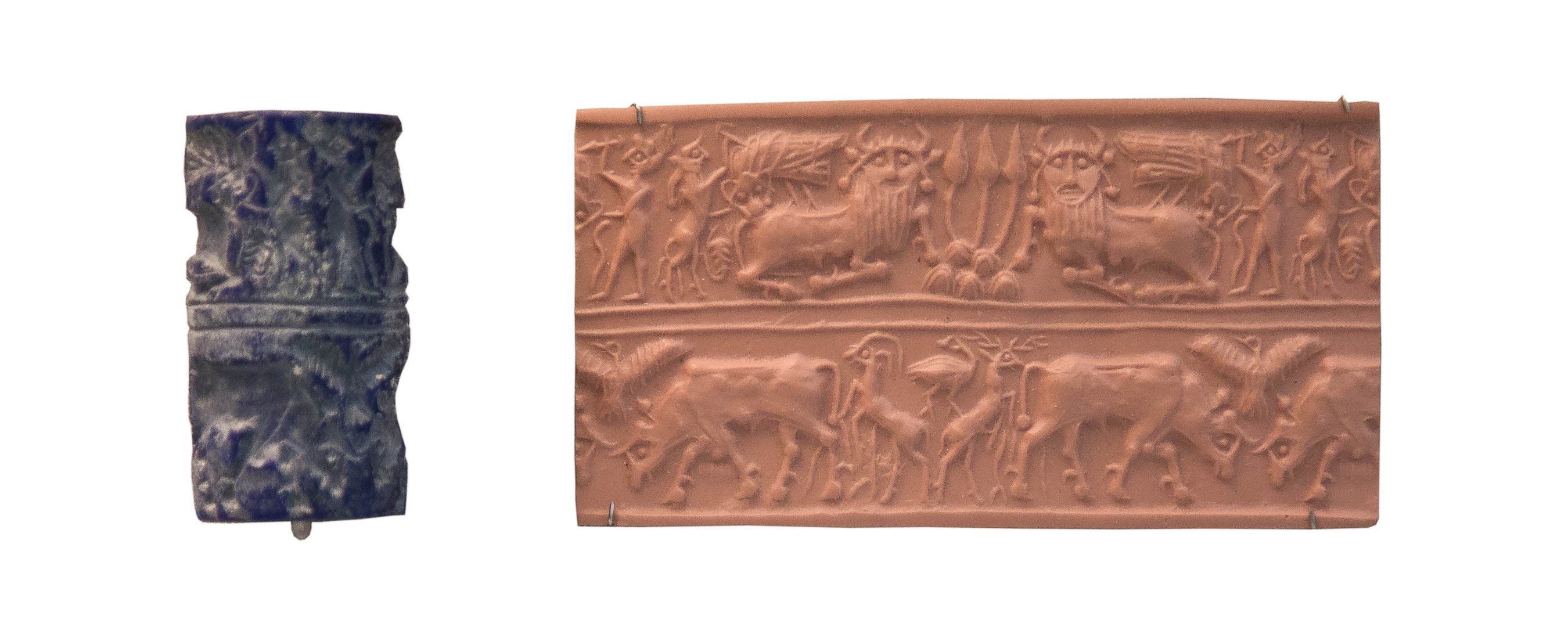
A third category of seal are those containing mythological motifs. Filled with obscure religious symbolism, it goes without saying that these seals are difficult to interpret. Despite the limited real estate, they are divided into two registers so that the rendering of fine detail was all but impossible. The seal cutters nevertheless sought to depict their subjects in a realistic way. Although most of the room on the seal is filled, there is not quite the same horror vacui that characterized Jemdet Nasr seals.

Despite the small surface, Early Dynastic seal cutters nevertheless dived the seal into two registers. The meaning of this one completely eludes me.
Crouching bulls are shown flanking a sacred tree. They look placidly towards the viewer, even while Imdugud is biting and clawing their back. Flanking the scene is a man armed with a sword who seeks to rescue the bulls from Imdugud. This seal could just well be included in the category of “contest scene.”
Collon, Dominique.
First Impressions : Cylinder Seals in the Ancient Near East.
Chicago, Illinois: University of Chicago Press, 1988.
Amiet, Pierre.
Art of the Ancient Near East.
New York: Harry N. Abrams Publishers, 1980.
Frankfort, H.
The Art and Architecture of the Ancient Orient.
Harmondsworth, Middlesex : Penguin Books, 1954.