These vessels contained fine oil or fat. The one shown above stands approximately 10 inches high.
In addition to the large number of Canaanite wine jars discovered in Tomb U-j, archaeologists found approximately 750 Wavy Handled Jars. Analysis of the residue left inside the jars indicates that they were used to store oil or fat. 125 of the jars discovered in the tomb were labelled with black ink. The writing is generally comprised of two symbols which fall into the pattern of subject + branch.
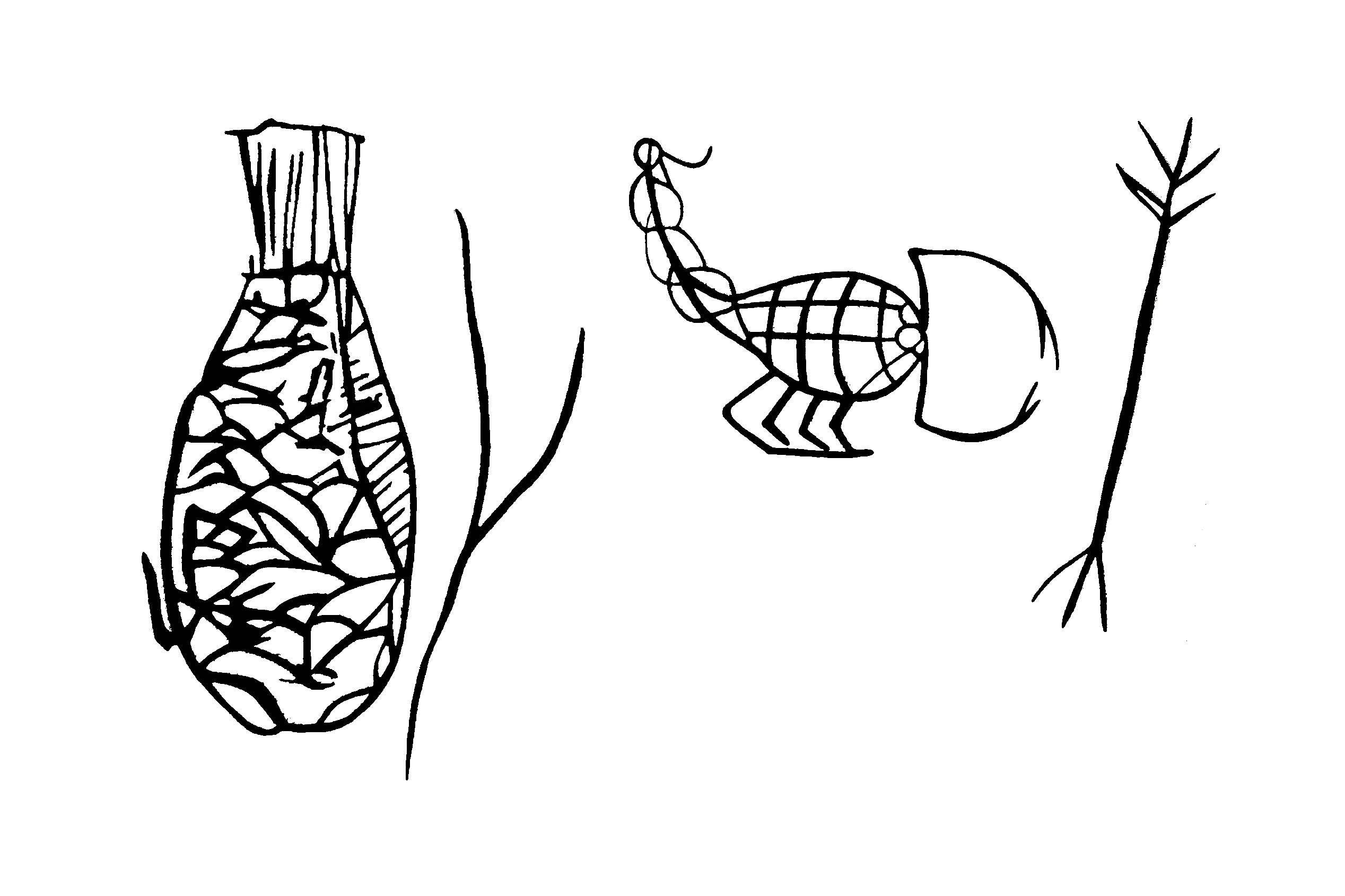
Two examples of the types of symbols written with black ink on the sides of Wavy Handled Jars. Note the pattern of creature + branch.
Dreyer interpreted the “branch” symbol to mean “from the estate of…” while the other symbol indicated the name of a place or person. Thus the symbol of the branch and the scorpion would read: “From the estate of Scorpion.” Since the scorpion features prominently on grave goods found in Tomb U-j, the tomb is thought to have belonged to a ruler named “Scorpion.” This ruler must have reigned towards the very end of the Predynastic period.1In fact, there are supposedly two kings named Scorpion (designated Scorpion I and II) whose reigns are thought to have been separated by around 150 years. It is not clear to me why it is necessary to posit two Scorpions. The occupant of Tomb U-j looks to have been very nearly a contemporary of Narmer. The adoption of the rebus principle on the bone tags from his tomb suggests as much. Furthermore, Tomb U-j is equal to the smaller tombs in Cemetery B in terms of complexity and contents. I do not see why the famous Scorpion mace-head discovered in the Main Deposit next the the Narmer Palette could not have belonged to the occupant of Tomb U-j rather than attribute it to another Scorpion, named Scorpion II. I am treating the two scorpions as one until I see definite evidence that there were two!
The Pottery Sequence
Since pots were produced for all kinds of uses, and since pottery is both brittle and highly durable, pottery sherds comprise the bulk of the matériel left behind by an ancient civilization. This might be perceived as an unfortunate circumstance but the humble pottery sherd has proven to be one of the best and most reliable means of identifying and dating a civilization. This is because styles are always changing, for no apparent reason at all. Pottery is especially prone to variation since its color and shape are subject to a myriad of subtle influences. These include: type of clay, kiln technology, and the techniques used to finish and apply decorations to the surface of the pot.
As noted in a previous entry, Sir Flinders Petrie was the first to make a careful study of the pottery recovered from the tombs of Naqada and Ballas and to arrange them into a sequence. The Wavy Handled Jar is a classic example of one such sequence—the evolution of the “Wavy Handled Jar” into the “Cylinder Jar.” According to Petrie’s analysis, the Wavy Handled Jar grew narrower and its sides straighter, while its wavy handle was reduced to a decorative scallop and then finally, to a thin, wavy line.

This chart illustrates the types of pottery discovered by Petrie at Naqada. The chart is read from left to right with the earlier pottery types on the left. The numbers assigned to the jars are sequence numbers that range from 30 to 80. The lower the number the earlier the date for the jar.
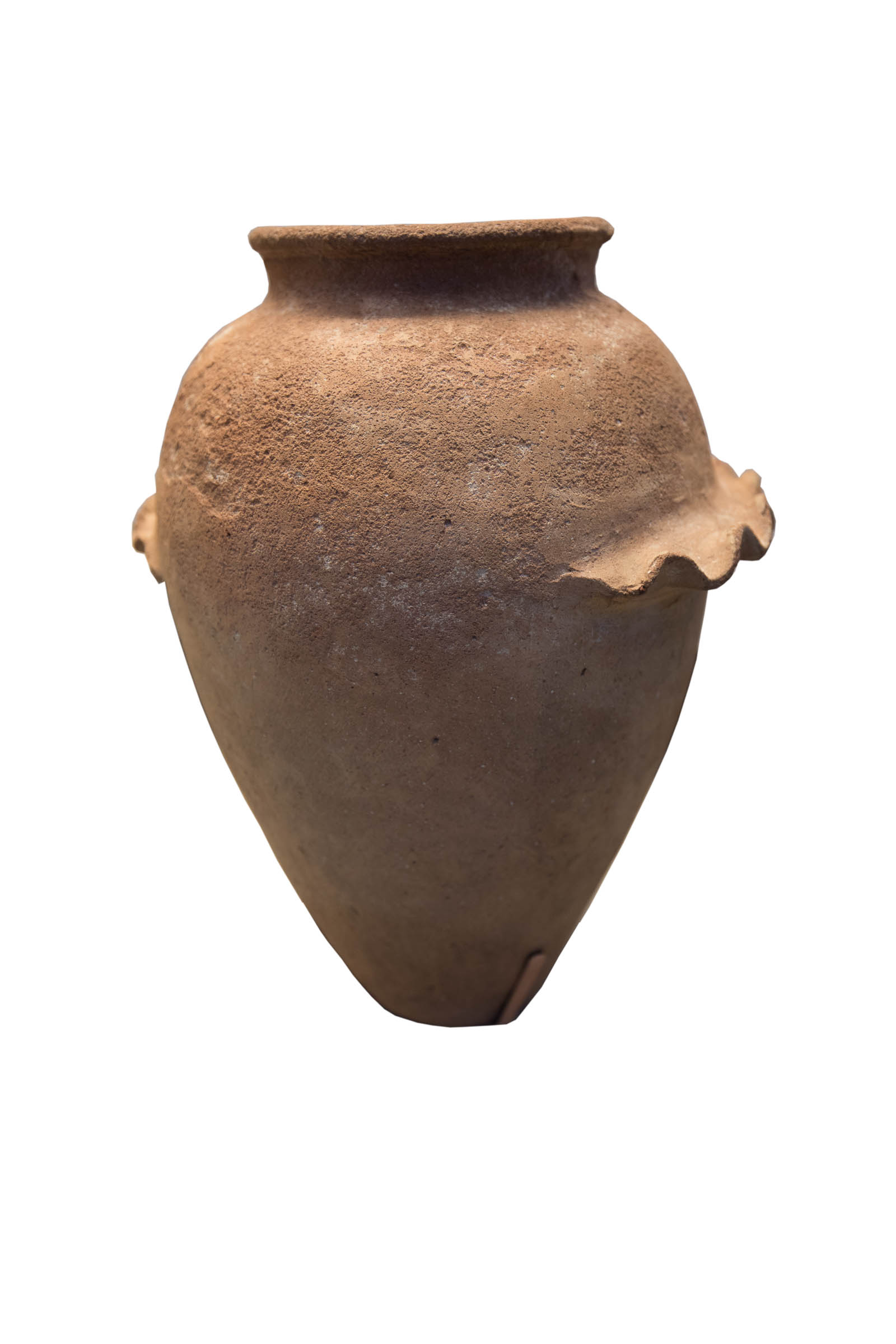

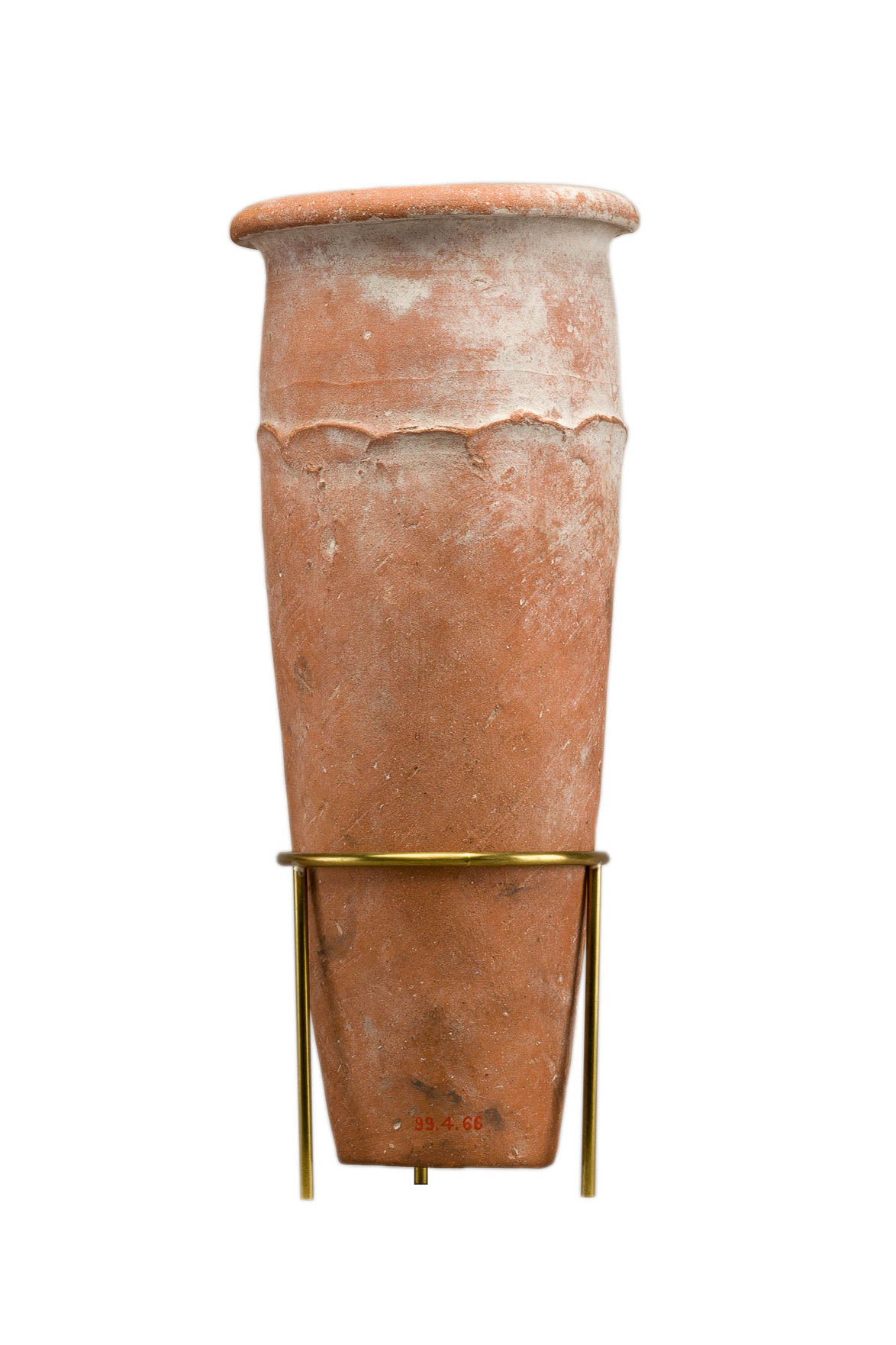
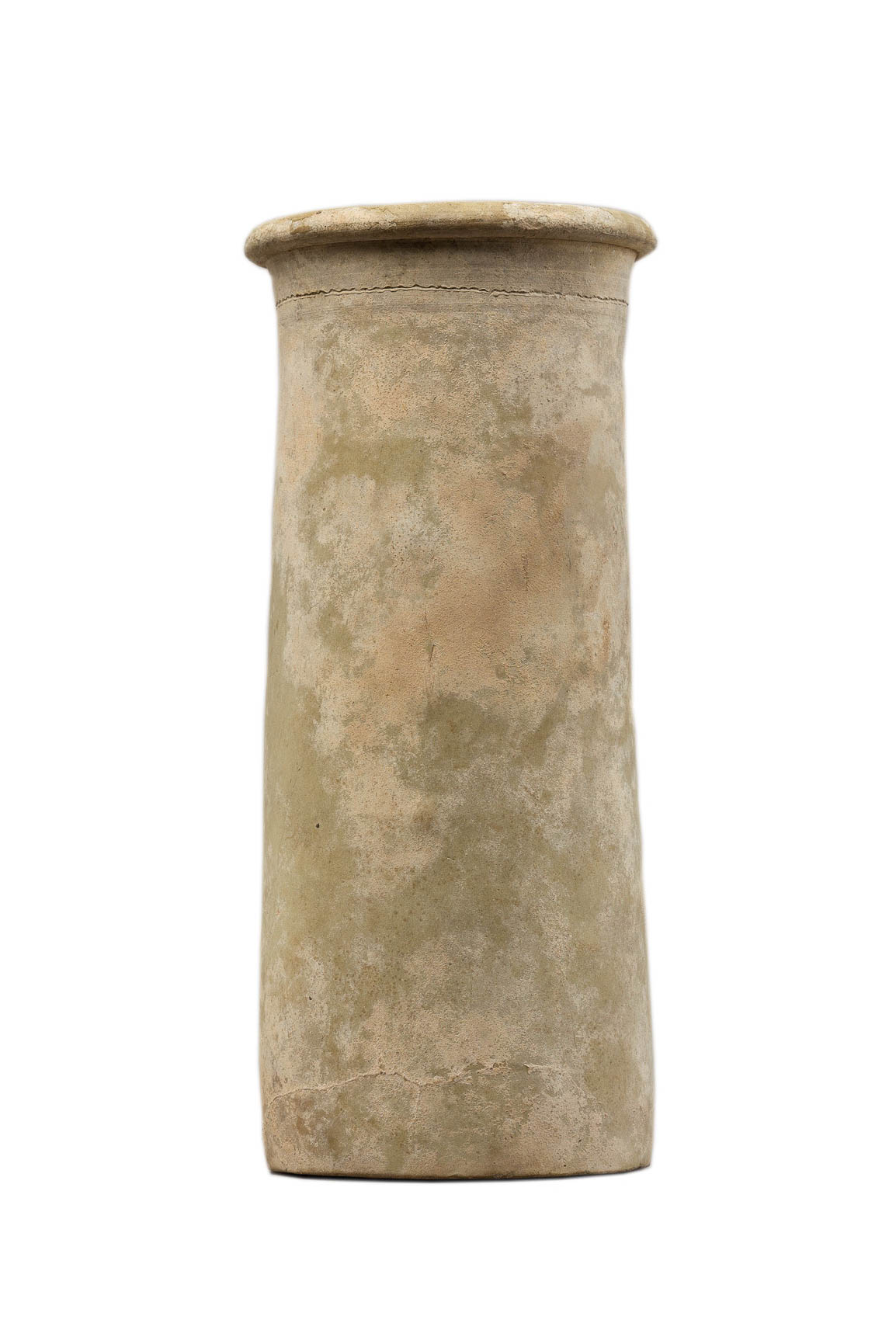
The wavy-handle evolved into a decorative scallop and finally into a thin wavy line, while the body of the vessel grew narrower and straighter until the base actually became wider than the body of the vessel.
Scholars generally date the wavy-handled jar on the left (43-50) to around 3600 BC (Naqada II). Another half a millennium or so is allowed for its evolution into the narrow, strait-walled cylinder jar (72-80). This type of analysis is fairly straightforward but a few cautions are in order. Firstly, there may be considerable overlap between styles. We’ve already seen this kind of overlap between the Uruk and Jemdet Nasr cylinders seals. Secondly, there is no bulletproof way of knowing how much time is required for a style to change. Leaving all other factors to one side, one could argue that the four stages in the evolution of the cylinder jar could have occurred in just a few generations rather than half a millennium, which is a very long time in human years. The most pressing problem, however, is the means by which archaeologists assign absolute dates to this pottery. It may be instructive, therefore, to consider the absolute dates Petrie assigned to this pottery sequence and consider how he arrived at them.
Absolute!
Petrie dated the beginning of the First Dynasty to around 4777 BC, give or take a “century or so.”2Petrie 1895, 253. Petrie writes, “In the present rough state of the astronomical data, and the doubts as to the MS authorities, we have reached quite as close an equivalence as we may hope for; and at least there is enough to show us that we may trust to the nearest century with fair grounds of belief. It is now generally accepted that Petrie was off by more than 1600 years, and that the First Dynasty began around 3100 BC, or even later according to chronology followed here. This is quite a swing and a miss for Petrie, whose gigantic contributions to the field of Egyptology hardly need to be stated here.
Petrie was not the only one to adopt such a high chronology. Eminent scholars such as Sir Leonard Woolley and James Henry Breasted likewise promoted very high chronologies in their popular histories of Mesopotamia and Egypt respectively. It was simply fashionable in the post-Darwinian era for scholars to produce high chronologies. But this in and of itself does not invalidate a high chronology, and certainly Petrie had what he considered to be sound scientific reasoning on his side. If you will bear with me, briefly, it is worthy looking more closely at his methodology, since it is still relied upon today, howbeit in a modified form.
The method is quite elegant.
Petrie accepted that Egyptian history was divided into cycles of 1460 years, an idea which had already been discussed and explored by scholars prior to Petrie. The cycle began when the Sothis star (known also as Sirius or the Dog star) was spotted on the eastern horizon at daybreak (what is known as its heliacal rising). Ideally, the heliacal rising of Sothis occurred during the Egyptian New Year celebration, that is Thoth 1.
This event occurs like clockwork once every 365.2422 days, which is, of course, the amount of time it takes for the earth to circuit the sun. Ideally, then, the heliacal rising of Sothis always coincided with Thoth 1 and thus with the Egyptian New Year. However, since the Egyptians had a year that was 365 days long and no leap year, this means that after four years their New Years celebration occurred one day too early, and after 120 years, it occurred a full month too early, and after 730 years it occurred six months too early, and so on and so forth. Thus the Egyptian civic calendar gradually fell out of sync with the universe until 1460 years later, the wrong was finally righted, and the heliacal rising of Sothis occurred once again on Thoth 1, New Years Day.
Theoretically, if it were possible to assign a calendrical date to just one of these beautiful days when the cosmos was in order, when the heliacal rising of Sothis occurred Thoth 1, then the “Sothic Cycle,” as it is known, could potentially be used as a framework for all of Egyptian history. (That is assuming the Egyptians maintained their calendar over such long periods, a very big assumption!)
It so happens that the Roman author, Censcorinus, provided precisely the date scholars needed. Writing in 239 AD, Censcorinus claimed that precisely 100 years before the date of his writing, the heliacal rising of Sothis had been observed on Thoth 1. Thus scholars were able to nail down the Egyptian calendar using the year 139 AD provided by Censcorinus. By subtracting multiples of 1460 years from this date, it was theoretically possiblee to establish several more “astronomically fixed dates” when the Egyptian calendar reset itself: 1322 BC, 2784 BC and 4242 BC.3Petrie 1895, 250
Now all that was needed was one or more recorded observations of the heliacal rising of the Sothis star, preferably with the month and day also given, and one could use this information to calculate how many days the Egyptian calendar had wandered from the nearest “astronomically fixed date.”4Petrie writes, “From this it is plain, that, as the nominal months rotated round all the seasons once in each of these cycles, therefore, if we only know the day of the nominal month in which any seasonal event happened, such as the rising of Sirius, or the inundation, we can find on what part of the cycle of 1460 years such a coincidence can have fallen.” Petrie 1985, 250 For example, lets say that an 18th dynasty inscription records that the heliacal rising of Sothis was observed on Thoth 1, New Years Day. This is one of those rare moments when the Egyptian calendar and the cosmos were of one accord and can therefore be dated by one of our astronomically fixed dates. Since the inscription belong to the 18th dynasty, we can narrow it down to 1322 BC (139 AD – 1460 years = 1322 BC).
Now lets say we have another inscription from approximately the same period which states that the heliacal rising of Sothis was observed on Thoth 30. We know that the calendar wanders 1 day every 4 years. So it will have taken 120 years for it to have wandered 30 days (30 x 4 = 120 years). Thus the calendrical date for the rising of Sothis may be calculated to have occurred on 1202 BC (1322 – 120 = 1202 BC).
Armed with this formula and several recorded sightings of the helical rising of Sothis, Petrie was able to fix absolute dates for the reigns of several pharaohs of the Eighteenth and Nineteenth Dynasties: Amenhotep I, Thutmose III, and Merneptah. Petrie fixed the date for the beginning of the Sixth dynasty to around 3503 BC. Using Manetho’s history to fill in the details he estimated that the First Dynasty began c. 4777 BC.
Petrie was probably the greatest applied mathematician of his generation. His survey work at Giza is still used and relied upon today. But his use of the Sothic cycle relied upon a faulty premise and an unwarranted assumption. Firstly, it is generally agreed that Petrie was working in the wrong Sothic cycle when he calculated the absolute dates for the Sixth dynasty, which is why he was out by at least 1460 years. Secondly, and more controversially, it is doubtful whether the Sothic cycle does, in fact, provide a sound basis for establishing an absolute chronology. For the method to work, the Egyptians had to have maintained their imperfect calendar perfectly over several millennia, which means they were content to let it wander in relation to the Sothis star and the Nile inundation. If at any point, the Egyptians reset their calendar, or simply lost track of it during a period of chaos, then the entire system is rendered useless as a method for establishing an absolute date.5It may still be used, perhaps, to measure the relative number of years that transpired between two observations of the heliacal rising of Sothis within a single cycle, but only if the wandering 365 day year is being accurately maintained.
That being said, the Sothic cycle is still commonly used by Egyptologists today to establish absolute dates for the reigns of Sesostris III and Amenhotep I.6Kitchen 1991, 205. Kitchen lists the various weaknesses of chronological calculations based on the Sothic cycle which could throw it off by 20 or 30 years but otherwise sees it as a viable method. Of course, Egyptologists now have access to radiometric dating which was unknown to Petrie.7Höflmayer 2017 The Sothic Cycle and C14 dating both promise to provide a rational and objective basis for an absolute chronology. Unfortunately both rely on premises which may not be correct. Dates derived from these methods should be viewed as data points that ought to be taken into consideration rather than the basis for a chronology.
Dever, William.
Does God have a Wife? Archaeology and Folk Religion in Ancient Israel.
Grand Rapids, Michigan: Eerdmans Publishing House, 2005.
Dreyer, G.
“Tomb U-j: A Royal Burial of Dynasty 0 at Abydos,” in Before the pyramids : the origins of Egyptian civilization, edited by E. Teeter.
Chicago, Ill.: Oriental Institute of the University of Chicago, 2011. Link
Höflmayer, Felix. “A Radiocarbon Chronology for the Middle Bronze Age Southern Levant.” Journal of Ancient Egyptian Interconnections 13 (March 2017): 20-33. Link
James, P.
Centuries of Darkness : A Challenge to the Conventional Chronology of Old World Archaeology.
London: Jonathan Cape, 1991. Link
Kitchen, K. A. “The Chronology of Ancient Egypt.” World Archaeology 23, no. 2 (October 1991): 201-208. Link
Petrie, W. M. Flinders .
History of Egypt, Vol. 1: From the Earliest Times to the XVIth Dynasty.
London: Methuen & Co , 1895.