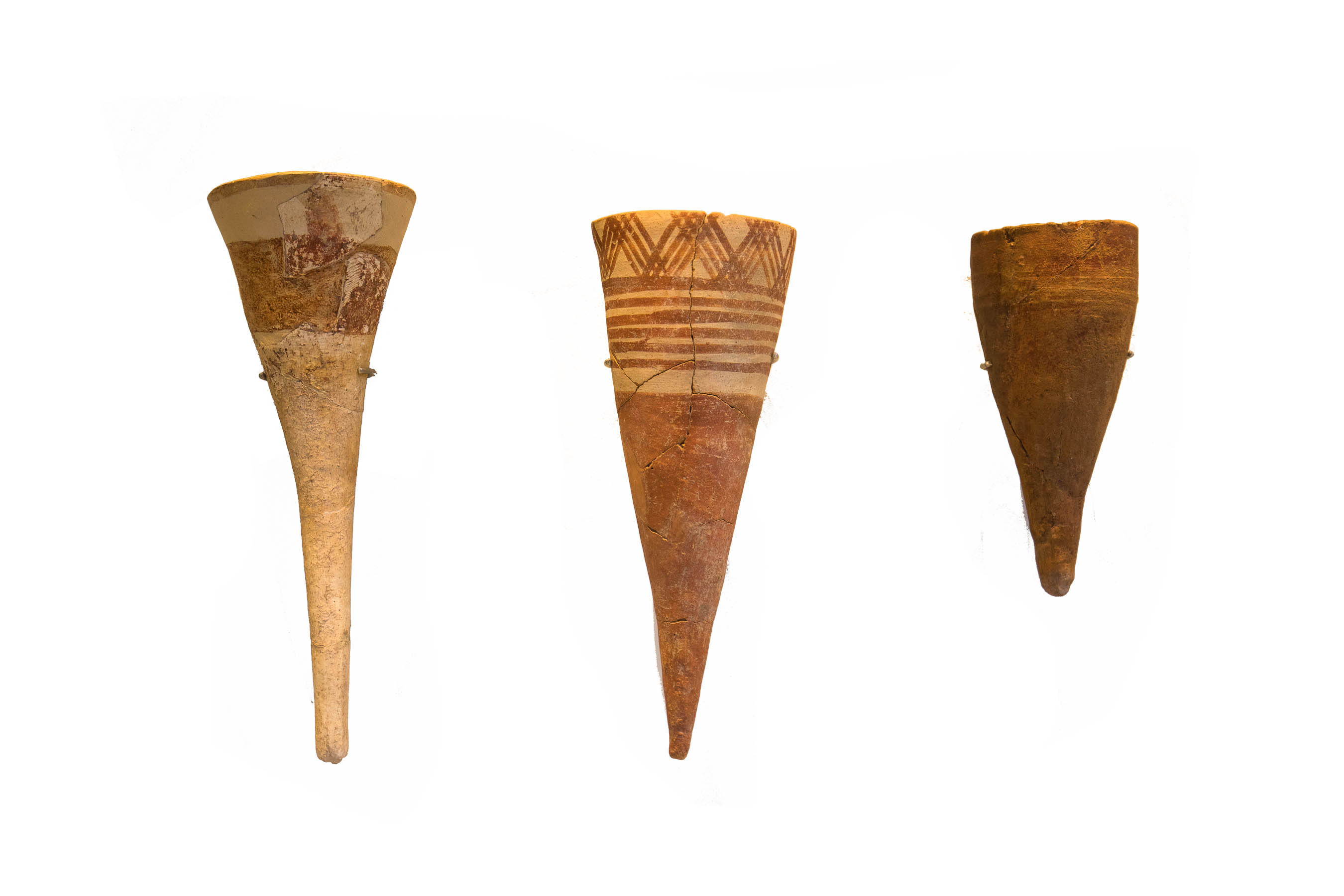
Cone-shaped vessels such as these are characteristic of the Ghassulian culture.
The cornet is one those distinctive pottery types which has come to define the Ghassulian culture. These pointed cups were often decorated with red lines or triangles painted on the buff surface of the cup (“buff” being a term used for the natural color of the clay). The cornets were probably intended to imitate the horns of animals. They seem to have had a ceremonial function.

The cornets were sometimes decorated with red horizontal bands and triangles.
A curious example of the cornet was discovered at Gilat in the Beersheva Valley where archaeologists found a vessel shaped like a ram with three cornets attached to its back. These vessels were typically filled through an opening in their back while the liquid was poured from a spout in their mouth.

This libation vessel comes from Gilat, a Ghassulian village located in the Beersheva Valley in southern Israel.
Similar “theriomorphic” (animal-shaped) vessels were found in the earliest levels of the Sin Temple at Khafajah, near modern-day Baghdad. (We will take a closer look at these in a future entry.) As you may recall, theriomorphic libation vessels are also depicted on the uppermost register of the Warka Vase. These date to the EB I. If the date we have assigned to the Ghassulian culture is correct then our ram-shaped libation vessel probably belongs to the EB I also.


These libation vessels from Khafajah, on the northern periphery of Sumer, bear more than a passing likeness to the ram-shaped libation vessel from Gilat. They were discovered in the early levels of the Sin Temple (the bird in Temple III and the bull in Temple IV).
_at_Khafajah,_Iraq._Early_Dynastic_period,_2800-2370_BCE._Iraq_Museum,_Baghdad.jpg)
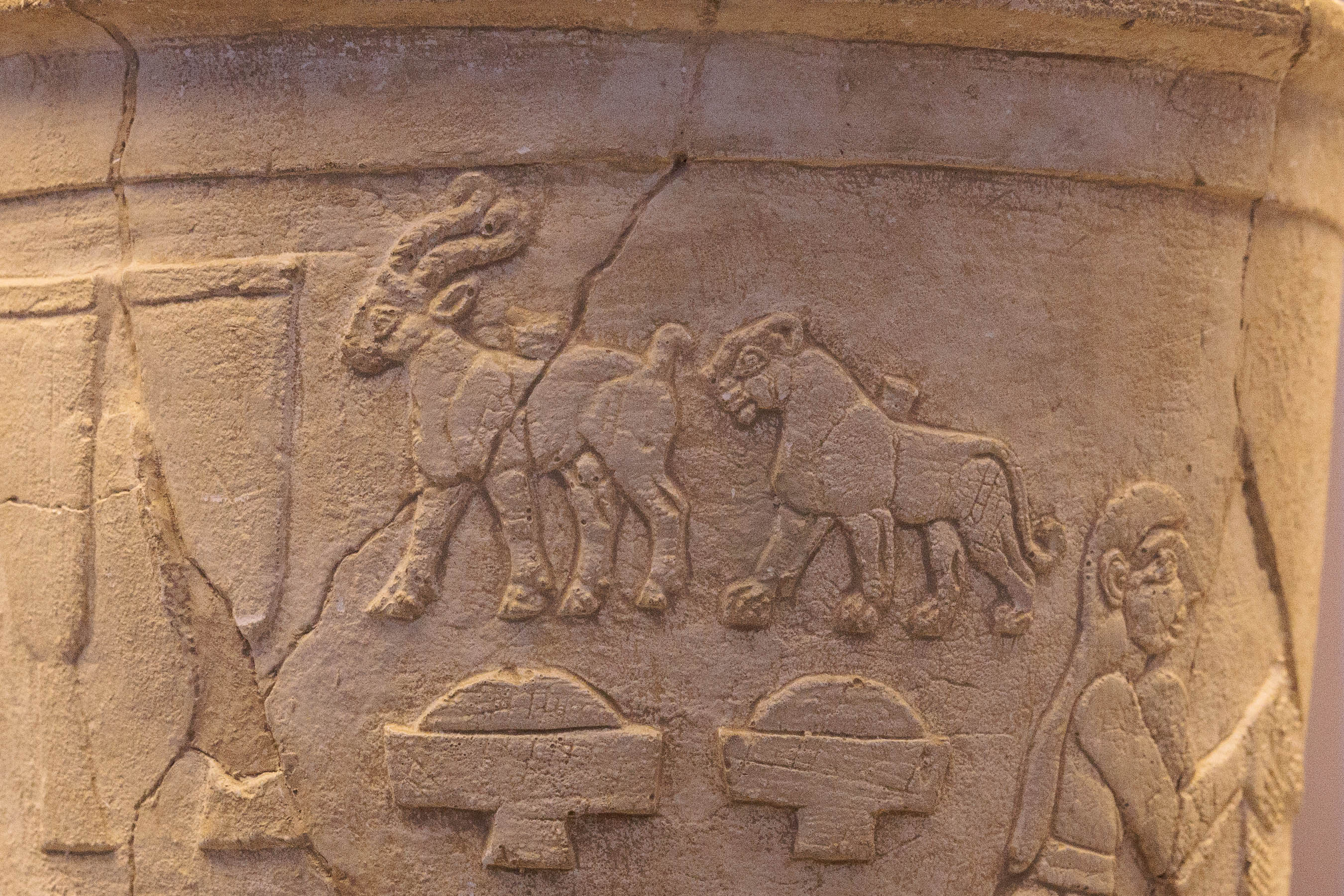
The animal shaped libation vessels in the upper register of the Warka Vase are identifiable by the opening in the back which was used to fill them.
Amiran, R.
Ancient Pottery of the Holy Land; from its Beginnings in the Neolithic Period to the end of the Iron Age.
New Brunswick, N.J.: Rutgers University Press, 1970.
Delougaz, Pinhas , Seton Lloyd, Henri Frankfort, Thorkild Jacobsen.
Pre-Sargonid Temples of the Diyala Region. OIP 58 vols.
Chicago: The University of Chicago Press, 1942. Link
Levy, T. E.
Archaeology, Anthropology and Cult: the Sanctuary at Gilat, Israel.
London ; Oakville, CT: Equinox, 2006.
Rowan, Yorke, Jonathan Golden. “The Chalcolithic Period of the Southern Levant: A Synthetic Review.” Journal of World Prehistory 22 (2009): 1-92. Link