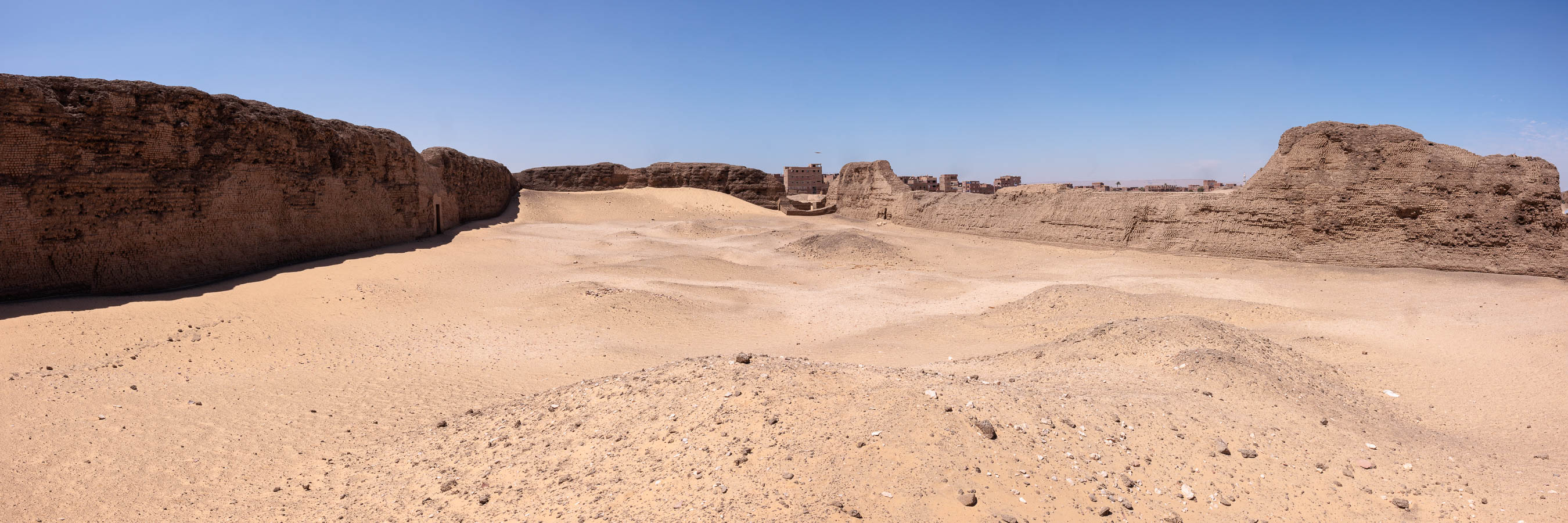
This picture was taken inside the enclosure known as Shunet el-Zebib (Arabic “Storehouse of Raisins”). The origin of its name is unknown. Constructed by Khasekhemwy, the last king of the Second Dynasty, it is over 430 feet long and 255 feet wide, enclosing an area of 2.5 acres.1O’Connor 2009, 159
The ascension of Khasekhemwy, the last ruler of the Second Dynasty, marks a new chapter in the history of Egypt. The name he bore at the beginning of his reign, Khasekhem, means “the power has appeared.” It was written in a serekh surmounted by the Horus falcon which was the traditional way of writing a kings name in Egypt. Later he changed his name to Khasekhemwy which means “the two powers have appeared” and he added the Seth-animal next to the Horus-falcon on his serekh. The falcon is shown wearing the white crown of Upper Egypt whereas the Seth-animal is wearing the red crown of Lower Egypt.
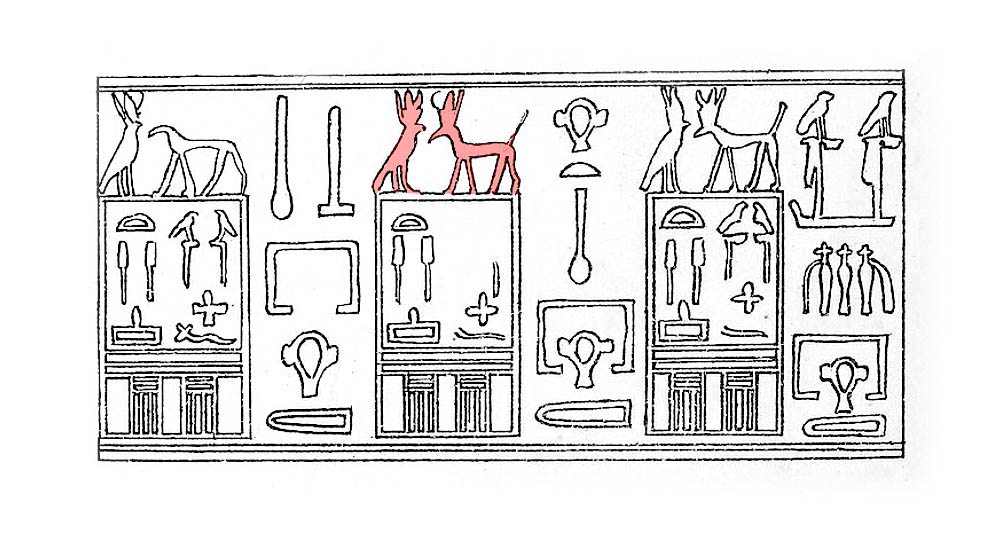
One of Khasekhemwy’s cylinder seals displays the serekh of the king surmounted by Horus and Seth facing each other. Horus wears the white crown of Upper Egypt and Seth the red crown of Lower Egypt.
What was the reason for the change of name and serekh? A clue is provided by a statue of Khasekhemwy, one of two buried beneath the temple of Horus at Hierakonpolis (not far from where the Main Deposit was found). The base of the statue was engraved with figures of the defeated enemies lying among papyrus reeds. The accompanying inscription reads: “northern enemies, 47,209.”
The statue base may be interpreted as a record of a campaign led by Khasekhemwy against Lower Egypt which resulted in his victory and the reunification of Egypt. As noted previously, the worship of Seth has traditionally been associated with Lower Egypt, no doubt due to Asiatic influence on the delta region (the storm gods of the Asiatics were named Seth, Sutekh, etc.). In contrast, the main temple of Horus was at Hierakonpolis in Upper Egypt. Perhaps Khasekhemwy chose to commemorate his victory over Lower Egypt by adding the Seth-animal to his serekh, next to the Horus falcon. This is probably also when he adopted the title “the two powers are at peace in him.”

This was one of two statues found beneath the Temple of Horus at Hierakonpolis.
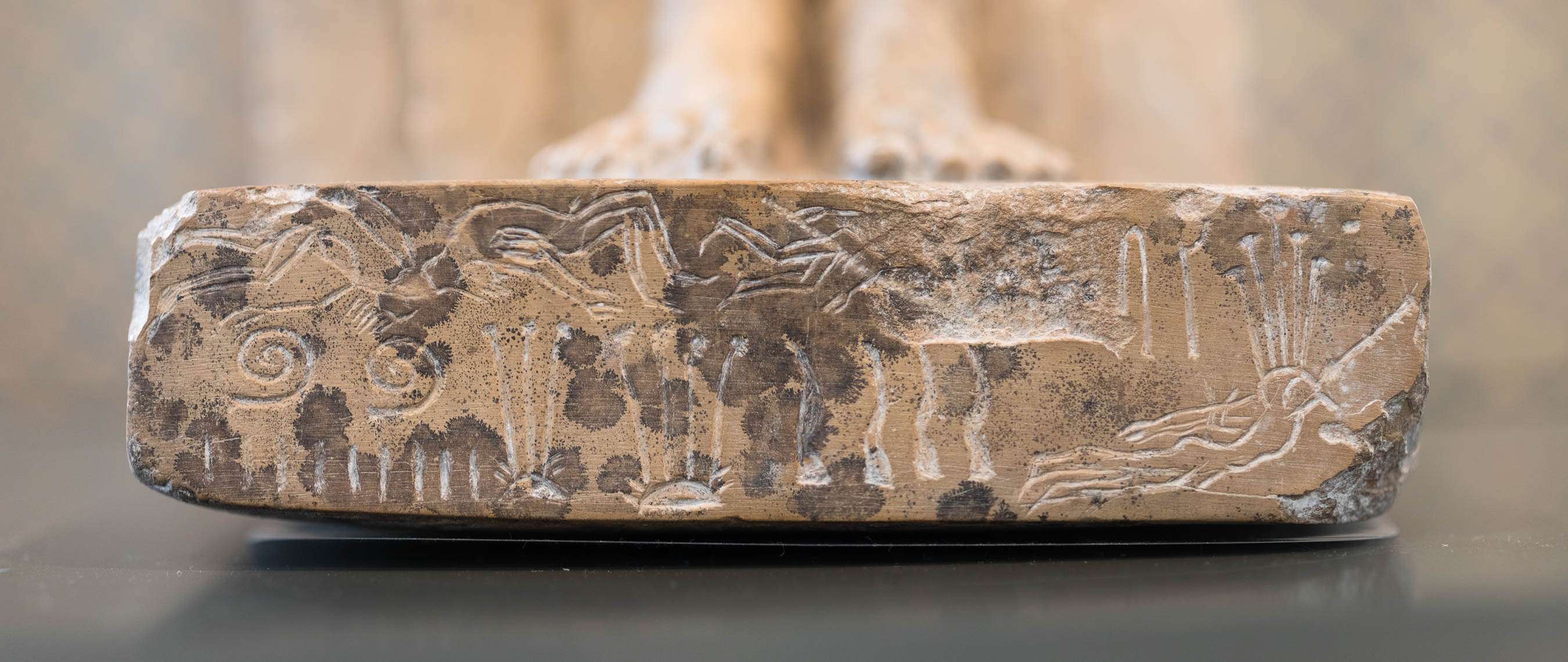
Inscribed with “northern enemies” and the number “47,209.” As you may recall, the papyrus reed signified Lower Egypt.
Tomb of Khasekhemwy
Following a precedent established by his predecessor, Seth-Peribsen, Khasekhemwy built his tomb at Umm el-Qaab instead of at Saqqara. It is the largest in the cemetery by far, measuring 223 feet long and 40 feet wide. When Petrie excavated the tomb, he noted that its walls had been pushed in by the force of the surrounding earth before collapsing. As a result, some of the tomb’s contents along the perimeter of the temple were hidden from tomb robbers and preserved.1Petrie 1901, 12 The tomb chamber itself was constructed with cut limestone blocks instead of mudbrick. This marks the beginning of stone architecture in Egypt. No attendant burials were found in the vicinity of Khasekhemwy’s tomb, this custom having ceased already by the conclusion of the First Dynasty.
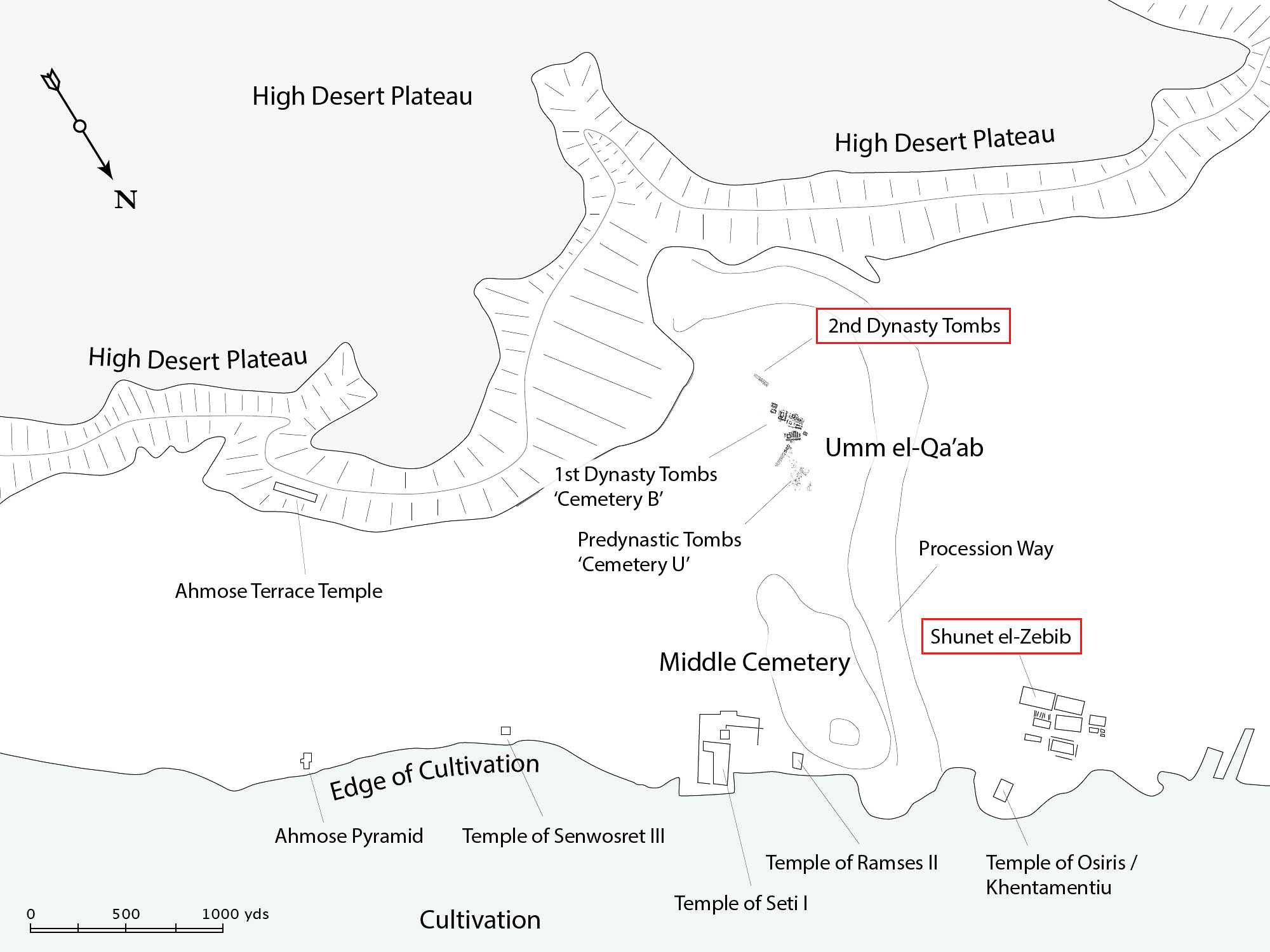
The Shunet el-Zebib and the Tomb of Khasekhemwy are highlighted in red.
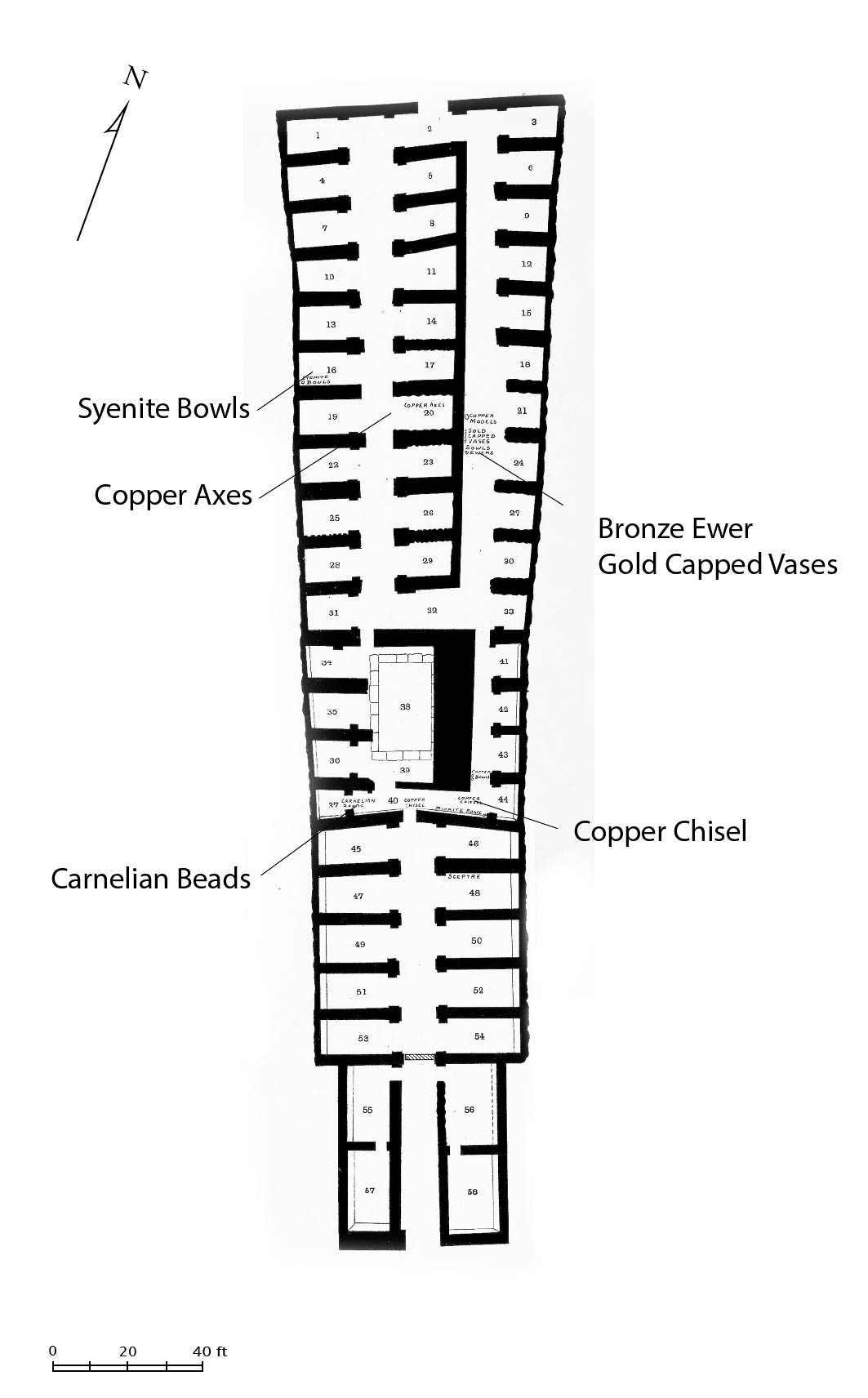
Khasekhemwy’s tomb is long and narrow and had many storage chambers (cf. the 12 chambers of Tomb U-j).
Sir Flinders Petrie excavated the tomb of Khasekhemwy in the early 1900’s. Although badly damaged by the unprofessional work of his predecessor, Émile Amélineau, Petrie found enough to show with what rich grave goods the tomb was originally equipped with. Many of the objects recovered from the tomb bear a marked resemblance to those found in the Royal Cemetery of Ur.2These include copper tools, a scepter made of precious stones, and a bronze ewer.

These fine stone vessels were covered with gold foil and sealed with clay. The largest does not measure more than a couple of inches in diameter.
Shunet el-Zebib
Khasekhemwy also erected a large mudbrick enclosure called the Shunet el-Zebib on the edge of the cultivated floodplain, approximately a mile from his tomb. It is a massive double-walled structure that enclosed an area the size of two American football fields. Its inner wall is 16 feet thick and likely stood about 36 feet high. It must have required an enormous amount of labour to erect such a massive structure, yet its purpose remains a mystery. Nothing was found inside the enclosure except a relatively small shrine in its southwest corner and scores of mummified ibises, a reminder of just how weird Egypt can get.3O’Connor 2009, 171 The mummified birds do not predate the 1st millennium BC and thus do not seem to be related to whatever was happening in this enclosure in the 3rd millennium. Khasekhemwy was not, in fact, the first to build an enclosure in this area; the kings of the First Dynasty also built enclosures, but Khasekhemwy’s was certainly the largest. As you would expect in Egypt, archaeologists found a fleet of fourteen wooden boats buried in the sand on the eastern side of the Shunet el-Zebib, but these probably date to the First Dynasty rather than the Second.4O’Connor argues that these boats were buried earlier, during the First Dynasty, and are contemporary with the “Western Mastaba.” See: O’Connor 2009, 185
Various explanations have been put forward to explain the purpose of these enclosures. The most popular explanation, and probably the correct one, is that they served as “dummy” palaces reserved for the king’s use in the afterlife.5O’Connor 2009, 177 Thus, not only were the kings of the First and Second dynasties buried with their servants, hunting dogs, game animals, food provisions, and ornaments, they were provided with “dummy” palaces equipped with a dummy quay, and a fleet of wooden boats buried in the sand! It is difficult to conceive of the time and effort required from so many people for the illusory benefit of one man. But the Shunet el-Zebib was just a warm up for what was to come.
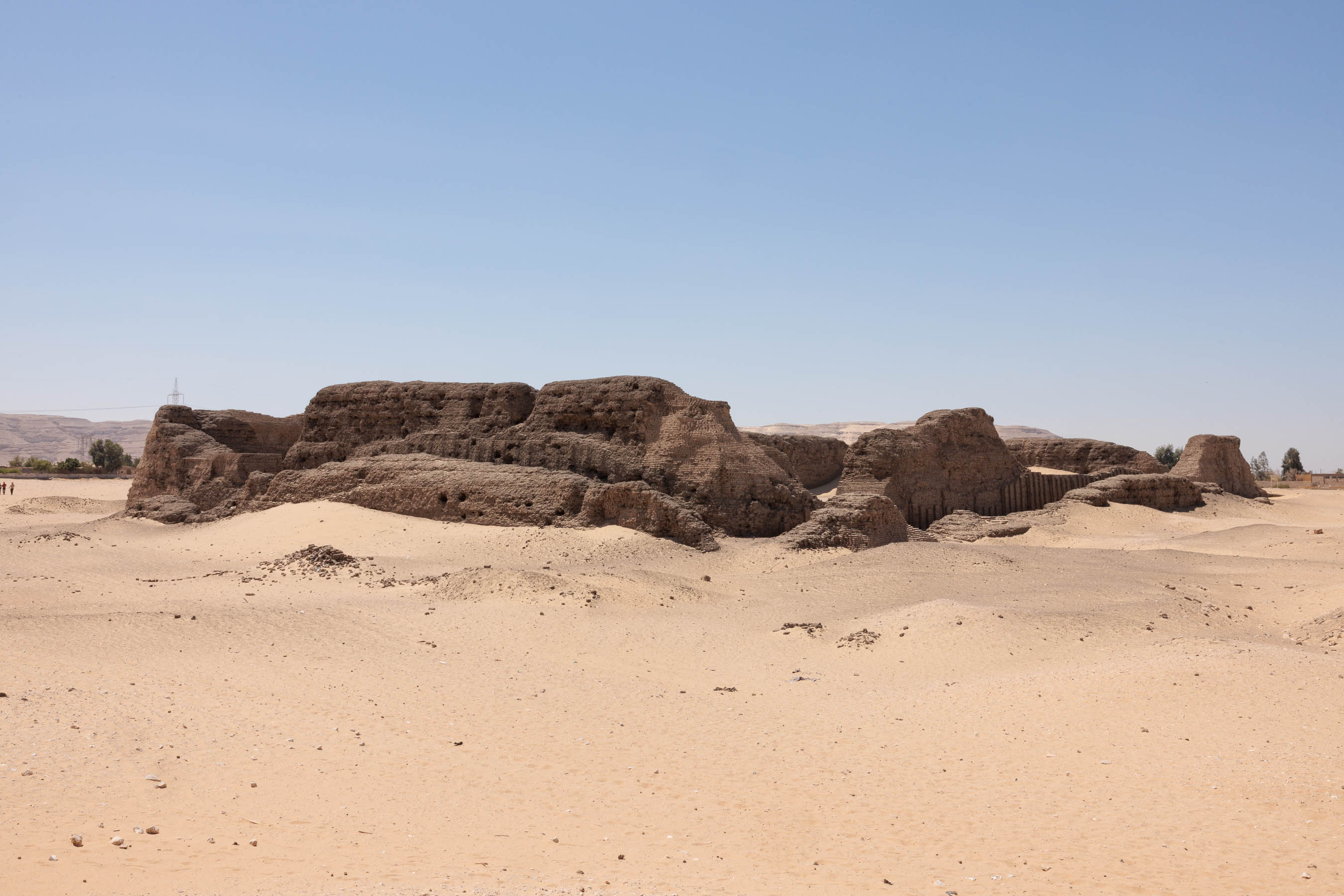
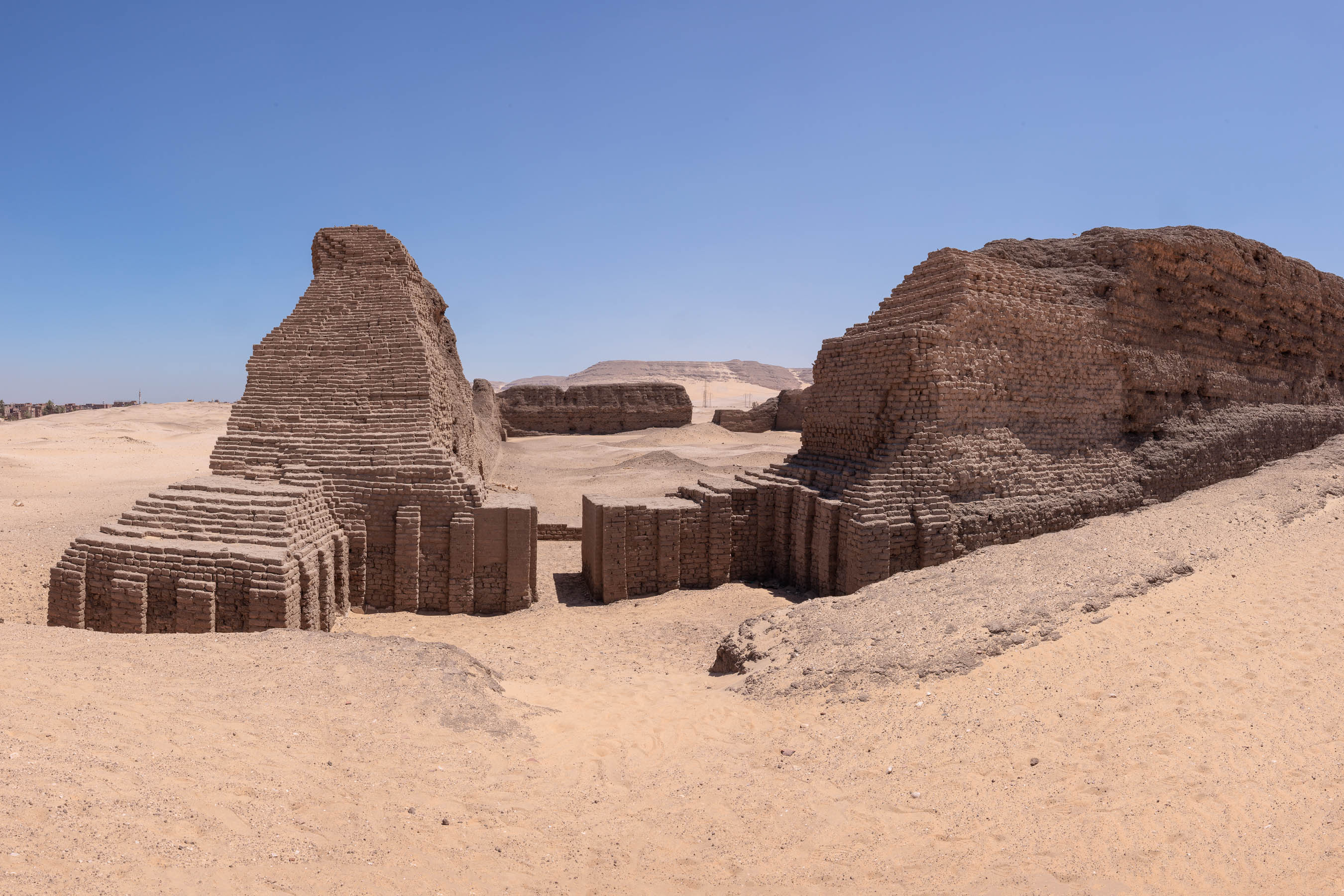
The purpose of this giant mudbrick enclosure is unknown. Notice the niched facade of the gateway to the enclosure.
O’Connor, David.
Abydos: Egypt’s First Kings and the Cult of Osiris.
London: Thames & Hudson, 2009.
Petrie, Flinders.
The Royal Tombs of the Earliest Dynasties: Part One.
London: The Egyptian Exploration Fund, 1900. Link
Petrie, Flinders.
The Royal Tombs of the Earliest Dynasties: Part Two.
London: The Egyptian Exploration Fund, 1901. Link
Wilkinson, Toby.
Early Dynastic Egypt.
London and New York: Routledge, 1999.