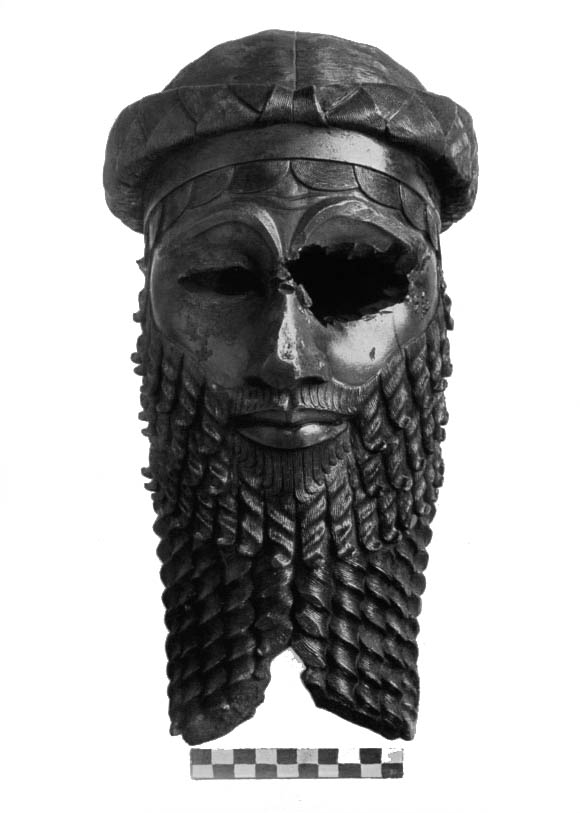
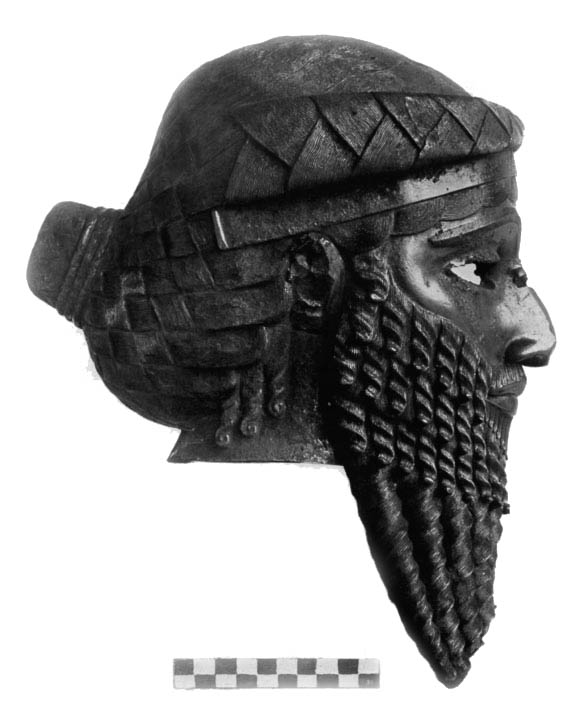
This life-size copper head is thought to represent an Akkadian king, perhaps Sargon of Akkad, or his grandson, Naram-Sin.
“It seems to me no exaggeration to claim that this must rank among the great masterpieces of antiquity.” Max Mallowan
In 1931, while excavating Nineveh, British archaeologist Campbell Thompson found a magnificent, life-size, bronze bust of a king. Cast using the cire perdue method discussed in a previous entry, the head is technically perfect. Besides the quality of the casting, the most curious feature of the bust is its astonishingly complex coiffure, described by Max Mallowan as “a triumph of hairdressing.”1Mallowan 1936, 104 The braided hair, plaited beard, closely trimmed mustache, curly locks of hair behind the ear, fillets of hair on the forehead, royal bun… is this for real? Mallowan thought the head was likely a portrait of Sargon of Akkad but left open the possibility that it might also belong to one of his successors.
Sargon “the Great”
Many stories were told about Sargon, the historical accuracy of which cannot always be verified. According to one of these, Sargon began as a cup bearer to Ur-Zababa, the king of Kish. He seems to disappear from the scene after Ur-Zababa is defeated in battle by Lugalzagesi, the governor of Umma. Lugalzagesi established himself in Uruk and boasted of a domain that stretched from the “Upper Sea to the Lower Sea”—that is from the Mediterranean to the Persian Gulf. It is doubtful whether he actually controlled such a large territory, but he is nevertheless the first king to lay claim to it.2Astour argues that Lugalzagesi was responsible for the destruction of Palace G at Ebla (Astour 2002, 54).
Through circumstance which remain shrouded by the mists of time, Sargon reemerges and defeats Lugalzagesi in battle, conquering southwards to the shores of the Lower Sea (“Persian Gulf”) where he famously “washed his weapons in the sea.”3Hamblin 2006, 75 The symbolic gesture communicated that he had conquered to the edge of the earth until there was nothing left conquer, but there was plenty left to conquer, and Sargon was just getting started. Beginning with the Elamites in the east, Sargon proceeded to conquer the Hurrians in the north, and the Eblaites in the west until he could claim to possess an empire which extended from the Upper to the Lower Sea. There was substance to his claim, proven by the numerous Akkadian building projects which have been discovered in many different regions, especially at Naggar (Tel Brak), where the kings of Akkad built a palace.4Hallo and Simpson 1994, 61 But whatever mastery the Akkadians exerted over their subjects was interrupted by constant revolt.
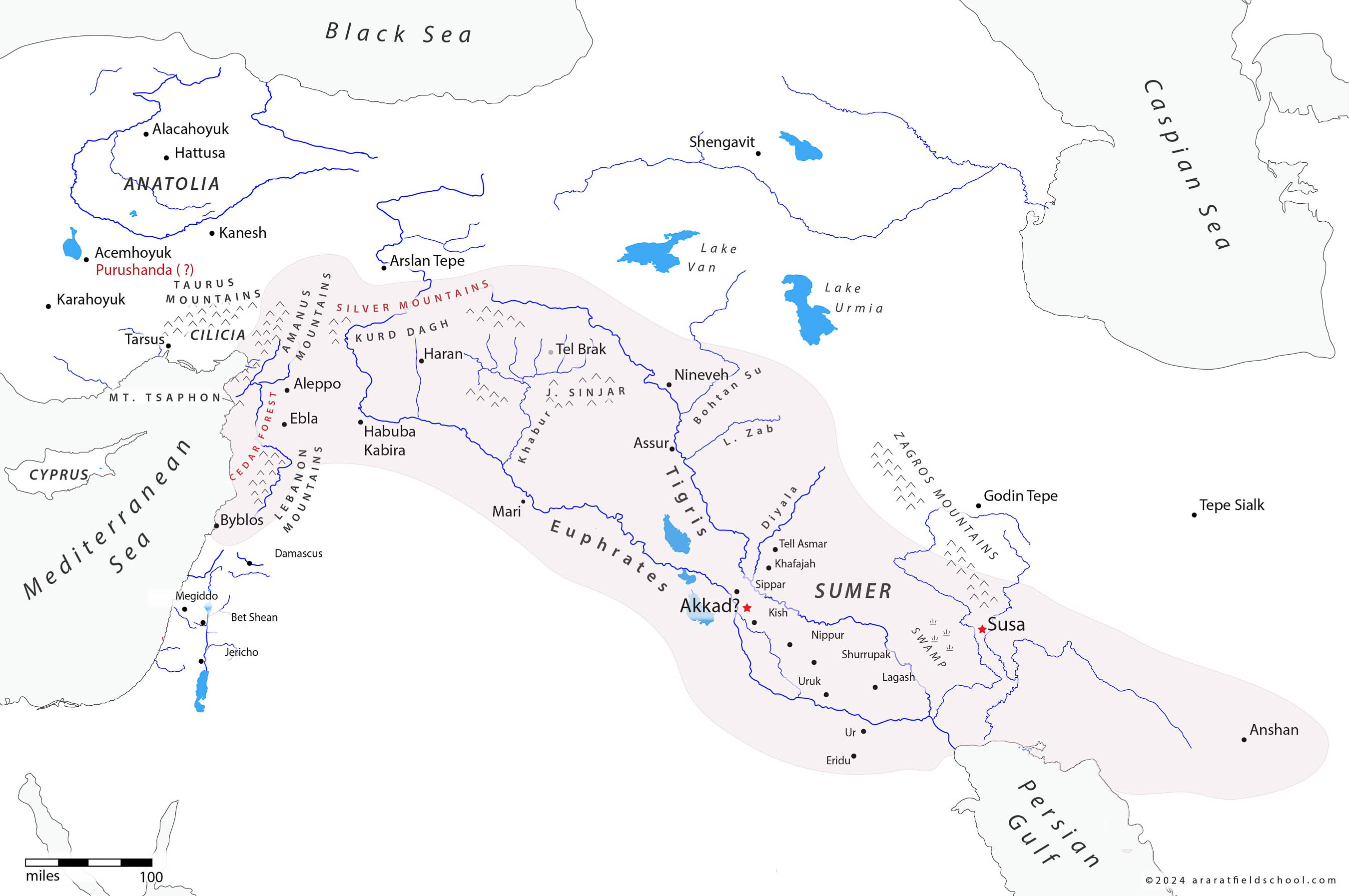
Sargon’s empire extended from the Persian Gulf to the Mediterranean.
Akkadian
The conquests of Sargon spelled the beginning of the end for Sumerian civilization. From this point on, southern Mesopotamia increasingly came under the influence of Akkadian culture and the Akkadian language, which was destined to become the lingua franca (the common spoken language) of the Ancient Near East for over a millennium. The Akkadian language is an eastern dialect of the semitic branch; western dialects include Ugaritic, Amorite, Hebrew, and Aramaic. Eblaite lies somewhere in between east and west. Like other cultures in the region, the Akkadians adopted the Sumerian cuneiform script to write their language.
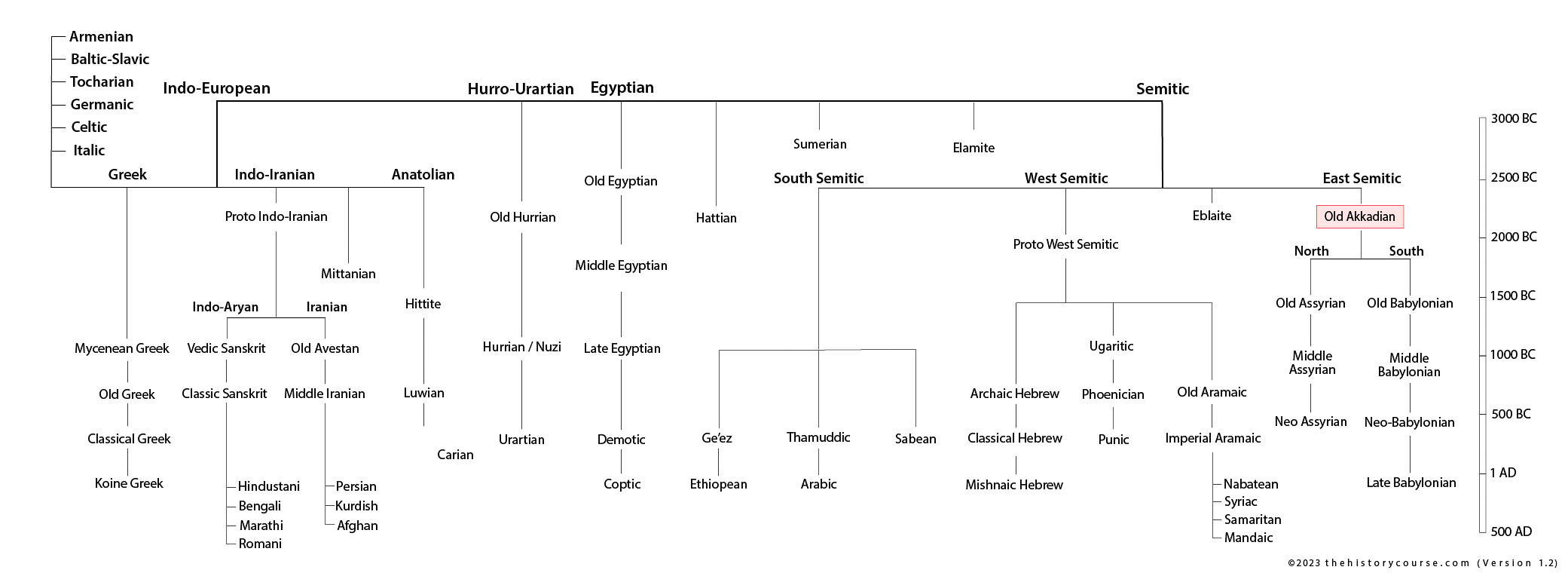
Akkadian belongs to the Semitic family of languages, more specially to its eastern branch. Related languages are Hebrew (Western Semitic) land Arabic (Southern Semiti). Eblaite seems to fall somewhere in between these dialects.
Origins
It is generally thought that the Akkadians were nomadic sheepherders who migrated into Mesopotamia from the west. If such a migration did occur, it must have happened very early since kings bearing semitic names are already found among the kings of the First Dynasty of Kish in the Sumerian King List.5Kramer 1963, 42 Of course, it has been argued that the Sumerians themselves migrated to Sumer, perhaps from Iran.6Kramer 1963, 42 When these migrations occurred and who were the “indigenous” peoples of Mesopotamia (the so-called “Sumerian Problem” which we discussed previously) are interesting questions which have, unfortunately, generated more heat than light. We know that by the late fourth millennium BC, Sumerian culture predominated in southern Mesopotamia and remained dominant until the conquests of Sargon of Akkad in the late the third millennium BC.
Having conquered all of Sumer, Sargon consolidated power by making Akkadian the official administrative language of the court and appointing Akkadian governors over the cities. But in other respects, the culture of the Akkadian court looks Sumerian. The mingling of Akkadian and Sumerian cultural influence is evident in the bronze bust of the Akkadian king, which, although it displays certain northern “Akkadian” features, such as the lean face, high cheekbones, and full beard, nevertheless retains the traditional hairstyle of a Sumerian ensi.
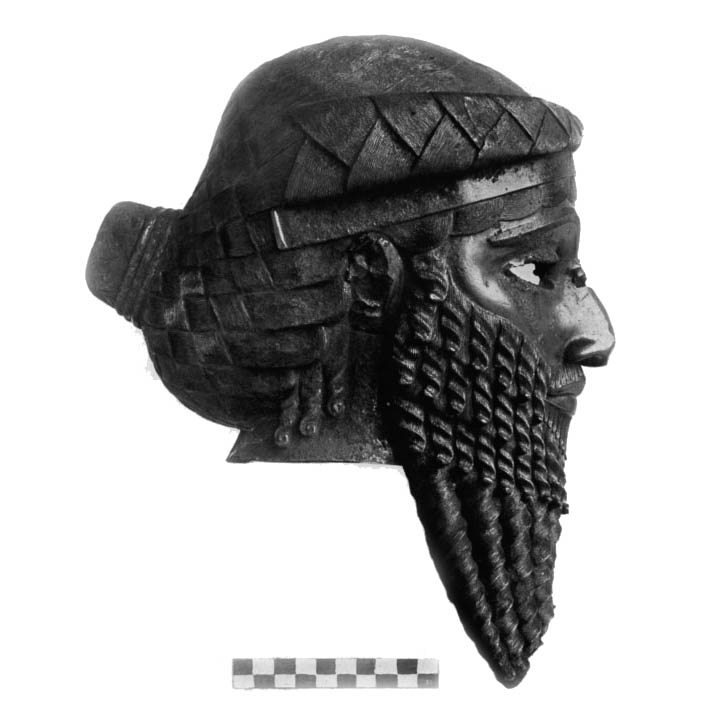
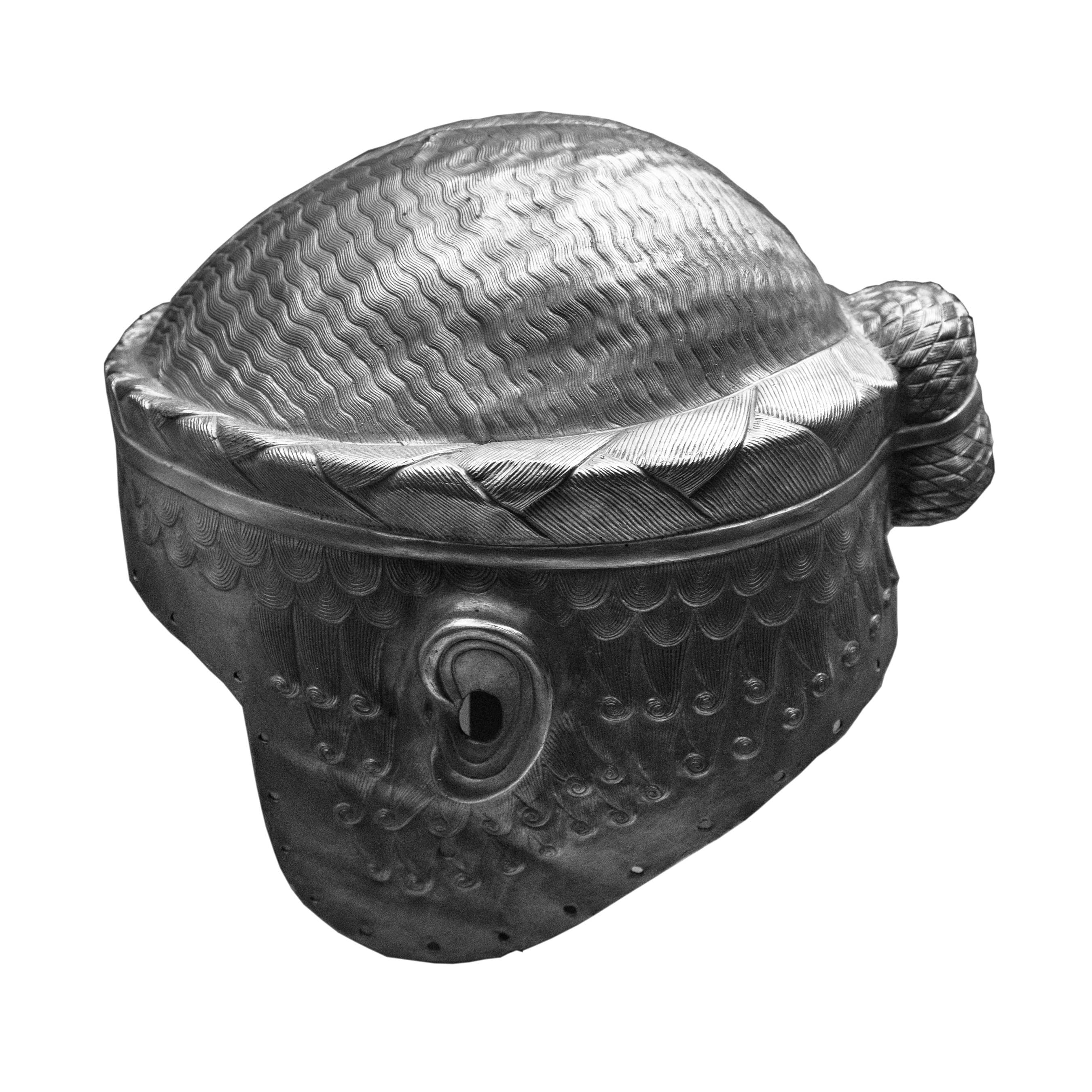
Left: The bronze bust of an Akkadian king, probably Sargon. Right: The gold helmet of Meskalumdug from the Royal Cemetery of Ur (Early Dynastic III). The hairstyles closely match.
Birth Legend
According to a late Assyrian text (7th century BC), Sargon was born in secret to a priestess of Ishtar residing in Nineveh. She placed the baby Sargon in a reed basket, sealed it with pitch, and set it adrift down the Tigris River. The infant was rescued by, Akki, a drawer of water, who raised the child as his own. It was there, in Akki’s orchard, that the goddess Ishtar is supposed “to have found” the young Sargon, “and loved him.”7Foster 2005, IV.18 It is probably not an accident that the bronze bust was found in the precincts of the temple of Ishtar in Nineveh. Max Mallowan, who was a young archaeologists on staff when the head was found at Nineveh, thought that it was likely placed in the temple, known as the E-me-nu-e, by Sargon’s son, Manishtushu, and that this temple endured in one form or another until Neo-Assyrian times (7th century BC).8Mallowan 2010, 78
There are some obvious parallels between this story and the birth of Moses recorded in the book of Exodus. Like Sargon, Moses was placed in a basket sealed with pitch and set among the reeds of a river. But the river was the Nile and the rescuer was the the pharaoh’s daughter. Many scholars have suggested that the Biblical story was derived from the birth legend of Sargon, or perhaps from an earlier myth, but as the Assyriologist, William Hallo, points out, “a third possibility is too often overlooked – namely that the tale of Sargon is modeled on that of Moses!”9Hallo 2010, 229 Hallo notes that textual evidence for the birth legend of Sargon is very late (7th century BC). The story could just as readily have been borrowed from the Israelites than vice-versa since by that time the Assyrians had conquered northern Israel and taken many Israelites captive.
It is also worth pointing out that it may not have been that unusual for an Assyrian or Egyptian woman to place her unwanted child in a basket and set it adrift down the river, just as it was customary among the Greeks to place an unwanted infant in a large earthenware vessel and set it on a road where it was likely to be found by passerby’s.10Cartledge 2006, 80
The King
The bronze head has suffered considerable abuse. One eye is gouged out, the nose is flattened, and the ears are cut off. This damage looks intentional although the responsible party cannot be known. Undoubtedly, there were many who would have liked to take a swing at the Akkadian king. If the head had been made of softer stuff, it probably would have been pulverized, but the toughness of bronze combined with its ability to form a corrosion-resistant patina (the surface of the metal oxidizes, turning green), makes it very nearly eternal. Sargon was the archetypal empire builder. Of course, Sumerian kings had for many centuries fought among each other, but never with the goal of complete subjection and domination. Sargon made a practice of destroying the cities he conquered, and installing one of his lieutenants as governor. Ancient literary accounts of Sargon’s campaigns depict him as eager for war. “My warriors! With [the land of] Kanish I desire war!”11Hamblin 2006, 77
Was it not because of his frightening radiance and his bellowing roar that no one dared to approach him? I, Sargon, am your raging lion… When there is combat, invoke my name!”12Hamblin 2006, 77
Sargon retained a body of 5,400 men who ate at his table—the earliest instance of a standing army in recorded history. Until then, rulers probably could not afford to feed and equip so many men on a continual basis. Only through constant acquisition of land and booty could a ruler justify such lavish spending on the military. Hamblin notes that this may be the earliest instance of a predatory army whose very existence depended upon perpetual warfare. There is much about this picture that is reminiscent of the future Assyrians. Both used cruelty and violence to exploit their subjects. Both enjoyed a period of apparent invincibility when their armies conquered vast regions of the ANE, followed by a near total collapse. It is somehow fitting that one of the kings of Assyria should have adopted the name Sargon, and that Sargon’s bust was set up in an Assyrian temple.
Nimrod
A popular interpretation links Sargon with Nimrod, the archetypal king singled out in the Table of Nations in Genesis 10.
“He was the first on earth to be a mighty man. He was a mighty hunter before the LORD. Therefore it is said, “Like Nimrod a mighty hunter before the LORD.” (Gen. 10:8 ESV)
The description of Nimrod as a “mighty hunter” is an apt description of Mesopotamian kings, who are often depicted as “mighty hunters.” The identification makes sense given that Sargon is the most famous of the early Mesopotamian kings. Both Sargon and Nimrod follow a similar trajectory to power, capturing cities in the south before expanding northwards. Thus it is said of Nimrod,
The beginning of his kingdom was Babel, Erech, Accad, and Calneh, in the land of Shinar (Sumer). From that land he went into Assyria and built Nineveh, Rehoboth-Ir, Calah, and Resen between Nineveh and Calah; that is the great city. (Gen. 10:10-12 ESV)
One of these cities, Akkad, was founded by Sargon and served as the capital of his kingdom. Nineveh also appears to have been an important Akkadian city.13Although the Akkadian stratum at Nineveh is poorly represented archaeologically, we have a dedicatory inscription which credits the Akkadian king, Manishtushu, with building a temple there. This temple was repaired by Shamshi Adad I who, in his dedicatory inscription, references its founding by Manishtushu: “The temple E-me-nu-e, which is in the district of E-mash-mash—which Manishtushu, son of Sargon, king of Akkad, had built—had become dilapidated. The temple which none of the kings who precede me from the Fall of Akkad until my kingship, until the capture of Nurrugu—seven generations have passed—had rebuilt.” (See Westenholz 2004.) The identification of the other northern cities founded by Nimrod have so far eluded scholars.
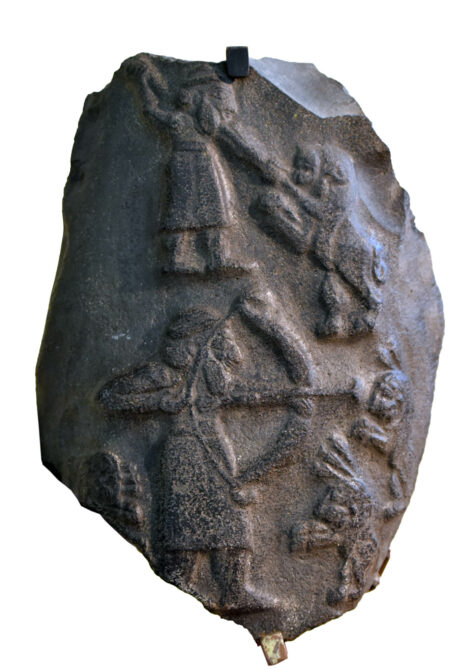

This stone relief which dates to the Uruk or Jemdet Nasr period shows a king hunting lions with a bow.
It is possible, therefore, that the short passage in Genesis 10 preserves the memory of Sargon of Akkad. The different name may be explained by the fact that Nimrod is likely not a proper name but the Hebrew epithet “we shall rebel.” Nimrod stands at the beginning of a long line of kings named in the Bible whose arrogance was typified by the first tower builders of Babel, and whose lust for power was a foreshadowing of the final beast in Daniel’s vision.
After this I saw in the night visions, and behold, a fourth beast, terrifying and dreadful and exceedingly strong. It had great iron teeth; it devoured and broke in pieces and stamped what was left with its feet. It was different from all the beasts that were before it…(Dan. 7:7 ESV)
Astour, Michael C.
“A Reconstruction of the History of Ebla (Part 2),” in Eblaitica : Essays on the Ebla Archives and Eblaite Language, Volume 4, edited by C. H Gordon, Gary Rendsburg.
Winona Lake, Indiana: Eisenbrauns, 2002.
Cartledge, P.
Thermopylae : the battle that changed the world.
New York: Vintage Books, 2006.
Foster, B. R.
Before the muses : an anthology of Akkadian literature.
Bethesda, Md.: CDL Press, 2005.
Hallo, William W, William K. Simpson.
The Ancient Near East: A History.
: Harcourt College Publishers, 1998.
Hallo, W.
The World’s Oldest Literature : Studies in Sumerian Belles-lettres. .
Leiden, Boston: Brill, 2010.
Hamblin, W. J.
Warfare in the Ancient Near East to 1600 BC: Holy Warriors at the Dawn of History.
London ; New York: Routledge, 2006. Link
Mallowan, Max.
Mallowan’s Memoirs.
London: Harper Collins, 2010.
Mallowan, M. “The Bronze Head of the Akkadian Period From Nineveh.” Iraq 3, no. 1 (1936): 104–110. Link
Waltke, Bruce.
Genesis.
Grand Rapids, Michigan: Zondervan, 2001.
Westenholz, Joan Goodnick. ” The Old Akkadian Presence in Nineveh: Fact or Fiction.” Iraq , no. 66 (2004): 7–18. Link
Westenholz, Joan Goodnick.
Legends of the Kings of Akkade : The Texts.
Pennsylvania: Pennsylvania State University Press, 1997.