
This distinctive hand made pottery originated in the Caucasus between the Kura and Araxes rivers.
The handmade pottery of the Kura Araxes culture is unique and easily recognized. The pots are typically black on the outside and red on the inside. The shiny metallic finish was achieve by burnishing the pot with a smooth stone before firing. The earliest pottery is mottled black and brown and lacks decoration.

The earliest examples are light brown or mottled, and lack decoration
These pots often incorporate small knobby handles named “Nakhichevan lugs” after the type site in Azerbaijan where they were first identified. Small but thick loop handles are also common. The vessels may incorporate simple geometric designs or enigmatic symbols which defy interpretation. Pots were made with a narrow rounded base so that they could be set in a depression in the ground or on a hearth. Specially made pottery stands are also common.

The narrow base of the pot, although seemingly quite impractical at first, makes sense when it is understood that the pot was made to sit in a stand or on a hearth.
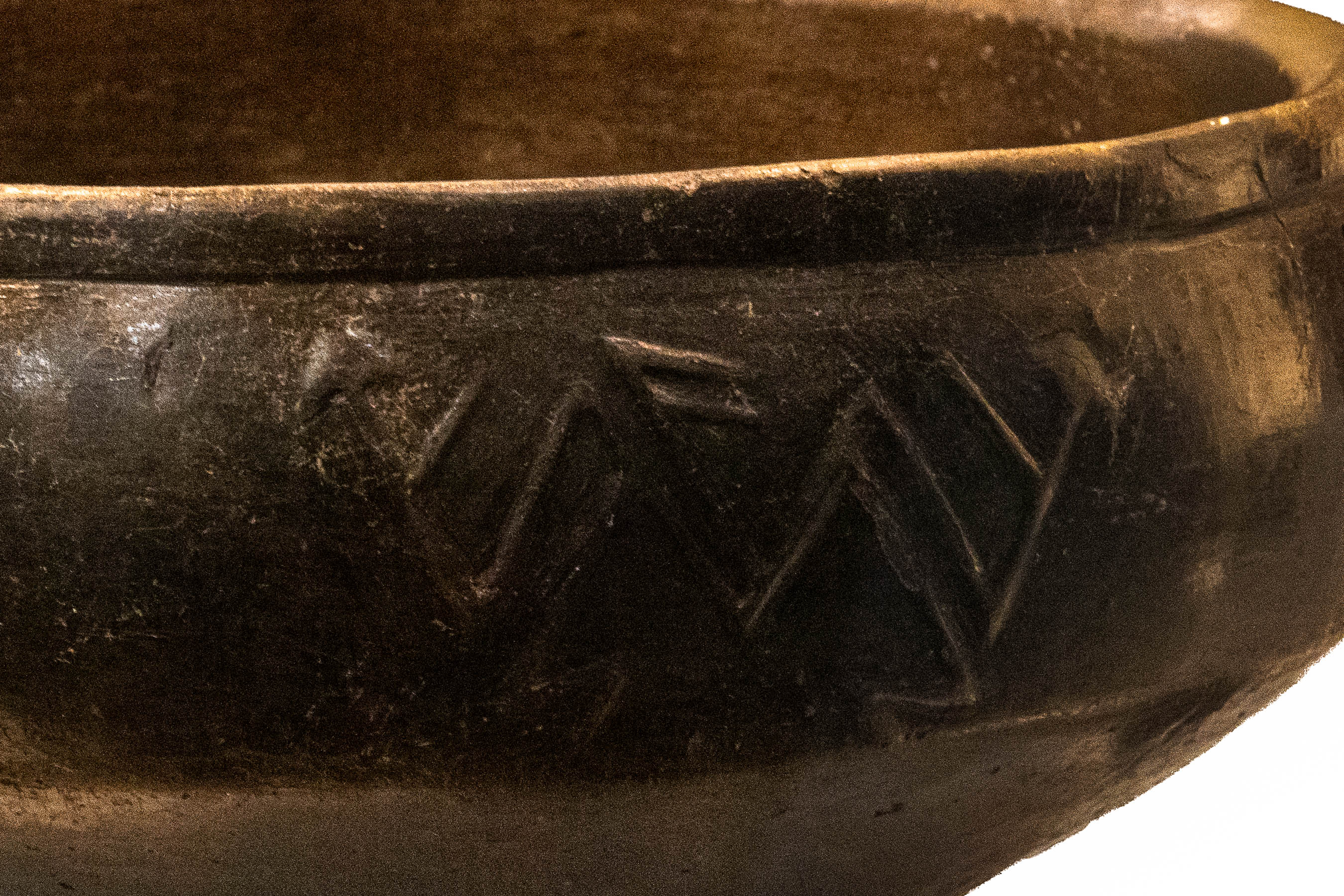

The use of spirals and triangles are typical for this type of pottery. Little regard is shown for symmetry. The symbols are enigmatic. The one on the right may be an abstract depiction of a bird.


These small lug handles flare to a circle where they attach to the pot, thus forming a very strong handle shape.


Small pots with lids and thickset loop handles are characteristic features of Kura Araxes pottery.
Characteristics:
- handmade
- black-burnished outside and red-burnished inside
- small loop handle or “Nakhichevan” lug
- incised or raised lines, spirals and enigmatic symbols
- narrow base
- lids
- stands
Red and Black Burnished at Arslantepe
Elements of the Kura Araxes culture have been found beyond the Caucasus, in northern Iran and eastern Anatolia. Most notably, Red and Black Burnished Ware was found at Arslantepe in Stratum VIA. A large administrative building which belongs to this stratum produced archaic accounting tablets, beveled-rim bowls, and cylinder seal impressions typical of the Uruk period. As you may recall, this level also produced “flowerpots” and fenestrated pottery stands. These objects suggest that Arslantepe functioned as a trading post for Urukean merchants. The presence of hand made Red and Black Burnished pottery in the same level points to some overlap between the Uruk period and the Kura Araxes culture.1Frangipane 1997, 69
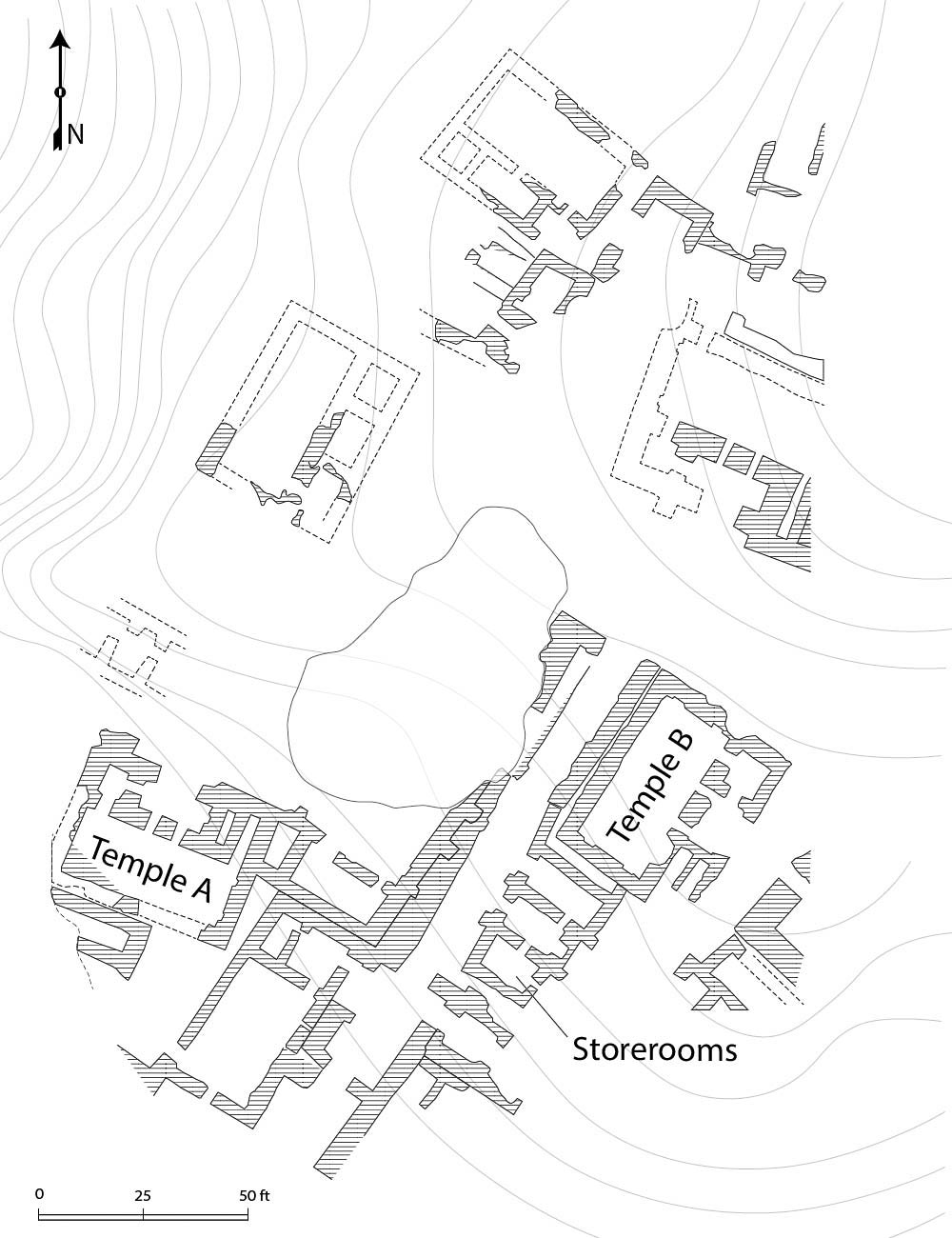
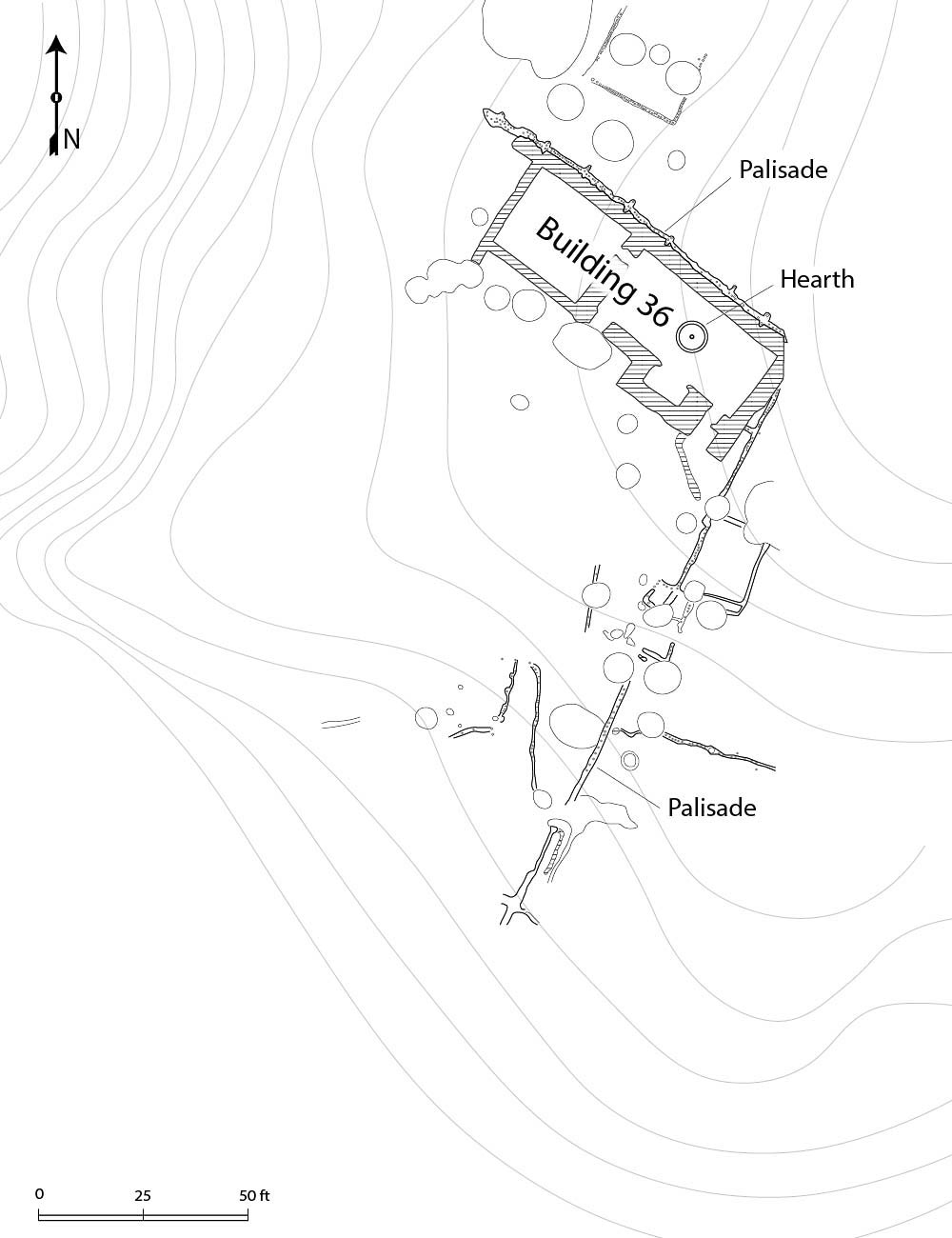
Left: Arslantepe during the Uruk period appears to have been an important trading post. Pottery, archaic accounting tablet, cylinder seals are readily identifiable as Urukean. Right: The next phase witnessed the construction of flimsy makeshift structures, wattle and daub construction, and hearths. Red and Black Burnished pottery typical of the Kura Araxes culture became the predominant type of pottery found at the site.
Arslantepe was not insulated from the sudden collapse of the Urukean trade network which marked the end of an era, although perhaps not the end of the Uruk period. The large administrative building which housed the archaic accounting tablets was destroyed and its place taken by smaller, less well constructed buildings. These buildings, some of which had a rounded floor plan, often had hearths while Red and Black Burnished Ware became the predominant pottery type at the site.
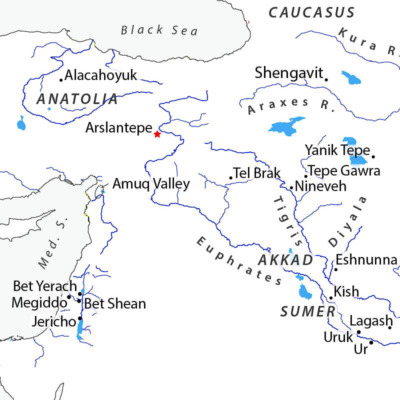
The evidence from Arslantepe suggests that the city succumbed to an invasion from the Caucasus. However, since Red and Black Burnished pottery was already present at Arslantepe during the Uruk period, it is difficult to argue that this was an invasion from the Caucasus. The destruction wrought at Arslantepe seems rather to have been the result of a broader phenomenon which saw a great many Uruk period settlements and trading posts destroyed and abandoned. Perhaps Uruk itself was overthrown, leaving its satellite colonies exposed to attack from other quarters. In either case, the culture which produced the Red and Black Burnished pottery became the dominant one at Arslantepe in the period following the Uruk period. In subsequent centuries pottery belonging to this culture will be found as far afield as Alacahoyuk in central Anatolia, the Amuq Valley in Syria, and the Galilee in Israel. It is not entirely clear whether Red and Black Burnished entered into Anatolia from the Caucasus or whether this type of pottery is native to both regions.2Braidwood argued that the Red and Black Burnished which he found at Amuq Valley sites in Syria evolved from an earlier type which he named Black-Faced Ware. He considered Red and Black Burnished to be the product of a regional phenomenon that encompassed both Eastern Anatolia and the Caucasus. Its appearance at sites in the Amuq Valley therefore could not construed as evidence for a northern invasion out of the Caucasus, contra Hood and Woolley. See: Braidwood 1960, 519 ff.
Algaze, Guillermo.
The Uruk World System: The Dynamics of Expansion of Early Mesopotamian Civilization (2nd Edition).
Chicago, IL: The University of Chicago Press, 2005.
Braidwood, Robert J, Linda S. Braidwood.
Excavations in the Plain of Antioch I, The Earlier Assemblages Phases A-J.
Chicago, Illinoi: The University of Chicago Press, 1960. Link
Frangipane, Marcella. “A 4th-Millennium Temple/Palace Complex at Arslantepe-Malatya. North-South Relations and the Formation of Early State Societies in the Northern Regions of Greater Mesopotamia.” Paléorient 23, no. 1 (1997): 45–73. Link
Frangipane, Marcella. “After collapse: Continuity and Disruption in the settlement by Kura-Araxes-linked pastoral groups at Arslantepe-Malatya (Turkey). New data..” Paléorient 40, no. 2 ( 2014): 169-182. Link
Palumbi, Giulio.
“The expansion of the Kura-Araxes culture in Iran: what role for the Uruk?,” in Le Plateau Iranien. Urbanisation, Commerce, Subsistance et Production à l’Age du Bronze.
Lyon, France: HAL Open Science, 2014 . Link
Simonyan, Hakob, Mitchell S Rothman.
Shengavit: A Kura-Araxes Center in Armenia.
Costa Mesa, California: Mazda Publishers, 2023.
Rothmann, Mitchell S. “Early Bronze Age Migrants and Ethnicity in the Middle Eastern Mountain Zone.” Proceedings of the National Academy of Science 112, no. 30 (July 2015). Link
Sagona, A.
“Encounters beyond the Caucasus: The Kura-Araxes Culture and the Early Bronze Age (3500–2400 BC),” in The Archaeology of the Caucasus: From Earliest Settlements to the Iron Age. Cambridge World Archaeology.
Cambridge: Cambridge University Press, 2017.