
An important city in the southern Levant during the Early Bronze Age, it was destroyed towards the end of the Early Bronze period and abandoned. Wadi Kerak is visible on the right.
The year was 1924 when Albright and his team descended into the southern Ghor. William Albright was already a well known figure in the world of Levantine archaeology. A gifted linguist, Albright would master 26 modern and ancient languages. And his pottery sequence for the southern Levant formed the basis for all subsequent work in the field. 1William Foxwell Albright (1891 – 1971) A Biographical Memoir Albright had been invited to lead an expedition to the south end of the Dead Sea (Arabic ghor “valley”) by his friend and colleague, M. G. Kyle, was then president of Xenia Seminary. Kyle had a keen interest in archaeology and, more importantly, the funding needed for an expedition. They were joined by Pere Mallon and E. L. Sukenik, both whom were rising stars in the world of archaeology. The purpose for the expedition was to see if there was any evidence of a bronze age civilization in the southern Ghor matching that which is described in the Bible. Since Zoar was the only one of the five cities of the plain that were not destroyed, and was in fact the seat of a bishopric during the Byzantine period, it made sense for the expedition to begin there.

The initial results of the expedition were disappointing. They found the remains of the Byzantine settlement at Zoar, but nothing really ancient. The difficult terrain hampered their efforts and claimed several of their mules. One of the poor creatures, says Albright, was “dashed to pieces” in the bottom of a wadi (Arabic wadi “canyon”). Their big discovery did not come until the very end, when Pere Mallon climbed above the plain onto a low ridge overlooking Wadi Kerak. There he began to find pottery and flint which clearly belonged to a much earlier period. It was their first real evidence of an early civilization in the southern Ghor. A closer inspection of the site, named Bab edh-Dhra (Arabic “Gate of the Arm”), revealed a large “fortified acropolis.” It was generally agreed that the pottery dated to the end of the Early Bronze period, although one of those who looked at it, Pere Vincent, thought some of it could date even earlier, to the beginning of the third millennium BC. Vincent proved to be correct. The earliest pottery did indeed date to an early period whereas the latest pottery from the site was thought to display some Middle Bronze characteristics and was therefore dated to c. 1800 BC at the latest.2Albright 1924, 6 Curiously, Albright fails to mention in his report the vast cemetery located just south of Bab edh-Dhra. He speaks instead of finding hearths and hastily erected structures which he thought must have belonged to a nomadic population. These may actually have been tombs, but of a unique kind otherwise unknown in the southern Levant, and strangely burned with fire. (We will come back to these in the next entry.)
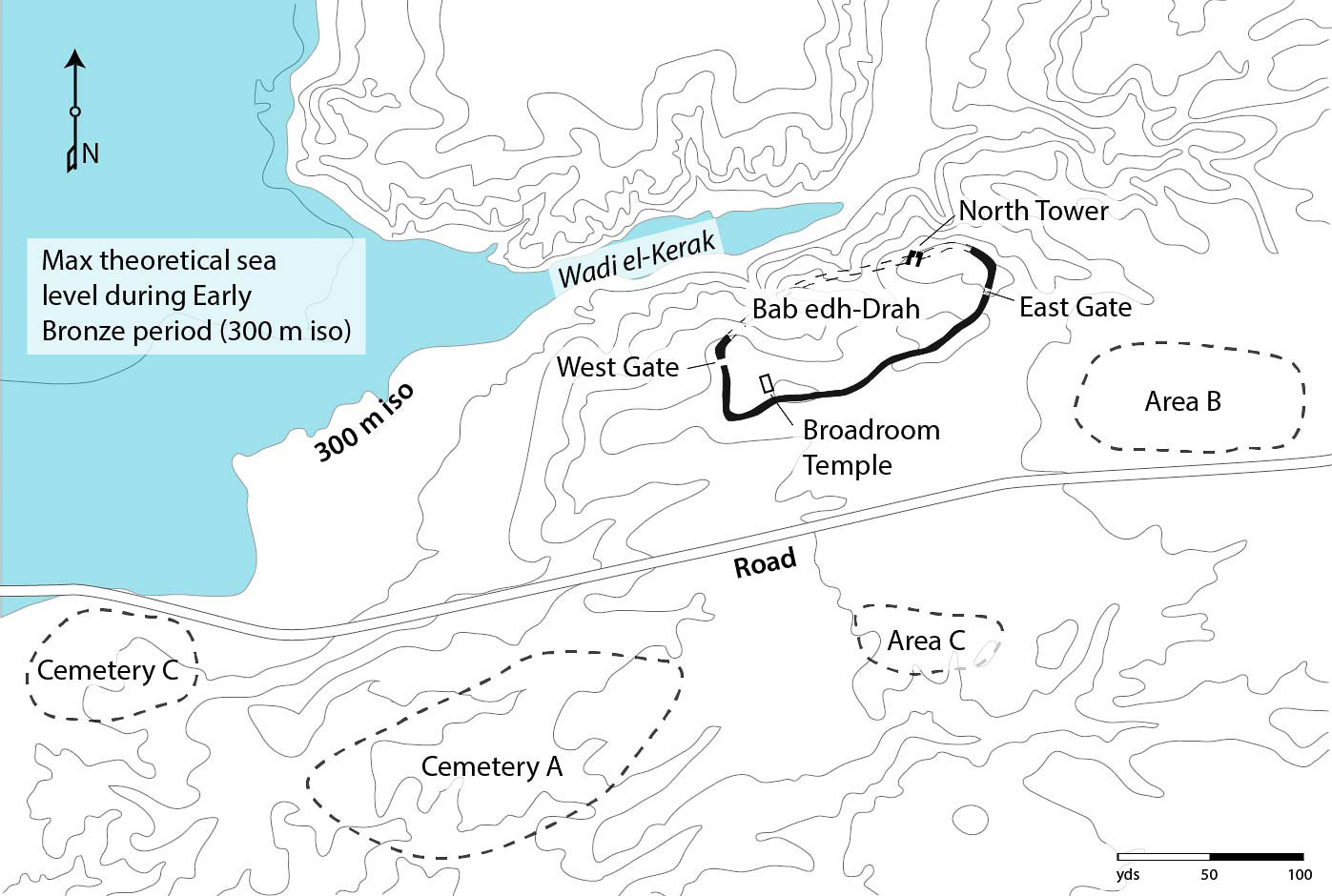
The blue area marks the possible shoreline of the Dead Sea if it reached as high as the 300 meter iso line, as some researchers believe.
Bab edh-Dhra
Excavations at Bab edh-Dhra did not commence until the 1960’s, when one of William Albright’s students, Paul Lapp, began work in the city and nearby cemetery. His work was tragically cut short in 1970 when he was swept to sea off the coast of Cyprus. Two of Lapp’s associates, Walter Rast and Thomas Schaub, assumed responsibility for publishing Lapp’s work and resumed work in the rarea in 1973, at Bab edh-Dhra and also at other sites in the region.
The excavations at Bab edh-Dhra revealed a city wall constructed during the Early Bronze III period. The wall enclosed an area of approximately 9 acres although it is difficult to make a precise estimate since the entire northern section of the city wall has collapsed into the wadi. The archaeologists also found remnants of a settlement outside of the walls, east of the city.3Rast and Schaub 2003, 251
Bab edh-Dhra is a likely candidate for one of cities of the plain, perhaps even Sodom, although there is no sure way of making this identification. Four more sites have been identified along the southern coast of the Dead Sea, each situated on a major wadi. These are: Numeira (Gomorrah), es-Safi (Zoar), Khanazir, and Feifa. Each of the wadis converges on the southern end of the Dead Sea. If they flowed with perennial streams during the Early Bronze period, which seems likely, then we have what may properly be described as a well watered plain.
It is noteworthy that all of the archaeological sites so far identified in the region are located east of the major north south fault line (see map above). They are, therefore, located on the tectonic plate that is sliding rather than the one that is subsiding. Albright would continue to maintain that some or all of the cities of the plain were submerged beneath the sea. If so, then they will be deeply buried by sediment by now. It nevertheless stands to reason that the Early Bronze sites identified in the region must belong to the same civilization. Some of them may, perhaps, be more properly classified as citadels, not unlike Troy. Perhaps there is a lower city waiting to be found. But if the archaeological work conducted so far in the southern Ghor has proven one thing, it is that the region was host to a large population during the Early Bronze period, even if we don’t know where the majority of the population resided.
Destruction
Bab edh-Dhra reached its apogee during the Early Bronze III period. It seems to have fallen upon hard times towards the end of this period or in the Early Bronze IV. This may be seen, for example, in the western gate of the city, which was blocked up with stones, as though the city had undergone a siege. This final phase of the city did not last long before it met with a violent end. Bright red bricks may still be found on the surface of the site in places, evidence of a burn destruction. With regards to these bricks, Rast and Schaub write,
On the problem of the firing of the bricks, the geological investigation concluded that oxidation of the bricks occurred secondarily, and that exposure to fire concretized them with the pink to reddish color. The basis for this conclusion was the localized burning, in which a fire had climbed up part of the wall while other parts were untouched. Thus the original brick was unfired, while those that were fired had apparently not been prepared that way by the builders.4Rast and Schaub 2003, 270
In other words, the bricks were not fired when the city was constructed, but when it was destroyed.


Left: The city was fortified with a 23 feet wide mudbrick wall, erected on a rubble stone foundation. The wall was built in segments detached from each other. Each segment was allowed to move, like a link in a bike chain, instead of a monolithic structure liable to crumble during an earthquake. This mode of construction suggests that the builders of Bab edh-Dhra had considerable experience with earthquakes. This is to be expected given that Bab edh-Dhra lies on a major fault. Right: The blocked up gate on the western end of city.
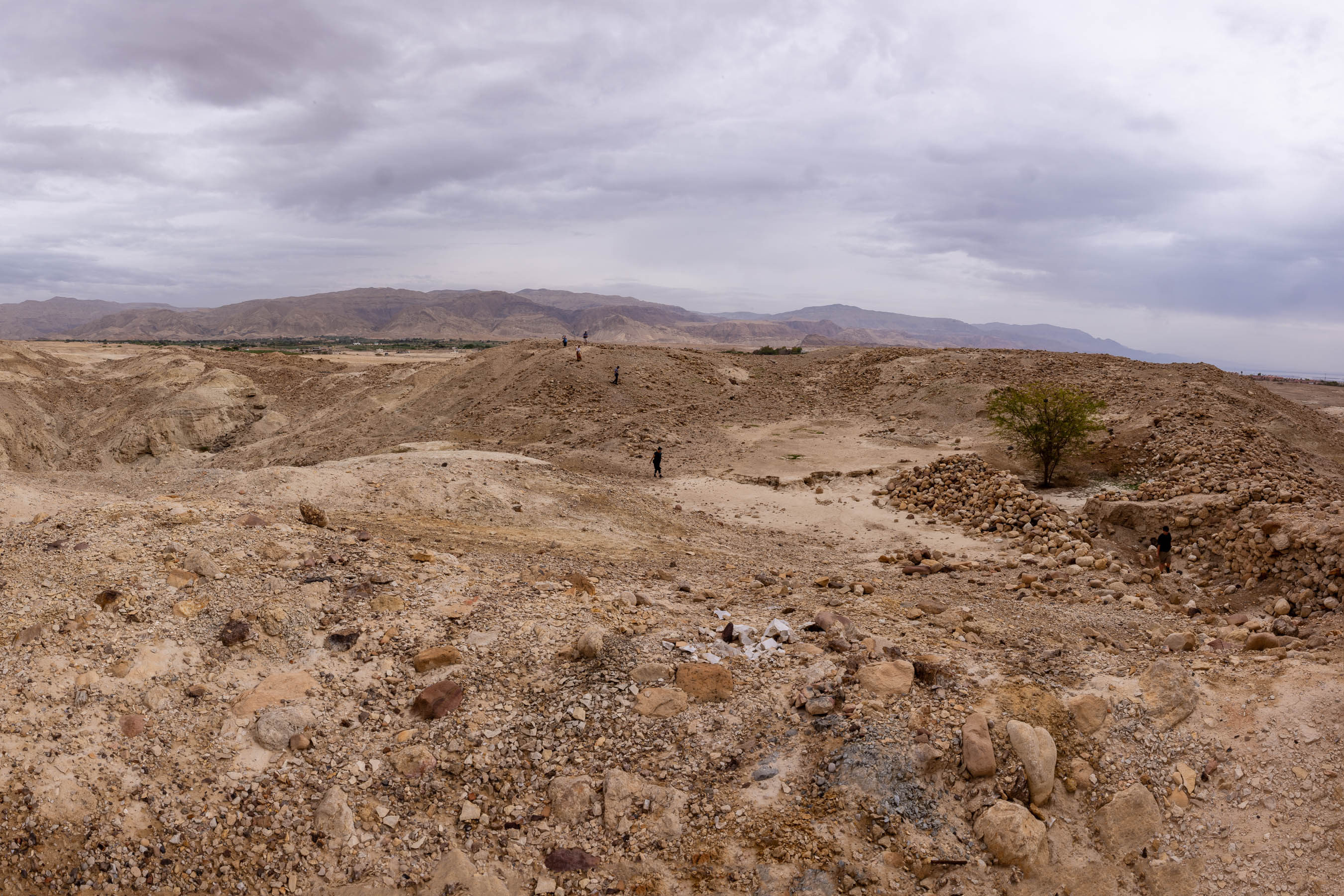

The city is now deeply cut with ravines which have eroded away much of the city. The mudbrick wall which formerly stood on the wall has now mostly disintegrated except for those bricks which were burned.
Numeira
An even more extensive burn level was discovered at the neighboring site of Numeira. Here is how Rast describes it:
The burnt debris covering this site has appeared in almost every area excavated, and it raises important questions. Was the town attacked by enemies, and if so, who were they? Or was the cause some sort of disaster — perhaps an earthquake which set off fires in all parts of the town? Whatever the cause, it was certainly a tragedy: the skeletons of two adult male victims were found embedded in burnt debris next to the tower.5Rast 1987, 47-48
The excavators of Numeira and Bab edh-Dhra date the destruction of these cities to the end of the Early Bronze III period. Numeira was completely abandoned whereas traces of a nomadic settlement persisting into the Early Bronze IV—Middle Bronze I was found at Bab edh-Dhra. Rast notes that houses were constructed “in several cases above the burned ruins of the former city, but mostly in the flatter areas to the north, east and south of the ruined city.”6Rast 1987, 48 The city therefore was never rebuilt. Its ruins became an encampment for nomads. We will look more closely at the fate of these cities in the next entry.


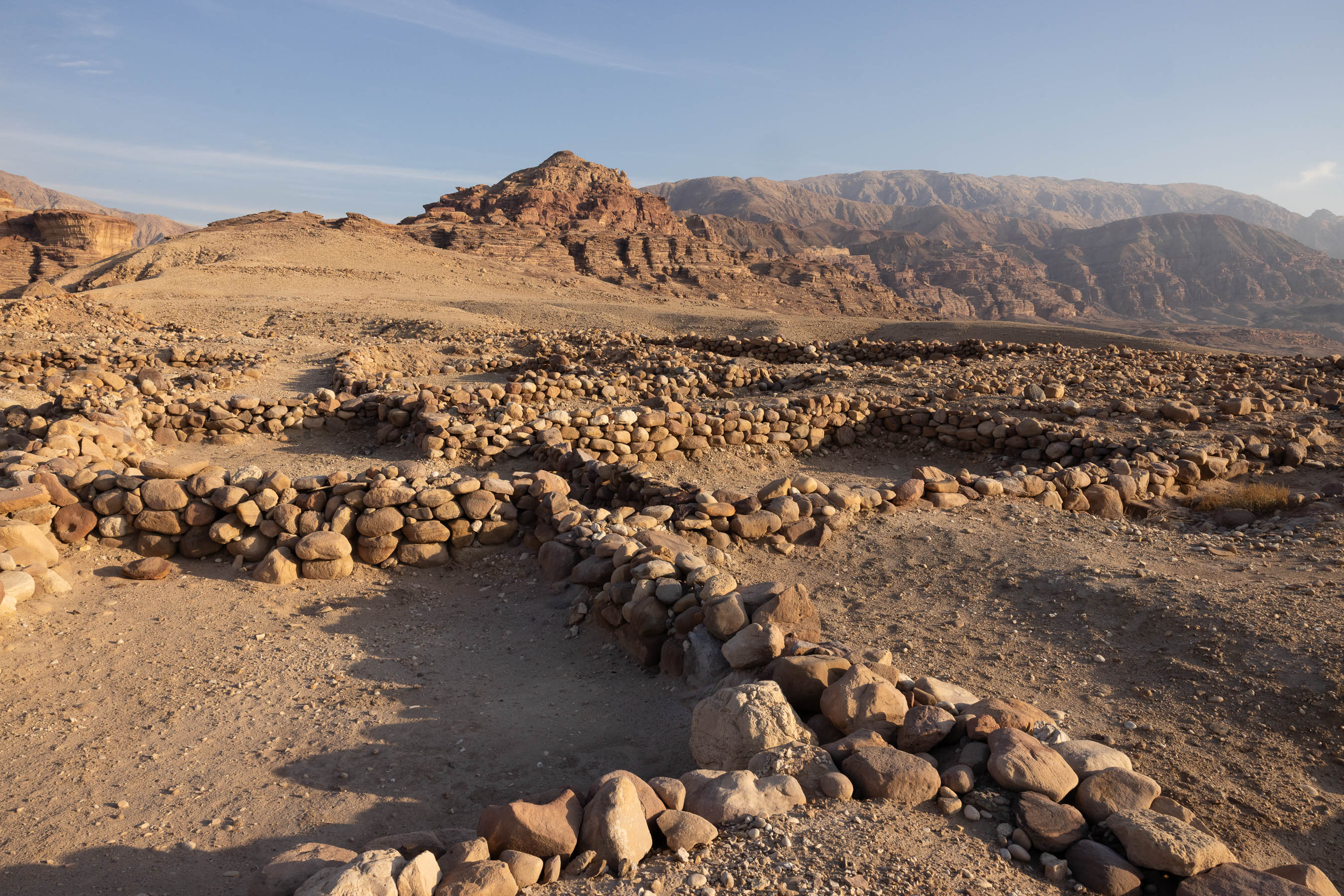

Numeira is perched above the southern basin of the Dead Sea. The Arabaic name “Numeira” likely preserves the Hebrew name “Amorah” which is translated “Gomorrah” in our Bibles. It was located right next to Bab edh-Dhra. If the latter is Sodom then this would explain why the two cities are always mentioned together. Although only a small portion of its defensive wall remains, the masonry used in its construction testifies to its former glory. Numeira was destroyed in a fiery destruction.
Chronology
Archaeologists uncovered four major strata at Bab edh-Dhra which are outlined in the table below. We will see as we continue that there is considerable disagreement about when the Early Bronze period ends and how it should be designated. That the cities of the southern Levant fell upon hard times at the end of the Early Bronze period, none will deny, but there is no agreement about the cause of the decline or when it began. Nor has it been possible to establish a precise chronology for the transition from the Early to Middle Bronze ages. Thus I have chosen to follow the popular convention of referring to this transitional period as the EB IV—MB I.
| Stratum | Period | Standard | AFS | Description |
|---|---|---|---|---|
| V | EB IA | 3800-3300 BC | 3200-2900 BC |
|
| IV | EB 1B | 3300-3000 BC | 2900-2750 BC |
|
| III | EB II | 3000-2700 BC | 2750-2500 BC |
|
| II | EB III | 2700-2300 BC | 2500-2150 BC |
|
| I | EB IV | 2300-2100 BC | 2150-2060 BC |
|
Albright, William F. “The Archaeological Results of an Expedition to Moab and the Dead Sea.” Bulletin of the American Society of Overseas Research 14 (April 1924). Link
Jampoler, Andrew.
Sailors in the Holy Land : the 1848 American Expedition to the Dead Sea and the Search for Sodom and Gomorrah.
Annapolis, Md.: Naval Institute Press, 2005.
Lapp, Paul, Thomas Schaub, Walter Rast.
Bāb edh-Dhrāʻ : Excavations in the Cemetery directed by Paul W. Lapp (1965-67).
Winona Lake, Indiana: Eisenbrauns, 1989. Link
Lapp, Paul. “Bâb Edh-Dhrâ’ Tomb a 76 and Early Bronze I in Palestine.” Bulletin of the American Schools of Oriental Research, no. No. 189 (1968): 12–41. Link
Oron, Asaf, Ehud Galili, Gideon Hadas, Micha Klein. “Early Maritime Activity on the Dead Sea: Bitumen Harvesting and the Possible Use of Reed Watercraft.” Journal of Maritime Archaeology 10, no. 1 (2015): 65–88. Link
Rast, Walter, Thomas Schaub.
Bāb edh-Dhrāʻ : Excavations at the Town Site (1975-1981).
Winona Lake, Indiana: Eisenbrauns, 2003.
Rast, Walter E.Archaeology 40, no. 1 (1987): 42–49. Link