The Eblaites used the archaic Sumerian word en for “king” long after it had ceased to be used this way in Sumer. To the Sumerian ear, this was the equivalent of an English speaker using the Old Saxon word atheling for “prince.” Conversely, the Sumerian title lugal (“big man”) adopted by all the great kings of Sumer refered to a mere governor in Ebla.
Such archaic language at Ebla suggests that Sumerian influence went back to a very early period.1Pettinato 1981, 74 A carved wooden fragment discovered in Palace G probably depicts a king of Ebla. His fleecy kaunakes is similar to those worn by Sumerian kings, but covers his whole body, a clothing style undoubtedly dictated by the cooler temperatures which prevailed in the region. He carries an axe identical to those found in the Royal Cemetery at Ur.
The names of several dozen Eblaite kings were discovered in the Ebla Archive. However, we only have detailed information about the last four kings, whose reigns coincide with the duration of the Ebla archive, a span of approximately 50 years by most estimates.
Giovanni Pettinato, the epigrapher responsible for the initial publication of the tablets, suggested that Eblaite kings may originally have been elected by a group of elders from the leading families of Ebla. Whether he is correct or not in this assessment, it is clear that during the period of the Ebla archives it was customary for the king share authority with a vizier who took a leading role in foreign affairs. This more decentralized form of administration contrasts with the highly centralized political structure that prevailed in Egypt, and arose in Sumer during the Akkadian and Ur III periods.
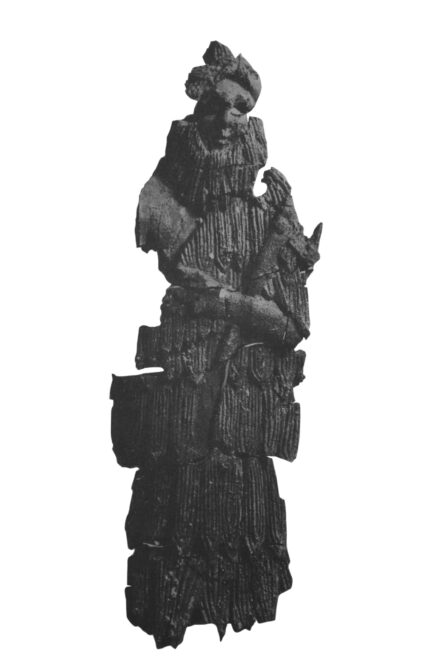

The fragment of a wooden relief of an Eblaite king or elder found in Palace G at Ebla.
| Name | AFS Chronology | Standard Chronology | Events |
|---|---|---|---|
| Igrish-Halam |
| ||
| Irkab-Damu |
| ||
| Ishar-Damu | c. 2185 - 2150 BC | c. 2335 - 2300 BC |
|
International Relations
As the power of Ebla increased, it drew many smaller city-states into its orbit and made alliances with others. Even Hamazi, located somewhere northeast of Mesopotamia, at least 500 miles distant from Ebla, entered into an alliance with Ebla. The fifty-five pounds of unworked lapis lazuli discovered in Palace G may have been carried there from Hamazi. If it was located somewhere in the vicinity of Lake Urmia, as Pettinato suggested, then it was well placed to serve as a conduit for the precious stone mined in Afghanistan.
Ebla also maintained relations with Egypt. A diorite lamp inscribed with the name of the Egyptian king, Khafre (Fourth Dynasty), and an alabaster vessel inscribed with the serekh of Pepi I (Sixth Dynasty) were found in the debris of the palace. The latter object may therefore provide a terminus post quem (“no earlier than”) for the destruction of the palace. Pepi I was probably a contemporary of Ishar-Damu, the last king of Ebla. If Sargon of Akkad was the destroyer of Ebla, which seems likely, then we have a synchronism at Ebla between Pepi I, Ishar-Damu, and Sargon of Akkad.
Destruction of Mardikh IIB1
The precise chronology surrounding the destruction of Palace G remains unclear. Both Sargon of Akkad and his grandson, Naram-Sin, claimed credit.2Giovanni Pettinato, the chief epigrapher of the Italian Expedition, did not think either king was responsible for the destruction of Palace G, which he thought must have occurred approximately 250 years earlier. Pettinato argued that the archaic style of writing displayed on the tablets recovered from Palace G made them contemporary with the tablets from Fara and Abu Salabikh (See: The Instructions of Shuruppak). Pettinato also notes that the tablets from Ebla make no mention of Akkad but numerous references to Kish and Adab (Pettinato 1981, 73). Pettinato cites texts which mention a certain me-sa-li-ma whom he identified with Mesalim. This identification has been called into question recently (See Astour 2002, 61). Pettinato suggests that Kish may have attacked Ebla and was responsible for the destruction of Palace G. The Sumerian King List (SKL) makes reference to a Second Dynasty of Kish followed by a dynasty of Hamazi. If this testimony is accepted, then Hamazi would have controlled the lowland cities of Sumer for a short period of time (only one king is listed for this dynasty). Since, as noted previously, Ebla had a treaty with Hamazi and relied upon it for mercenaries, it is possible that Ebla was drawn into a war with Sumer. Pettinato cites inscriptions which suggest that Kish defeated Hamazi, contrary to the Sumerian King List which credits the victory to Uruk instead. More recently, Michael Astor has argued that the “Ebla” mentioned in Akkadian texts was not the Ebla located in Syria, but a city with that name located in the headwaters of the Tigris (Astour 2002, 65). Astour points to an alabaster lid inscribed with the name of the Sixth Dynasty Egyptian pharaoh, Pepi I, found in the destruction level of the palace, which provides a possible terminus post quem (Latin. “no earlier than”) for the destruction of the city. If the reign of Pepi I preceded that of Sargon, as Astour argues, then this means the destruction of Palace G might have occurred in the decades prior to the reign of Sargon (Astour 2002, 60). According to Astour, the Akkadians never attacked the Syrian Ebla. The destruction of Palace G should be attributed to Lugalzegesi, king of Uruk, whose reign immediately preceded Sargon of Akkad’s. Conversely, Pettinato dismissed the alabaster object inscribed with the name of Pepi I as intrusive, placing more weight instead on the date of the archive itself, which he dated much earlier than the reign of Pepi I. It seems to me that Occam’s Razor favors the identification of the “Ebla” in the Akkadian inscriptions with the Syrian Ebla. Both Sargon of Akkad and Naram-Sin claimed not only to conquer Ebla but also to have reached as far as the Amanus mountains. There is a clear progression here, with Ebla being the largest city in the region that controlled the road to these mountains. However, in light of the generally archaic style of the Ebla archive, and the glaring absence of any references to the kings of Akkad in the tablets, Matthiae considers Sargon of Akkad to be the most likely candidate rather than one of his successors. Naram-Sin undoubtedly conducted a western campaign approximately fifty years after Sargon’s, but his primary opponent seems to have been the city of Armi in northern Syria, rather than Ebla. Although Naram-Sin claims to have conquered both Armi and Ebla, his inscriptions only mentions the king of Armi by name. In fact, Ebla had had been vanquished years earlier by Sargon, but a royal scribe may be forgiven a few small embellishments.
Astour, Michael C.
“A Reconstruction of the History of Ebla (Part 2),” in Eblaitica : Essays on the Ebla Archives and Eblaite Language, Volume 4, edited by C. H Gordon, Gary Rendsburg.
Winona Lake, Indiana: Eisenbrauns, 2002.
Benati, Giacomo , Marco Bonechi.
“The Fiscal Capacity of the Ebla State in the Early Bronze Age: Taxation and Political Structure,” in Economic Complexity in the Ancient Near East, edited by Jana Mynářová , Sergio Alivernini .
Prague: Charles University, 2020. Link
Caracuta, Valentina, Girolamo Fiorentino.
“Use of Wood and Environment in Bronze Age Ebla: Results of the Anthracological Analyses,” in Proceedings of the Fourth International Meeting of Anthracology, edited by Freddy Damblon. BAR International Series 2486 vols.
Oxford, UK: Archaeopress, 2013. Link
Matthiae, Paolo.
, edited by Mattia Bilardello, Anita Weston, translated by Richard Bates.
London and New York: Routledge, 2021.
Matthiae, P.
Ebla : An Empire Rediscovered.
Garden City, N.Y: Doubleday, 1981. Link
Pettinato, G.
The Archives of Ebla : An Empire Inscribed in Clay.
Garden City, N.Y.: Doubleday, 1981. Link