The war between Ebla and Mari persisted for over a century. The expansionist Mariote king, Ishtup-Ishar, whose reign falls into the period before the Ebla archives, pushed Ebla back from the Balikh westwards, seizing the strategic city of Emar on the Euphrates. His successor, Iblul-Il, commanded the whole stretch of the Upper Euphrates, as far north as Carchemish and beyond. He was the contemporary if Igrish-Halam, the earliest of the four Eblaite kings who feature prominently in the Ebla archive.
Iblul-Il also struck north towards the Khabur Basin where he captured the important city of Naggar. Thus Mari attained a position of unprecedent power in the region. As for Ebla, it was now cut off from its trading partners in the east. Whereas before Eblaite merchants had been able to travel through the upper Khabur, via Naggar, and thence to the Tigris, now Mari controlled access to both the Tigris and the Euphrates.

Tribute
Ebla itself escaped conquest only by paying enormous amounts of tribute. The sum is recorded in a letter written by the Marioite king, Enna-Dagan, to the king Ebla. In the letter Enna-Dagan boasts of his exploits and those of his predecessors, Iblul-Il and Nizzi, and tallies the amount of tribute paid by the kings of Ebla to Mari.1Archi and Biga 2003, 2
2193 minas of silver and 134 minas, 26 shekels of gold.2Pettinato 1981
A mina was equal to 60 shekels and a shekel to 180 se. Each se was equal to one full grain of barley, or about 1/500th of an ounce.3See Rositani 2017, 55 Thus a shekel weighed about .4 of an ounce. The sum of 2193 minas of silver was therefore equal to 131,580 shekels or approximately 1.6 tons, which is an enormous amount of silver. To put this into perspective, the Hammurabi Code sets the wages of an unskilled laborer at approximately 12 shekels of silver per year.4Rositani 2017, 56
The sum of tribute paid by Ebla to Mari provides a useful baseline for comparing similar tallies of gold and silver recorded in the Bible and in Assyrian texts.
- Menahem paid tribute to Tiglath Pileser III of “1000 talents of silver” (2 Ki 15:19-20).5cf. Raging Torrent, nos. 9 & 10 where ‘Menahem of Samaria’ is one of the tribute bearers listed in a annal fragment dating to 738 BC.
- Hezekiah paid tribute to Sennacherib of “30 talents of gold, 800 talents of silver…” (Raging Torrent, no. 28).6cf. 2 Ki 18:15,16; This amount added up to 900 kg of gold and 24,000 kg of silver. 2 Ki. 18:16 states that Hezekiah had to strip the gold off of the door and door post of the temple which “King Hezekiah had overlaid.”
- Metenna of Tyre paid tribute to Tiglath Pileser III of “150 talents of gold, [(and) 2,000 talents of silver]” (Raging Torrent, no. 11).
According to Exodus 38:24, a sum total of 29 talents of gold and 730 shekels of silver were required for the building of the tabernacle, which is an immense weight of gold and silver, no doubt, but dwarfed by the 120 talents of gold the queen of Sheba is said to have brought to Solomon. Such large quantities of gold and silver are often said to be gross exaggerations. However, they may readily be compared with the sums of tribute mentioned above. It is true that very little in the way of gold and silver has been found in the cities of Israel and Judah, but the same is true of Ebla and Mari, such is the patchy and unreliable nature of the archaeological record.
Rebound
Although Ebla was forced to pay large sums of tribute to Mari for many decades, its fortunes improved with the ascension of Irkab-Damu and his energetic general, Ibrium, who brought the important cities of Emar and Armi back into the Eblaite alliance. Functioning as vizier and de facto ruler of Ebla after the death of Irkab-Damu and the ascension of his son, Ishar-Damu, who was still a boy when he ascended the throne. Ibrium pushed eastwards, capturing Tuttul, at the junction of the Balikh and Euphrates. This important city was home to the temple of Dagan, the “lord of the land” Its capture therefore had great symbolic value. There followed a period of twenty-five years of relative peace between Mari and Ebla. Each regularly received diplomatic guests from other. The Ebla archive faithfully preserves names of prestigious guests from Mari and the gifts given to them. Much less is known of what happened in the court of Mari since no major archives from the Early Bronze period have been found in that city.
The period of relative calm ended with the ascension of Ibbi-Zikkir to the vizirate of Ebla following the death of his father, Ibrium. Ishar-Damu remained king during both vizirates but does not seem to have taken an active role in Ebla’s foreign policy. Ibbi-Zikir, on the other hand, proved to be just as energetic as his father, if not perhaps also a little reckless. Having formed alliances with Naggar and Kish, he defeated Hidar, the king of Mari, at Terqa on the Middle Euphrates. The victory is recorded on a tablet found at Ebla.
Final total: 446 garments, 21 blankets: issue (for) the expedition (against) Mari. 1+ 1 + 1 garments (for) Tububu-malik, the man of Dadud, (who brought) the news (that) Mari was defeated.7Archi and Biga 2003, 14
Although it is just a receipt for provisions , the tablet is not only interesting for its mention of the defeat of Mari, but also for the special treatment it gives to a certain Tububu-malik, who “brought the news” that Mari was defeated. Tububu-malik was given a particularly fine, three piece garment, denoted in the tablet as 1+1+1.
The special honor accorded to the bearer of good news of victory is known also from ancient Greek traditions, and made famous by the Greek runner, Phidippides, who brought news from the battlefield at Marathon to Athens that the Persian army had been defeated. He collapsed and died due to extreme physical exertion but not before he uttered the words, “We have won.” The long distance marathon is named after this famous event.
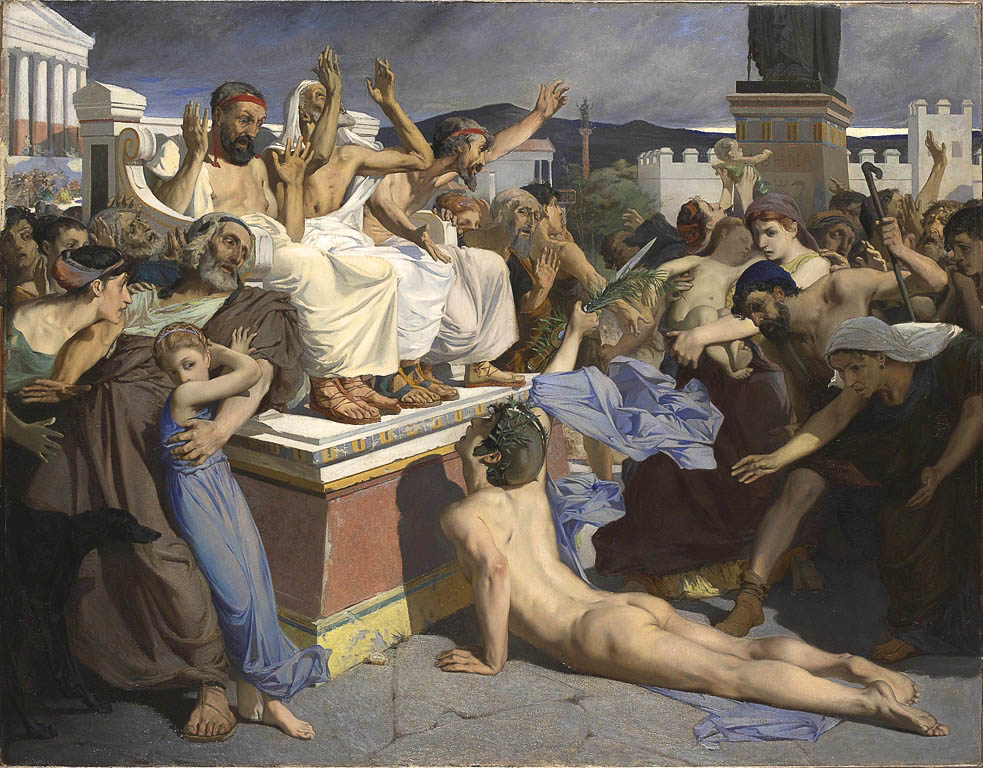
The messenger Phidippides brought news to Athens that the Persians had been defeated at the Battle of Marathon.
The tradition of ascribing great honor to the bearer of good news is found also in the Bible (2 Sam. 18:19 ff). In the book of Isaiah, the prophet uses the terms habishra (good news) and mevesheret (bearer of good news) in a theological sense to refer to the final triumph of good over evil. The four accounts of the life of Christ, known collectively as the Gospels, take their name from the same Hebrew term, translated into Greek as euangelion (“good news”).
Mari’s defeat was an astonishing reversal. Only a few short years prior it had commanded the whole of the Middle and Upper Euphrates and also the Khabur. Now the tables had turned. However, it does not seem as though Ebla attacked the city directly. At least there is no record of Mari’s destruction at the hands of Ebla. But Ebla’s victory gained Ishar-Damu international prestige, as may be seen by the fact that two of his daughters married into the royal houses of Kish and Naggar.
Ishqi-Mari
The account described above was pieced together from diplomatic letters, records of payments, gifts received, etcetera; which were pulled from the Ebla archive. These documents might contain the name of a king, record the conquest of a city, or some other event which can be used to reconstruct the history of the period. Here, for example, is an example of one such document from the Ebla archive.
1 mina of silver: gift for Warutum of Mari (who) brought the news (that)
Kish was completely (?) defeated.
Thus we learn of the conquest of Kish during the lifetime of Warutum. Since the name of this messenger appears in other tablets, it has been possible to assign him to the latter half of the reign of Ishar-Damu. On this basis, a relative chronology has been painstakingly pieced to together. But who captured Kish and was the dominant power in southern Mesopotamia at this time? The Ebla tablets are silent. Unfortunately, the archive has not produced any narrative accounts or royal inscriptions.8The closest we get to a narrative is a letter written by Enna-Dagan, king of Mari, and preserved in the Ebla archives, in which the king boasts of the successes he and his ancestors achieved in battle.
Thus you can see why, despite the valiant efforts of scholars to make sense of the archaeology of Ebla and Mari, and correlate it with the fragmented textual record, the results have not been altogether clarifying. The destruction of the palace at Mari (P-1), for example, has been ascribed alternatively to Sargon or Naram-Sin while the destruction of the palace at Ebla (Palace G) has been ascribed variously to Ishki-Mari, Lugalzagezi, Sargon, or Naram-Sin!
An important step towards deciphering the history of this period was made during the 2000-2001 excavation season at Mari when Jean Margueron discovered a number of important seal impressions belonging to several kings of Mari, including Iku-Ishar and Hidar. These seal impressions were found in the gate area of the palace in strata P-1. Both kings are known from the Ebla tablets.9Archi and Biga 2003, 30-31 Furthermore, approximately 100 seal impressions belonging to another king, Ishki-Mari, were recovered from the uppermost strata of the palace (P-0). Evidently he was the last ruler of Mari before the city was completely destroyed.

Over 100 impressions from door seals were found in the palace at Mari. It was possible from these to fully restore two of Ishki-Mari’s seals, including this one.
As you may recall, a statue of Ishki-Mari had already been discovered by by Andre Parrot in the Temple of Ishtar in 1933. Indeed, it was this statue that had enabled Parrot to positively identify Tell Hariri with Mari. Whereas the statue had tenatively been dated to c. 2500 BC, the evidence from the seal impressions, of Ishki-mari suggests that the reign of this king belongs to the final years of City II.
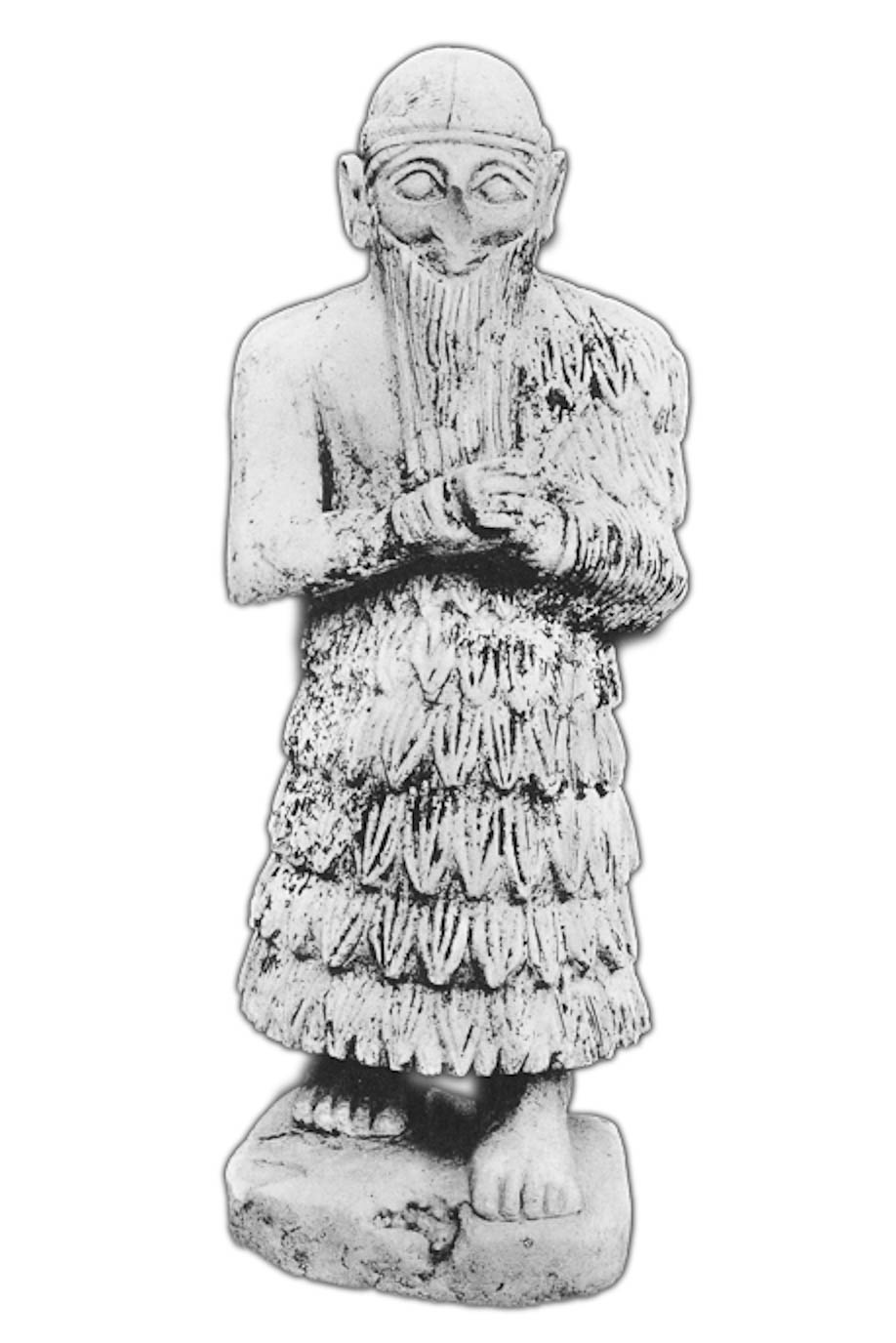
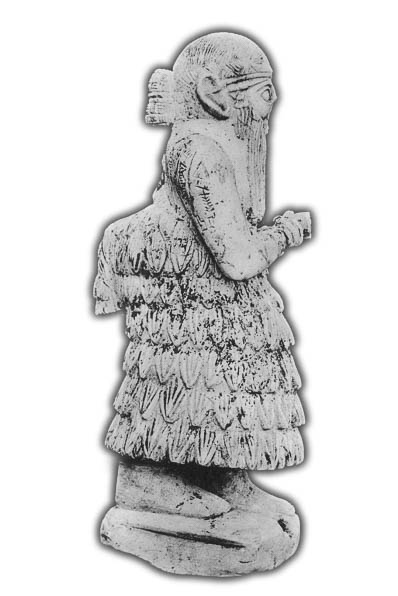
Ishki-Mari wears the kaunakes. Note the tail and the “royal bun.”
Mari was undoubtedly brought to a violent end; widespread evidence of burning has been found throughout the city. And when the city was rebuilt (City III), it was constructed on a completely different plan. Who destroyed Mari?
If we accept the testimony of Sargon, then it was he who destroyed the city. As was the custom of the Akkadian kings, each year of their reign was named after an important event. One of the “year names” of Sargon reads:
Year in which Mari was destroyed
In another quite interesting text recovered from Nippur, the king claims to have been given dominion over the whole region by none other than the god Dagan.
He (the god Dagan) gave to him (Sargon) the Upper Land: Mari, Iarmuti, and
Ebla as far as the Cedar Forest and the Silver Mountains.
A very straightforward interpretation of these events, then, ascribes the destruction of both Mari and Ebla to Sargon.10Lugalzagezi also claims to have conducted campaigns into Syria in the years immediately preceding the rise of Sargon. He could have attacked and destroyed Ebla.
Seal Impressions of Ishki-Mari
The cylinder seals of Ishki-Mari provide a remarkable glimpse into the modes and customs of a Sumero-Syrian dynast at the very end of the Early Dynastic III period.
The King
The king is shown seated on a “crate” and shielded by parasol. The heroic “mast of beasts” figure next to him was traditionally associated with royalty on Sumerian seals. The parasol “umbrella” is otherwise unknown on Sumerian seals but is represented on a stelae of Sargon of Akkad.
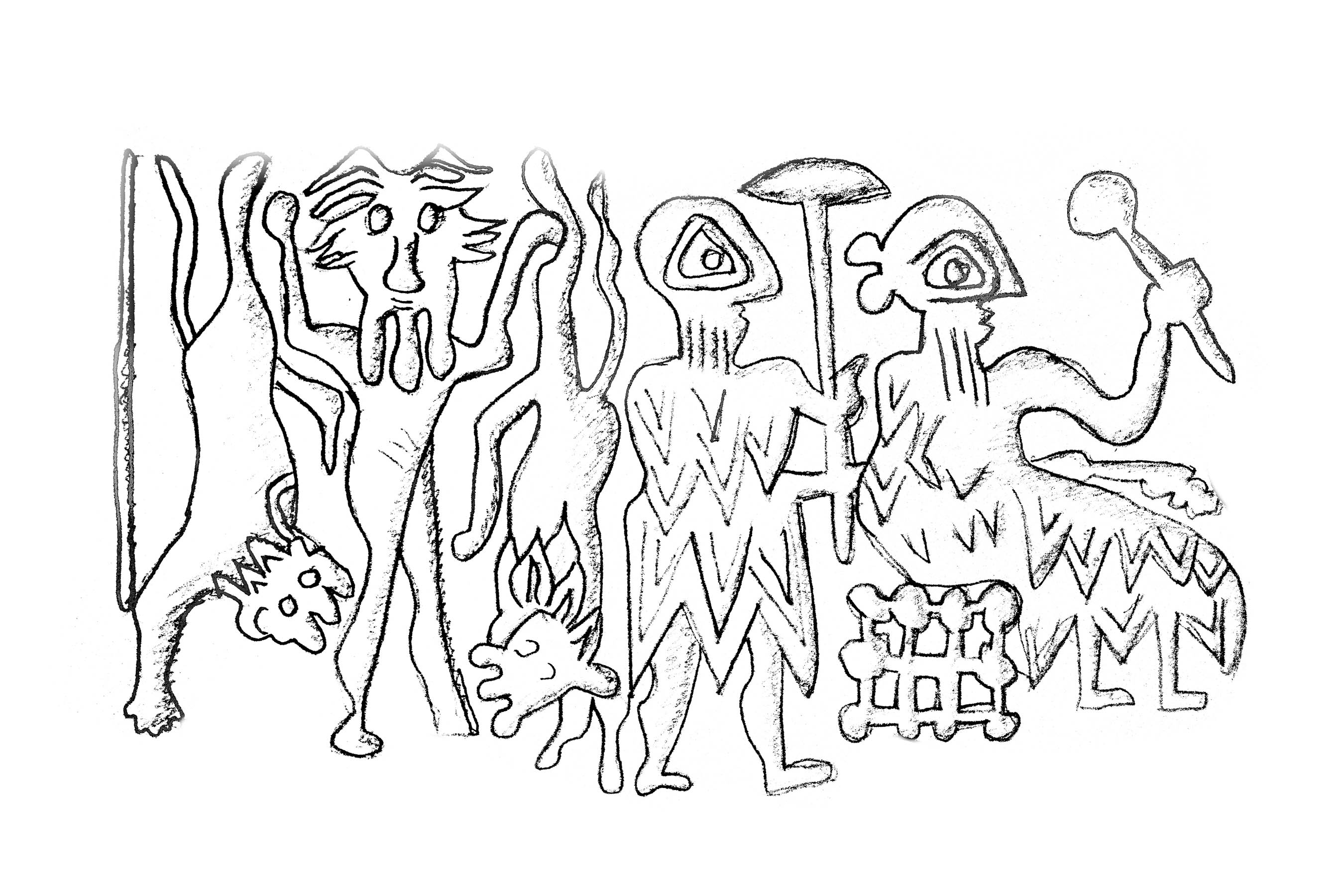
The king is shown seated on a square “throne” identical to Manishtushu’s, which we looked at in the previous entry. An attendant stands behind the king holding a parasol.

This basalt stele shows Sargon at front, with long beard in hair bun, followed by a servant bearing a parasol and by a dignitary holding a lion-headed scimitar (see below). Both the parasol
The Libation
A priest offers a libation to the gods, represented on the seal by their symbols. The rosette and scorpion are probably manifestations of Ishtar. The bull may represent Ea. The lion-headed scimitar next to the rosette probably belongs to a warrior god such as Erra. The three dots may be a constellation of stars.
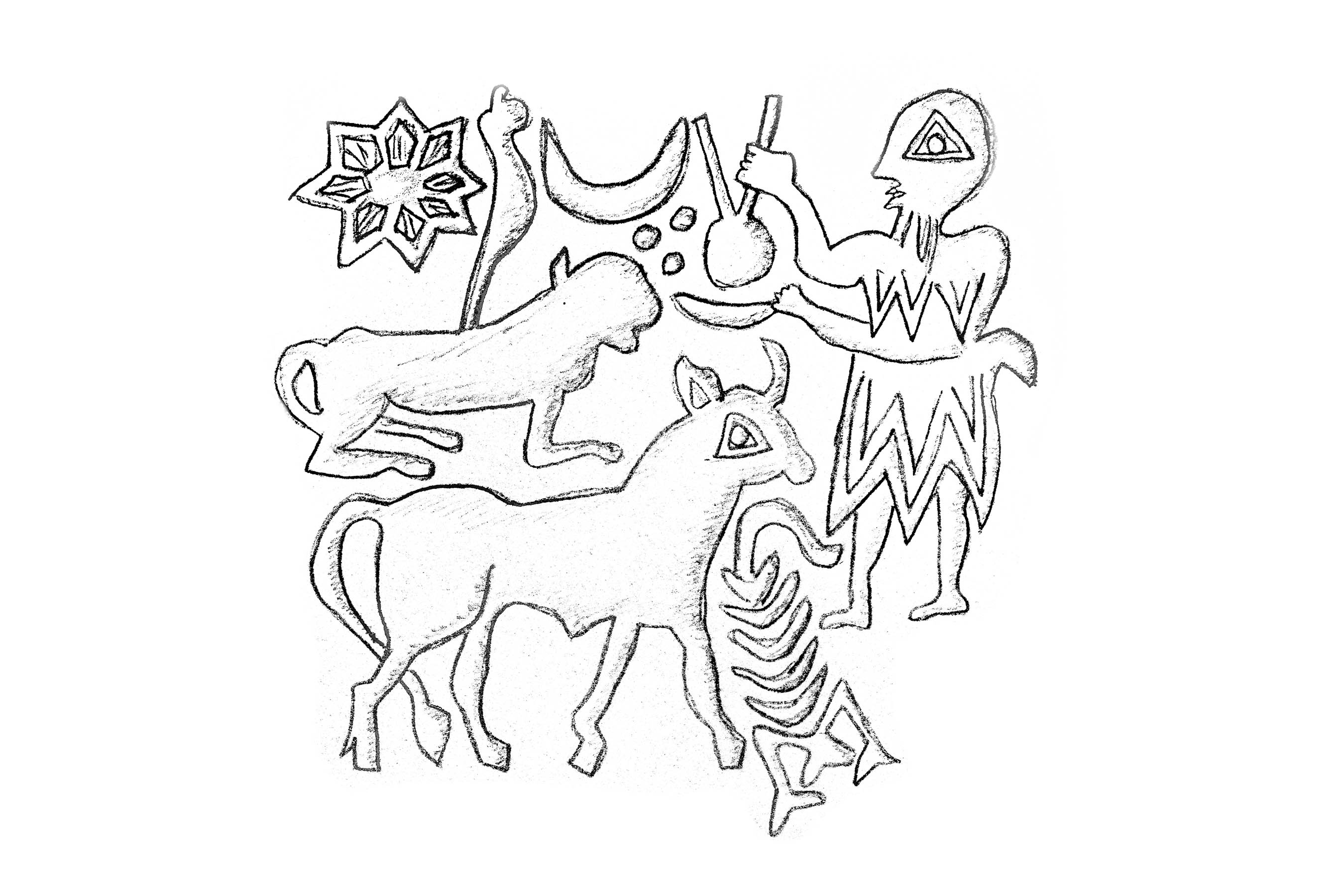
A priest offers a libation to the gods, represented by animals or astral symbols.
.jpg)

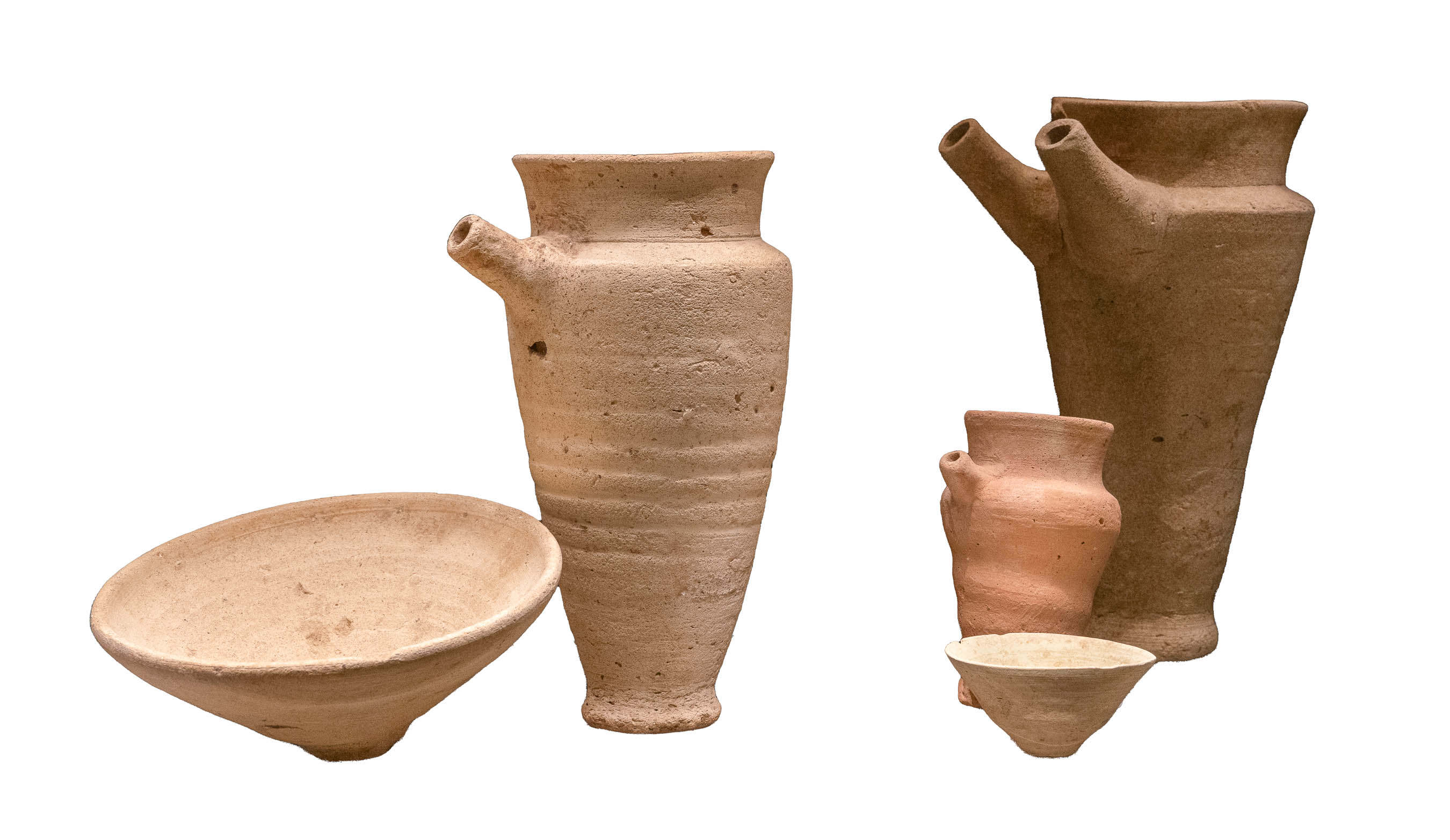
These spouted jars from Mari were used in libation ceremonies. Oil, water, or some other liquid was poured onto the ground or, more often, into a receptacle embedded in the floor of the temple.
The Battle
Sumerian cylinder seals and relief art typically display soldiers in serried ranks. In contrast, the Ishki-Mari seal displays soldiers in battle melee, a style found also on Akkadian objects of art, such as the Victory Stele of Naram-Sin (which we will look at shortly). In other respects, the scene looks Sumerian. The soldiers, for example, are wearing the kaunakes, a Sumerian garment which goes out of style in the Akkadian period. The vultures are reminiscent of Eannatum’s Stele of the Vultures.
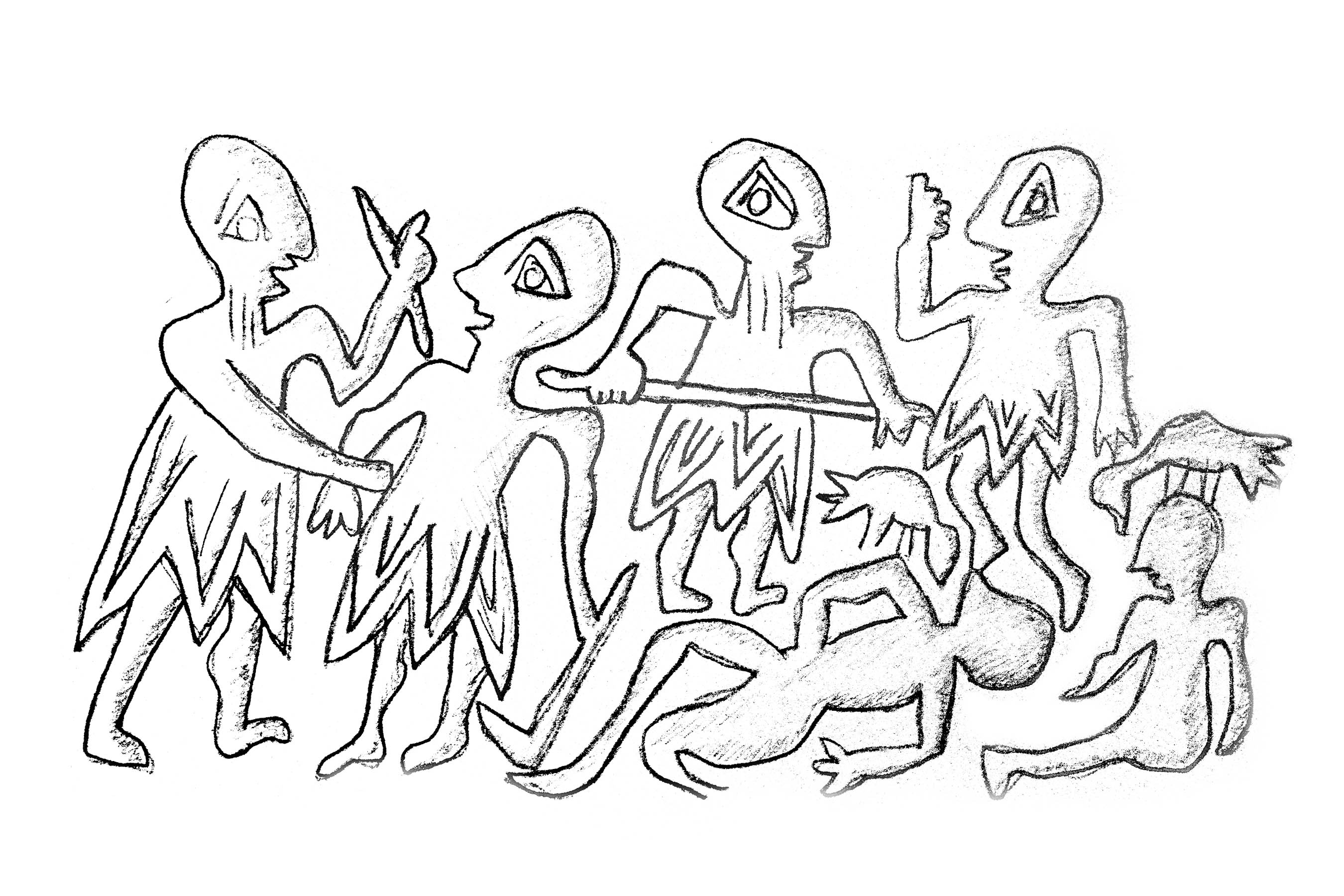
The fact that both parties are dressed identically suggests that the battle portrayed on this seal was between Mari and another city-state, although not necessarily Sumerian (the kings of Ebla, as you may recall, also wore the kaunakes).
The War Cart
The depiction of the war cart appears to be influenced by similar depictions on the Standard of Ur. This connection is strengthened by the fact that a lapis lazuli inscribed with the name “Mesannepada” was found in a jar beneath the floor of Palace P-0 at Mari (this was the final occupation of the palace before Mari was destroyed by the Akkadians).
If Mesannepada’s reign belongs to the first half of the Early Dynastic period (ED IIIA), as is generally thought, then he predates Ishqi-mari by approximately two hundred years.11As you may recall, seal impressions inscribed with his name were found in the layers directly above the Royal Cemetery of Ur. Thus it seems that the reign of Mesannepada falls at the very end of the use of that cemetery. However, in light of the discoveries at Mari, it may be wondered if Mesannepada was not more nearly a contemporary of Ishqi-mari. Of course, it is also possible that the bead is a heirloom.

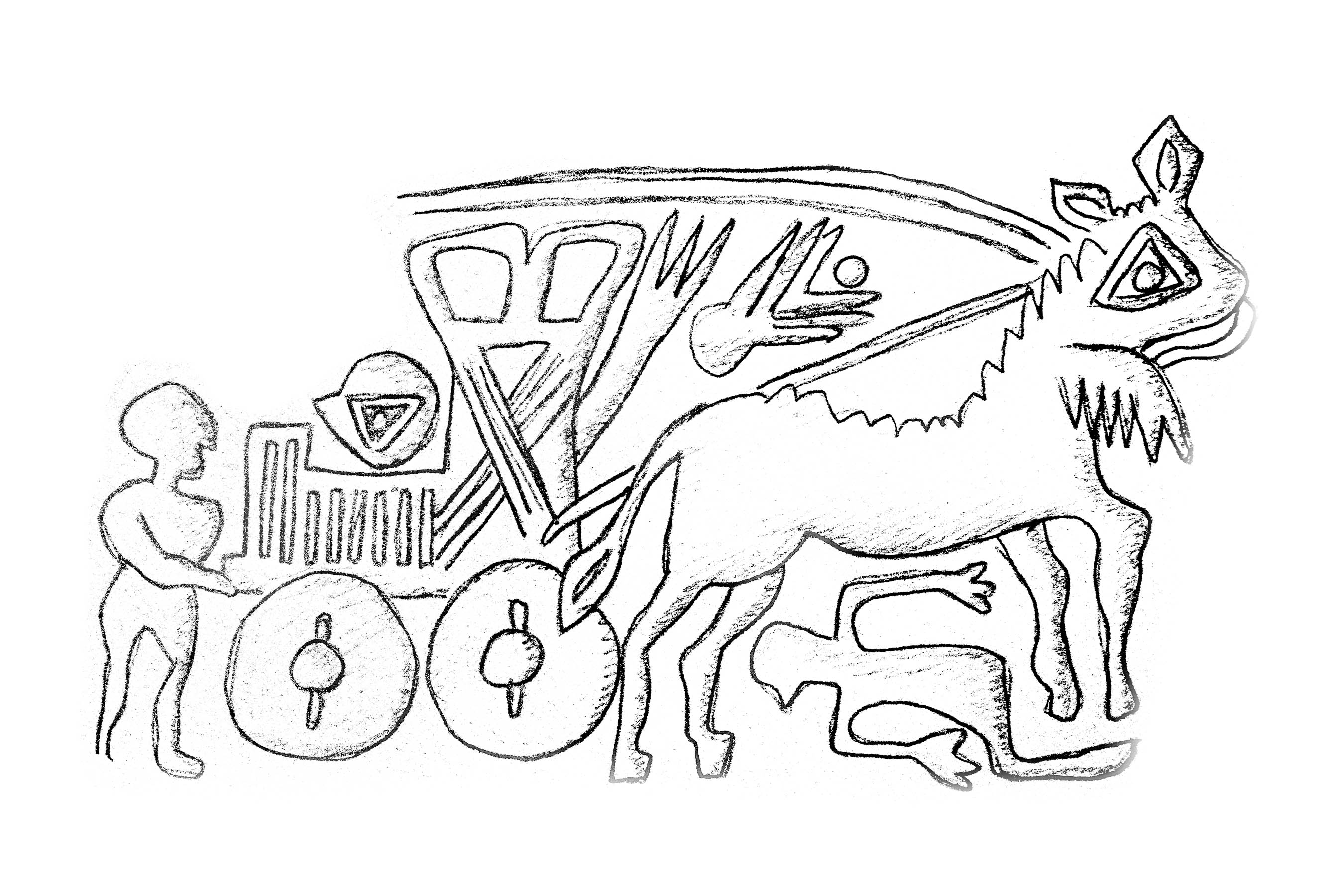
Javelins are stored in a quiver at the front of the car. The asses hitched to the cart appear to have some kind of protective armour covering their chest. The upside-down head in the cart probably represents a trophy of war hanging from the side of the cart. The mysterious symbol between the yoke and the reigns remains unidentified.
Postscript
Ebla and Mari were conquered by the Akkadians. Both cities were rebuilt and enjoyed a certain measure of prosperity during the Ur III period. Mari would become the seat of a powerful Amorite dynasty. Ebla, on the other hand, never regained the economic power it once had. Palace G was never rebuilt and no writing tablets have so far been recovered from the levels which postdate the Ebla archive (Mardikh IIB2).12Astour 2002, 81; also 76
Akkermans, Glenn M, Peter M. M. G. Schwartz.
The Archaeology of Syria: From Complex Hunter-Gatherers to Early Urban Societies (ca. 16,000-200BC).
Cambridge: Cambridge University Press, 2003.
Archi, Alfonso, Maria Giovanna Biga. “A Victory over Mari and the Fall of Ebla.” Journal of Cuneiform Studies 55 (2003): 1–44. Link
Astour, Michael C.
“A Reconstruction of the History of Ebla (Part 2),” in Eblaitica : Essays on the Ebla Archives and Eblaite Language, Volume 4, edited by C. H Gordon, Gary Rendsburg.
Winona Lake, Indiana: Eisenbrauns, 2002.
Beyer, Dominique..
“Les sceaux de Mari au IIIe millénaire,” in Akh Purattim, edited by Jean-Claude Margueron, Olivier Rouault, Pierre Lombard.
Lyon: MOM Éditions, 2007. Link
Matthiae, P.
Ebla : An Empire Rediscovered.
Garden City, N.Y: Doubleday, 1981. Link
Pettinato, G.
The Archives of Ebla : An Empire Inscribed in Clay.
Garden City, N.Y.: Doubleday, 1981. Link
Rositani, Annunziata. “Work and Wages in the Code of Hammurabi.” Egitto e Vicino Oriente, no. 40 (2017): 47–72. Link