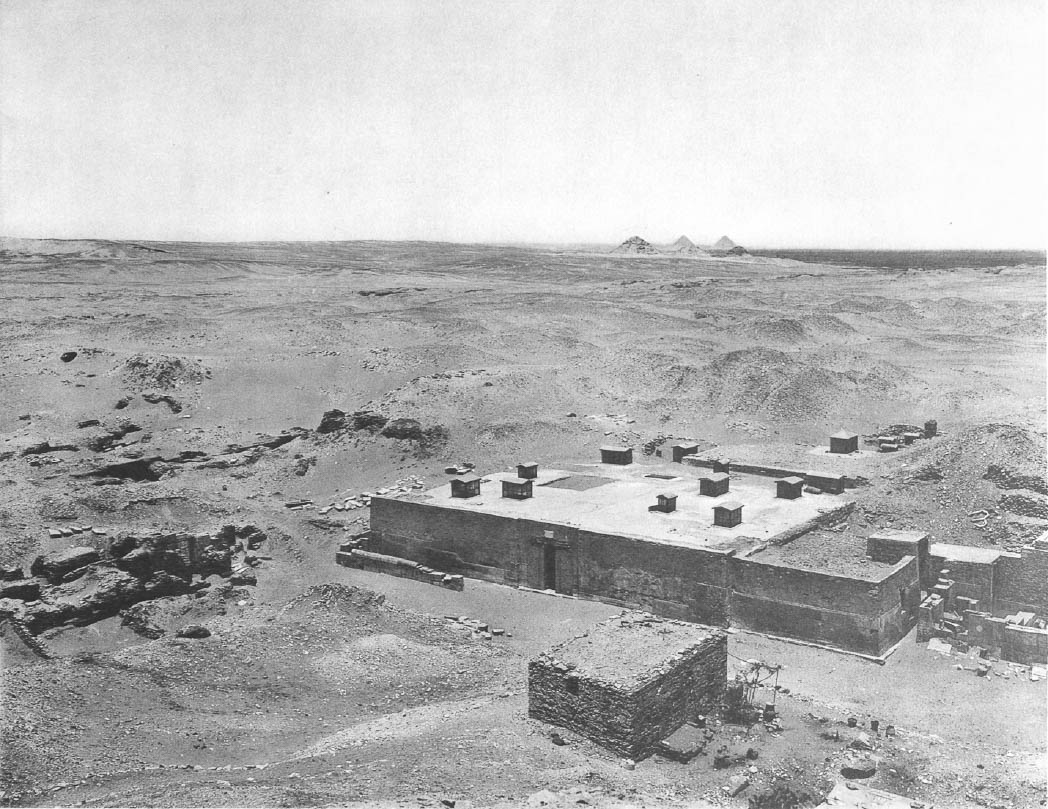
Picture taken at Saqqara looking north towards the pyramids of Abusir. One of the pyramids of Giza is visible on the horizon (it is the same size as the pyramids of Abu Sir). The upper portion of the wall and the roof of the the mastaba of Mereruka were restored. The false door is visible on the facing wall of the mastaba.
In 1889, seven years after he deciphered the hieroglyphic script, Jean-Francois Champollion made his first and only visit to Egypt. Saqqara was at the top of his list of place to visit but after three days walking the site he finally concluded that “this locality… is almost worthless for study…”1The Saqqara Expedition, <i>The Mastaba of Mereruka</i>, xiii Although one of the great necropolises of Egypt, where Djoser built his pyramid, Champollion was greeted by a vast wasteland littered with broken wall reliefs and pottery shards devoid of the inscriptions for which he sought. Unbeknownst to Champollion, beneath the heaps of sand there lay hidden some of the most beautiful and interesting wall reliefs in Egypt. Their unveiling awaited the German explorer, Karl Richard Lepsius, who began the arduous task of excavating the tombs fourteen years later.
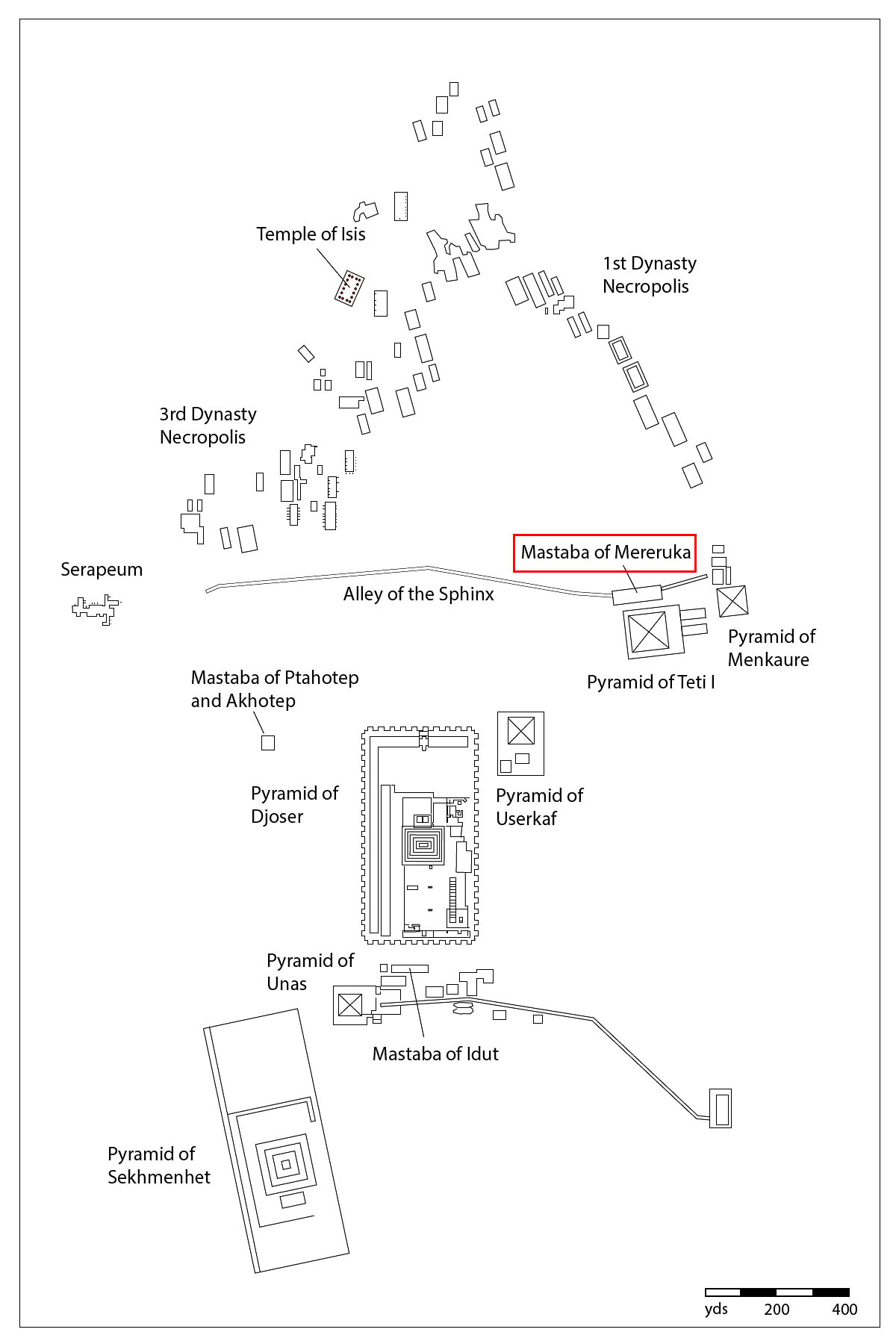
Saqqara was dominated by the Step Pyramid of Djoser and other smaller pyramids, most notably the Pyramid of Unas. The tomb of Mereruka was located next to the small pyramid of Teti.
The Mastaba
The Arabic term mastaba (“bench”) is a fitting name for the low-lying tombs of Egyptian nobility which cluster around the pyramid of the their king. Architecturally the mastaba was a continuation of the Early Dynastic brick lined tombs found at Abydos, but they were made of stone rather than brick, and their storage chambers were constructed above ground rather than beneath it. Only the sarcophagus was buried underground.
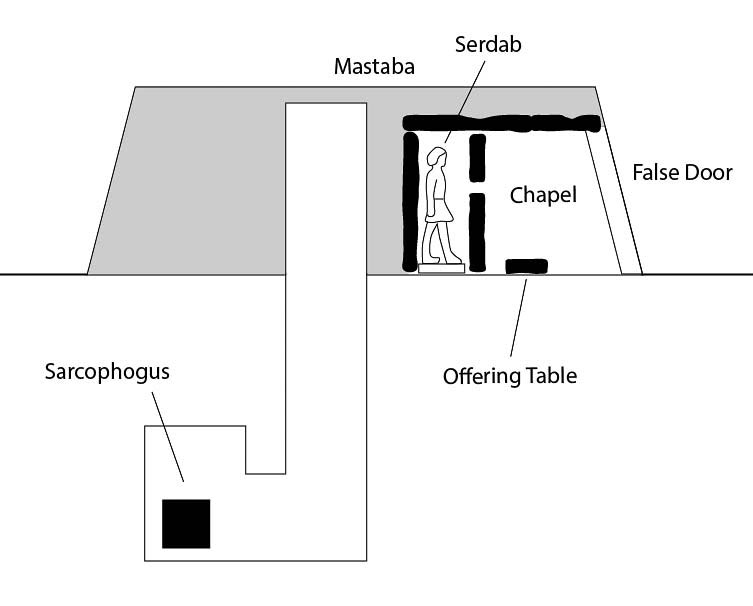
A simplified cross section of a typical mastaba.
The mastabas of the Fifth and Sixth dynasties developed into elaborate affairs, complete with storerooms and a chapel. Their elaborately carved interior walls are a rich store of knowledge about the plants and animals of the Nile.
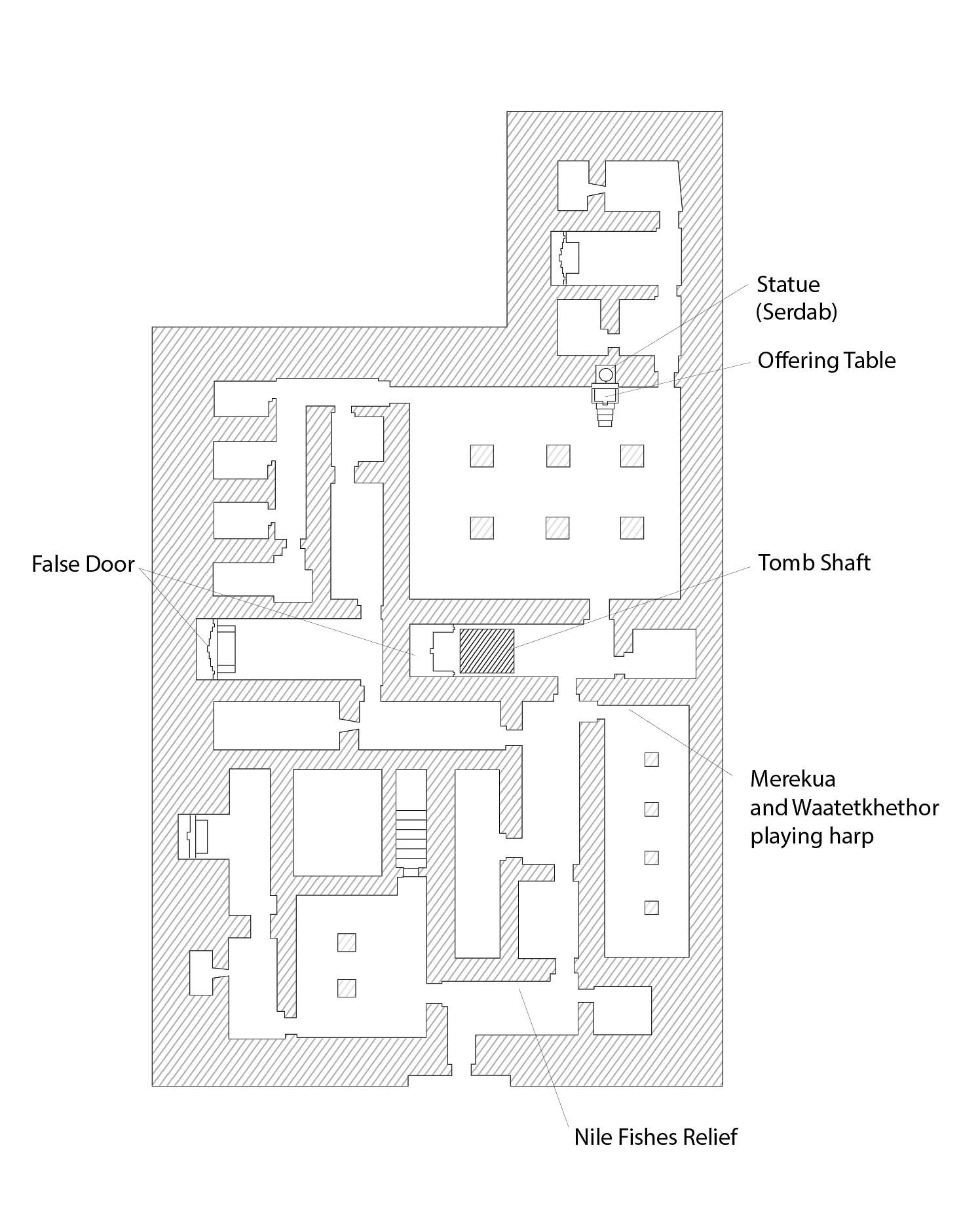
The floor plan of Mereruka’s mastaba. The tomb was shared by Mereruka, his wife, and son.

Mereruka’s statue in its serdab with an offering table in front.
Mereruka’s Mastaba
Discovered in 1898, the mastaba of Mereruka is the largest and most elaborate mastaba discovered at Saqqara. Carved on low relief with scenes of daily life, its walls show Egyptians fowling, fishing, driving livestock, and hunting hippopotamai. There seems to be an element of sport in these scenes, as though daily life for ancient Egyptians was not a matter of scratching out a bare existence, but left time for pleasurable and intellectual pursuits as well.

A man is about to spear a lassooed hippopotamus while others are busy fishing and fowling.
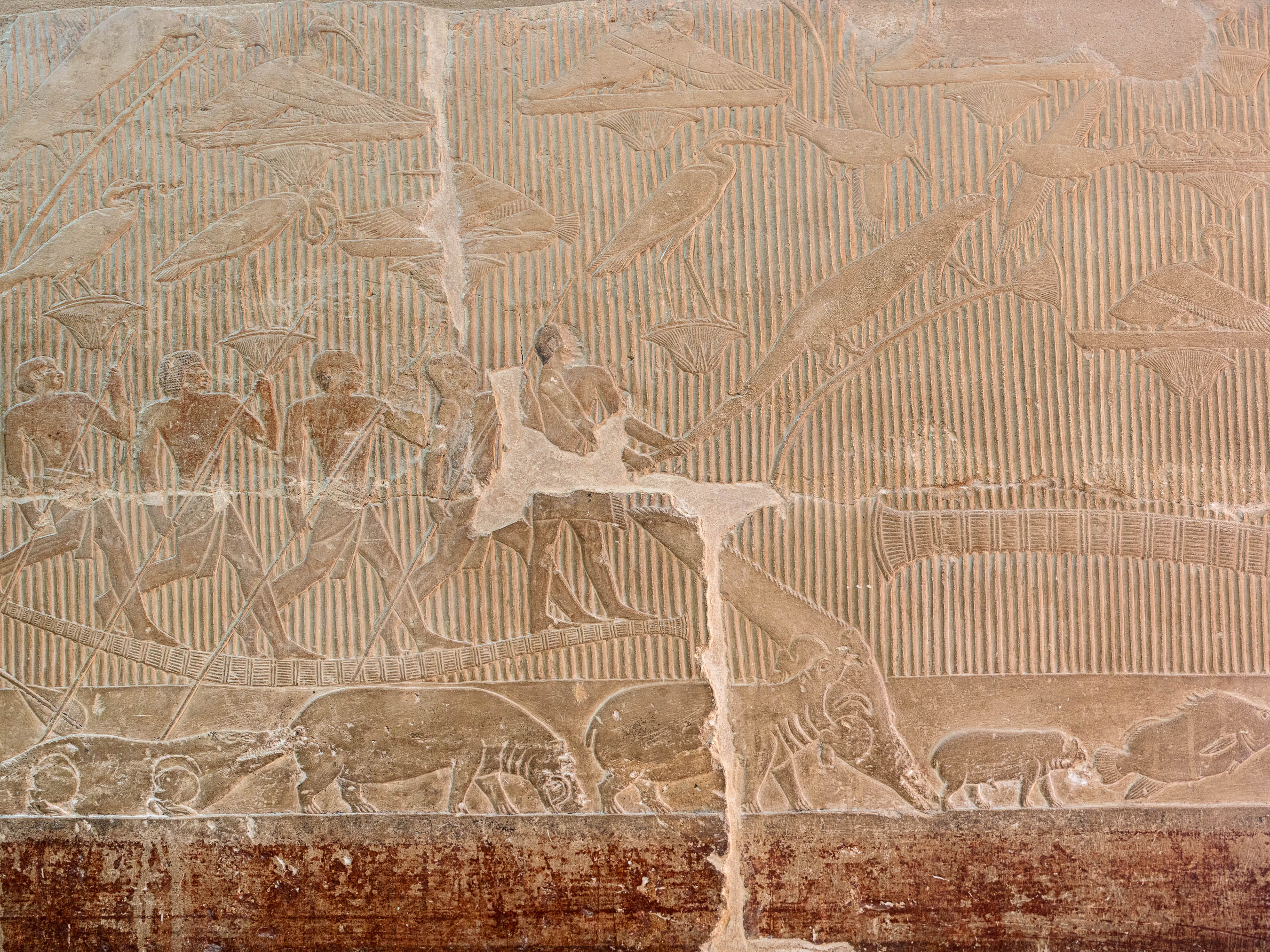
Men are pushing their skiff through marsh. In the foreground a giant hippo attacks an equally giant crocodile that is threatening its young. Another crocodile is preparing to eat the young of a mother hippo as it gives birth. A man at the front of the skiff grabs a mongoose by the tail to prevent it from making a meal out of a nest of baby lapwings, while mama and papa lapwing circle angrily overhead.
Here is how J. H. Breasted describes life on the Egyptian estates of the rich and famous during the Fifth and Sixth Dynasties:
This was the noble’s paradise; here he spent his leisure hours with his family and friends, playing at draughts, listening to the music of harp, pipe and lute, watching his women in the slow and stately dance of the time, while his children sported about among the trees, splashed in the pool, or played with ball, doll or jumping-jack. Again in a light boat of papyrus reeds, accompanied by his wife and sometimes by one of his children, the noble delighted to float about in the shade of the tall rushes, in the inundated marshes and swamps. The myriad life that teemed and swarmed about his frail craft gave him the keenest pleasure.2Breasted 1927, 90
The walls of Mereruka’s tomb certainly present an idyllic life. To what degree it was shared by common Egyptians is question for which archaeology supplies very little information since no townsites or tombs of common folk have been excavated from this period.
Fishing
Scenes of fishing in the Nile feature prominently on the tomb walls of the Fifth and Sixth dynasty mastabas. Egyptian sculptors of later generations would never achieve the level of detail and accuracy displayed in these tombs.
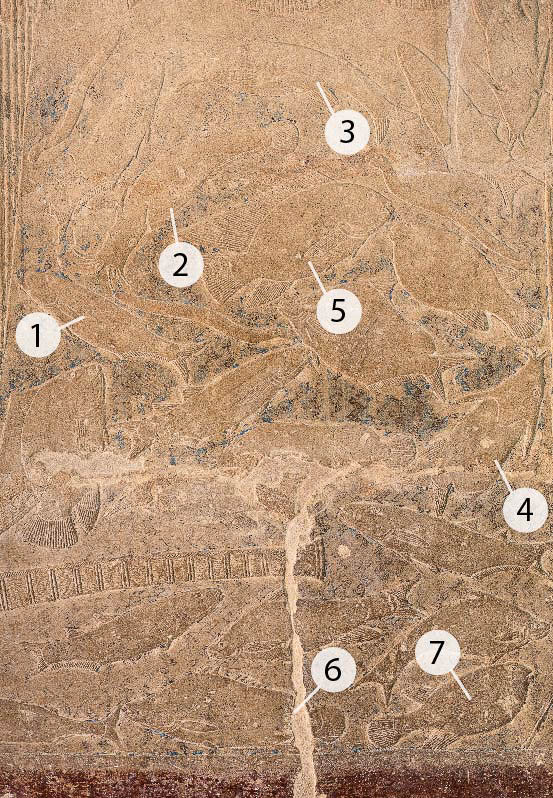
The Nile river is shown teeming with many different varieties of fish. The numbered fish are described in more detail below.


These fish can grow up to 24 inches long. They were probably the most common fish eaten for food in Egypt.
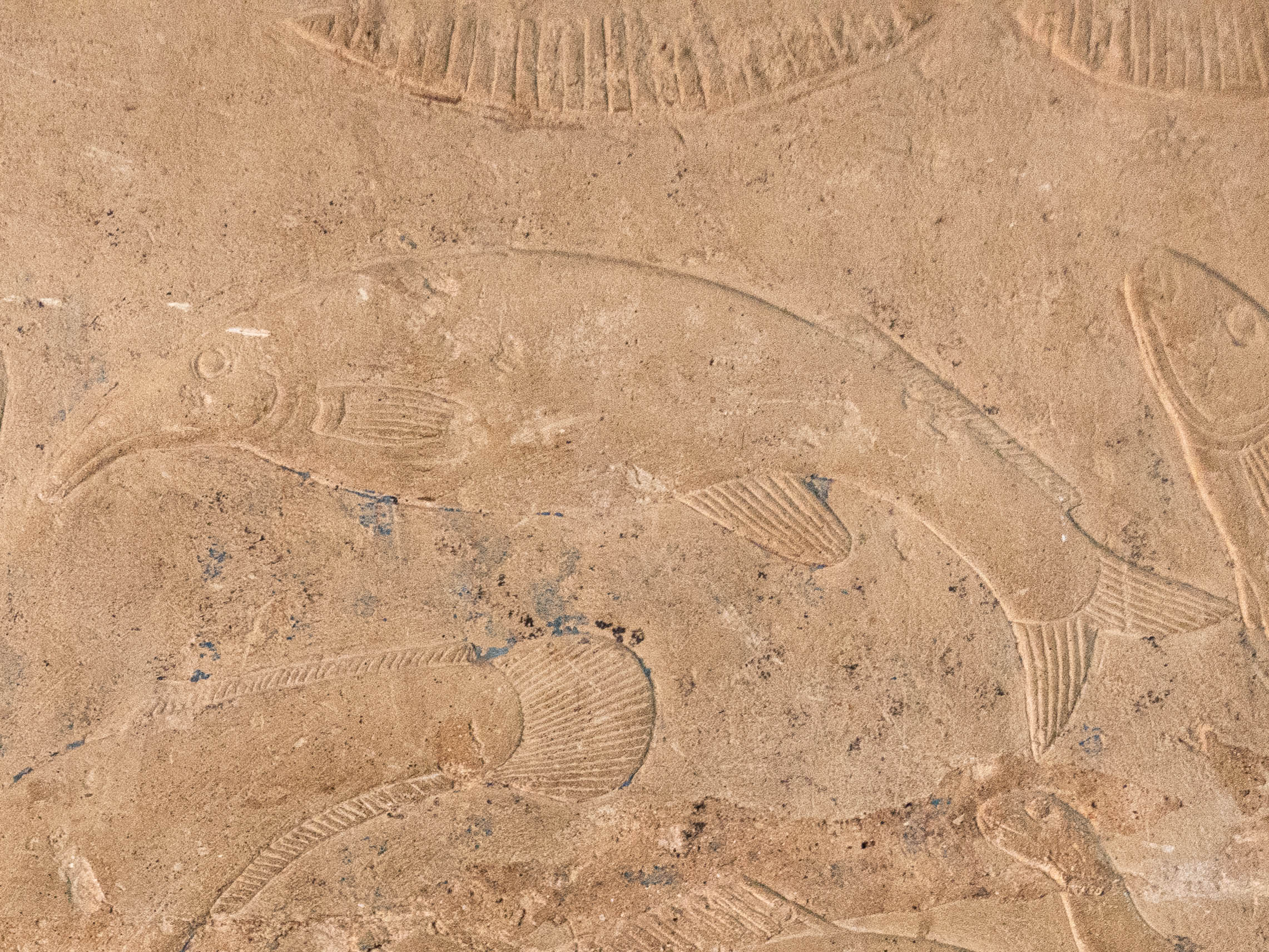
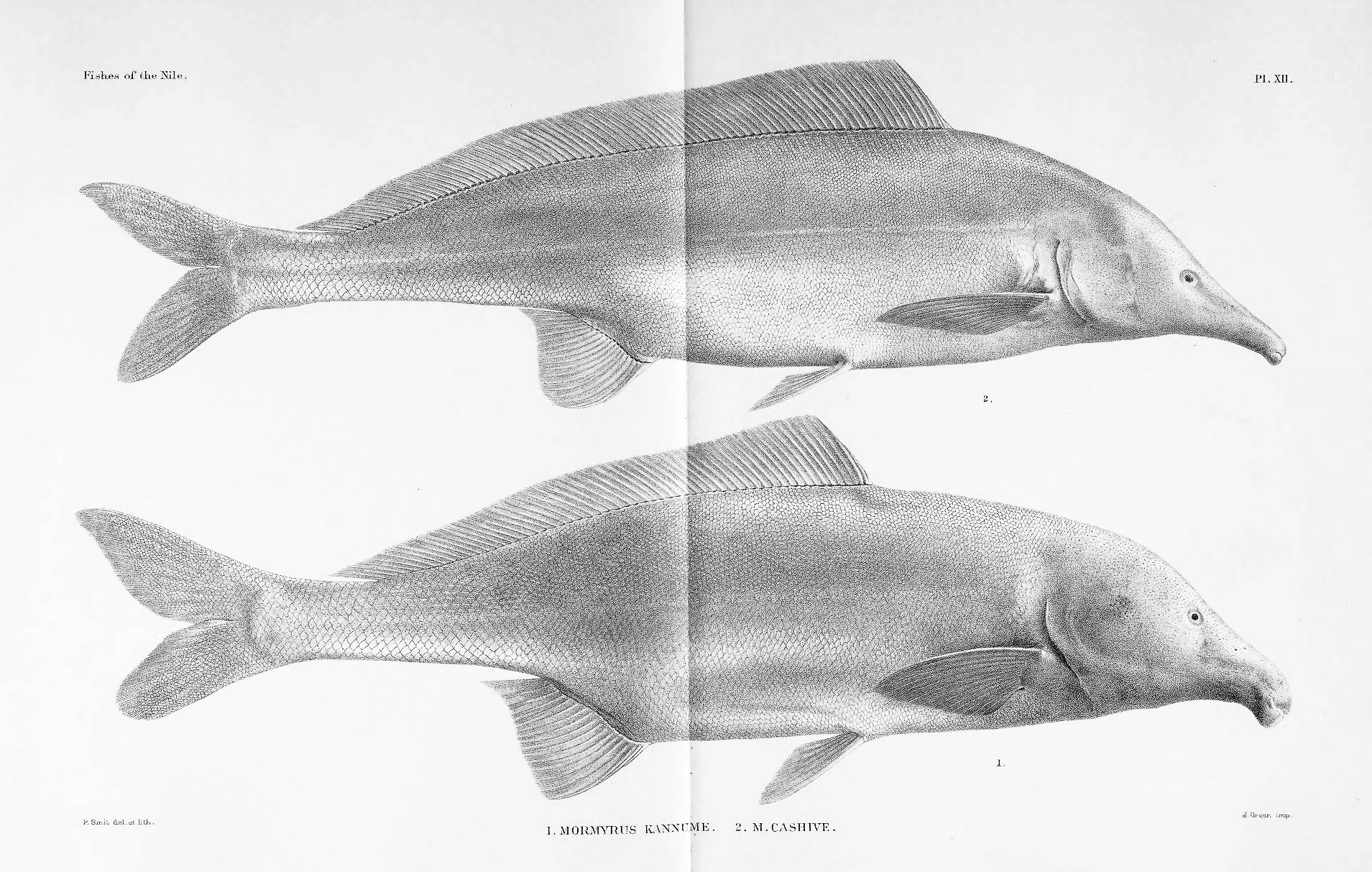
The bodies of these curious fish emit a slight electric field while their nose acts like sonar capable of detecting even the slightest perturbations. The fish uses its nose to find worms in the mud.


These catfish are capable of generating an electric current equal to three or four hundred volts. The shock generated by the catfish was used by Egyptian physicians of the Greco-Roman period to cure gout, headaches, and arthritis. 1P. Kellaway, The Part Played by the Electric Fish in the Early History of Bioelectricity and Electrotherapy, 129 ff.
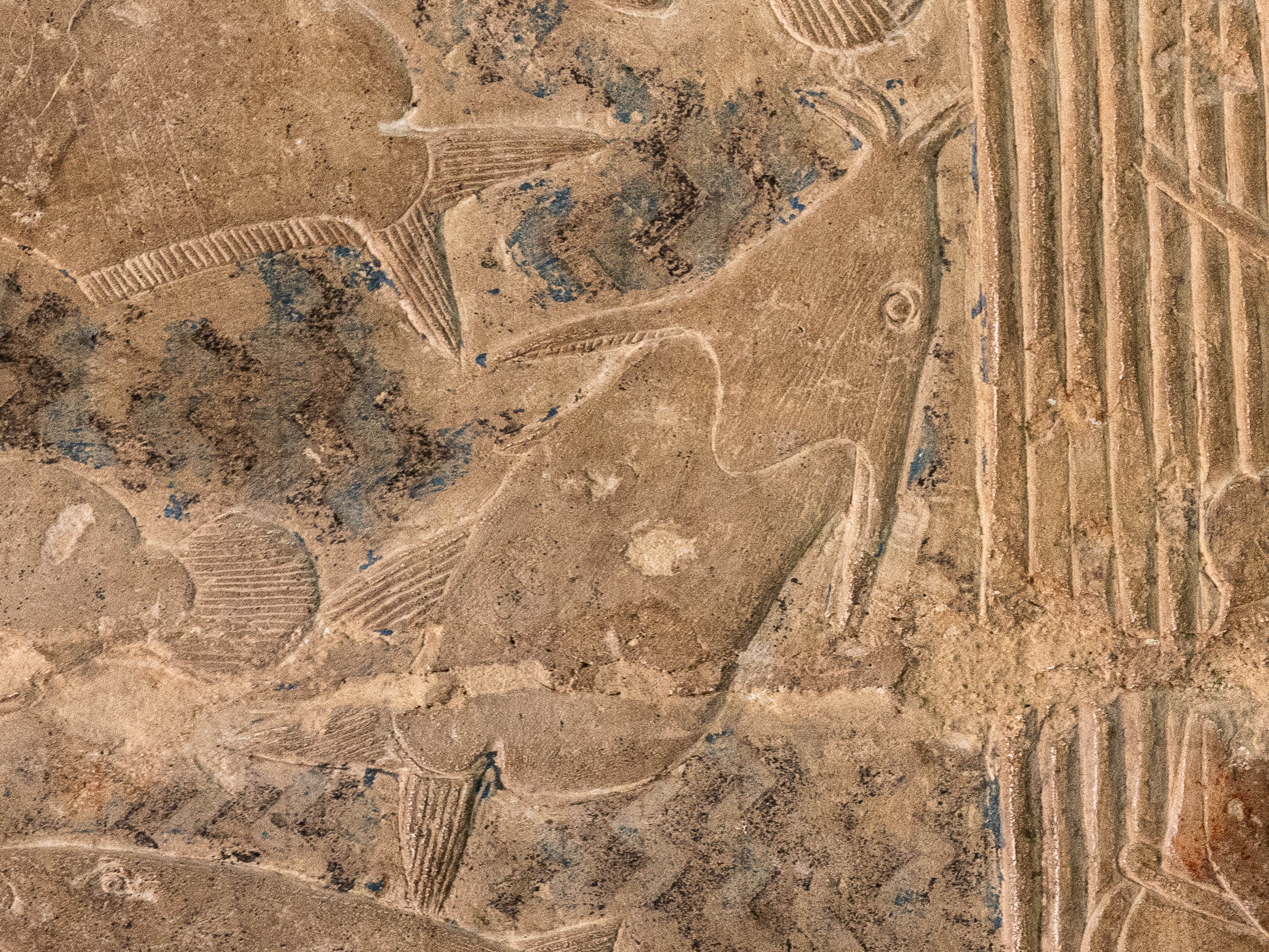
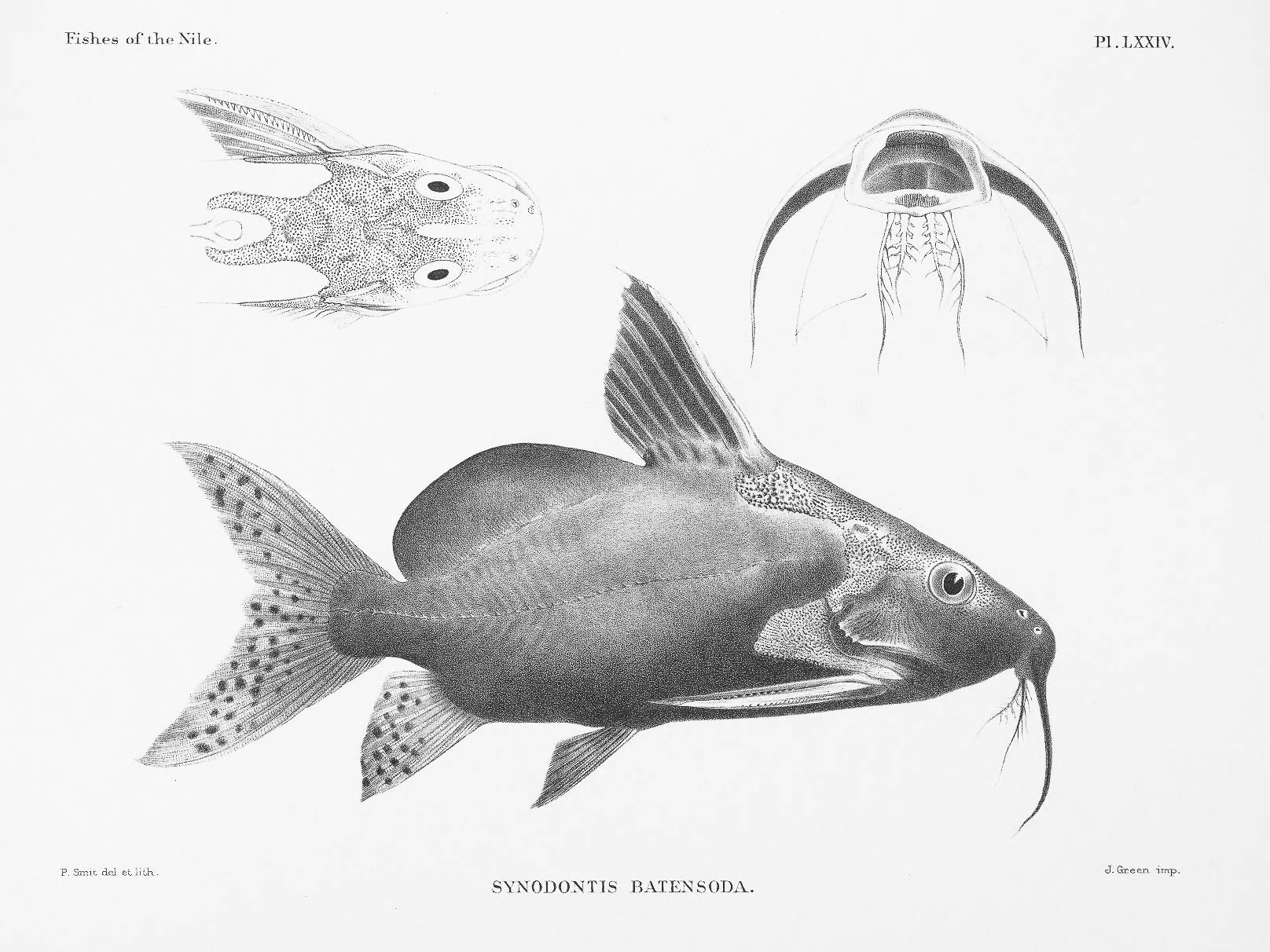
The bladder on these peculiar catfish makes them swim upside down—a curiosity not lost on the sculptor of this particular relief.
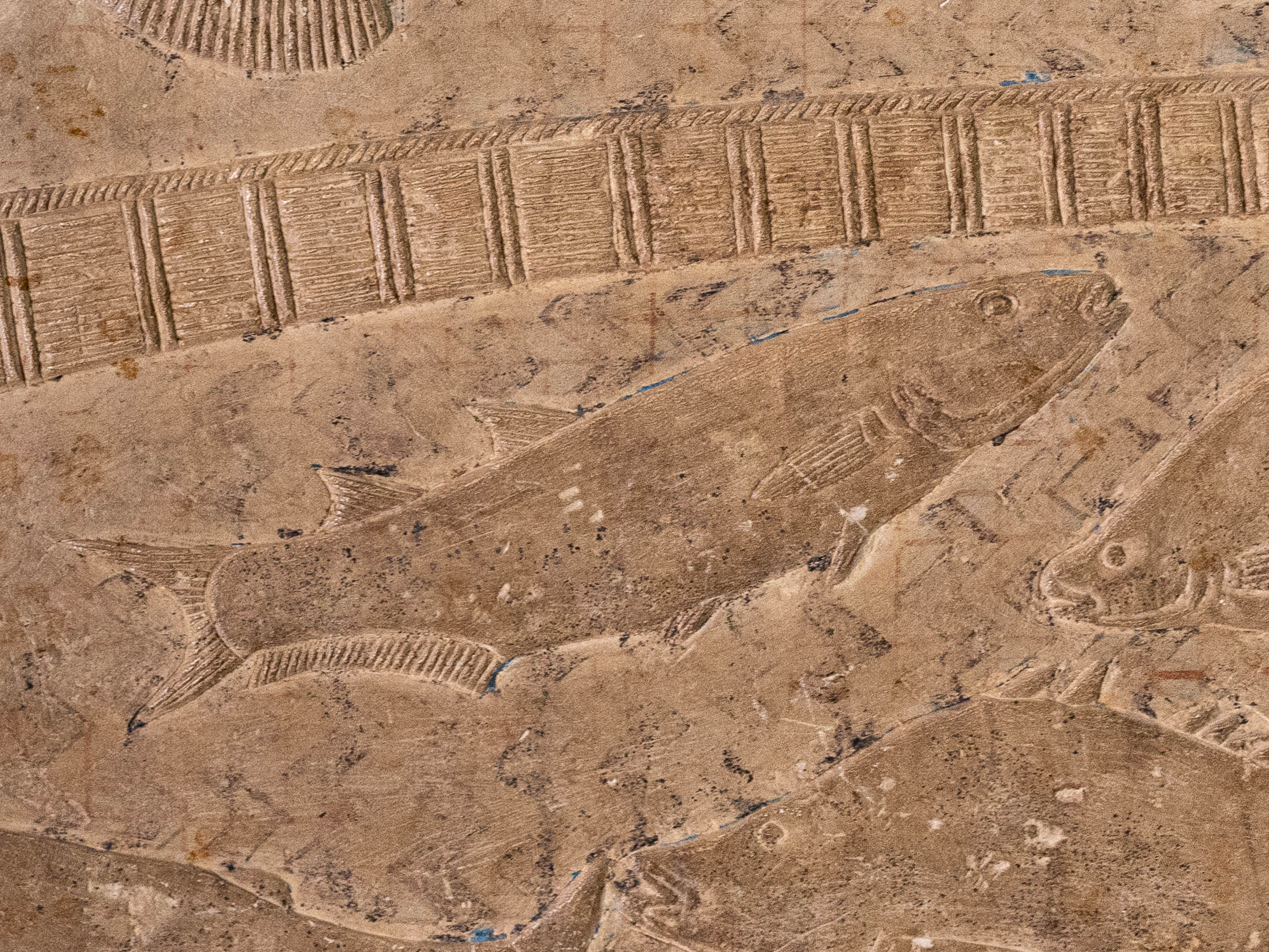
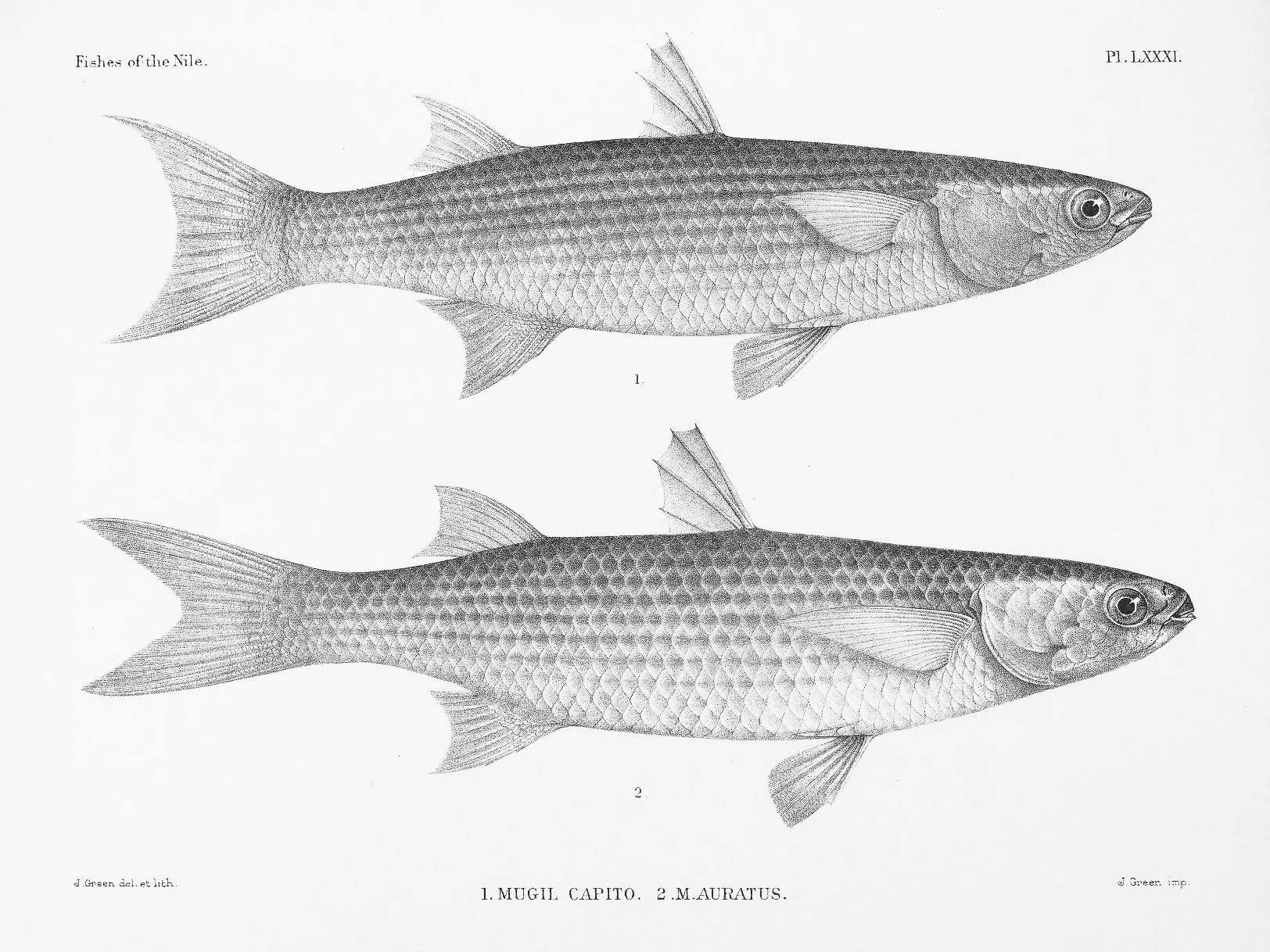
Fermented and salted mullet, known as feseekh, remains a popular Egyptian delicacy.
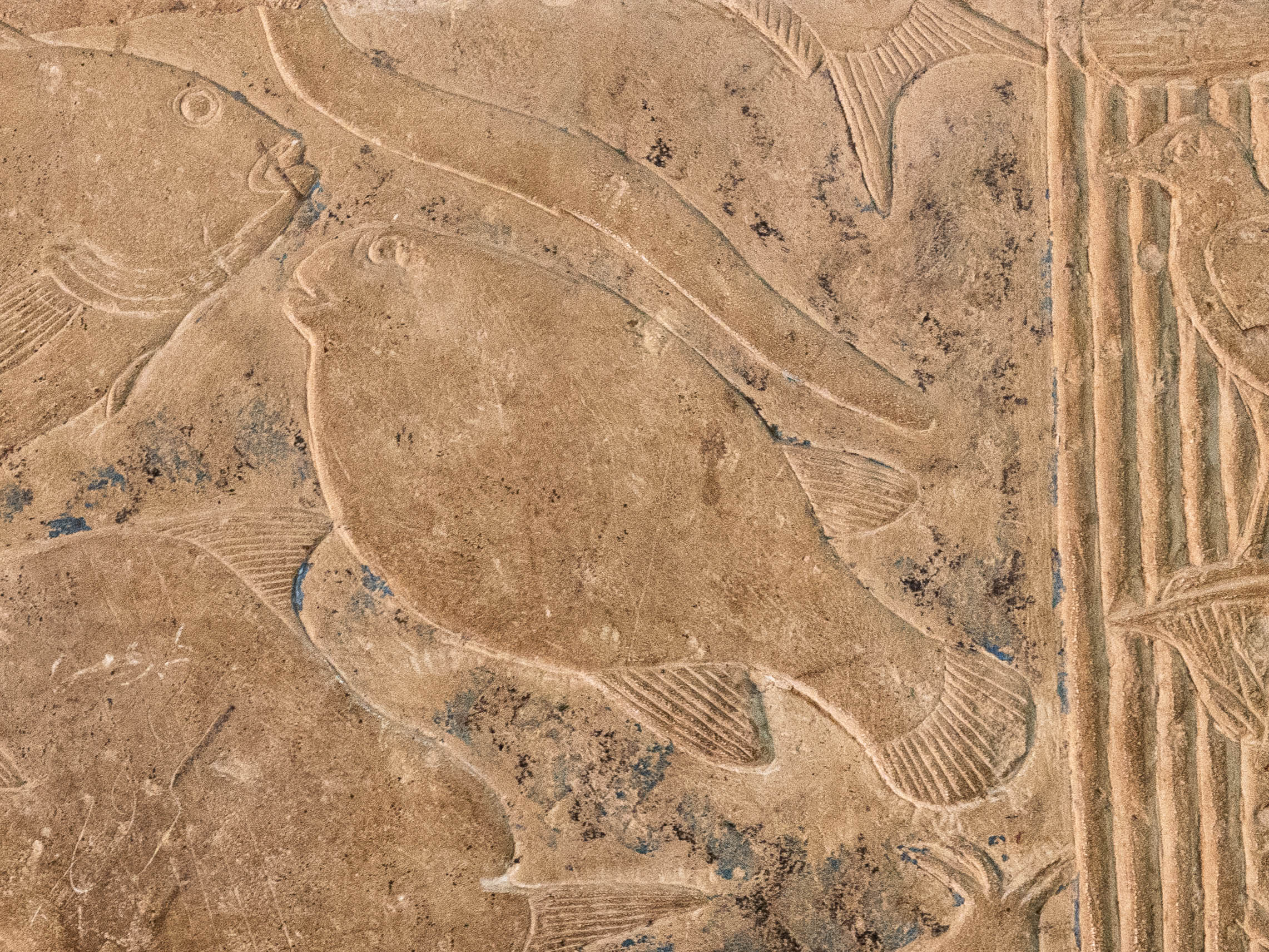
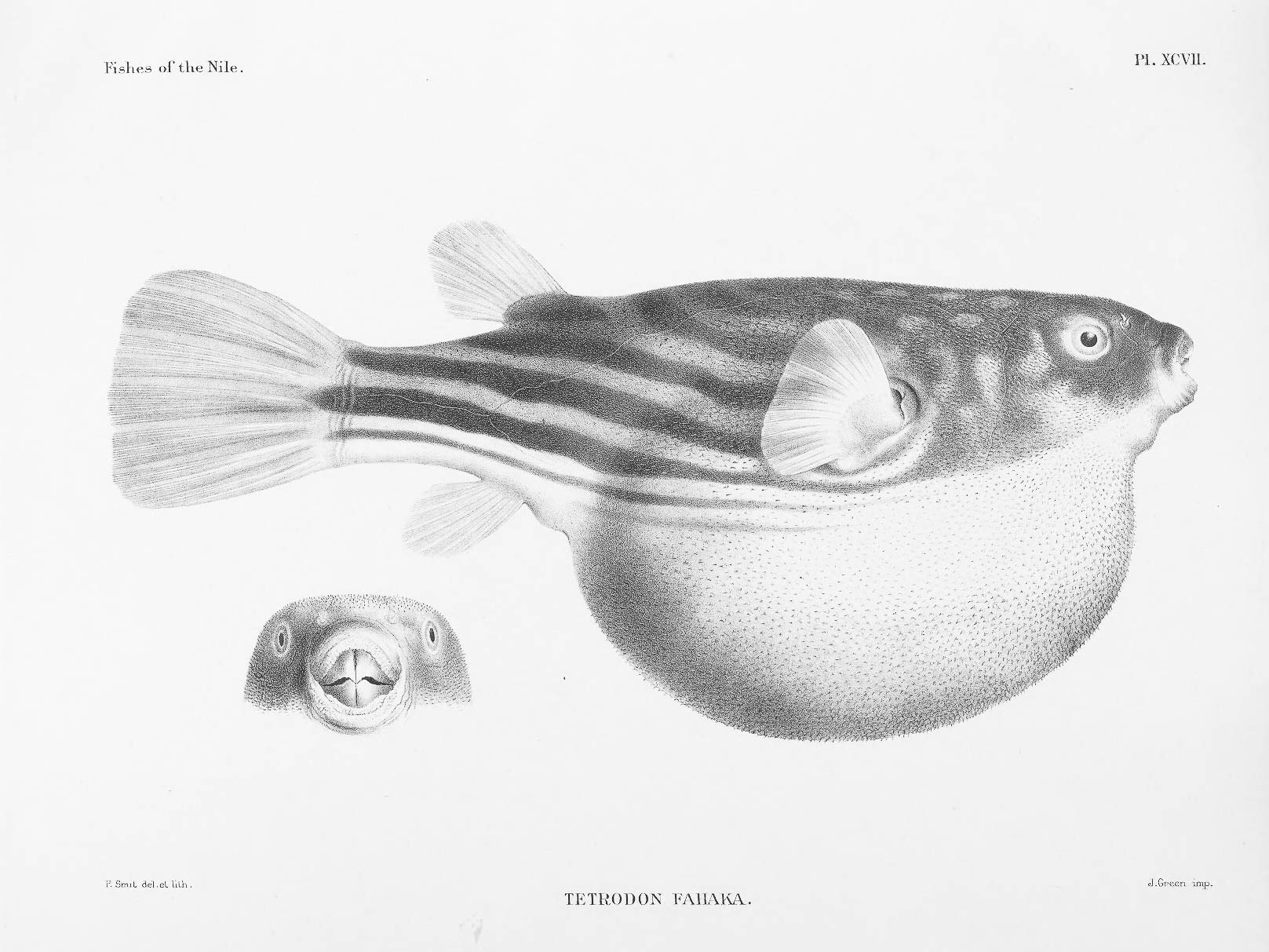
These fresh water fish, like their saltwater cousins, fill their bellies with air as a means of warning off potential predators. Theirs is no idle warning; puffer’s are of course poisonous to eat.

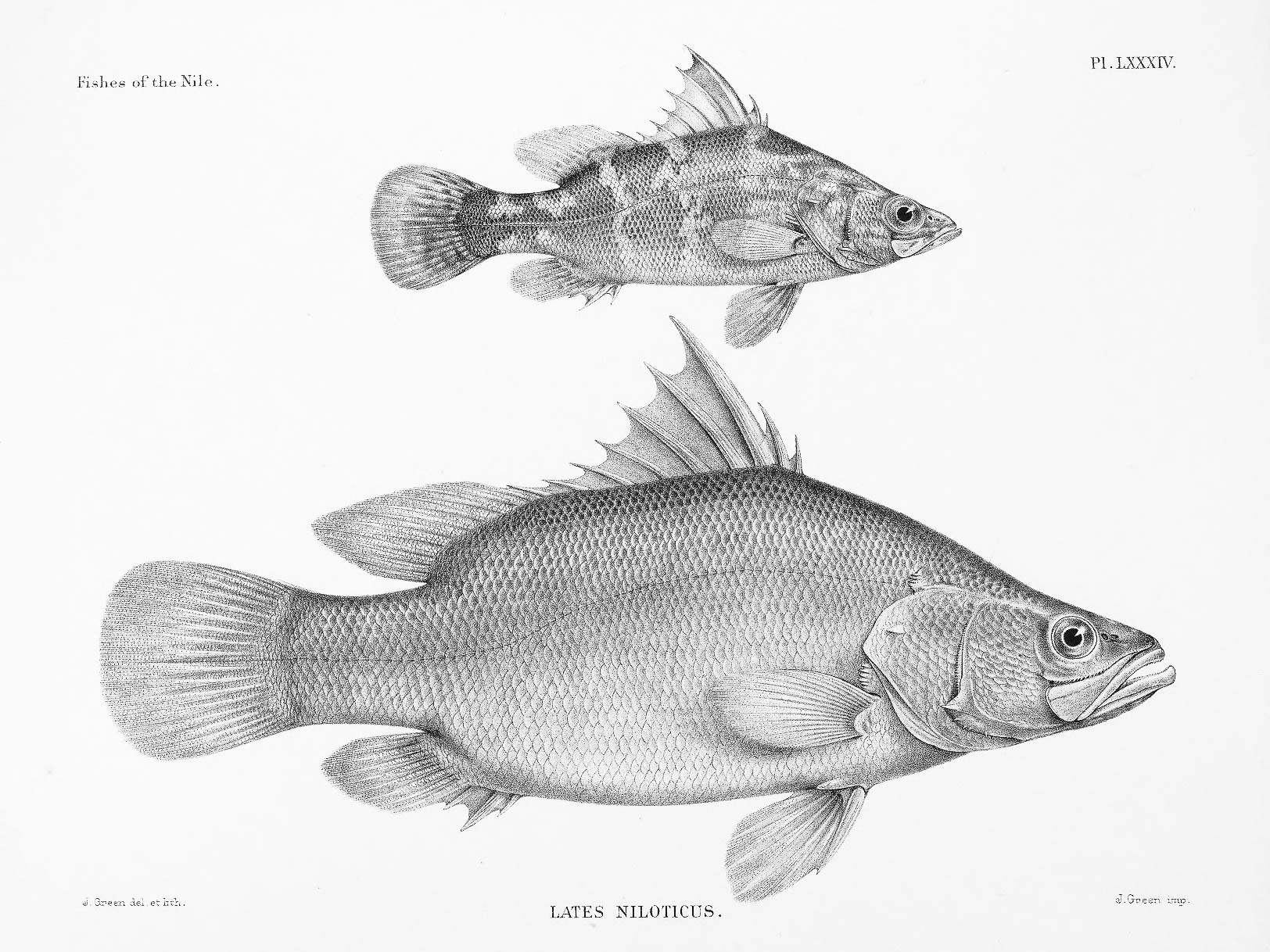
These fish, known to grow up to 6 feet long, are the lords of the Nile. Bones of giant perch found at the predynastic site of Hierakonpolis belonged to fish averaging five feet long. This size of perch are rarely seen today in the Nile and are difficult to catch.2R. Friedmann, Week Three Bone Report The Nile Perch inhabits the deepest parts of the river, which is reflected in the relief by their appearance at the bottom of the wall relief.
The Sixth Dynasty
The Fifth and Sixth dynasties are marked by the devolution of power from the capital to its provinces. Decentralization may explain why kings were no longer able to build such magnificent tombs for themselves. If the success of a civilization is measured by the size of its monuments then the Fifth and Sixth Dynasties belong to a period of decline in Egypt, but if it is measured by general literacy, governance, and the freedom of people to enjoy the fruit of their labor, then it probably was not a bad time be alive in ancient Egypt.
The tombs of the regional governors testify to the care with which they governed their provinces.
Never did I judge two brothers in such a way that a son was deprived of his paternal possession.3Breasted 1927, 81
The success of Mereruka is emblematic of the changes Egypt was undergoing. A vizier during the reign of Teti, the first pharaoh of the Sixth Dynasty, he married the king’s daughter, Seshseshet Waatetkhethor. Since the pharaoh’s daughter was considered to be a daughter of a god, it was unusual for her to marry outside the royal line; a practice which must have resulted in genetic problems for the decedents of such unions. However, as the Egyptian king’s power diminished, it became necessary for him to form marriage alliances as a means of consolidating power. Thus Seshseshet Waatetkhethor was allowed to marry Mereruka and was buried with him in the same mastaba.
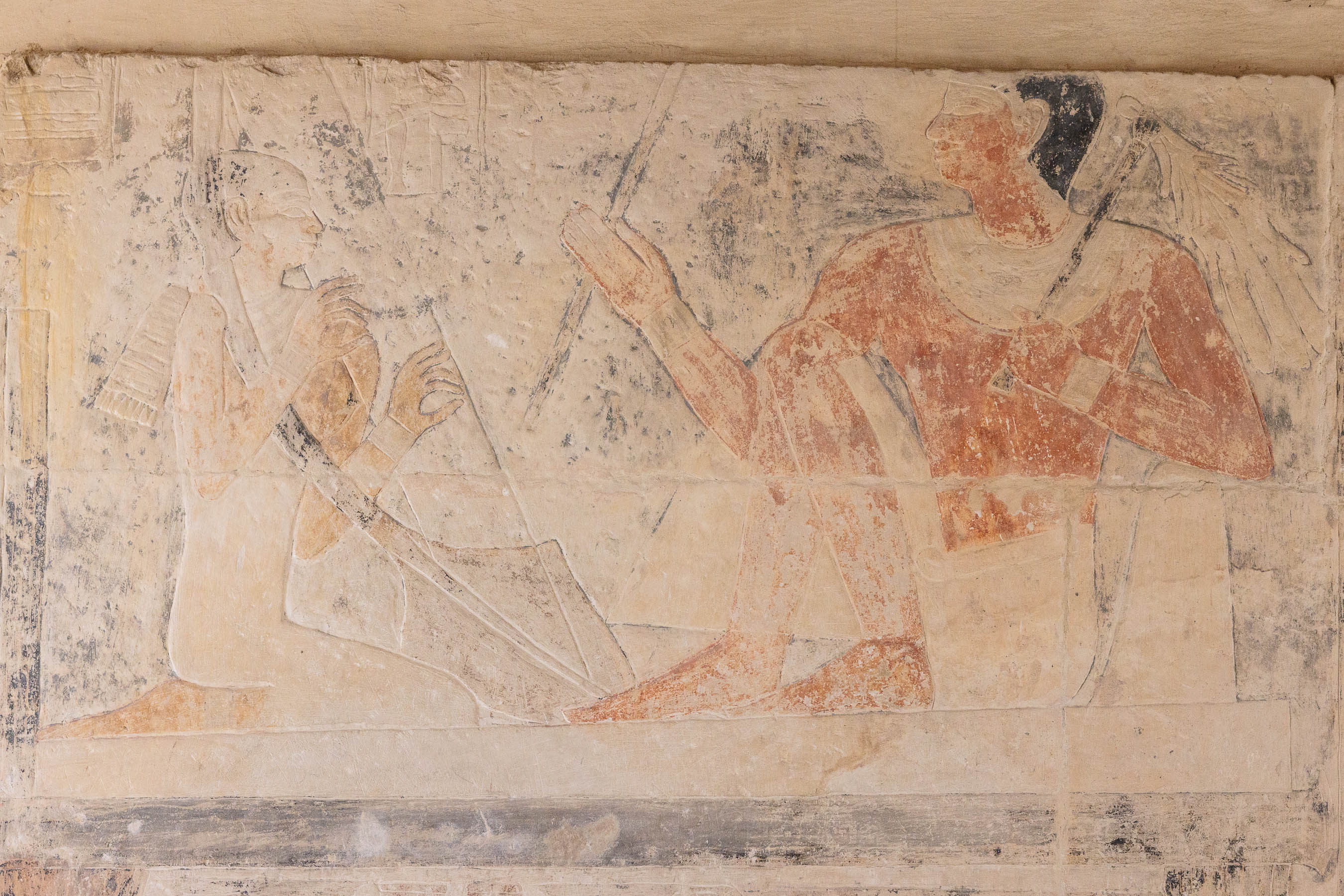
Mereruka and his wife, Waatetkhethor, are seated on a couch. Waatetkhethor plays the harp and Mereruka taps the beat with a stick.
Boulenger, George Albert.
The Fishes of the Nile: Atlas.
United Kingdom: Egyptian government, 1965. Link
Breasted, J. H.
A history of Egypt, from the earliest times to the Persian conquest.
London: Houghton & Stodder, 1927. Link
Duel, Prentice.
The Mastaba of Mereruka: Part I.
Chicago: The University of Chicago Press, 1938. Link
Kellaway, Peter. “The Part Played by the Electric Fish in the Early History of Bioelectricity and Electrotherapy.” Bulletin of the History of Medicine 20, no. 2 (1946): 112-37. Link