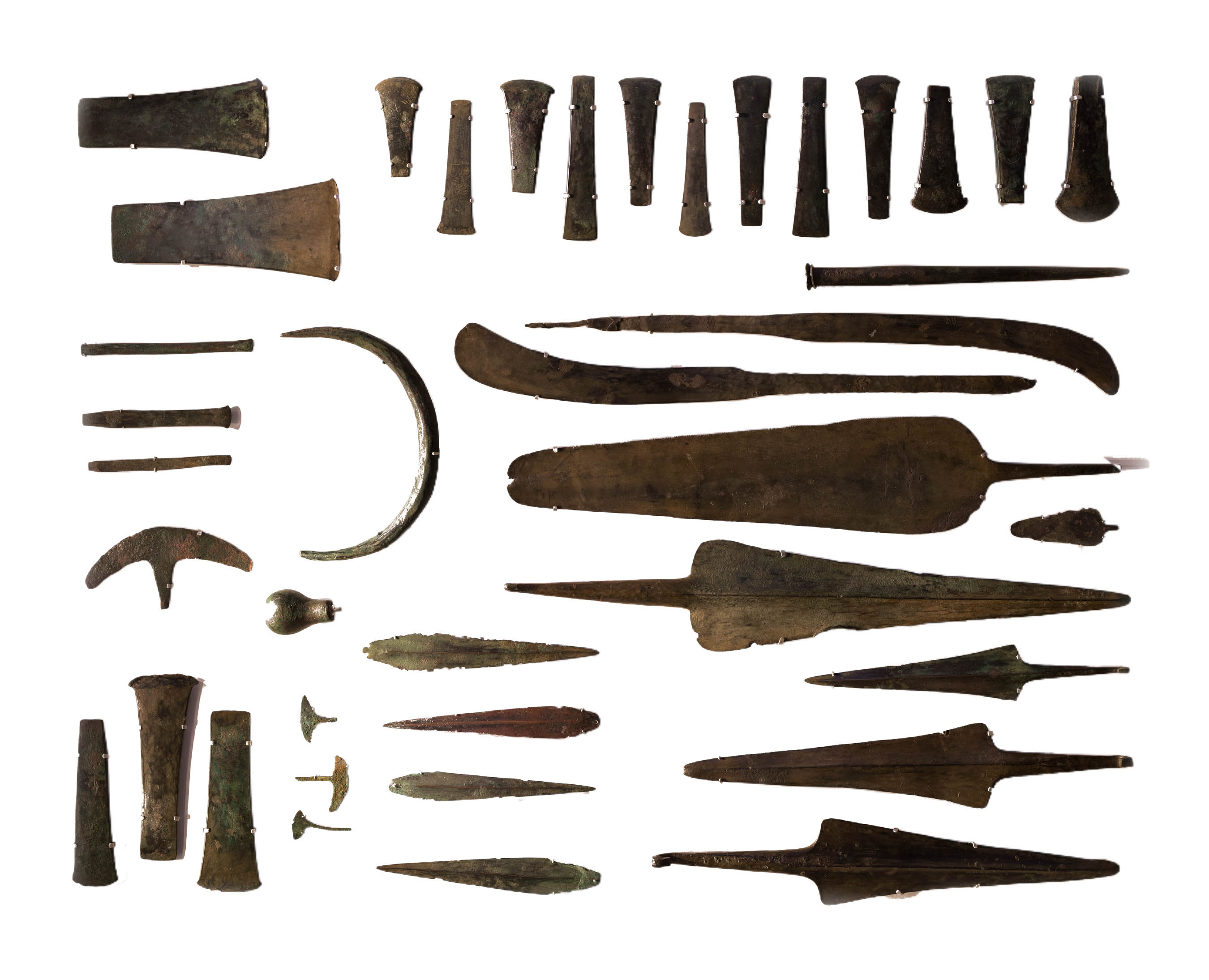
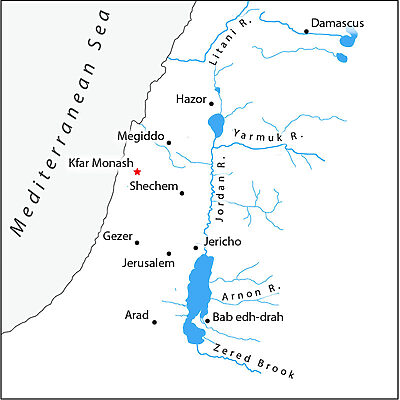
These copper objects were found buried in a field at Kfar Monash, not far from Megiddo.
In 1962 an Israeli farmer ploughing his field unearthed an intriguing hoard of copper objects, now on display in the Israel Museum. Most of the objects from the hoard were made of almost pure copper except for one of the spearheads, a curved knife, and several adzes, which were made from arsenical copper instead.1Hauptmann 2011


Adzes were used for shaping wood. The axe is a thicker and heavier tool, better suited for chopping wood.
Spearheads
Unique to this hoard are several unusually large spearheads. The largest is 26 inches long and weighs slightly more than 4 1/2 pounds. Fitted to a properly balanced shaft, this spear would have made an exceptionally cumbersome weapon. By way of comparison, a short English pike typically weighs around 5 1/2 pounds, ash pole included! Hestrin and Tadmor thought the largest of the spearheads might have been used for ceremonial purposes.2Hestrin and Tadmor 1963, 281 Yigael Yadin suggested the large spears could have been used to dismantle enemy fortifications.3Yadin 1963 Neither of these proposals is particularly compelling.

Spear heads from the Kfar Monash were made with hooked tangs and pronounced midribs.
Copper Plates
The approximately 800 ridged copper plates were also recovered from the Kfar Monash hoard. They were probably used as armor although, like the spearheads, they are unusually large (the average plate 4 inches x 1-1/2 inches) to have served this purpose. Scale armor from later periods was typically made from bronze plates a fraction of the size of the plates in the Kfar Monash Hoard. And they were always punched for sewing to an undergarment. Furthermore, if the plates were used as scale armor, it is the only known examples of this type of armor from the Early Bronze period.


Left: Ridged copper plates are thought to have functioned as armor although they are unusually large to have served that purpose. Bronze armor is otherwise unknown until the Middle Bronze period. Right: Bronze scales were found at Hazor that date to the 13th century BC. Note the holes punched in them for sewing to a shirt.
The Horned Goddess
Among the objects from the hoard was a fine-toothed saw. Besides the exceptionally small teeth, which do not seem like they would have been very effective, the saw was engraved with the image of a cow that has horns terminating with stars. As you may recall, an identical symbol was embossed on an Egyptian stone vase, and also on a stone palette. In each instance, it represents the Egyptian goddess, Bat.

The saw has very fine teeth barely visible in this photo. The symbol of the horned goddess, Bat, was punched into its surface.


Left: A slate palette generally dated to the Naqada II (Gerzean period; 3650-3300 BC in the Standard Chronology) carved with the image of a cow with five stars. Right: The symbol of the goddess is punched into the saw from the Kfar Monash hoard. Although the symbol is known exclusively from predynastic Egypt, the hoard itself probably does not date much before the Early Bronze II period.
How old are they?
The date of the hoard has generated considerable debate. The archaeologists who published the hoard, Ruth Hestrin and Miriam Tadmor, dated it to the Early Bronze I or to the first half of the Early Bronze II (3200-2750 BC in the Conventional Chronology). This corresponds to the Late Predynastic or to the First Dynasty of Egypt.4Hestrin and Tadmor 1963, 286 Hestrin and Tadmor did not think the hoard could date much later than that due to parallels between it and metal objects which date to the Chalcolithic period in the southern Levant (ie. the Nahal Mishmar Hoard).
Amnon Ben-Tor disagreed with the early date, noting that spearheads are otherwise unknown from the Early Bronze I period. He also pointed to a crescentic axehead, discovered approximately six hundred feet from the Kfar Monash hoard, which he thought must originally part of the hoard. Like the spearheads, this style of axehead is otherwise unknown in the EB I.5A. Ben-Tor 1971; See also J. Tubb 1981, 8-9 Ben-Tor was rather inclined to date these weapons later than Hestrin and Tadmor, to the end of the EB II period.

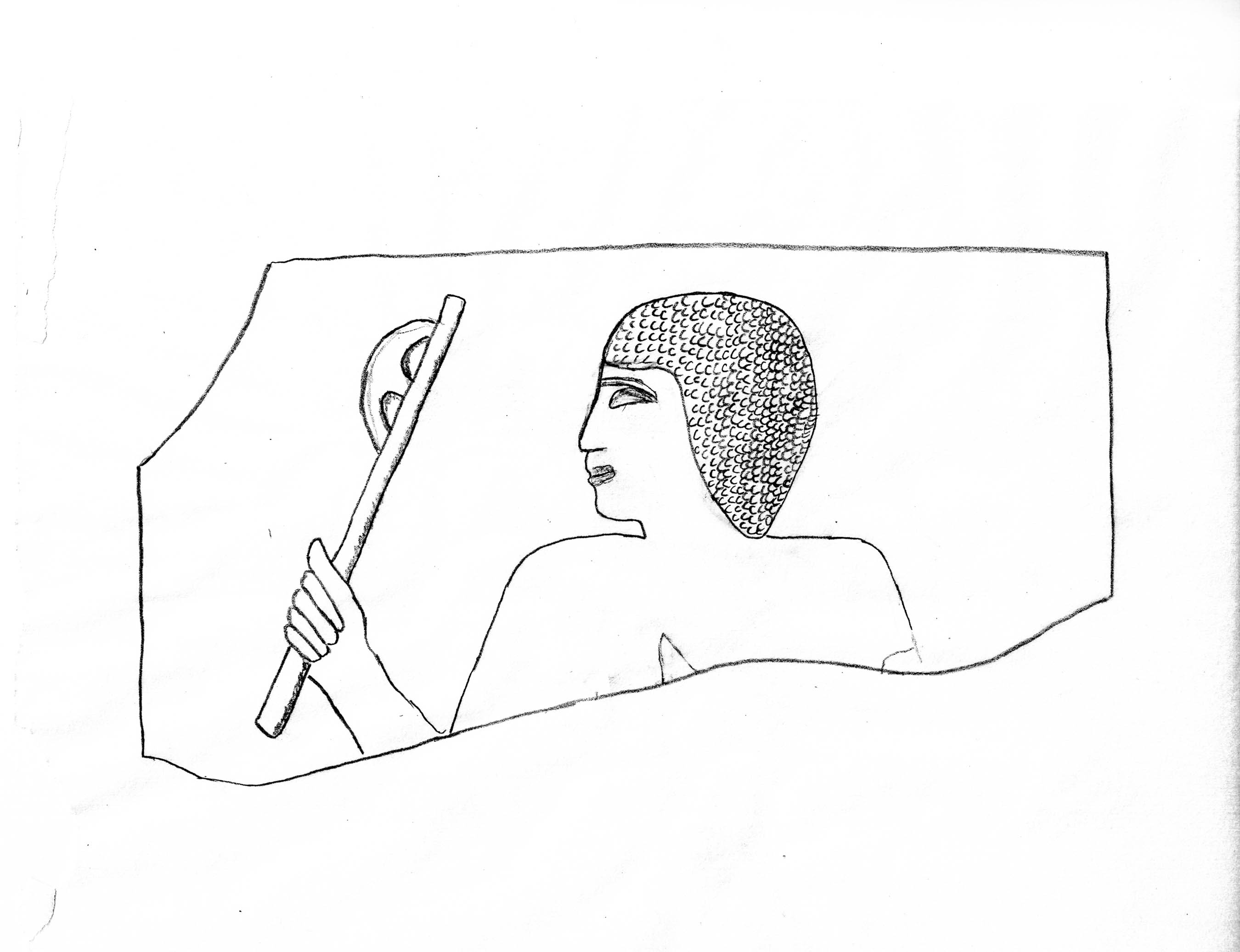
This style of axehead is known only from the latter half of the Early Bronze period (EB II-III). Ben-Tor therefore argues that the axehead from the Kfar Monash cannot date earlier than 2700 BC (Standard Chronology).

A crescentic axe found in one of the tombs in the Royal Cemetery at Ur.
Ben-Tor, A. “The Date of the Kfar Monash Hoard.” Israel Exploration Journal 21, no. 4 (1971): 201-206. Link
Gophna, R. “A Crescentic Axehead from Kfar Monash.” Israel Exploration Journal 18, no. 1 (1968): 47-49. Link
Hestrin, R, M Tadmor. “A Hoard of Tools and Weapons from Kfar Monash.” Israel Exploration Journal 13, no. 4 (1963): 265-288. Link
Schmitt-Strecker, S, A. Hauptmann, F. Begemann. “Bronze Age Kfar Monash. Palestine – A Chemical and Lead Isotope Study into the Provenance of its Copper.” Paléorient 37, no. 2 (2011): 65-78. Link
M., Tadmor, et al . “The Nahal Mishmar hoard from the Judean Desert: Technology, composition, and provenance.” Atiqot, no. 27 (1995): 95-148. Link
Tubb, Jonathan N. “A Crescentic Axehead from Amarna (Syria) and an Examination of Similar Axeheads from the Near East.” Iraq 44, no. no. 1 (1982): 1-12. Link
Yadin, Yigael.
The Art of Warfare in Biblical Lands in the Light of Archaeological Study.
New York: McGraw-Hill, 1963.