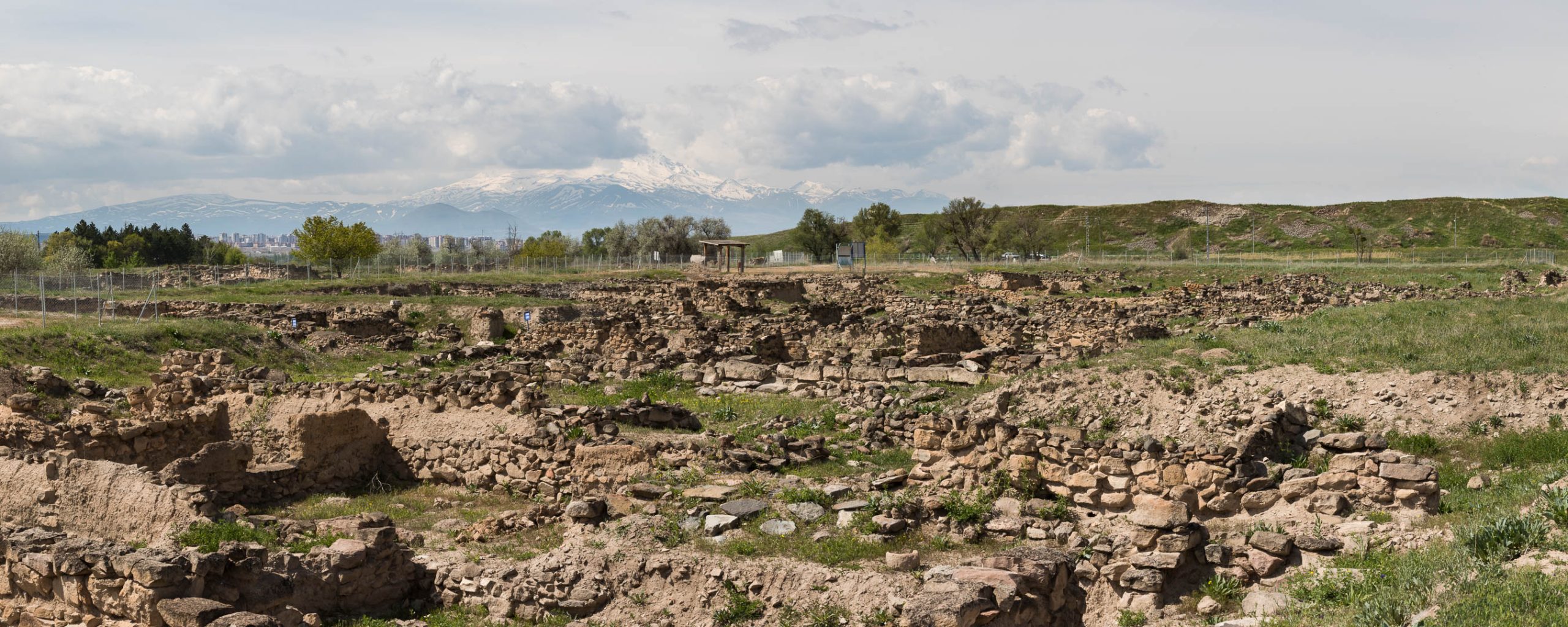
Foreground: The sprawling lower city called Karum Kanesh. Background: The upper city also called Karatepe which means “black hill”.
arcLocated in an isolated valley in central Anatolia, surrounded by mountains and steppe, Kanesh was an impressive Bronze Age city. Its size has been estimated at 170 hectares (420 acres), which was considerably larger than the Assyrian capitol of Assur. The site may be divided into an upper and a lower city. The upper city is a raised mound or ‘tel’ with levels of occupation that go back to the earliest periods of human civilization. Sometime towards the end of the 20th century BC (c. 1975 BC) the city expanded to encompass a lower city. This lower city became the site for an Assyrian trading colony.

The Caravans
The beginning of the Middle Bronze Age Assyrian traders developed a trade network that stretched across the central Anatolian mountains. They erected trading colonies (‘karums’) along this trade route of which Karum Kanesh was the largest and most important. The natives of Anatolia traded their gold, silver and copper for wool cloth and tin. The back bone of this trade was the sturdy black Cappadocian donkey capable of carrying about 65 kilograms of tin or 25 squares of woolen cloth. Each caravan consisted of around 200 of these donkeys.
Everyone seems to have benefited from these trading arrangements. Cities along the major trade routes grew wealthy from the tolls they charged for passage through their land. In return, they secured the roads for safe for passage. This was crucial since a caravan of 200 donkeys presented a soft target in the remote and rugged mountains of Anatolia. The very fact that trade on a large scale was possible speaks to the stable political situation that existed during this period of time.

Merchandise
Flourishing commerce requires competency in both literacy and math. It also depends upon the maintenance of an accurate calendar. For a commercial contract to be valid, it must answer a few basic questions. What kind of product is being delivered? How much? When should it be delivered? If money is being paid in advance, how much interest should be charged? Information such as this was recorded on clay tablets. As many of 20,000 such tablets were discovered at Kanesh, nearly all of them related to commerce. For example, the following tablet was sent by a certain Assyrian merchant name Puzur-Assur to a woman named Waqartum living in the Assyrian capital of Assur:
“The fine textile which you sent me – keep producing similar textiles and send them to me with Assur-idi, and I will send you 1/2 mina of silver each. Let them comb one side of the textile, they should not shear it, its weave should be close. Compared to the last batch of textiles, you should add another mina of wool in each piece, but keep them thin! …” (slightly paraphrased from Sayce, 28)
The land of Sumer was reknown for the fine quality of its woolen garments. As you may recall from the story of Achan in the Bible, Achan took from the spoils of Jericho a “beautiful cloak from Shinar [Sumer]…” (Jos 7:21 ESV). Undoubtedly the people of Jericho traded for “cloaks from Shinar” just as the people of Kanesh did. A warm woollen garment must have been a welcome purchase for anyone living through a cold Anatolian winter.
Debt
Wealthy merchants often employed their large pools of money to lend money. They were able to charge anywhere from 30 to as high as 180 percent on their capitol. Sons and daughters were liable to be sold into slavery if the debt could not be repaid. Heavy debt burdens often became a point of contention. If interest payments on the debt grew beyond the ability of most people to repay, the king might declare that all the debt should be cancelled. Lenders tried to circumvent these debt ‘jubilees’ by inserting phrases into their contracts: “If the king cancels the obligation to pay debt, you will pay me my grain.”1Bryce 1998, 29
The word ‘jubilee’ comes from the Hebrew word yobel which means ‘horn’. According to chapter 25 of the book of Leviticus, a partial debt jubilee was to be declared every seven years, and a total debt jubilee once every fifty years. To mark the beginning of the Year of Jubilee a horn was sounded throughout the land. The sounding of the horn (yobel = Jubilee) signified that all debts were to be cancelled, all captives released, and all ancestral land returned to its owners. The book of Leviticus equates the sounding of the horn with the “proclamation of liberty throughout the land.” (Lev. 25:10) Incidentally, this verse was inscribed on the Liberty Bell that rang from the tower of the Pennsylvania State Legislature.
The purpose for the Year of Jubilee was to prevent the accumulation of land into the hands of just a few people, the natural trajectory of an unregulated economy. Rather than give the king arbitrary power to declare a Jubilee, the Mosaic law incorporates it into the festival calendar. The ethical conviction underpinning this legislation found fiery expression in the words of the prophet Isaiah.
Woe to those who join house to house, who add field to field, until there is no more room, and you are made to dwell alone in the midst of the land. (Isa 5:8 ESV)
In another passage the prophet looks forward to a day when the ‘anointed’ or ‘messiah’ would inaugurate a final Jubilee.
The Spirit of the Lord GOD is upon me, because the LORD has anointed me to bring good news to the poor; he has sent me to bind up the brokenhearted, to proclaim liberty to the captives, and the opening of the prison to those who are bound; to proclaim the year of the LORD’s favor, and the day of vengeance of our God; to comfort all who mourn; (Isa. 61:1-2 ESV)
When Jesus got up to speak in the synagogue of Nazareth, he read this passage from Isaiah and declared, “Today this Scripture has been fulfilled in your hearing.” (Lk. 4:21 ESV).
And all spoke well of him and marveled at the gracious words that were coming from his mouth. (Lk. 4:22 ESV)
Bryce, T. (1998). The kingdom of the Hittites. Oxford New York, Clarendon Press; Oxford University Press.
Barjamovic, Gojko. “The Size of Kanesh and the Demography of Early Middle Bronze Age Anatolia.” Current Research in Kültepe/Kanesh: An Interdisciplinary and Integrative Approach to Trade Networks, Internationalism, and Identity during the Middle Bronze Age. (Journal of Cuneiform Studies, Supplemental Series 4), edited by L. Atici, F. Kulakoglu, G. Barjamovic & A. Fairbairn. (2014): 55–68. Print.
Foreground: The sprawling lower city called Karum Kanesh. Background: The upper city also called Karatepe which means “black hill”.
arcLocated in an isolated valley in central Anatolia, surrounded by mountains and steppe, Kanesh was an impressive Bronze Age city. Its size has been estimated at 170 hectares (420 acres), which was considerably larger than the Assyrian capitol of Assur. The site may be divided into an upper and a lower city. The upper city is a raised mound or ‘tel’ with levels of occupation that go back to the earliest periods of human civilization. Sometime towards the end of the 20th century BC (c. 1975 BC) the city expanded to encompass a lower city. This lower city became the site for an Assyrian trading colony.
The Caravans
The beginning of the Middle Bronze Age Assyrian traders developed a trade network that stretched across the central Anatolian mountains. They erected trading colonies (‘karums’) along this trade route of which Karum Kanesh was the largest and most important. The natives of Anatolia traded their gold, silver and copper for wool cloth and tin. The back bone of this trade was the sturdy black Cappadocian donkey capable of carrying about 65 kilograms of tin or 25 squares of woolen cloth. Each caravan consisted of around 200 of these donkeys.
Everyone seems to have benefited from these trading arrangements. Cities along the major trade routes grew wealthy from the tolls they charged for passage through their land. In return, they secured the roads for safe for passage. This was crucial since a caravan of 200 donkeys presented a soft target in the remote and rugged mountains of Anatolia. The very fact that trade on a large scale was possible speaks to the stable political situation that existed during this period of time.
Merchandise
Flourishing commerce requires competency in both literacy and math. It also depends upon the maintenance of an accurate calendar. For a commercial contract to be valid, it must answer a few basic questions. What kind of product is being delivered? How much? When should it be delivered? If money is being paid in advance, how much interest should be charged? Information such as this was recorded on clay tablets. As many of 20,000 such tablets were discovered at Kanesh, nearly all of them related to commerce. For example, the following tablet was sent by a certain Assyrian merchant name Puzur-Assur to a woman named Waqartum living in the Assyrian capital of Assur:
“The fine textile which you sent me – keep producing similar textiles and send them to me with Assur-idi, and I will send you 1/2 mina of silver each. Let them comb one side of the textile, they should not shear it, its weave should be close. Compared to the last batch of textiles, you should add another mina of wool in each piece, but keep them thin! …” (slightly paraphrased from Sayce, 28)
The land of Sumer was reknown for the fine quality of its woolen garments. As you may recall from the story of Achan in the Bible, Achan took from the spoils of Jericho a “beautiful cloak from Shinar [Sumer]…” (Jos 7:21 ESV). Undoubtedly the people of Jericho traded for “cloaks from Shinar” just as the people of Kanesh did. A warm woollen garment must have been a welcome purchase for anyone living through a cold Anatolian winter.
Debt
Wealthy merchants often employed their large pools of money to lend money. They were able to charge anywhere from 30 to as high as 180 percent on their capitol. Sons and daughters were liable to be sold into slavery if the debt could not be repaid. Heavy debt burdens often became a point of contention. If interest payments on the debt grew beyond the ability of most people to repay, the king might declare that all the debt should be cancelled. Lenders tried to circumvent these debt ‘jubilees’ by inserting phrases into their contracts: “If the king cancels the obligation to pay debt, you will pay me my grain.”1Bryce 1998, 29
The word ‘jubilee’ comes from the Hebrew word yobel which means ‘horn’. According to chapter 25 of the book of Leviticus, a partial debt jubilee was to be declared every seven years, and a total debt jubilee once every fifty years. To mark the beginning of the Year of Jubilee a horn was sounded throughout the land. The sounding of the horn (yobel = Jubilee) signified that all debts were to be cancelled, all captives released, and all ancestral land returned to its owners. The book of Leviticus equates the sounding of the horn with the “proclamation of liberty throughout the land.” (Lev. 25:10) Incidentally, this verse was inscribed on the Liberty Bell that rang from the tower of the Pennsylvania State Legislature.
The purpose for the Year of Jubilee was to prevent the accumulation of land into the hands of just a few people, the natural trajectory of an unregulated economy. Rather than give the king arbitrary power to declare a Jubilee, the Mosaic law incorporates it into the festival calendar. The ethical conviction underpinning this legislation found fiery expression in the words of the prophet Isaiah.
Woe to those who join house to house, who add field to field, until there is no more room, and you are made to dwell alone in the midst of the land. (Isa 5:8 ESV)
In another passage the prophet looks forward to a day when the ‘anointed’ or ‘messiah’ would inaugurate a final Jubilee.
The Spirit of the Lord GOD is upon me, because the LORD has anointed me to bring good news to the poor; he has sent me to bind up the brokenhearted, to proclaim liberty to the captives, and the opening of the prison to those who are bound; to proclaim the year of the LORD’s favor, and the day of vengeance of our God; to comfort all who mourn; (Isa. 61:1-2 ESV)
When Jesus got up to speak in the synagogue of Nazareth, he read this passage from Isaiah and declared, “Today this Scripture has been fulfilled in your hearing.” (Lk. 4:21 ESV).
And all spoke well of him and marveled at the gracious words that were coming from his mouth. (Lk. 4:22 ESV)
Bryce, T. (1998). The kingdom of the Hittites. Oxford New York, Clarendon Press; Oxford University Press.
Barjamovic, Gojko. “The Size of Kanesh and the Demography of Early Middle Bronze Age Anatolia.” Current Research in Kültepe/Kanesh: An Interdisciplinary and Integrative Approach to Trade Networks, Internationalism, and Identity during the Middle Bronze Age. (Journal of Cuneiform Studies, Supplemental Series 4), edited by L. Atici, F. Kulakoglu, G. Barjamovic & A. Fairbairn. (2014): 55–68. Print.