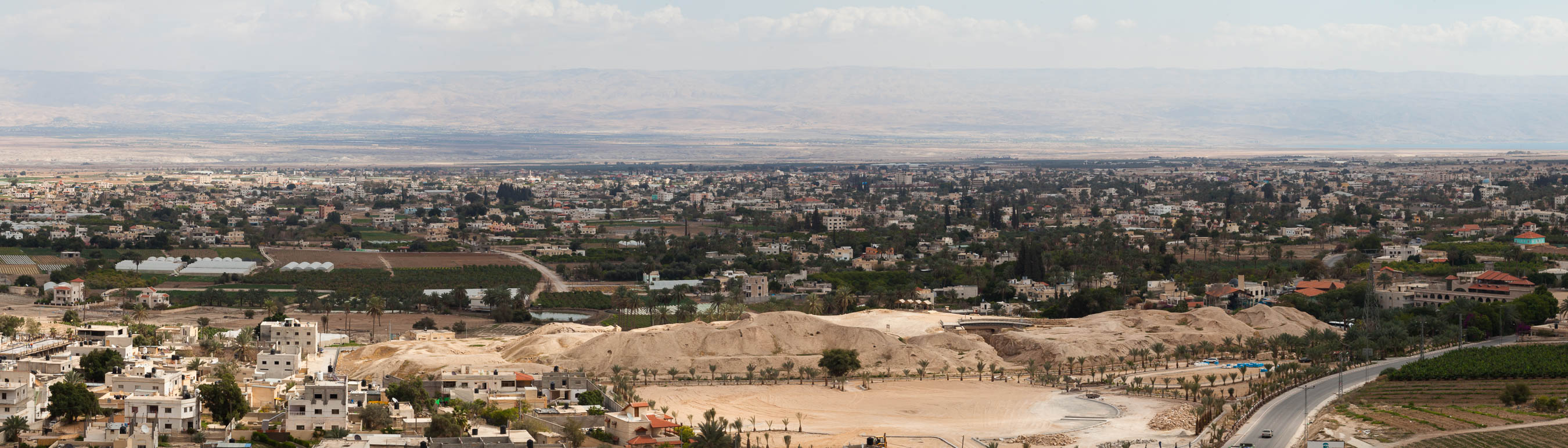
The story of Joshua and Jericho is one of the best known stories in the Bible. The Israelites were commanded by God to march around the city of Jericho seven times. On the seventh day, after the trumpet blast, the walls of the city came tumbling down. This story is part of a larger narrative: the exodus from house of bondage, the giving of the law, the wilderness wandering, the crossing of the Jordan, the judgement of God on the inhabitants of Canaan, the promise of land and peace. They form the backdrop for the psalms and the gospels that have become such an integral part of western culture. It is no wonder, then, that for many of those who had grown up reading the Bible, the discovery of the mound of Jericho and its subsequent excavation were matters of no small curiosity. Would archaeologists find the famous walls that came tumbling down?
Dating Jericho
Jericho is located in a lush oasis at the bottom of a deep gash in the earths surface known as the Great Rift Valley. The Jordan River runs at the bottom of this great rift until it reaches the deepest part, more than 700 meters below sea level. Here the water collects to a depth of 300 meters to form the Dead Sea. At 400 meters below sea level, temperatures rarely dip below 30 degrees C in this region. Despite such harsh living conditions, archaeologists have found some of the earliest evidence of human habitation in this region. One reason reason for this may simply be that the the climate was cooler and more moist back then. But in the case of Jericho, the primary reason must be the abundance of water for irrigation.
The early explorers of Palestine were quick to take note of the distinctive tell of Jericho (Tel es-Sultan). Charles Warren was the first to dig at the site but his efforts were met with little success. In fact, his trench missed the some of the earliest structures at Jericho by less than a meter! The Germans were next to dig at Jericho, from 1907-1909, shortly after Macalister dug at Gezer. They found well preserved houses and the remains of a mud-brick city wall built on top of a stone embankment. But it was really John Garstang who put Jericho on the map. Over the course of six years he found the remains of a palace, storerooms and a temple. Remarkably, these areas were covered by a thick burn layer.


with clay vessels full of charred grain.
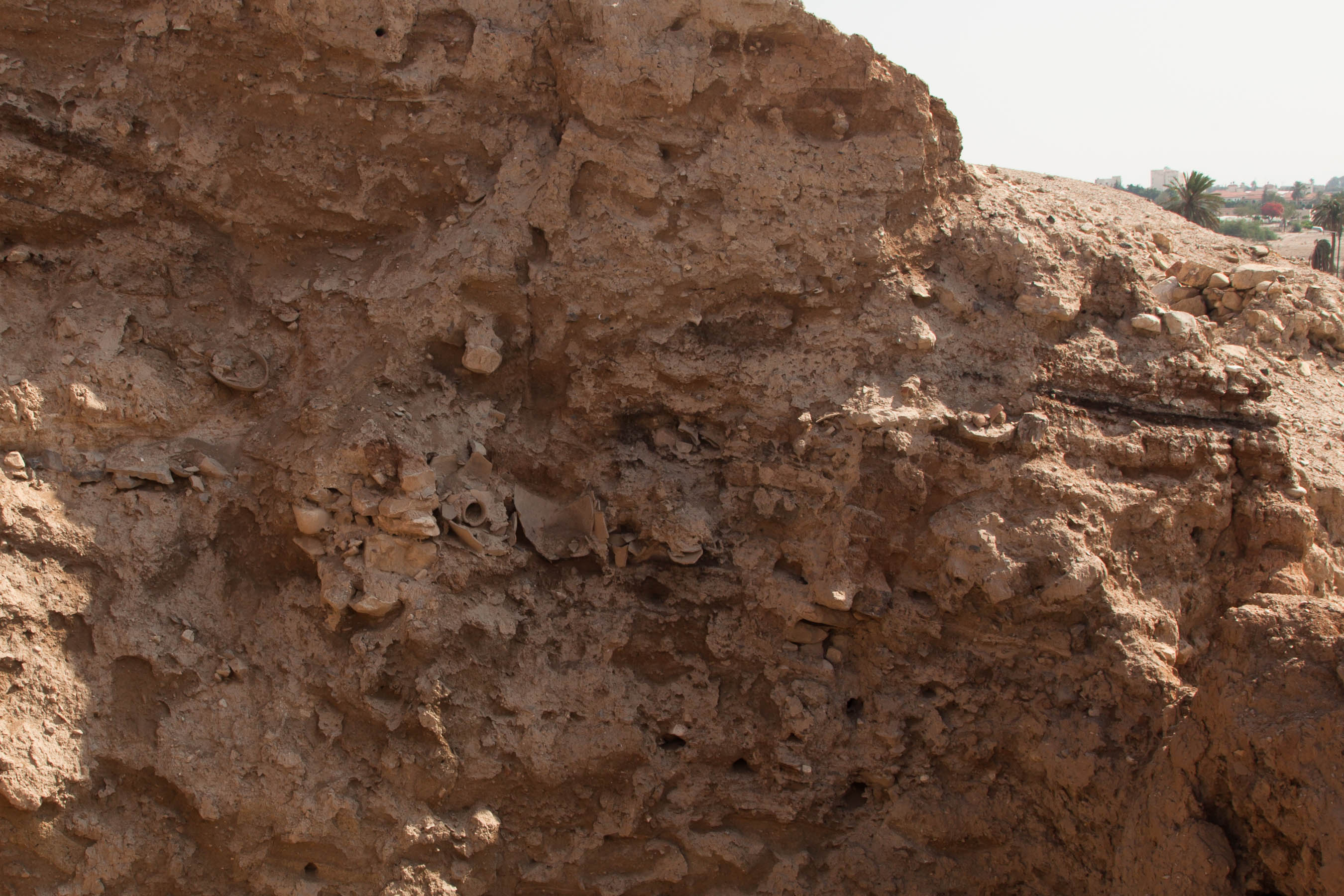
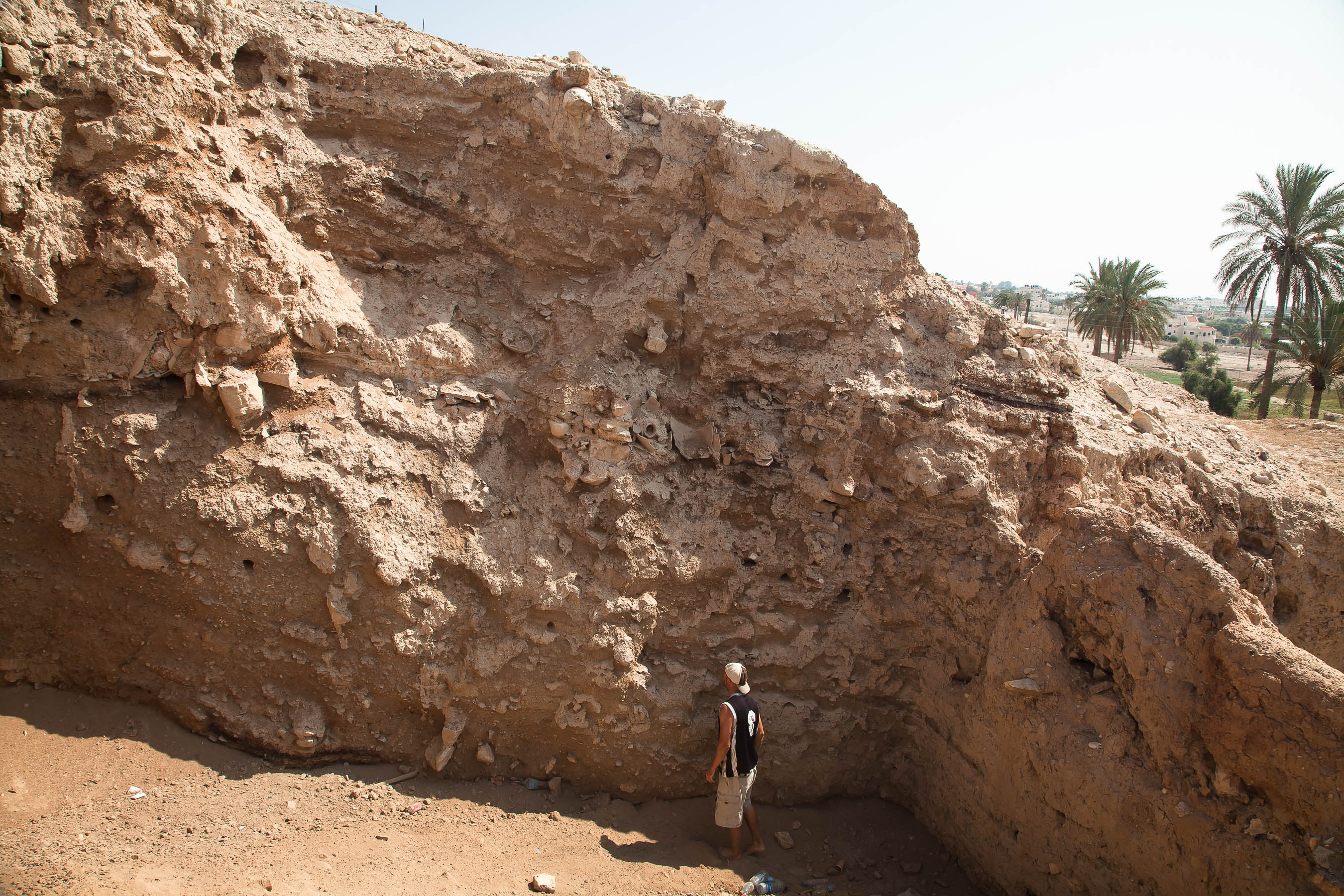
The thick destruction level may still be seen at places on the site. It is marked by large amounts of broken pottery and ash.
Garstang found evidence of a fiery destruction which he argued could date to Joshua’s conquest of Jericho. He based his conclusions on the type of pottery found in the storerooms and on several scarabs that he found in nearby tombs inscribed with the names of Hatshepsut, Thutmose III and Amenhotep III. Garstang reasoned that Jericho must have been destroyed sometime during or after the reign of this last king, since all evidence for Egyptian involvement in Canaan drops off after Amenhotep III. Not only was this born out in the archaeological record, but also in texts from this period. For example, in one letter addressed to the pharaoh, a vassal complains that “for fifty years no Egyptian troops had visited the country which was in imminent peril of being overrun and falling into anarchy.”
Garstang argued that Jericho must have been destroyed in this same time period. The destruction level found at the site was impressive:
The excavators found themselves knee-deep in charcoal and white ash among the tumbled walls of the former Palace; while the great protective walls of mud brick, that had stood upon the brink of the mound, lay in confused ruin upon its slopes, shaken down seemingly by earthquake. That Joshua’s inroad synchronized with a series of such episodes is suggested by other contexts.” (Garstang, History in the Bible, 381-382)
Garstang concluded by citing the following passage from the Bible:
. . . the wall fell down flat, so that the people (the Israelites) went up into the city, every man straight before him, and they took the city…. And they burnt the city with fire, and all that was therein…
Garstang’s conclusions raised a great deal of interest among the public and no small amount of controversy in the scholarly world. At the time of writing, the scholarly concensus was moving away from the theory of an Israelite conquest of the land of Canaan in favor of another theory that had the Israelites settling the land of Canaan after the Canaanite city states had already fallen into ruin. Garstang’s excavations were not conclusive. The larger portion of the tell was still waiting to be dug, and so the question of Jericho lingered. Did the mound show evidence of destruction in the 15th century BC that might be attributed to the Israelites?
The Walls
It wasn’t until after World War II that another archaeologist, Kathleen Kenyon, was able to renew excavations at Jericho and test Garstang’s claims. Kenyon contradicted Garstang on almost every point. She argued that the destruction which Garstang dated to the 15th or 14th century BC (the time of Joshua’s conquest) should rather be dated to the 16th century BC. Kenyon attributed this destruction to one of the early 18th dynasty pharaohs who pushed the Hyksos out of Egypt and then pursued them into Canaan. Perhaps more importantly, Kathleen Kenyon argued that Jericho was virtually non-existent in the late bronze age. This means that there was no Jericho for the Joshua and the Israelites to conquer.
Kenyon’s excavation provided a very fine cross-section of the tell. In it, you can see the strong stone embankment that would have once supported the mudbrick walls that surrounded the city. The wall itself was found collapsed in a jumble of bricks at the base of the embankment. These mudbricks are colored orange in the image below. Furthermore, a thick layer fine silt and gravel was found above the collapse of this city wall (light yellow) indicating that the site was left unoccupied for a period of time.

of the wall of Jericho showing the original position of the mud-brick wall, and the thick mass of mud brick excavated at the base of the foundation wall.
It was this wall that Garstang identified with the Israelite destruction. However, Kenyon dated the destruction of these walls to 1700 BC which was much too early to be attributed to the Israelites. However, the discovery of a whole new fortification system, clearly earlier than this one, resulted in a revised date of around 1500 BC for the destruction of these walls of Jericho. This is still too early to be dated to the time of Joshua, and thus Kenyon argued that the destruction should be attributed to the Egyptians even though no Egyptian pharaoh claimed credit for the destruction as was their custom.
Chronology
If Jericho was destroyed by Joshua as the Bible attests, then we are forced to go against what amounts to the scholarly concensus. Where are the city walls? However, since archaeologists have already been forced to down date the middle bronze age walls of Jericho by 150 years, from 1700 to 1550 BC, it is not difficult to imagine a further adjustment to the dating of these walls. The question that needs to be answered is to what what degree of accuracy archaeologists are able to date the walls of a city? Many fortifications continued in use for centuries and even millennia. It is possible that walls constructed during the middle bronze age continued in use into the late bronze age. This was opinion expressed by Avraham Biran, the archaeologist who excavated Tel Dan, in an interview with Hershel Shanks:
Avraham Biran: “When you talk about Jericho and other late bronze age cities, people always think of city walls. “Where are the city walls, the fortification?” they ask. Now I’ve always maintained-with respect to Dan, and I think it may be true for Jericho as well-that what we found at Dan, the middle bronze age rampart, the huge, so-called Hyksos fortification, may help solve the dilemma. When the Israelites came, they encountered these middle bronze age fortifications which were still being used in late bronze age. These were formidable fortification. If we don’t find late bronze age walls, it’s because the middle bronze age fortifications served as a defense system in the late bronze age as well.
Hershel Shanks: That was [Yigael] Yadin’s view, too, wasn’t it? About Jericho as well as Dan?
Avraham Biran: I think so, and I think he was quite right.
The views expressed by Avraham Biran are not well received today, but I think it is worth bearing in mind in any discussion of Jericho. Although most archaeologists today are adament that the collapsed middle bronze age walls of Jericho cannot be attributed to the Israelite conquest, there are good reasons to believe that the walls themselves, although constructed during the middle bronze, continued in use into the late bronze age. Garstang may not have been so far off the mark after all.
The story of Joshua and Jericho is one of the best known stories in the Bible. The Israelites were commanded by God to march around the city of Jericho seven times. On the seventh day, after the trumpet blast, the walls of the city came tumbling down. This story is part of a larger narrative: the exodus from house of bondage, the giving of the law, the wilderness wandering, the crossing of the Jordan, the judgement of God on the inhabitants of Canaan, the promise of land and peace. They form the backdrop for the psalms and the gospels that have become such an integral part of western culture. It is no wonder, then, that for many of those who had grown up reading the Bible, the discovery of the mound of Jericho and its subsequent excavation were matters of no small curiosity. Would archaeologists find the famous walls that came tumbling down?
Dating Jericho
Jericho is located in a lush oasis at the bottom of a deep gash in the earths surface known as the Great Rift Valley. The Jordan River runs at the bottom of this great rift until it reaches the deepest part, more than 700 meters below sea level. Here the water collects to a depth of 300 meters to form the Dead Sea. At 400 meters below sea level, temperatures rarely dip below 30 degrees C in this region. Despite such harsh living conditions, archaeologists have found some of the earliest evidence of human habitation in this region. One reason reason for this may simply be that the the climate was cooler and more moist back then. But in the case of Jericho, the primary reason must be the abundance of water for irrigation.
The early explorers of Palestine were quick to take note of the distinctive tell of Jericho (Tel es-Sultan). Charles Warren was the first to dig at the site but his efforts were met with little success. In fact, his trench missed the some of the earliest structures at Jericho by less than a meter! The Germans were next to dig at Jericho, from 1907-1909, shortly after Macalister dug at Gezer. They found well preserved houses and the remains of a mud-brick city wall built on top of a stone embankment. But it was really John Garstang who put Jericho on the map. Over the course of six years he found the remains of a palace, storerooms and a temple. Remarkably, these areas were covered by a thick burn layer.
with clay vessels full of charred grain.
The thick destruction level may still be seen at places on the site. It is marked by large amounts of broken pottery and ash.
Garstang found evidence of a fiery destruction which he argued could date to Joshua’s conquest of Jericho. He based his conclusions on the type of pottery found in the storerooms and on several scarabs that he found in nearby tombs inscribed with the names of Hatshepsut, Thutmose III and Amenhotep III. Garstang reasoned that Jericho must have been destroyed sometime during or after the reign of this last king, since all evidence for Egyptian involvement in Canaan drops off after Amenhotep III. Not only was this born out in the archaeological record, but also in texts from this period. For example, in one letter addressed to the pharaoh, a vassal complains that “for fifty years no Egyptian troops had visited the country which was in imminent peril of being overrun and falling into anarchy.”
Garstang argued that Jericho must have been destroyed in this same time period. The destruction level found at the site was impressive:
The excavators found themselves knee-deep in charcoal and white ash among the tumbled walls of the former Palace; while the great protective walls of mud brick, that had stood upon the brink of the mound, lay in confused ruin upon its slopes, shaken down seemingly by earthquake. That Joshua’s inroad synchronized with a series of such episodes is suggested by other contexts.” (Garstang, History in the Bible, 381-382)
Garstang concluded by citing the following passage from the Bible:
. . . the wall fell down flat, so that the people (the Israelites) went up into the city, every man straight before him, and they took the city…. And they burnt the city with fire, and all that was therein…
Garstang’s conclusions raised a great deal of interest among the public and no small amount of controversy in the scholarly world. At the time of writing, the scholarly concensus was moving away from the theory of an Israelite conquest of the land of Canaan in favor of another theory that had the Israelites settling the land of Canaan after the Canaanite city states had already fallen into ruin. Garstang’s excavations were not conclusive. The larger portion of the tell was still waiting to be dug, and so the question of Jericho lingered. Did the mound show evidence of destruction in the 15th century BC that might be attributed to the Israelites?
The Walls
It wasn’t until after World War II that another archaeologist, Kathleen Kenyon, was able to renew excavations at Jericho and test Garstang’s claims. Kenyon contradicted Garstang on almost every point. She argued that the destruction which Garstang dated to the 15th or 14th century BC (the time of Joshua’s conquest) should rather be dated to the 16th century BC. Kenyon attributed this destruction to one of the early 18th dynasty pharaohs who pushed the Hyksos out of Egypt and then pursued them into Canaan. Perhaps more importantly, Kathleen Kenyon argued that Jericho was virtually non-existent in the late bronze age. This means that there was no Jericho for the Joshua and the Israelites to conquer.
Kenyon’s excavation provided a very fine cross-section of the tell. In it, you can see the strong stone embankment that would have once supported the mudbrick walls that surrounded the city. The wall itself was found collapsed in a jumble of bricks at the base of the embankment. These mudbricks are colored orange in the image below. Furthermore, a thick layer fine silt and gravel was found above the collapse of this city wall (light yellow) indicating that the site was left unoccupied for a period of time.
of the wall of Jericho showing the original position of the mud-brick wall, and the thick mass of mud brick excavated at the base of the foundation wall.
It was this wall that Garstang identified with the Israelite destruction. However, Kenyon dated the destruction of these walls to 1700 BC which was much too early to be attributed to the Israelites. However, the discovery of a whole new fortification system, clearly earlier than this one, resulted in a revised date of around 1500 BC for the destruction of these walls of Jericho. This is still too early to be dated to the time of Joshua, and thus Kenyon argued that the destruction should be attributed to the Egyptians even though no Egyptian pharaoh claimed credit for the destruction as was their custom.
Chronology
If Jericho was destroyed by Joshua as the Bible attests, then we are forced to go against what amounts to the scholarly concensus. Where are the city walls? However, since archaeologists have already been forced to down date the middle bronze age walls of Jericho by 150 years, from 1700 to 1550 BC, it is not difficult to imagine a further adjustment to the dating of these walls. The question that needs to be answered is to what what degree of accuracy archaeologists are able to date the walls of a city? Many fortifications continued in use for centuries and even millennia. It is possible that walls constructed during the middle bronze age continued in use into the late bronze age. This was opinion expressed by Avraham Biran, the archaeologist who excavated Tel Dan, in an interview with Hershel Shanks:
Avraham Biran: “When you talk about Jericho and other late bronze age cities, people always think of city walls. “Where are the city walls, the fortification?” they ask. Now I’ve always maintained-with respect to Dan, and I think it may be true for Jericho as well-that what we found at Dan, the middle bronze age rampart, the huge, so-called Hyksos fortification, may help solve the dilemma. When the Israelites came, they encountered these middle bronze age fortifications which were still being used in late bronze age. These were formidable fortification. If we don’t find late bronze age walls, it’s because the middle bronze age fortifications served as a defense system in the late bronze age as well.
Hershel Shanks: That was [Yigael] Yadin’s view, too, wasn’t it? About Jericho as well as Dan?
Avraham Biran: I think so, and I think he was quite right.
The views expressed by Avraham Biran are not well received today, but I think it is worth bearing in mind in any discussion of Jericho. Although most archaeologists today are adament that the collapsed middle bronze age walls of Jericho cannot be attributed to the Israelite conquest, there are good reasons to believe that the walls themselves, although constructed during the middle bronze, continued in use into the late bronze age. Garstang may not have been so far off the mark after all.