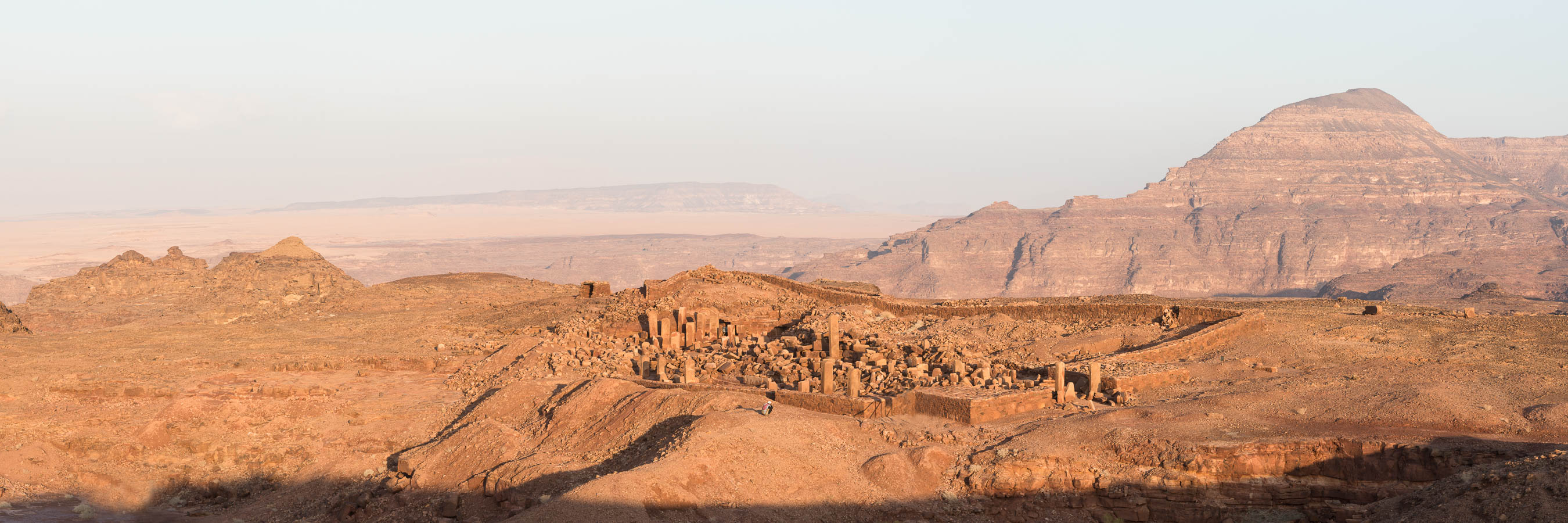
on a hill overlooking the turquoise mines.
Barren mountains and broad trackless desert made the Sinai an effect barrier to any army which sought to invade Egypt. The Egyptians themselves did not venture into the Sinai except to mine copper and turquoise. The latter was prized by Egyptian craftsmen for its glassy, almost translucent, bluish green color. Although ancient sources of turquoise could be found in the remote mountains of Iran, the only known sources of turquoise available to the Egyptians were the mines at Serabit el-Khadim in the Sinai.

Turquoise was mined at Serabit el-Khadim throughout the Middle and New Kingdom periods. The miners who worked in the mines left recorded their names and achievements on stelae which were subsequently deposited in the Temple of Hathor at Serabit el-Khadim. These stelae preserve the many different titles borne by the members of the expedition:
- Commander
- Seal-bearer
- Elder of the Treasury
- Scribe
- Guards of the Storehouse
- Chief of Transport
- Chief Physician
- Chief of Boats
- Interpreter
- Copper Smith
- Stone Worker
- Inspector
- Foreman
- Gardeners
- Guard
- Asiatics
It is evident from the long lists of official titles recorded on the stelae that the expeditions to Serabit el-Khadim were carefully organized and controlled affairs.1See this list of expedition members for example: Gardiner et al. 1952, Text 88 Pl. XXII Unlike gold and copper mines, the turquoise mines were not very deep. Rather than tunnelling into the earth, turquoise miners dug open galleries in the sandstone. There must always have been a danger of the roof collapsing, as may be judged by the following prayer inscribed on the wall of Mine L.
Oh my god, rescue me from the interior of the mine!2Albright 1969, Text 350

A typical turquoise mine cut into the sandstone.

The temple to the goddess Hathor was erected on a plateau above the turquoise mines. Stelae erected inside the temple preserve the names of officials and their titles.
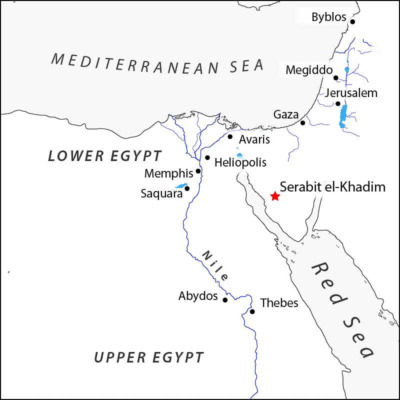
The Egyptians referred to Hathor as the “Mistress of the Foreign Lands” and “Lady of Turquoise.” Her association with turquoise may be due to its blue and green color since these are also the colors associated with the goddess, not just in Egypt but in Mesopotamia as well. The origins of the temple of Hathor at Serabit el-Khadim go back to the Middle Kingdom period when Egyptians first began mining turquoise there.3Earlier mines existed in the Sinai at Wadi Maghareh that date back to the 3rd dynasty but these were copper mines.
As noted previously, a large number of the stelae erected inside the sacred precinct name the pharaoh who sponsored the expedition and also the name of his overseer.4The earliest of these date to the reign of Amenemhat I, the founder of the 12th dynasty. One of these, which was set up by an official named Harwerre during the reign of Amenemhet III, describes the harsh conditions the miners experienced in the Sinai and the difficulties associated with finding good stone. Harwerre goes on to declare that he succeeded in his task thanks to help from the goddess Hathor, “the Lady of Heaven.”
I had come from Egypt discouraged in soul. It seemed impossible to find [stones] of suitable color. This deserted region is burning in summer, the mountains are [as if] heated with red-hot iron and the colors [of the stones] are spoiled by it.
I had collected this precious gem. I had succeeded better than anyone [before me] and beyond all that had ever been commanded. It was impossible to wish for better. The color [of the stone] was perfect and it was a feast for the eyes. The gem was even more beautiful than [if mined] at the normal season! Therefore invocations were repeatedly offered to the Lady of Heaven. Rely then on Hathor. Do it; you will be better off for it. You will succeed better. Good luck to you!5Barrois 1932, 114-115
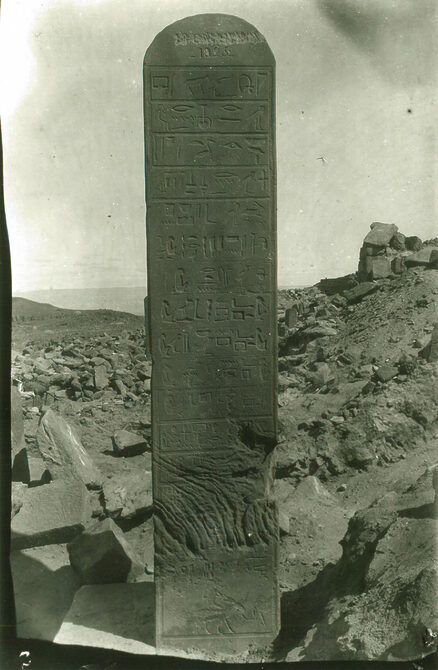
Harwerre associates the goddess with “good luck.” This association would persist into the Greco-Roman period with the goddess Tyche (Greek. “luck”) and Fortuna (Latin “fortune”). Thus “Lady Luck” has entered into popular English idiom.

The longstanding connection between the goddess and “good fortune” sheds light on a dispute which arose between the people of Judah and the prophet Jeremiah. Everything was going fine, the people of Judah claimed, so long as they were making offerings to the Queen of Heaven.
But since we left off making offerings to the queen of heaven and pouring out drink offerings to her, we have lacked everything and have been consumed by the sword and by famine.” (Jer. 44:18 ESV)
Jeremiah replied that their problems did not spring from a lack of proper ritual but from their failure to do what is right and good.
…your sins have kept good from you. For wicked men are found among my people; they lurk like fowlers lying in wait. They set a trap; they catch men. Like a cage full of birds, their houses are full of deceit; therefore they have become great and rich; they have grown fat and sleek. They know no bounds in deeds of evil; they judge not with justice the cause of the fatherless, to make it prosper, and they do not defend the rights of the needy. Shall I not punish them for these things? declares the LORD, and shall I not avenge myself on a nation such as this?”
An appalling and horrible thing has happened in the land: the prophets prophesy falsely, and the priests rule at their direction; my people love to have it so, but what will you do when the end comes? (Jer. 5:25-31 ESV)
The dispute between Jeremiah and the people of Judah was the clash between a fatalistic worldview and a moral one.
Serabit El-Khadim Abandoned
Stelae continued to be erected at Serabit el-Khadim until the reign of Ramses VI, the sixth pharaoh of the 20th dynasty (c. 1150 BC). The temple was abandoned at the end of the New Kingdom period (c. 1100 BC) when the Egyptians were unable to maintain control of the Sinai.
Barrois, A. “The Harvard Theological Review.” The Harvard Theological Review 25, no. 2 (1932): 101-121. Link
Gardiner, A. H.
Egypt Exploration Society.
London: Egypt Exploration Society, 1952.
Petrie, W.M.F, C.T. Currelly.
Researches in Sinai.
London: John Murray, 1906. Link
Albright, W. F.
The Proto-Sinaitic Inscriptions and Their Decipherment.
Cambridge: Harvard University Press, 1966.