
at Serabite el_Khadim.
Many of the foreign workers employed in the mines at Serabit el-Khadim were of Semitic origin. Not all were slaves. Some of the overseers also bore semitic names. One stele shows a semitic chief riding a donkey and wearing a distinctive hat that marks him as one of the foreign amurru. What is most remarkable about this stele, however, is its inscription. Whereas the upper part is inscribed with hieroglyphs, the lower part utilizes a new script that has the appearance of being a crude script that made use of only a limited number of symbols. Sir Flinders Petrie was the first to draw attention to this “barbaric” script which he found inscribed on stele and also on the walls of the turquoise mines at Serabit el-Khadim.
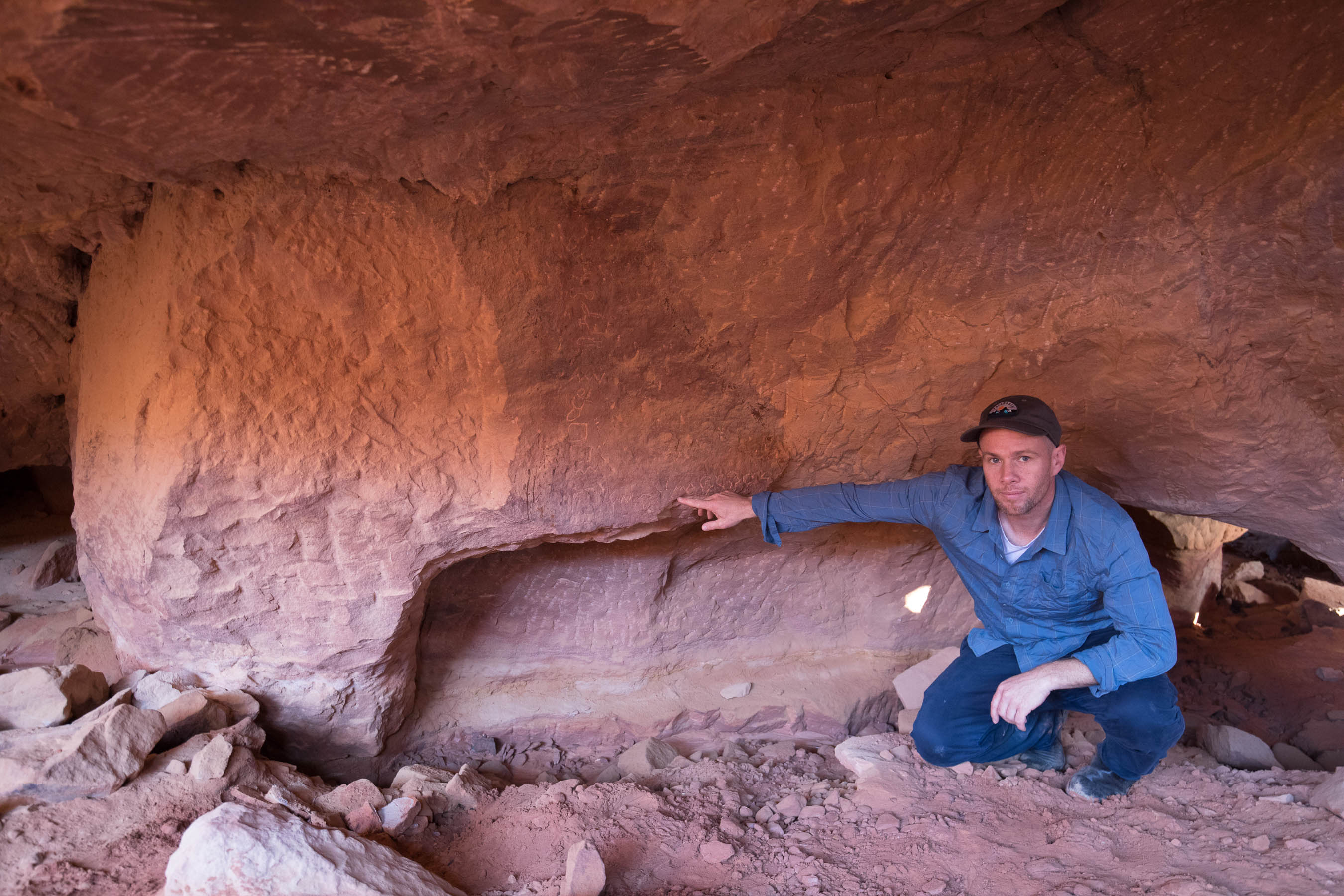

showing graffiti inscribed on the wall of the mine. It deals with a purely mundane matter. “Thou, O Shapahn, collect from Ababa eight (?) mins (of turquise). Shimea, groom of the chief of the car[aveers(?)]. (Albright 1969, 23)
arcProto-sinaitic Script
Alan Gardiner was the first to make a tentative step towards translating the script in 1910. He focused on a set of symbols often repeated. He guessed that they were Semitic and not Egyptian and that they were used for their phonetic value (symbols = sounds) instead of as pictograms (symbols = words). Based on these assumptions, he translated the aforementioned symbols as “Baalat,” which means “our lady.” This interpretation fit with the overall context of the discovery since the inscriptions were largely found in and around the Temple to Hathor (“Baalat” being the semitic term for “Hathor”). Although Gardiner made the first breakthrough, it was left for another scholar, William F. Albright, to fully decipher the script. He managed to assign phonetic values to most of the 27 letters of the script, which he named “Proto-Sinaitic.”
The discoveries of Gardiner and Albright would shake the scholarly world. What had originally been considered a “barbaric” script was actually the first alphabet! Its genesis was not in a center of literature and learning, but in the hot desert of Sinai, amongst the “Am,” a people of low status who worked the mines of Serabit el-Khadim.
The Alphabet
The transition from a pictogram based writing system to the alphabet would prove to be one of those transformative moments in the history of civilization. Pictogram based writing systems such as Egyptian hieroglyphics and Mesopotamian cuneiform required more than 400 signs, many of which had multiple uses Such a complex writing system required many years of study to achieve literacy, but with the invention of the alphabet, one needed only to learn 22 signs, each representing a discreet sound (phoneme). The shift from a pictogram-based script to the alphabet led to the democratization of writing. From this point on it would not be uncommon to find grafitti scribbled on walls or pot sherds, such as we find on the walls of the mines at Serabit el-Khadim, by people who were not scribes.
When did the transition to an alphabetic writing system occur? The earliest examples of the Proto-Sinaitic script have been found in Wadi el-Hol (“the Valley of Terror”) in middle Egypt. These are thought to date to the 19th century BC. The inscriptions at Serabit el-Khadim are slightly later. Thus whereas it was once thought that the alphabet was invented by the Phoenicians it is now clear that the alphabet originated in Egypt among a people who spoke a semitic language. And it began nearly a millennia earlier than previously thought. Perhaps what is most intriguing of all is that the inscriptions were found in isolated places, where men toiled in harsh conditions as porters and miners. Egyptian scribes probably did not see any point in this new script. They never did adopt it.






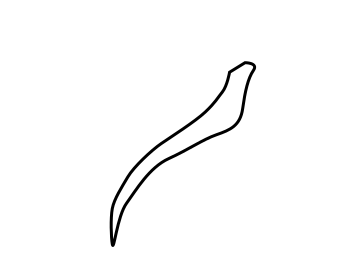



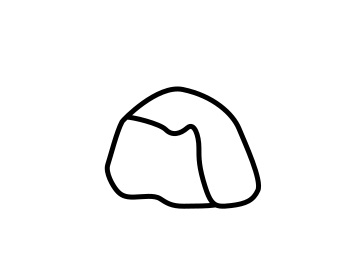




The Egyptian hieroglyph was used for its sound value instead of for its meaning. The semitic word for bull (‘aleph’) and house (‘bait’) combine to give us the ‘alphabet’.
Gardiner, A. H.
Egypt Exploration Society.
London: Egypt Exploration Society, 1952.
Albright, W. F.
The Proto-Sinaitic Inscriptions and Their Decipherment.
Cambridge: Harvard University Press, 1966.