
was built on a spur of Mount Euboea (right) overlooking the Plain of Argos.
Homer describes Mycenae as a city located “in the depth of the horse-pasturing Argos.” The most important city in Greece during the Bronze Age, it was built on the spur of a mountain overlooking the Plain of Argos, not too far from the sea, but far enough away to afford some protection from pirates. The Inachus River, which flows through the Plain of Argos, must have maintained a continuous flow in ancient times although by the 8th century BC it had already dwindled to a seasonal stream. Aristotle, writing in the middle of the 4th century BC, observed that the land around Mycenae had been more productive in former times than it was in his day.
According to Greek myth, Mycenae was founded by Perseus, the son of Danae, a mortal woman, and heavenly Zeus. A king named Polykrates was madly in love with Danae but was prevented from marrying her by her son, Perseus. Thus the king hatched a plan that would remove Perseus from the scene by sending the young man on an impossible mission: the slaying of Medusa. This monstrous female deity, one of the Gorgons, had serpents for hair and a gaze that turned men into stone. Perseus would surely have died on this quest if the gods had not come to his aid and given him winged sandals, an adamantine sword, and a bright shield with which to view the reflection of Medusa rather than look at her directly and be turned into stone. Perseus succeeded in cutting off the head of Medusa, which retained its power to turn men into stone. Perseus put this power to good use by turning his enemies into stone, including King Polykrates whose unrequited affection drove Danae to take refuge in a temple.
On his way home Perseus espied from afar the lovely Aetheopian maiden, Andromeda, and immediately fell in love. It was an opportune moment for the lady was at that moment chained to a rock, the unfortunate object of a goddess’s jealousy after Andromeda’s mother had foolishly published abroad that Andromeda was even more beautiful than the Nereids. Aroused to jealousy, the sea nymphs demanded that Poseidon do something. Thus the giant sea monster, Cetus, was sent to destroy the kingdom of Aetheopia unless they sacrificed Andromeda to the monster. With great sorrow the Aetheopians chained Andromeda to the rock, but just as Cetus was about to devour the maiden, Perseus flew to her rescue on his winged sandals and slew the monster. Thereupon the grateful father was pleased to give his daughter to Perseus as his wife. After a raucous wedding celebration that left a large number of the wedding party dead (Andromeda’s jealous fiancé showed up) Perseus and Andromeda returned to Mycenae and had many sons and two daughters together.
The Perseid dynasty would rule Mycenae for three generations. It was followed by the Pelopid, so named after king Pelops, from the nearby city of Pisa. Pelops had two sons, Atreus and Thyestes, each seeking the throne of Mycenae. Atreus would ultimately prevail, but having gained the throne he lost his wife, Aerope, a Minoan princess, to his brother Thyestes, with whom she was having an affair. Atreus took revenge by killing the three sons of Thyestes and serving their flesh to Thyestes at a banquet. Only afterwards did Atreus reveal what he had done. This terrible deed would invoke a generational curse on the family of Atreus. A long string of sordid deeds would follow from it which involved incest, rape and murder. The house of Pelops would nevertheless give its name to the Greek archipelago, known to later generations of Greeks as “the Peloponnese.”

The Walls the Cyclops Built
The imposing ruins of Mycenae have long attracted the notice of passersby’s. It’s stones are of such immense proportions that Greeks of later ages thought they must have been built by demons or by the mythical giant ‘Cyclopes’. Thus Euripides referred to the walls of Mycenae as “Cyclopean heavenly walls” while the Greek geographer, Pausanias, offered the following description of its masonry:
The circuit wall, which is the only remaining ruin, was built by the Cyclopes. It is composed of unwrought stones, each of which is so large that a team of mules cannot even shake the smallest one: small stones have been interposed in order to consolidate the large blocks.1Paus. II. 25, 8 – This descriptions was with regards to the walls of another Mycenaean city, Tiryns, although it equally applies to Mycenae.

The reason for Pausanias’ amazement is best understood by comparing the stones used in the original wall of Mycenae with those used to patch a sections of it, perhaps a millennium later, in the 5th century BC.

It is remarkable to think that a people lacking iron tools or a massive, centralized workforce (like what the Romans possessed), were nevertheless capable of building walls of unsurpassed strength. The closest parallels to these great walls comes from Canaan where we find similar stone masonry in the massive Bronze Age fortification walls of Canaanite cities.

The Lions Gate
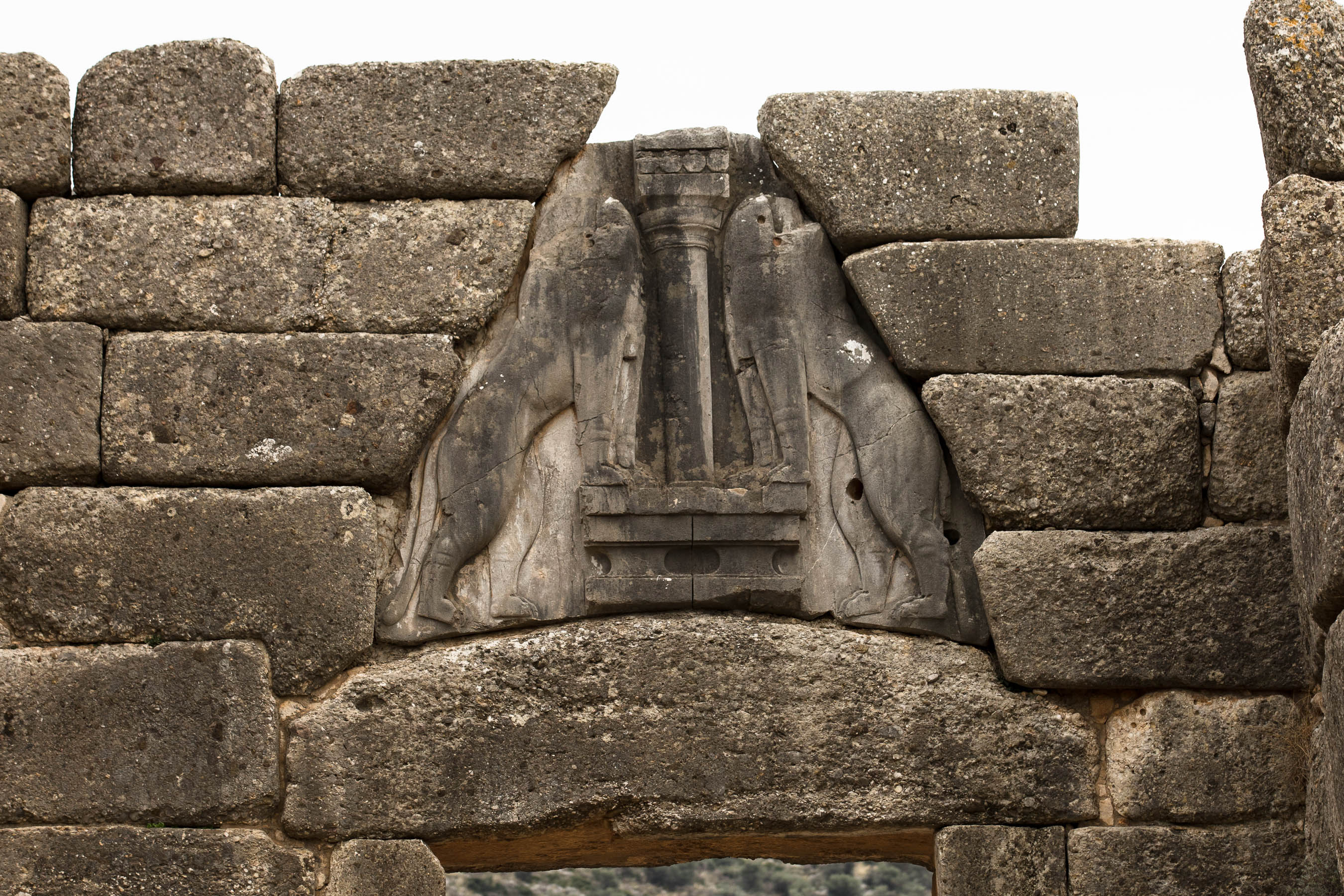
It is easy to forget that the massive walls of Mycenae only encircle the acropolis area whereas most of the inhabitants of the city resided in the lower city, which is barely preserved. The only way to pass from the lower city into the acropolis area was through the Lions Gate, a monumental structure made with cut stones, called ‘ashlars’, rather than with the roughly hewn boulders used to construct the wall. The opening of the gate was framed by massive stone slabs, above which the builders placed an intricately carved triangular shaped stone. The shape of this stone served to transfer the weight of the stones above it, now fallen, to the vertical pillars on either side.

is the only monumental Mycenaean sculptures preserved until the present day.
Two lions were carved in relief on the triangular stone, their front paws resting on a low pedestal. Their heads, which were carved separately and attached with bronze dowels, were unfortunately never found in the excavations. The lions flank a single pillar, shaped in typical Minoan fashion, with a reverse taper (the base is narrower than the top). The pillar was a symbol of Hera, patron goddess of Mycenae.

Left: The front of this coin depicts the head of Hera while the obverse depicts a pillar associated in some way to the goddess. The pillar may perhaps be likened to the Asherah pole erected in Canaanite high places. Right: The pillar with a reverse taper is just one example of the many synchronisms between the art and architecture of Mycenae and the Minoans.
The Water Shaft
The Mycenaeans went to great lengths to secure their water supply by extending the walls of the city and digging a water shaft down to the water table. The water shaft was constructed with a corbelled arch, a style of architecture with which we’ve already met at Hattusa. Indeed, these two cities, with their massive walls and monumental gates, share much common, although Hattusa was much larger than Mycenae.


from the water shaft at Mycenae (left) and at Hattusa (right).
What brought an end to Mycenaean civilization? Was it foreign conquest, internal division, or a natural disaster of some sort? One long standing theory is that a people from Europe, known as the Dorians, invaded the Peloponnese sometime around 1200 BC. Others attribute the demise of the Mycenaeans to sea-born invaders, the so-called Sea Peoples. But there is very little evidence to support either of these theories. Another possibility, for which there is some literary support, is that the Mycenaeans exhausted their strength during a decade long war with the Trojans, followed by plague and internal strife. In any case, the Mycenaean civilization clearly did come to an end, and in dramatic fashion. The period which followed was a “Dark Age” from which the Peloponnese did not emerge until the 8th century BC.2The “Greek Dark Age” is a perplexing phenomenon which has left historians with many unanswered questions. The lack of evidence of material culture for a period of four centuries has led some scholars to argue that there is an unnaturally long ‘gap’ in the historical record that requires a major revision of the chronology of the ANE in order to resolve. See for example: James, P. and I. J. Thorpe (1993). Centuries of Darkness : a challenge to the conventional chronology of Old World archaeology. New Brunswick, N.J., Rutgers University Press. It seems to me that the attempt to shorten the chronology by more than 250 years creates more problems than its solves. What, for example, is one to do with the Amarna Letters? But that is not to say that there are no problems with the current paradigm. Although Mycenae would maintain a shadowy existence until the 5th century BC, it never regained its former glory. When the Spartans called for troops to join them in the struggle against the Persians at Thermopylae, the city of Mycenae was only able to muster 80 soldiers. It was destroyed by the neighboring Argives shortly thereafter. And so it happened, wrote the Roman historian, Diodorus Siculus, that,
…this city, which was in ancient times blessed with wealth and power, which produced such great men and accomplished such important actions, was thus destroyed and remained uninhabited till the present time.3Diodorus Siculus, Library of History XI, 65
Schliemann, H.
Mycenae.
New York: Scribner, Armstrong & Company, 1878. Link