The crown prince, Siptah, was just ten years old when he assumed the throne vacated by his father, Seti II. However, the real power in the land lay with a certain wealthy Syrian merchant named Bey, until Siptah came of age and gave orders for Bey to be executed. Siptah died shortly thereafter and the rule of Egypt was transferred to his step-mother, Twosret. Another Canaanite ruler named Irsu gained the confidence of Twosret and used his favoured position at court to plunder Egypt. The Great Papyrus Harris describes these as “empty years” when Egypt had no “chief mouth” or leader.
The land of Egypt was overthrown from without, and every man was thrown out of his right; they had no “chief mouth” for many years formerly until other times. The land of Egypt was in the hands of chiefs and of rulers of towns; one slew his neighbour, great and small. Other times having come after it, with empty years, Irsu, a certain Syrian was with them as chief. He set plundering the peoples possessions. They made gods like men, and no offerings were presented in the temples.
A degree of order was restored when an obscure man named Setnakhte seized power and established what would become the 20th dynasty. Although he did not rule for long, he ruled long enough to place his son, Ramses III, on the throne.
Medinet Habu
Although Ramses III bore no relation to Ramses II, he sought to emulate his namesake by conducting military campaigns and erecting great monuments. The most notable of these was Medinet Habu, a massive complex which served as both a mortuary temple and a fortified palace. The structure has survived largely intact until the present day thanks to a group of monks who turned it into a monastery in the 5th century AD. They plastered over many of the reliefs, thereby preserving them. After the monastery was abandoned, the structure was covered in sand, which also helped to preserve it.

The building was constructed near the Valley of the Kings on the edge of the desert.
Thus when the French passed through the area during Napoleon’s military expedition to Egypt in the late 1700’s, they found Medinet Habu buried in sand. Champollion would make the first sketches of the structure but the real work of excavating and documenting the site awaited the arrival of a team of American scholars led by James Henry Breasted.
Breasted’s team copied and transcribed all of the important reliefs carved into the walls of the temple. The events recorded on the walls of the temple are vital for understanding what led to the decline and destruction of the bronze age civilizations of the eastern Mediterranean at the end of the Late Bronze Age.
In the first scene from the temple wall, the pharaoh is shown fighting a battle in Djahy, a region that encompassed all of the coast of Canaan, as far north as Lebanon. The enemy are shown heavily armed and are wearing a distinctive plumed headdress. It is generally agreed that these are the “Peleset” named in the accompanying inscription. These are also the “Philistines” of the Bible. Their appearance on the walls of Medinet Habu is an important aid for dating their appearance in southern Canaan. Although Ramses III claims to have defeated the Peleset, it is doubtful that he was as successful as he claims since the next relief shows the pharaoh battling the Peleset within the boundaries of Egypt proper.

as seen in Napoleon’s Description de l’Égypte
The Philistines
The Bible states that the Philistines came from “Caphtor,” the Hebrew name for Crete. Although the Minoans maintained a presence in Egypt and the Levant from the Middle Bronze Age onwards, and perhaps even earlier, it was not until the latter half of the Late Bronze Age that large numbers of people from Crete and the Aegean islands began to settle on the Levantine coast. The Medinet Habu inscription refers to them as a diverse group of islanders with names like Peleset, Sherden, Weshwesh and Shekelesh (Tjeker).
We are already familiar with some of these names from the inscriptions and reliefs of Ramses II. The Sherden, for example, were allies of Ramses II at the Battle of Kadesh. The Shekelsh allied with Mursilli on the opposite side. But those who formerly had fought alongside Hatti and Egypt now fought against them. They must have possessed significant military prowess for they quickly overran the major centers of Late Bronze age culture. One of the wall inscriptions from Medinet Habu describes the devastation they wrought on western and eastern Anatolia (Arzawa and Hatti), Syria (Code and Carchemish), and Cyprus (Alashiya).
The foreign countries made a conspiracy in their islands. All at once the lands were removed and scattered in the fray. No land could stand before their arms, from Hatti, Kode, Carchemish, Arzawa, and Alashiya on, being cut off at [one time]. A camp [was set up] in one place in Amor. They desolated its people, and its land was like that which has never come into being.
The “sea peoples” established a land base in Amor, a region known also as Amurru, which was located on the northern Levantine coast. Having laid waste to large swaths of Anatolia, Cyprus, and Syria, they turned against Egypt.
The Battle of the Sea
Ramsses III fought two battles against the “sea peoples.” As noted previously, the first was fought on land in Djahy. We know almost nothing about this battle except that Ramses III claimed complete victory. But there are reasons to question this claim since he fails to provide any details of the victory, how many captives were taken, or even to make a boastful claim about his prowess in battle. Most tellingly, the next battle took place in the very mouth of the Nile itself.
On an inscription from Medinet Habu, Ramses claims that he was aware of the fast approach of the sea peoples and made preparations for battle. He placed ships loaded with crack troops in the Nile and lined the shore with troops.
Those who reached my frontier, their seed is not, their heart and soul are finished forever and ever. Those who came forward together on the sea, the full flame was in front of them at the river mouths, while a stockade of lances surrounded them on the shore. They were dragged in, enclosed, and prostrated on the beach, killed, and made into heaps from tail to head. Their ships and their goods were as if fallen into the water.
The text is accompanied by a remarkable wall relief of the battle. It shows the enemy attacking in ships that look almost identical to the Egyptian boats except for their distinctive duck-shaped prow. Soldiers who should probably be identified as the Sherden wear horned helmets while the Pelest (Philistines) are shown wearing a feathered headdress. The attackers are all heavily armed with long swords and carry large round shields. They are also shown wearing body armor identical to the muscled cuirasses of a later period. Oddly enough, archaeologist have yet to find armor of this type from the Late Bronze Age. It is well attested in the latter half of the Iron Age.
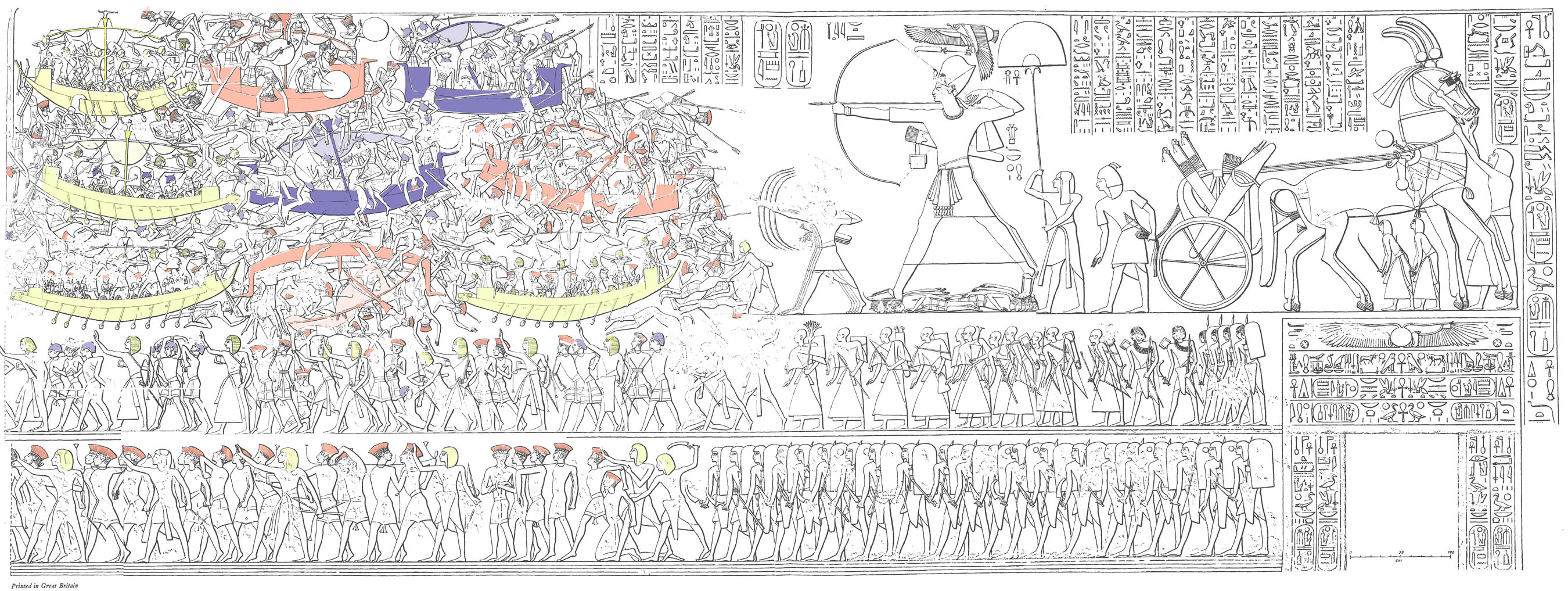
The Egyptians are shown in yellow, the Philistines in red, and the Sherden in blue. The Philistines and Sherden formed a coalition to attack the Egyptians.
The bronze scimitars and wooden shields of the Egyptians were no match for the long swords and bronze shields of the invaders, but the Egyptians had a weapon the enemy seems to have lacked—the bow—which they used to good advantage. Rather than allow the enemy invaders to make an orderly landing, the Egyptians attacked them in the mouth of the Nile.
The relief shows Egyptian ships bristling with bowmen rowing towards the enemy ships. Once within range they released volley after volley of deadly arrow fire. The Egyptians also employed grappling hooks to drag the enemy ships to the shore where Egyptian soldiers were ready to pounce.
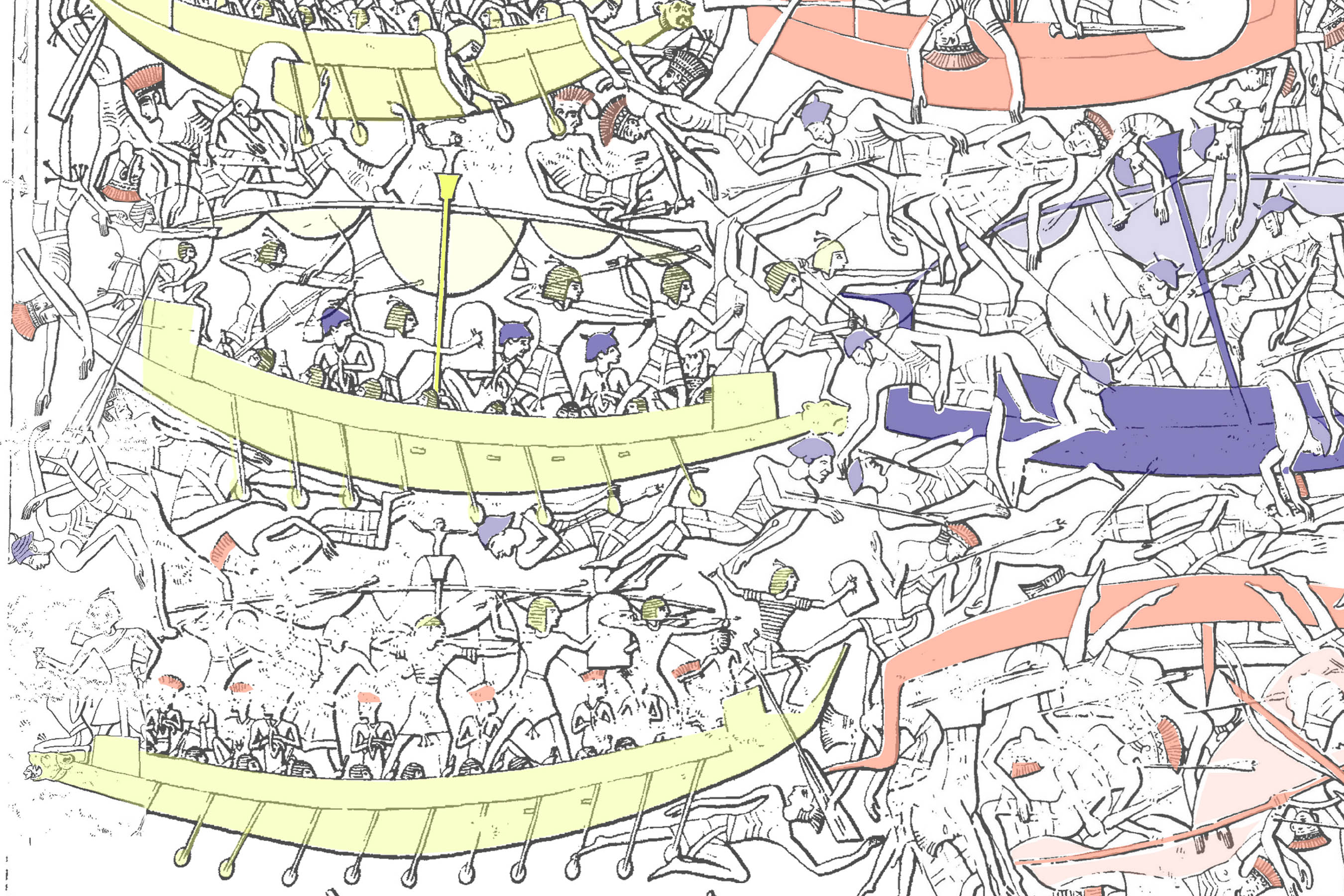
in boats with lion-head prows. The primary attacking weapon is a bow.
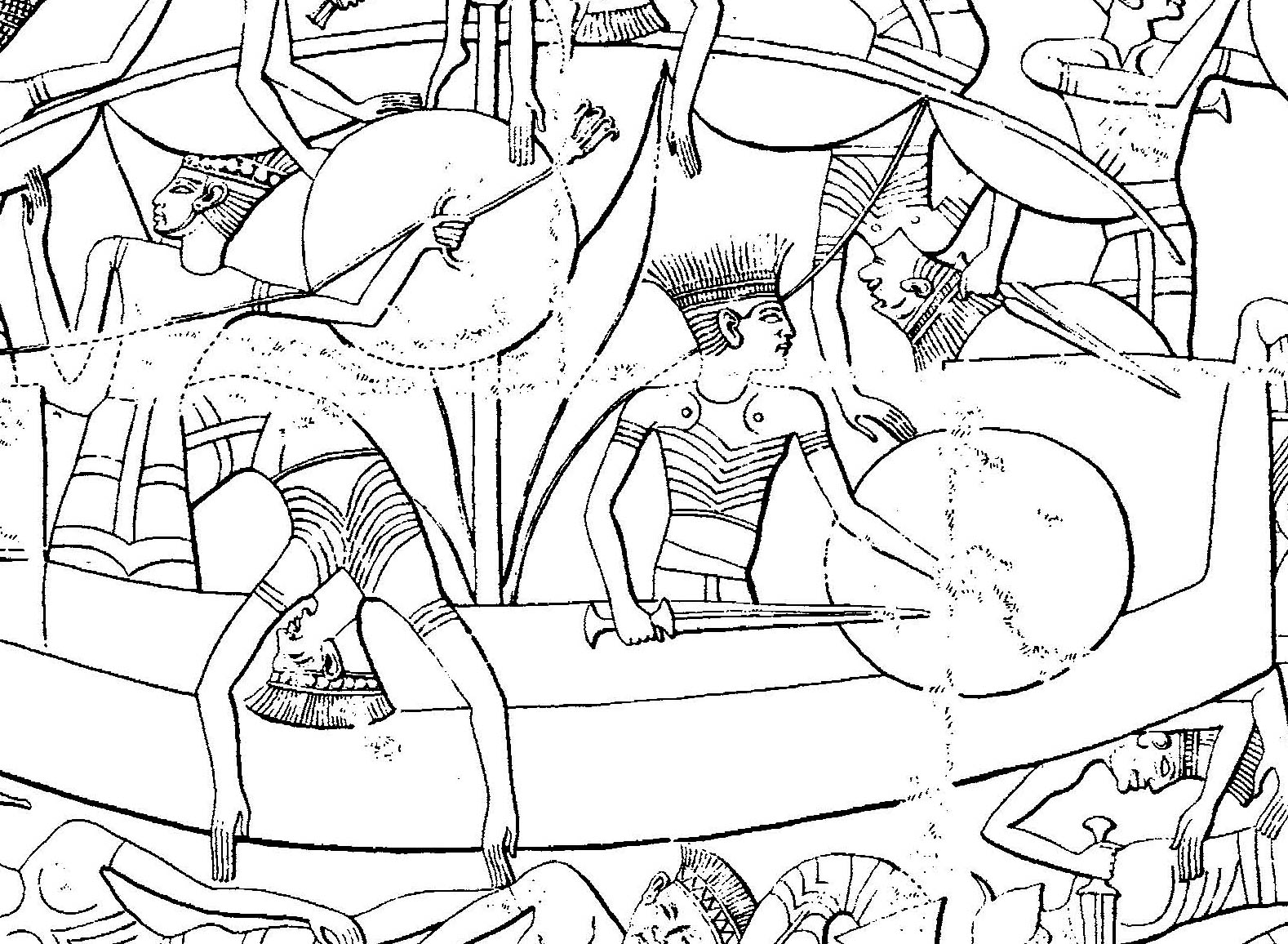


wearing a plumed headdress and muscle curias very similar to this Greek curias on display at the National Museum of Spain which dates to the 7th century BC. You can also see a grappling hook thrown by an Egyptian soldier so as to demast the ship or tip it over.
Ramses III presents the battle as a victory, and such it must have been, since the invaders do not seem to have penetrated any further into Egypt. But if the battle was as successful as he claimed, then we would expect for him to have followed it up with an attack on their camp in Amurru. There is no account of him ever having done so. The last powerful pharaoh of Egypt, the reign of Ramses III marks the end of Egyptian control over Canaan and Nubia.
Breasted, J. H.
A history of Egypt, from the earliest times to the Persian conquest.
London: Houghton & Stodder, 1927. Link