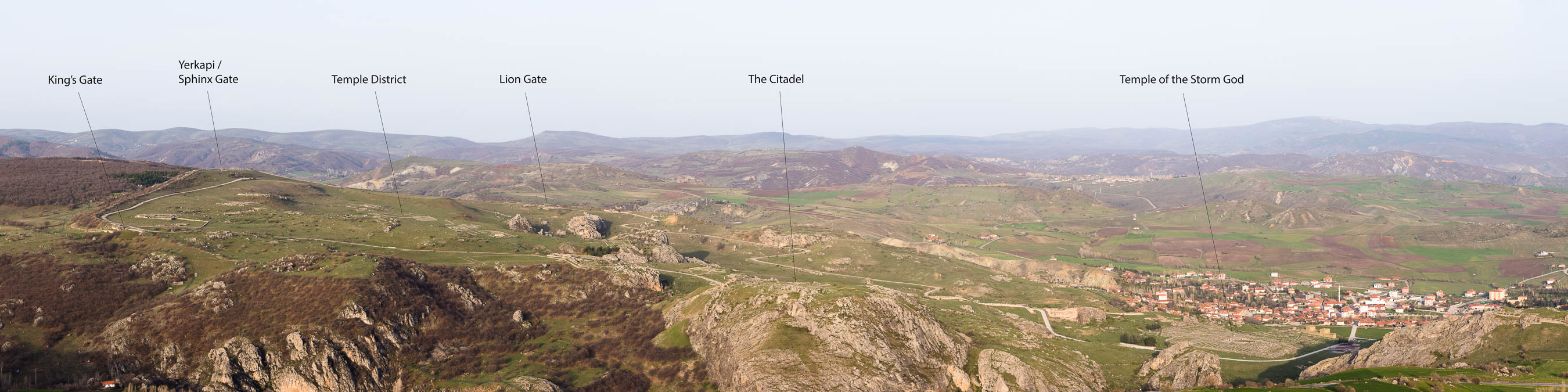
A view of Hattusa looking west
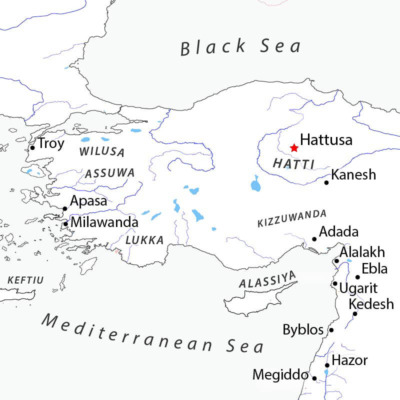
The Hittites were once thought to have possessed a small kingdom located somewhere in the vicinity of Canaan. Although Bible hints that the Hittites were a major power on par with Egypt (2 Kings 7:6), it wasn’t until archaeologists began to excavate their ancient cities in Anatolia that they were finally restored to their rightful place next to the other major civilizations of the Ancient Near East. The earliest king named in Hittite cuneiform texts is a certain Labarna who reigned in Kussar. Nothing more is known about this king or his city. We are on firmer ground with his grandson, Hattusili, who transferred the capitol from Kussar to Hattusa, perhaps during the first half of the 16th century BC.
The Wall of Hattusa
Hattusa began as a city of modest proportions, its walls encompassing a temple to the Storm God and a royal citadel named Büyükkale. From there it grew into a sprawling complex of palaces and temples, encompassed by a wall over 5 1/2 miles long. Although the region is barren of trees or vegetation today, the region must have been covered with forests in ancient times. Vulnerable to attack from the north, the Hattusans had always to be prepared for attack by the Kaskans, a northern people who inhabited the shores of the Black Sea. No doubt this threat provided the needed impetus to build a wall around their city whose foundations may still be seen today.

The walls of Hattusa were casemate walls which means they were built with two parallel walls that were linked together to form inner chambers. The walls were built with postern gates at regular intervals. These are large enough to provide a means for individuals to conveniently come and go yet small enough to seal off completely in times of war.
The Lion Gate
Each night an official was charged with closing the gates of the city and sealing them with the royal seal. The same official would return in the morning and check that the seal remained intact before the gate could be opened. The survival of the city depended on such precautions, for it only took a few good men to infiltrate a city and compromise its defenses.
The three gates of the upper city were named after their stone guardians, which stood as a silent sentinel on either side of the gate. Of the three gates, the Lion Gate is perhaps the most iconic. It was constructed with a pointed or ‘corbelled’ arch, of which only the two massive foundation stones remain. These were carved with the front torso of a lion. The first few courses of ‘cyclopean’ masonry are also visible near the gate, so called because it was thought that only the mythical Cyclops could have built a wall with such massive stones. Although the stones are irregularly cut, they are nevertheless fitted together like the pieces of a jigsaw puzzle.


An offering table was placed before of each of the iconic lions which guarded the entrance to the city.
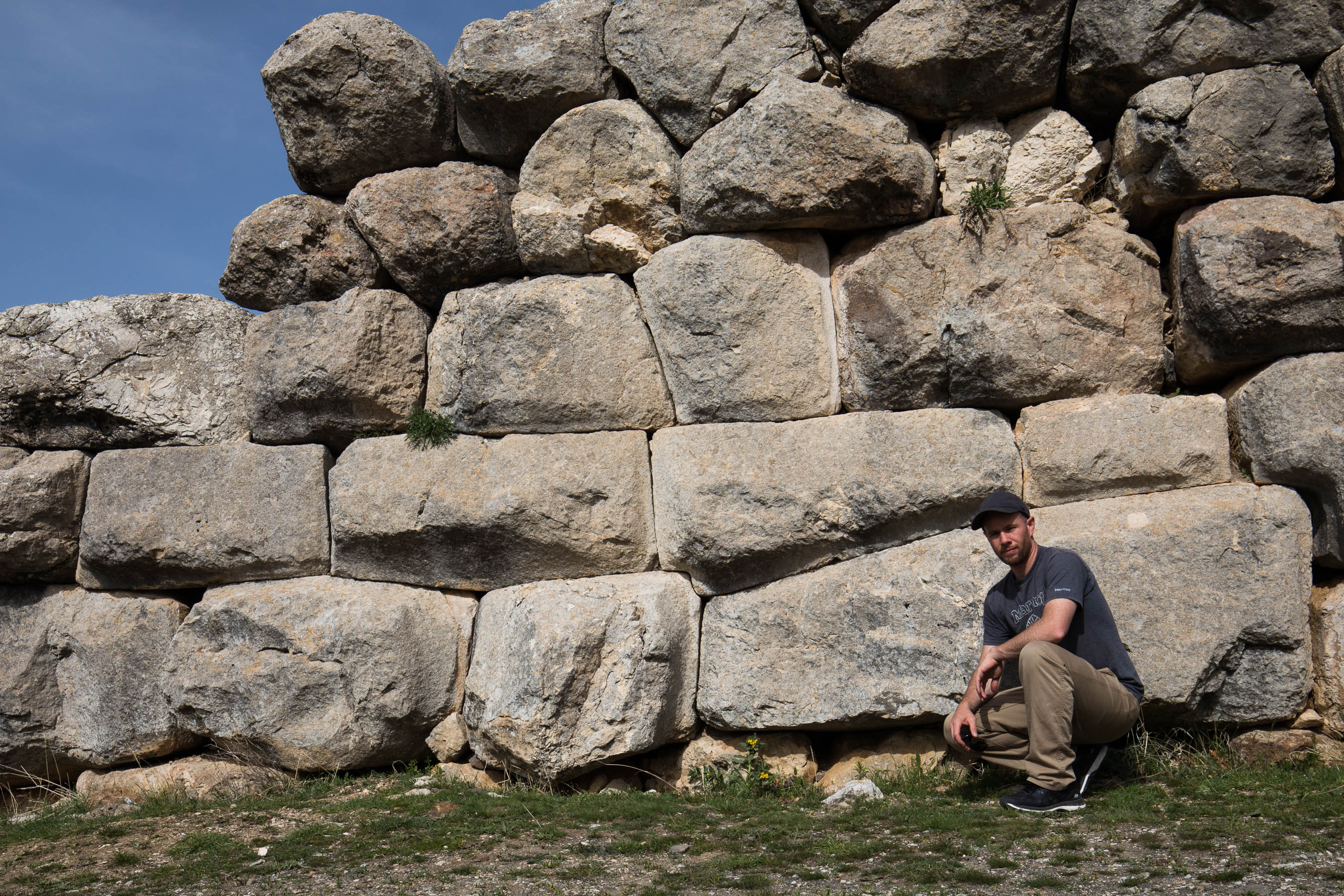
One can still see the large and precisely cut blocks of stones used to build earliest wall of Hattusa.
The King’s Gate
A pair of standing figures flanked either side of the King’s Gate. The horns protruding from their helmet suggests that they represented deity. The figure presents a fair approximation of how a Hittite king might have appeared since gods were often fashioned in the image of the king just as the king was often deified after death. The figure holds a distinctive bronze axe unique to the Hittite, examples of which have been found as far south as Canaan.


The figure wears a short kilt with a dagger tucked in his belt and a battle axe in his hand.


The axe head on the left was discovered at Bet Shean (14th century BC) while the one on the right was discovered in Shilo (18th century BC).
Yerkapi
Hattusa’s most impressive gate was located on the northern end of the upper city. Here the Hittites built a massive stone embankment known as Yerkapi. Scholars debate whether this structure could have served some kind of defensive purpose. Although the embankment was not so steep that a enemy soldier could not scramble up it, he would have been exposed to withering fire from defenders stationed on the walls above. From this perspective, one could argue that it served a defensive purpose, yet it is difficult to explain why the embankment was built on just this one section of the wall. For this reason, some scholars think that its primary function was ceremonial rather than defensive.

The northern defensive wall was fortified with a massive stone embankment.
Situated atop Yerkapi, the Sphinx Gate could only be accessed via a finely constructed stairway built into the side of the embankment. However, these stairs were a very inconvenient way to go in or out of the city for it meant climbing up the embankment and back down again. The solution was provided by a postern gate that pierced it in the middle. It provided passage to individual travelers but could easily be blocked off in times of war. It, too, was constructed with a corbelled arch, a common feature of bronze age architecture.


Left: The postern gate. Right: The stairs leading to the top of Yerkapi.
The Sphinx Gate was probably the focal point of religious processions that went in and out from the city. Hittite sphinxes were not the intimidating, masculine sphinxes we find in Egypt, nor were they the great bull-headed sphinxes that would later stand guard over the temples and palaces of Assyria; they are more graceful feminine creatures, their faces bracketed by the omega (Ω) hair-style, a feature which the Hittites probably borrowed from the Egyptian goddess Hathor.


A pair of sphinx once flanked the Sphinx Gate on top of Yerkapi. Today they are located in the Boğazkale Museum, Turkey.
Crowning the headdress of the goddess was a six ring emblem with a rosette in each ring. It may be possible to trace the history of this symbol back as far back as the Uruk period, to the Sumerian goddess, Innana, who was symbolized by a six-ring pole. Curiously, a six-ring symbol may also be seen hanging on a necklace around the neck of a statue of Aphrodite of Aphrodisias from the Roman Period. It can’t be proven that these six-ring symbols have the same provenance, but it is remarkable how ancient symbols seems to persist in one form or another over time.
The Hittite sphinx goddess was probably named Hebat although in later periods she went by the name Cybele.
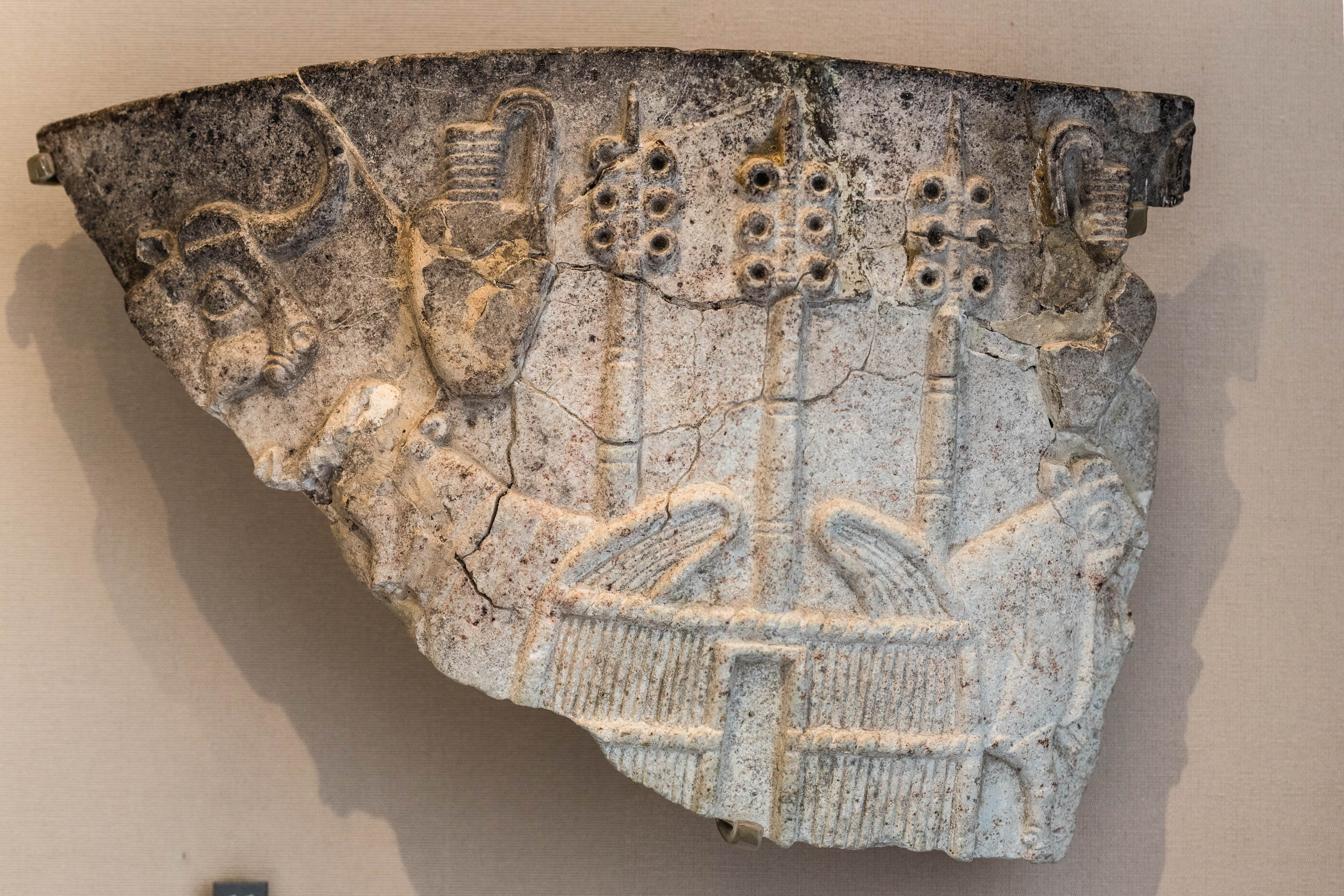
In Mesopotamia the presence of the goddess Inanna in her shrine was depicted by the ring pole, oftentimes shown with six rings. From the Uruk period.
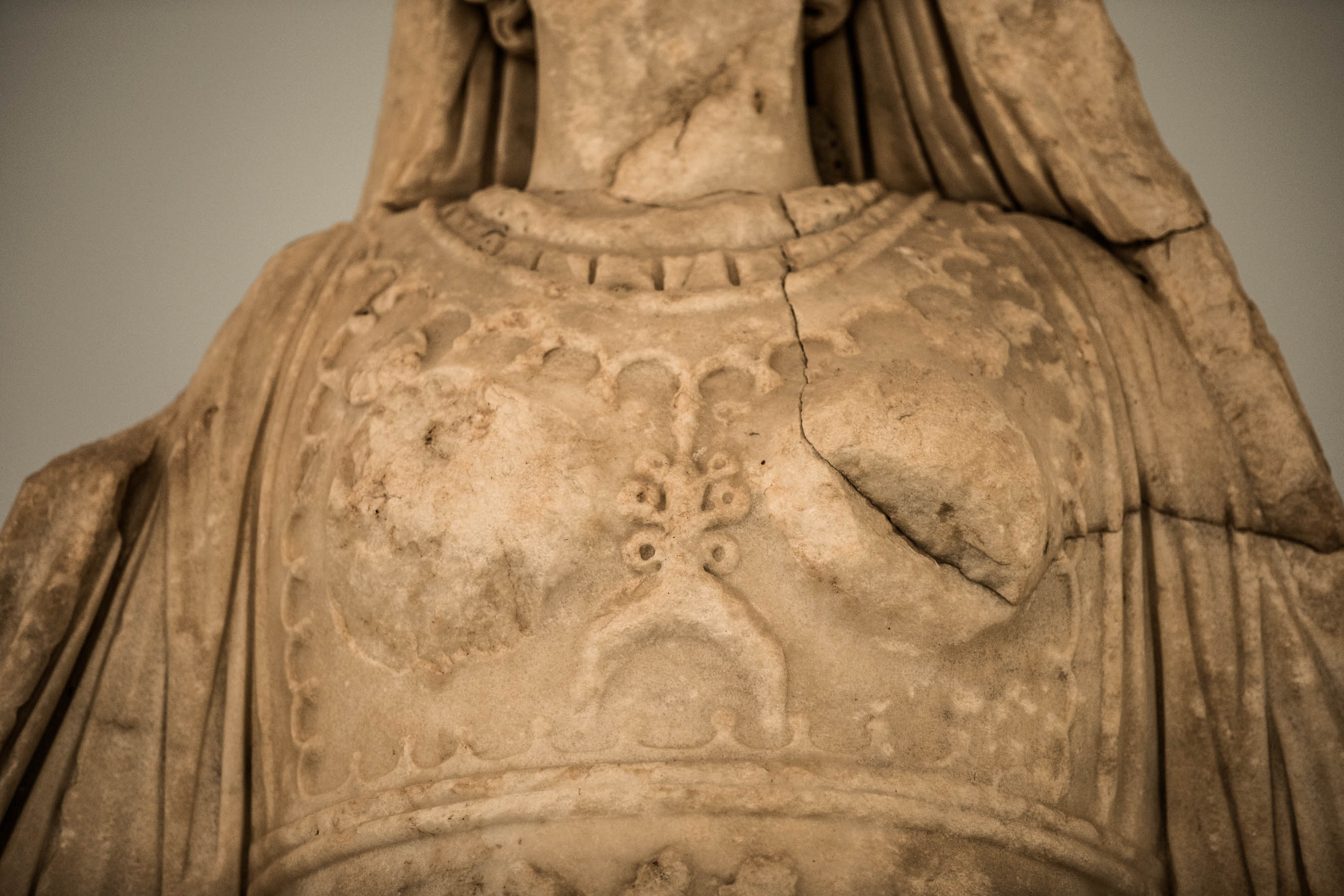
A six ring symbol worn around the neck of the goddess Aphrodite at Aphrodisias.
The Land of One Thousand Gods
The Hittites worshiped a plethora of deities. Every bubbling brook and lofty mountain was home to a deity. Archaeologists have discovered over thirty temples in just the upper city of Hatussa alone. However, the largest and most important temple was located in the lower city. This temple was dedicated to the Hittite storm god, Tarhunta, the chief god of the Hittite pantheon. .
A great many storerooms were built around the temple, suggesting that the temple also served as an administrative center and treasury. A very peculiar green stone composed of nephrite (more commonly known as jade) was found in one of the storerooms. It may have been a sacred stone associated with the temple cult.
The buildings of Hattusa were mostly made of mud brick which has long since eroded away, leaving just the stone foundation blocks visible. The square and finely cut interior foundation blocks—known as ‘orthostats’—were drilled with holes that were fitted with bronze rods. The rods projected into the mudbrick superstructure, thereby securing it to its stone foundation.


Top: The temple as seen from the upper city. Bottom Left:A block of green nephrite. Bottom Right:Orthostats with holes drilled to fit bronze rods.

Archaeologists have uncovered over 30 temples in the upper city of Hattusa.
Hattusili’s Last Days
Hattusili liked to compare his military exploits with those of Sargon of Akkad, the archetypal conqueror of the Ancient Near East. He had reason enough to make such claims for he managed to conquer all of eastern Anatolia, a large part of Syria, and even managed to briefly cross the Euphrates.
As the end of his days drew near, Hattusili returned to the city of Kussar, the original seat of Hittite power, where he had a scribe copy out his Testament. This remarkable document recounts how the old king struggled to find a successor to the throne. He had set up his two sons as governors in separate provinces but was forced to depose them after they rebelled against him. His daughter was implicated in another plot to overthrow him and was likewise banished. In the end, Hattusili was forced to nominate one his nephews as a successor to the throne! He also proved to be a disastrous choice
This youth was an abomination to the sight; he shed no tears, he was without compassion’ he was cold and pitiless (Testament I, II 5-7).
Thus Hattusili had been forced to banish his two sons, daughter, and nephew!
“Until now no member of my family has obeyed my will.” (Testament 19, 3.26)
Hattusili finally chose his grandson, Mursili, to succeed him. Mursili proved to be an effective military commander who continued the conquests begun by his grandfather. He was able to subdue the powerful Syrian city of Aleppo and then, for reasons unknown, embarked on a lightning campaign against Babylon, 500 miles distant, effectively bringing to an end the Old Babylonian kingdom founded by Hammurabi several hundred years earlier.
But Mursili had even less success maintaining his domestic affairs than his grandfather did. Upon returning home, he was assassinated by his brother-in-law, Hantili, and his cupbearer, Zidanta.
And Zidanta conspired with Hantili, and they made a wicked plot. They murdered Mursili. They shed blood. (Telipinu Proclamation II, I 32-34)
Zidanta would eventually turn on Hantili, his former co-conspirator, and murder him together with all of his sons. This sordid episode brought the Old Hittite Kingdom to a close. The nation would enter into decline from which it did not emerge for more than a century.
Bryce, T.
The Kingdom of the Hittites.
Oxford, New York: Clarendon Press; Oxford University Press, 1998. Link