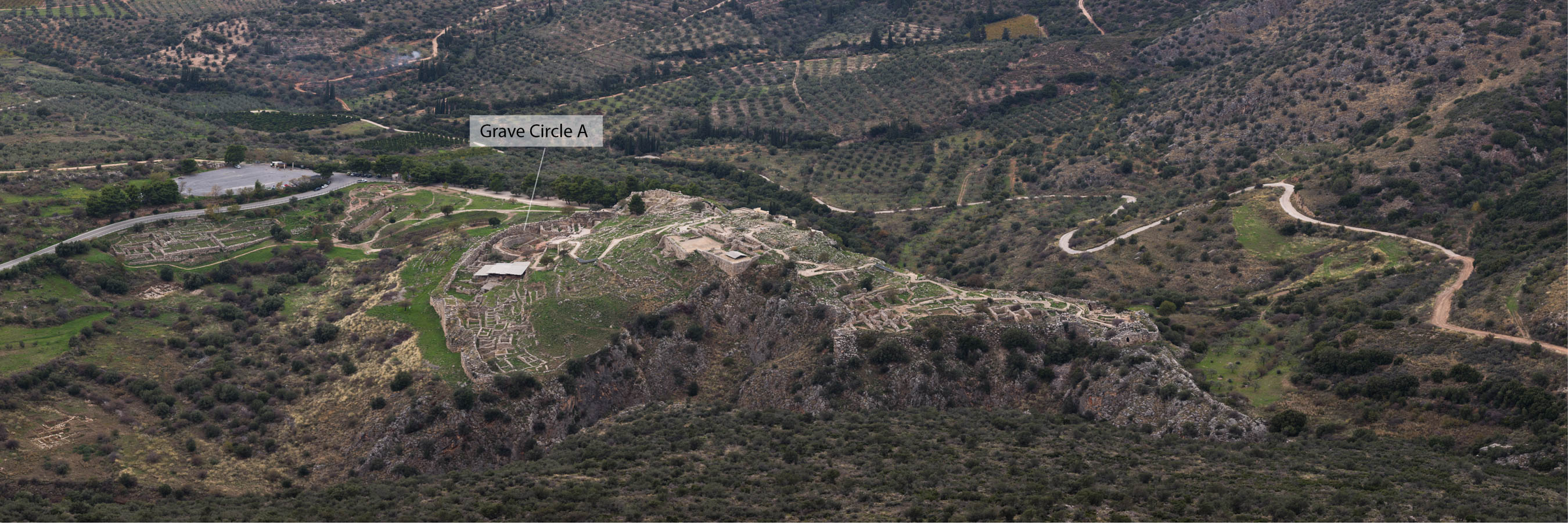
Grave Circle A was once located outside of the city but was subsequently brought within the confines of the city, probably in the 13th century BC.
The German archaeologist, Heinrich Schliemann, knew what he was looking for when he arrived at the ancient city of Mycenae in the fall of 1876. He had read the description of the Greek geographer Pausanias (110-180 AD), of royal tombs located inside the walls of Mycenae belonging to king Agamemnon, his charioteer Eurymedon, the Trojan princess Cassandra, and her two children, Teledamus and Pelops.1Pausanias is citing the written work of a certain Hellanicus (495 – 411 BC). Thus the tradition is quite old. According to Homeric tradition, these individuals were all slain together in a palace coup upon returning to Mycenae after the Trojan War. Schliemann believed that the tombs were still there, waiting to be discovered.
The Circle
Schliemann selected a site just inside the city gate and set his team to work looking for the tombs. Approximately ten feet down they uncovered a giant circle formed with stone slabs. Schliemann interpreted them as the boundary of a Greek agora (marketplace) which he dated to the 5th century BC, supposing that Greek agoras were most often circular shaped and noting also that ancient kings were often buried beneath the agora of a city. As it turned out, this was not actually an agora but a circular burial ground or “grave circle.”

the rectangular walls of one of the tombs can still be seen at the very bottom of the circle.
As they dug deeper, they began to find figurines and pottery that suggested to Schliemann that this circle was used as a sacred area from an early period. Particularly noteworthy was a circular ‘altar’, with a hole in the middle. Schliemann suggest that it might have been placed over a grave to receive drink offerings (libations). Schliemann also found the first real evidence of tombs in the form of grave stelae (stone markers) carved with reliefs of horse and chariot or with abstract spiral symbols. The designs were unlike anything known from the Greek world of the Classical era (5th century BC) or even from the Archaic period (8th century BC). Schliemann and his men kept digging.


were found after digging 10 feet below the surface. The meaning of the symbolism is unknown but the fascination with spirals is typical of Mycenaean art.
Tombs
Schliemann found his first tomb twenty five feet below the surface, and then several more, each with 2 or 3 bodies in them. The tombs contained grave goods the likes of which had never been seen before in Greece. Among the finds were gold goblets, diadems, pins, brooches, necklaces made with amber, swords inlaid with gold and rock crystal, alabaster from Egypt, faience, and ivory. At one point Schliemann exclaimed, “The treasure I found is so immense, that the Greek and Roman jewels of all the museums in the world do not make up one quarter of the quantity; and as to the quality, the Mycenaean treasure stands alone…” He wasn’t far from the truth. Schliemann would go on to uncover fifteen bodies in five separate tombs.


The shear number of swords and daggers found in the tombs suggest that many of the tombs belonged to warriors.


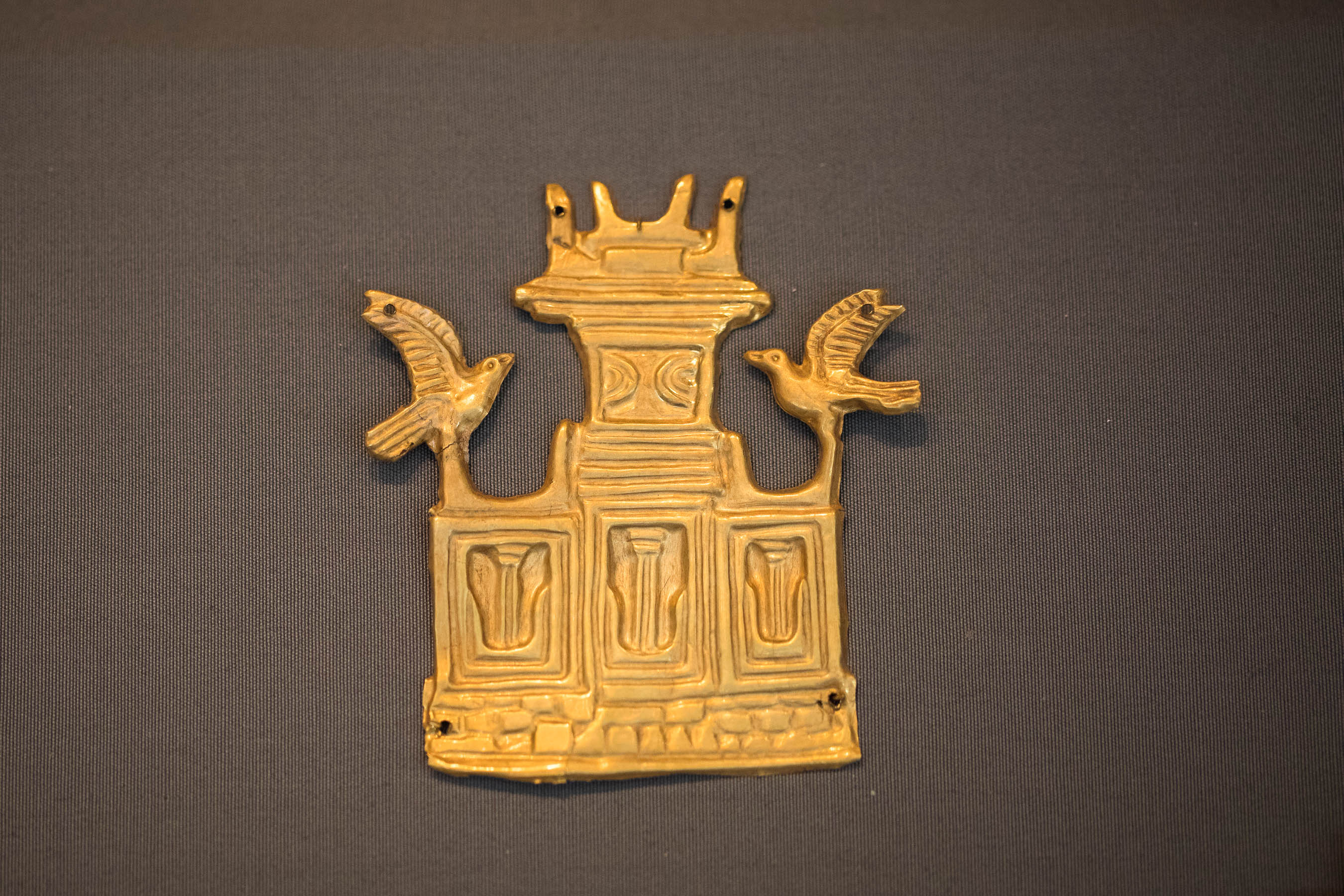
with maritime animals, butterflies, and the facade of a tripartite shrine reveal Minoan influence. Identical types of jewelry were also found on Crete.


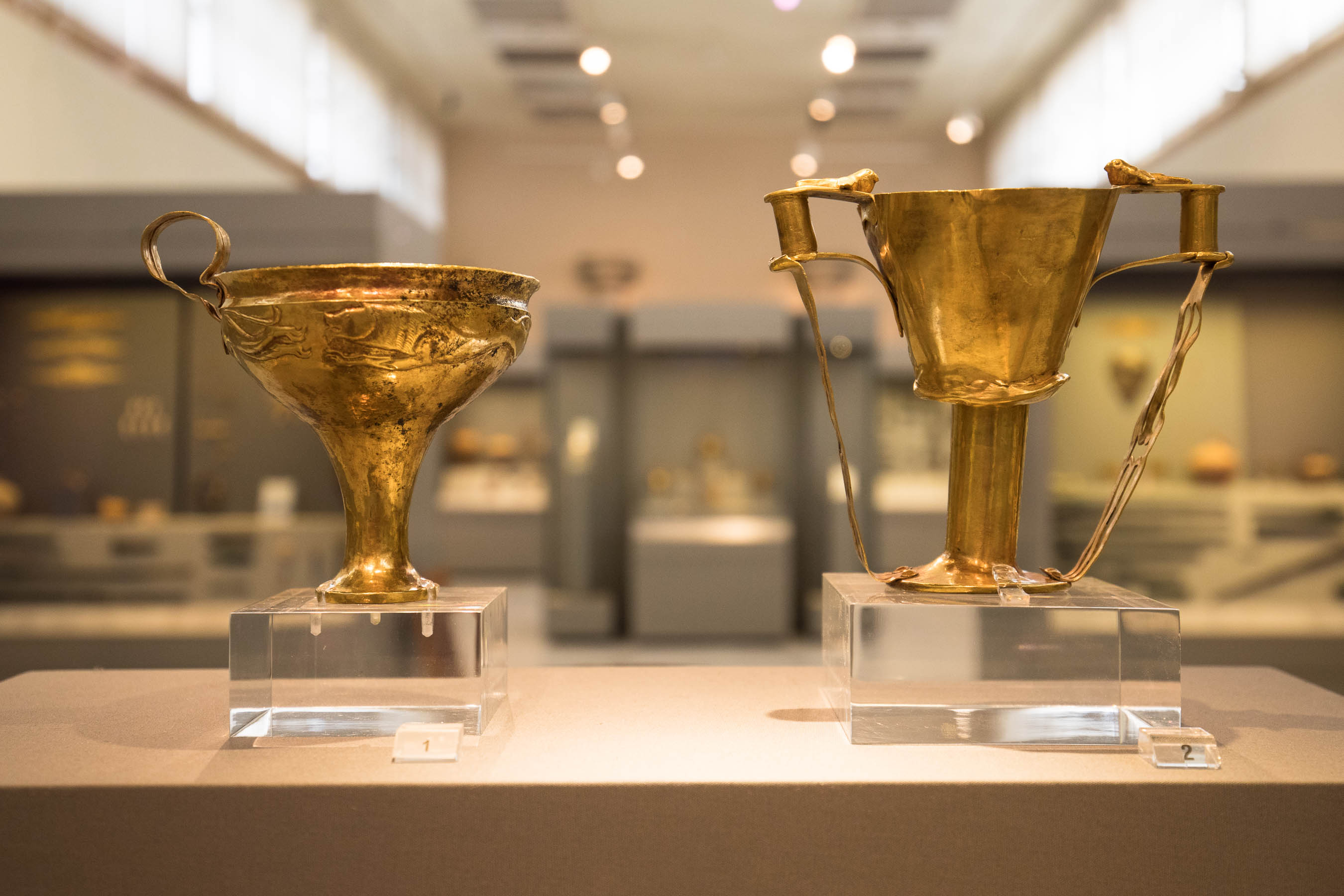


Cups such as these are found in large numbers in Mycenaean tombs.

shaped like a stag. It was probably produced by a Hittite craftsman.


The style and material point to an Egyptian origin for these vessels.
Agamemnon
“Could this be the grave of Agamemnon?” Schliemann asked. The location fit Pausanias’ description. Schliemann observed that the bodies were placed close together. This suggested to him that they had been buried around the same time. Furthermore, the bodies of men, women, and two children were found in the tombs. This fit with Pausanias’ statement that Agamemnon and his family were buried together. One tombs, in particular, was distinguished from the others by the shear number of bronze swords it contained, nearly 80 in total, and by a particularly well preserved skeleton whose bones were strewn with gold leaf, while a gold mask of particularly fine workmanship covered the face.

The practice of burying the dead with golden masks is also known from Egypt, the golden mask of king Tutankhamen being the most famous example of this practice.
News of the discovery drew thousands of people to the site. Although Schliemann did not, as is often said, send off a telegram with the words, ‘”I have gazed upon the face of Agamemnon,” he did say that he thought the gold mask might have belonged to this king. Not everyone was enthusiastic about Schliemann’s discovery. One critic observed that, “Schliemann’s geese are all swans,” while the famous scholar, E. Curtius, thought the mask was of “such incredible thinness that the hero Agamemnon must have been but a beggarly prince.” Curtius was certainly mistaken. It is estimated that the gold from the three richest graves weighed a total of 15 kilograms, no mean amount.2Moorehead 1996, 171 Curtius also ventured to suggest that the mask may very well prove to be a Byzantine head of Christ! Schliemann’s discovery was met with so much skepticism that at one point, Schliemann exclaimed: ‘What? So this is not Agamemnon’s body, these are not his ornaments? All right, let’s call him Schultze.’ Ever afterwards, in conversation, he spoke not of Agamemnon but of Schultze.”3Moorehead 1996, 170
Today, scholars generally agree that the tombs are too early to belong to Agamemnon. The Trojan War is thought to have occurred sometime around 1150 BC and these tombs are generally thought to date to the 16th century BC. However, it must be admitted that it is a remarkable coincidence that Pausanias should have preserved a tradition that placed the tomb of Agamemnon and his closes associates within the walls of Mycenae next to the gate, precisely where Schliemann found incredibly rich tombs. If not the mask of Agamemnon, then whose was it? It was Schultze’s, of course!