
Standing approximately 15 inches tall, this bronze statuette provides unique insight into cult of Jupiter Heliopolitanus.
As is usually the case, the primary cult statue that once stood in the temple of Jupiter Heliopolitanus has long since disappeared. But smaller copies of the statue have been found which give us an idea of what it looked like. One of these, now located in the Louvre, shows a young, unbearded god with an upraised arm that would have once grasped a whip with which he drove the chariot of the sun across the sky. His other hand held thunderbolts. Thus he combined the attributes of sun god and the storm god.
His body is shaped like a pillar, which is the traditional shape for a cult image. He is standing between two bulls—animals traditionally associated with Baal. The sun, moon and the five planets are depicted on his body. Together, they represent the days of the week. This astral symbolism was probably intended to communicate the universal extent of Jupiter’s power.
The God of the Mystic Basket
Jupiter Heliopolitanus wears a tall basket-shaped hat, called a kalathos, on his head, which was a symbol of abundance. Plutarch explains that the Syrians celebrated a festival each year during which women wailed in order to “awaken the god of the Mystic Basket,” this being a reference to the kalathos worn by Jupiter Heliopolitanus.1Plutarch, Isis and Osiris, 202 It was believed that the god of the Mystic Basket died during the hot, dry summer months and needed to be awakened before the land would yield its bounty. The practice of ritual weeping may explain why the largest spring at Baalbek was named Ayin Bacchi which means the “Spring of Weeping.”
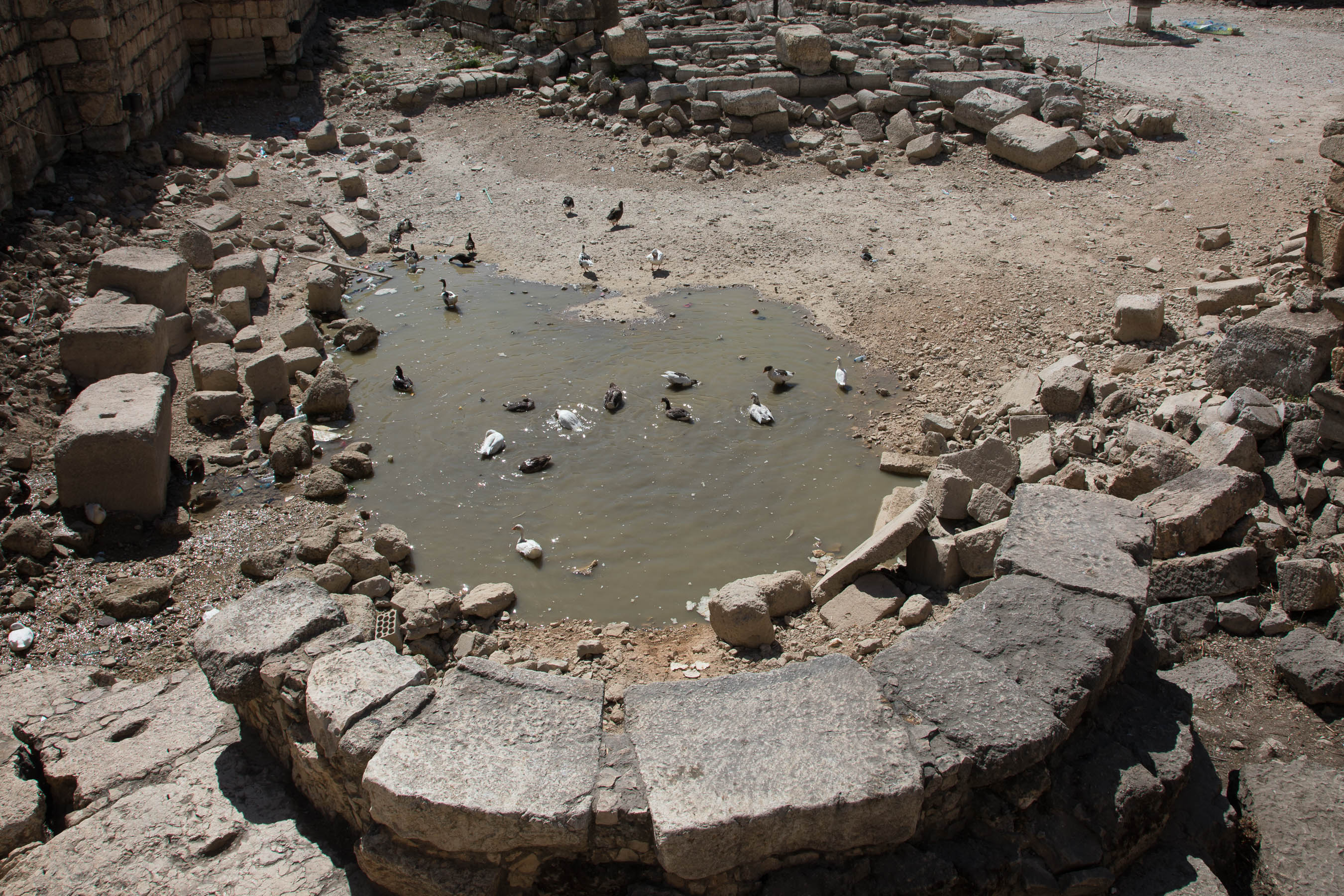
One can still see the remains of Roman architecture in the vicinity of the spring named Ein Bacchi (“Spring of Weeping”).
There are several references in the Bible to the practice of weeping for a dead or sleeping god. For example, in the account of Elijah’s confrontation with the prophets of Baal on Mount Carmel, the prophets slash themselves and cry out to Baal in order to “awaken” the god and bring rain (1 Ki. 18:27). It is quite interesting, in this context, that a statue base was found on Mount Carmel dedicated by a Roman colonist to the “Heliopolitan Zeus.” The cult of Jupiter Heliopolitanus should undoubtedly be considered the continuation of the Baal cult described in the book of Kings.
There is also a passing reference in Ezekiel to women seated in the gateway of the temple in Jerusalem “weeping for Tammuz” (Ezek. 8:14), this being the Babylonian name for Baal. Thus we see how this cult persisted until the exilic period. The essence of the Baal cult was belief in a god, inherent in nature, who could be awakened through certain rituals and sacrifices, thereby restoring fertility to the land. The Greek writer, Theophrastus, summed up the purpose for sacrifice with the following statement: “One must sacrifice to the gods for three purposes: to give honor, to show gratitude, or because of one’s need for good things.” The Baal cult focused on the last of these objectives—the need for good things.
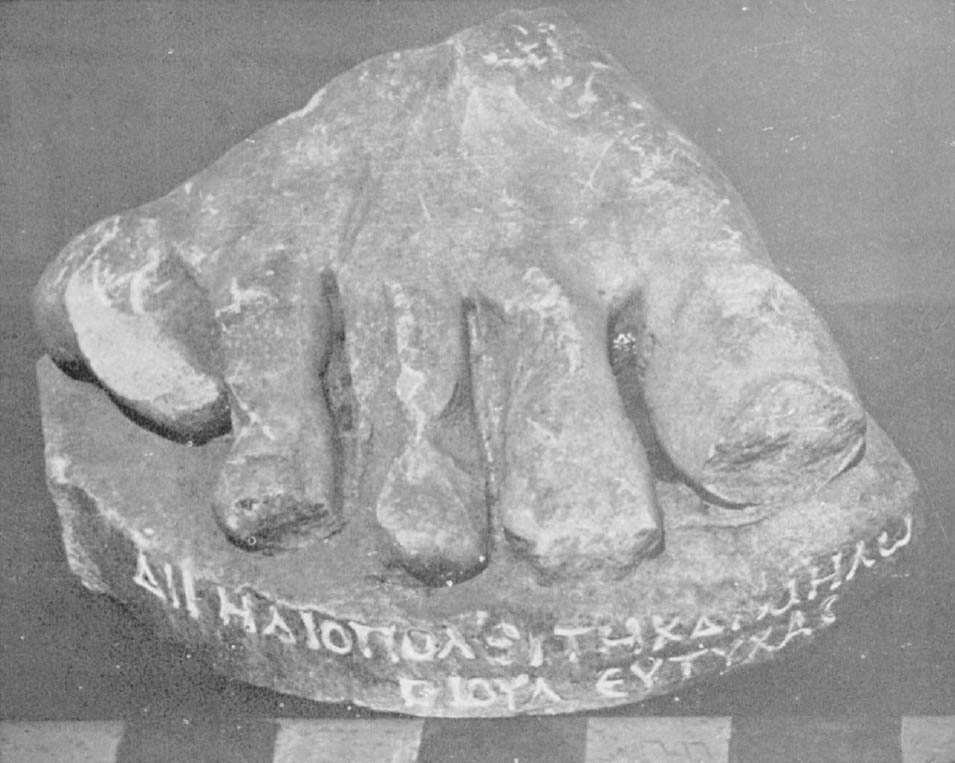
Statue Base found on Mt. Carmel – This statue base was found near the Carmelite monastery on Mt. Carmel. Based on the size of the foot, the statue would have stood twice life size. The base of the statue contains the following inscription: “(Dedicated) to Heliopolitan Zeus (god of) Carmel (by) Gains lulius Eutychas colonist (of) Caesarea”
Avi-Yona, M. “Mount Carmel and the God of Baalbek.” Israel Exploration Journal 2, no. 2 (1952): 118-124.
Steiner, R. C. “On the Rise and Fall of Canaanite Religion at Baalbek: A Tale of Five Toponyms.” Journal of Biblical Literature 128, no. 3 (2009): 507-525. Link
Wiegand, T.
Baalbek (1898 – 1905).
: Berlin Und Leipzig Vereingung Wissenschaflicher Verleger, 1921.