
the ancient capitol of Urartu. Lake Van and the mountains of Armenia can be seen in the background.
The Greek general, Xenophon, writing some time around 399 BC, describes a harrowing journey he made through the high, snowy mountains of Armenia. He was at the head of of a small band of Greek mercenaries—the famous Ten Thousand—whose numbers had dwindled considerably by this time. As the Greek army made made its way over high mountain passes and through secluded valleys they encountered two fearsome tribes, the Carduchoi and the Chaldians (not to be confused with the Chaldeans). These tribes proved to be the toughest opponents Xenophon’s army encountered on their long journey to Persia and back. The Carduchoi were probably the ancestors of the modern day Kurds whereas the Chaldians were undoubtedly a people named after Haldi, a god whose origins can be traced back to ancient Uaratu.
Urartu
Urartu appears in the Bible as the mountainous region named “Ararat” where Noah’s Ark came to rest. It is also mentioned in the annals of the Assyrian king, Shalmaneser III (859–824 BC), who conducted a campaign against Arame “king of Urartu.” This campaign is depicted on some bronze bands which were attached to the gate of Shalmaneser’s fortress at Balawat. In one of the scenes, Shalmaneser is shown making a sacrifice to the great inland sea, known today as Lake Van, by hurling the quarters of an ox into the lake. These were gobbled up by a sea monster (although to our eye the sea monster bears a closer resemblance to a dog).
Shalmaneser’s campaign does not seem to have inflicted lasting damage on Urartu since, over the course of the next century, it would greatly increase the amount of territory under its control. Assyria, on the other hand, descended into chaos after Shalmaneser’s death as various factions vied to place their candidate on the throne.


A scene from a bronze band of the Balawat Gate celebrating the victory of Shalmaneser III, king of Assyria, over Urartu. This scene is matched by an inscription which reads:
“I marched to the Sea of Nairi [Lake Van]. I washed my weapons in the sea; I made sacrifices to my gods. At that time I made an image in my own likeness; the glory of the lord Ashur, the prince my lord, and the might of my power I wrote thereon. Beside the sea I set it up. (The Monolith Inscription, Obv. 11. 23-27).”

is 400 meters deep. It has no outlet. As a result, the water is high in salts and minerals. The only fish that can live in the lake is a type of carp and, if the Assyrian inscription is to be believed, a giant sea monster!
Citadel
It was left to Arame’s successor, Sarduri I, to rebuild the capital after it was destroyed by Shalmaneser III. Sarduri selected a new site for the capital, at Tushpa, where a giant stone massif rose above the eastern shore of Lake Van. The citadel presented a nearly insurmountable barrier to an attacking army. There is no record of it ever being taken by frontal assault.
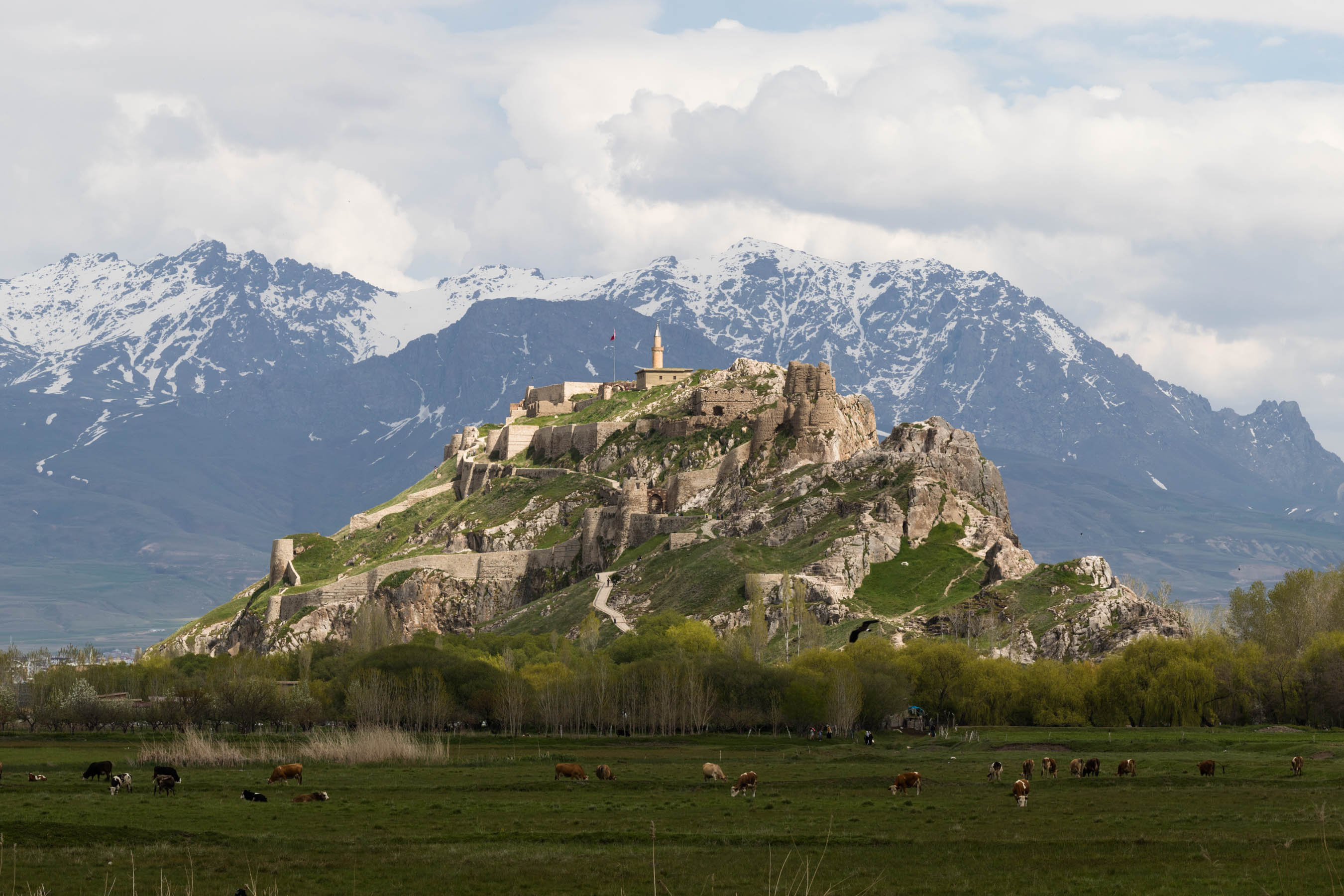

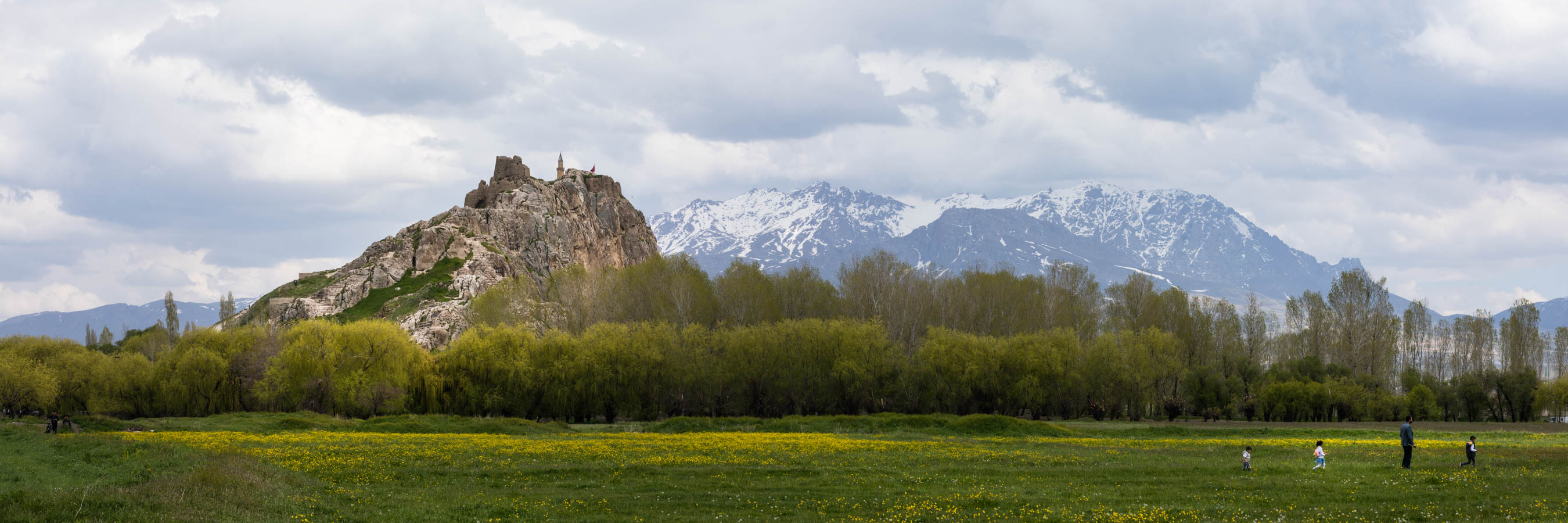
The massive stone citadel rises above the plains next to the shore of Lake Van.
Sardursburg
Tushpa was supplied with water from springs located on its western side. Sarduri sought to secure the water supply with a massive stone tower—dubbed the ‘Sardursburg’—located at the base of the citadel, on its western side. Although only the foundation blocks of the structure remain visible today, one can still find Sarduri’s name inscribed on them.

Water was supplied to the citadel from spring on the western end of the citadel. A corner of the ‘Sardursburg’ is visible in the upper right corner of this picture.

Sarduri I built stone fortifications at base of the citadel in order to secure access to the city’s water supply.

Sarduri I founded the capital of Urartu at Tushpa. His inscriptions claim credit for founding Tushpa. Although Urartians spoke an Indo-European language distantly related to Hurrian, Sarduri’s inscriptions are written in the Assyrian language, using the Assyrian script.
Apart from the Sardursburg, very little remains of the Iron Age citadel. Our best source of information for Urartian architecture comes from several carved reliefs which show buildings that stood at least five stories high, and with towers that reached even higher. One can only imagine how imposing such high walls must have appeared while they remained standing atop the rocky citadel of Tushpa.
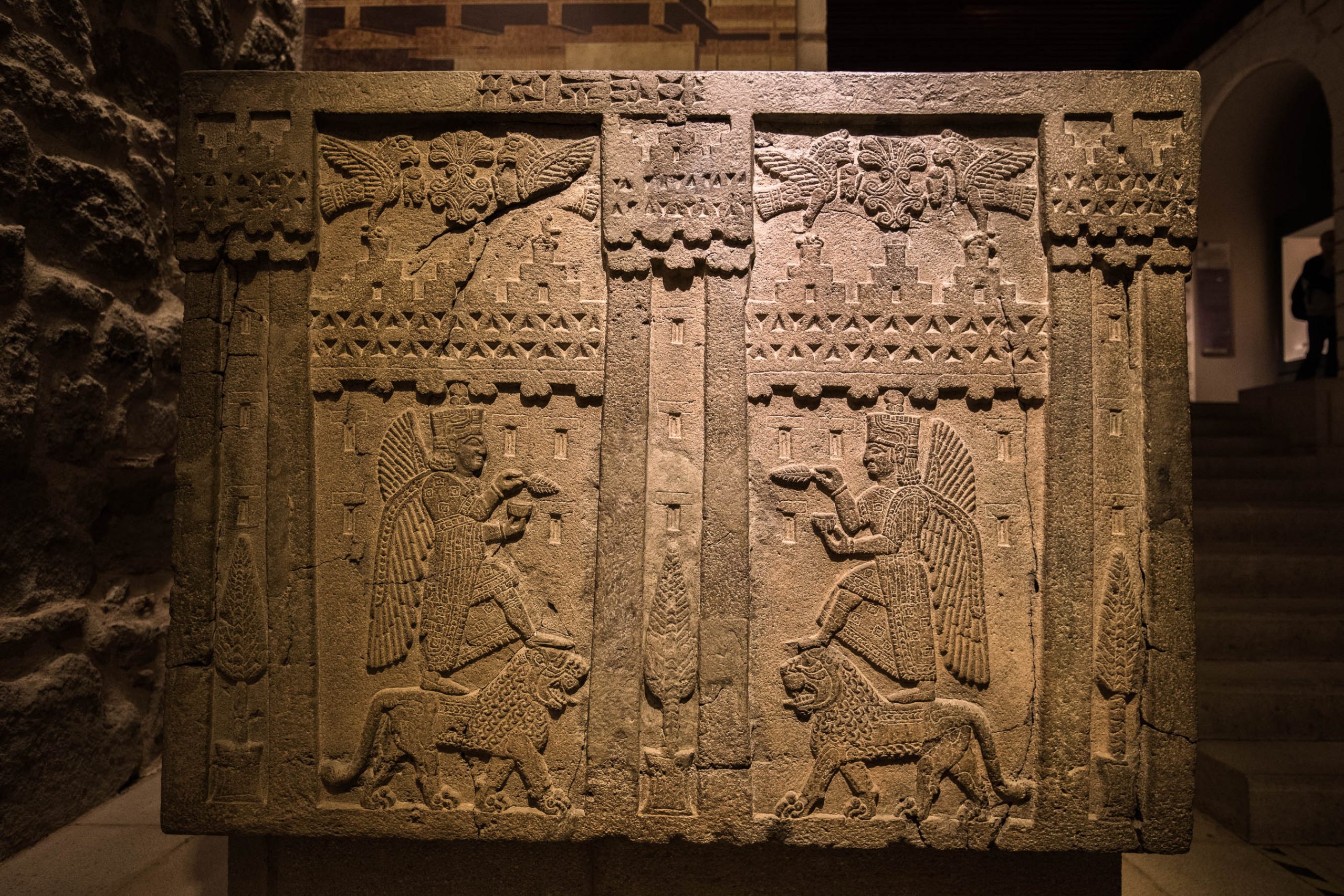
judging by the number of windows, the building stands five stories high.
Horses
The warriors of Urartu were renowned for their horsemanship. Thus Menua (c. 810–786 BC), grandson of Sarduri, boasted in an inscription that his horse could jump 36 feet!1Burney, C. 1971, 129 The Urartians should probably be credited with the invention of the eight-spoked chariot wheel, a design adopted also by the Assyrians.2Burney 1971, 147 And they pioneered the effective use of cavalry on the battlefield. The Assyrian Annals describe how the Urartians would mount “their prancing riding horses” and ride into battle.3Letter to Assur, 152 Horses could also be useful for escaping from battle as Assyrian scribes were fond of pointing out. They record at least two instances of Urartian kings fleeing the scene of battle on the back of a mare. But this might be more of a literary convention than actual fact!
The Assyrians
As mentioned previously, the final years of Shalmaneser III’s reign were racked with internal division which persisted for the better part of a century. In contrast, the royal succession in Urartu remained fairly stable. Three generations of rulers: Sarduri I, Ishpuini, and Menua would expand the borders of Urartu and consolidate control of the territory around Lake Urmia. The Assyrians could not have been pleased with this development since Lake Urmia was in Assyria’s backyard, so to speak, and that region was the primary source of the horses they used for their chariot teams.
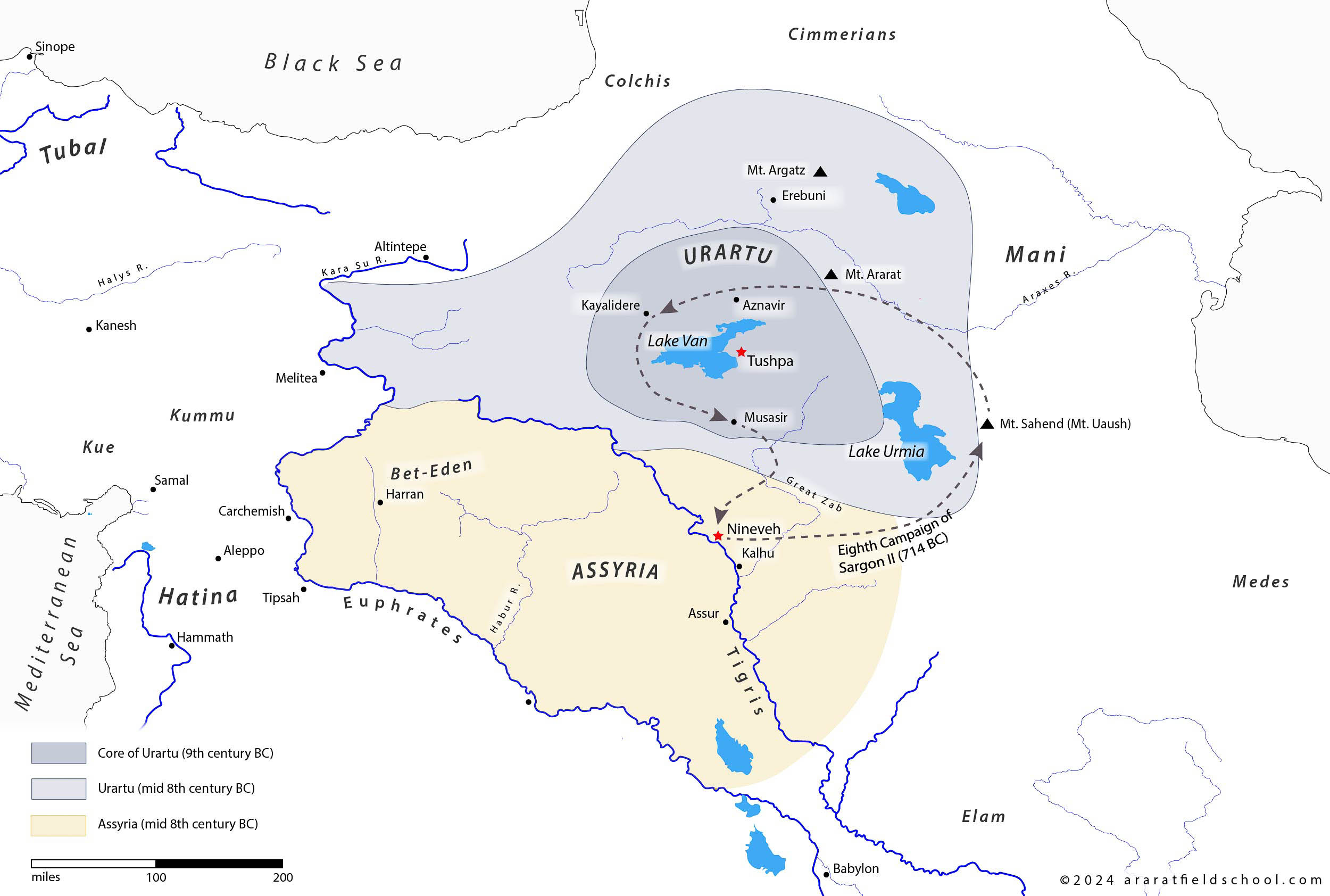
Sargon’s campaign in Urartian territory effectively crippled the kingdom.
The tide began to turn when Tiglath Pileser III seized the throne of Assyria in 745 BC and launched a series of westward campaigns. In 735 BC he won a decisive victory over Sarduri II, the king of Urartu, who, as you may have guessed, was last seen fleeing the battlefield on the back of a mare! Tiglath continued to carry the attack into the heartland of Urartu. We don’t know what became of Sarduri II. Likely he was killed in battle or was deposed since his son, Rusa I (735-714 BC), ascended to the throne of Urartu that same year. The early years of Rusa’s rule were relatively uneventful. Although Urartu had been decisively defeated by the Assyrians, it nevertheless retained its independence.
In 714 BC the Cimmerians launched an attack on Urartu’s northern border. Rusa marched his army northwards to meet these northern nomadic tribes only to receive word that the Assyrians were also attacking from the south. These Assyrian forces were led by Sargon II, the son of Tiglath Pileser III. The detailed and colorful description of his campaign known as the “Letter to Assur” is unique among Assyrian annals.
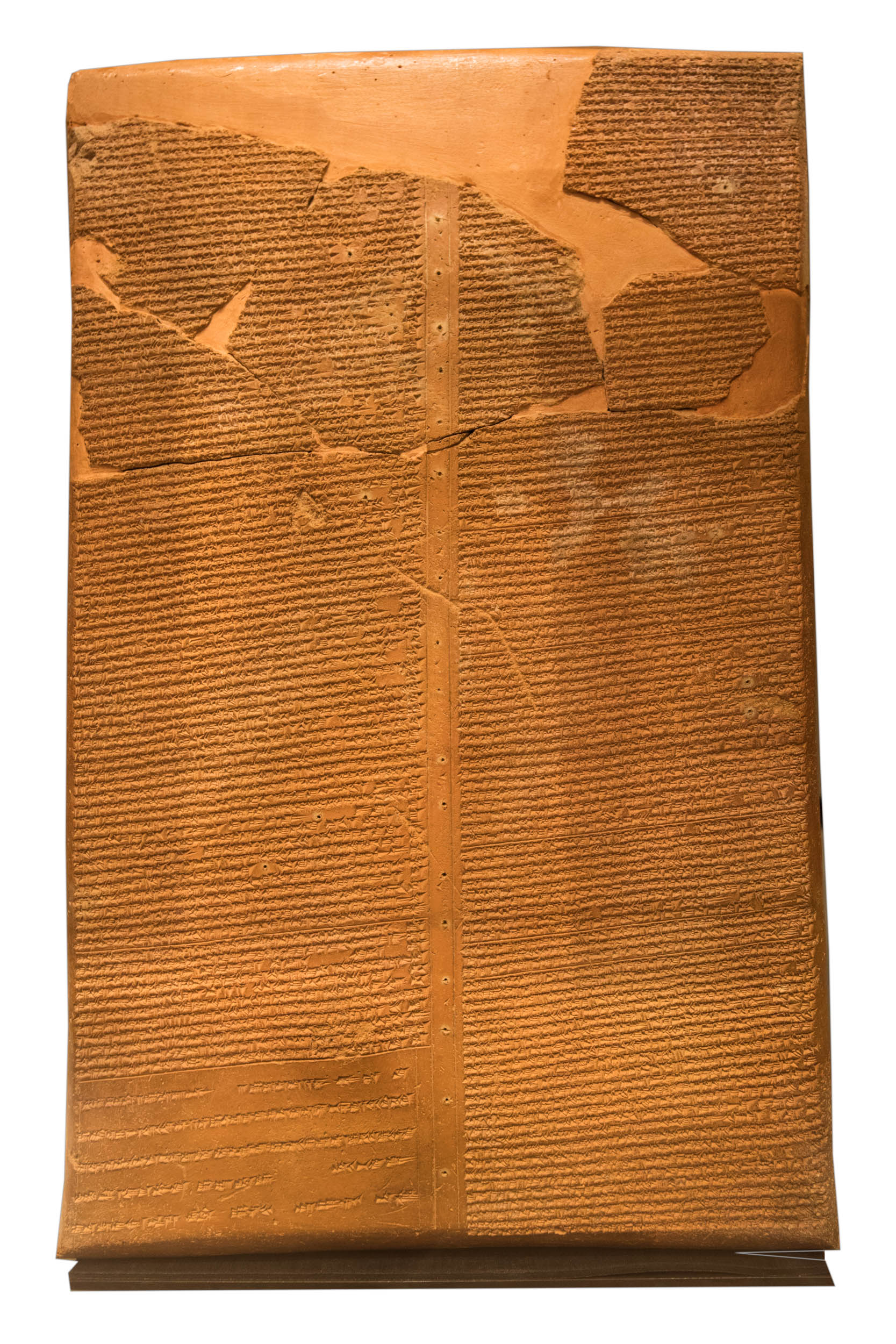
records the 8th campaign of Sargon II against Urartu. The tablet reads like a letter in which the king recounts his great deeds for the god.
Sargon boasted that his army cut roads into the sides of mountains with bronze picks and dragged chariots up cliff faces until they reached Mount Uaush, a mountain whose peak “stands up like the blade of a dagger.” With a rhetorical flourish, the scribe declares that the mountain was of such great height that since the beginning of time “the seed of humankind had not passed… nor any bird that wings its way across the heavens.” Sargon II claims to have defeated the army of Rusa I at Mount Uash.
As with a dense cloud of the night, I covered that province, and all of its great cities, I like an attack of a swarm of locusts.
Although grievously wounded, the kingdom of Urartu was not dead. It experienced a brief renaissance with the ascension of Rusa II in 680 BC. Very little is known of the history of Urartu after that. “Ararat” is briefly mentioned in the book of Jeremiah where it is listed next to other mountain tribes—the Ashkenaz and Minni—who formed an alliance with the Medes against Babylon (Jer. 51:27). The last ancient ruler to make his mark on the citadel of Tushpa was the Persian king Xerxes I whose inscription may still be viewed high up on the rock face of the citadel (full text).

Xerxes I was the last ruler to leave his mark on Tushpa. This inscription was carved high up on the cliff face, unreadable to anyone except the gods.

The inscription of Xerxes I is located at center about half way up the cliff face.
Barnett, R. D, L.G. Davies, M.M. Howard, C.B.F. Walker.
The Balawat gates of Ashurnasirpal II.
London: London, British Museum Press, 2008. Link
Burney, C, D. M. Lang.
The peoples of the hills: ancient Ararat and Caucasus.
London: Weidenfeld and Nicolson, 1971.
A map of Sargon II’s eighth campaign against Urartu. <a href=”https://en.wikipedia.org/wiki/Xerxes_I%27s_inscription_at_Van
Sargon II’s “>Click here</a>
<a href=”https://oi.uchicago.edu/sites/oi.uchicago.edu/files/uploads/shared/docs/ancient_records_assyria2.pdf”>Letter to Assur</a> (see pg. 73 ff.)
Xerxes’ Inscription at Tushpa
<a href=”https://en.wikipedia.org/wiki/Xerxes_I%27s_inscription_at_Vanf”> (full text)</a>