
This picture was taken looking north across Slaver’s Hill. The area was a major source of copper until relatively recent times. The dark black patchy areas in the center foreground are slag heaps left behind from ancient copper smelting operations (see below).
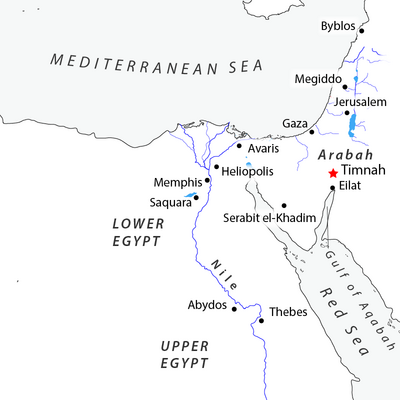
The Timnah Valley is located in the vast expanse of desert known as the Arabah which lies between the Dead Sea and the Gulf of Aqaba. (Arabah and Arab are derived from the semitic term “erev” which means desert.) A survey of the region conducted by Benno Rothenberg in the 1960’s catalogued a surprising number of settlements that flourished in the region during the Chalcolithic and Early Bronze periods. With regards to these settlements, Rothenberg writes,
We can no longer speak of a short-lived, sporadic, exploitation of natural wealth, but must now consider the Chalcolithic-Early Bronze Age occupation of this huge desert, from the Nile delta to the Arabah, and probably well into the Transjordan Plateau and north-west Arabia, as the earliest and, as the survey proved it to be, the most intensive (and for many parts the only) phase of the history of sedentary occupation in this area.1Rothenberg 1972, 52
By now you will probably have discerned a pattern of desert regions inhabited during the Chalcolithic and Early Bronze periods. As noted previously in our discussion of Hierakonpolis, the desert regions of the Ancient Near East likely received considerably more rain during the Early Bronze period than they do today, transforming them into something like the African savannah. Even a little rain may transform arid regions into pleasant and habitable places. Writing of his experiences living with the Bedouin (nomadic Arabs) in the Empty Quarter of Saudi Arabia, Wilfred Thesiger relates a conversation he had with a bedu about how they kept their camels alive in the desert.
I asked how much rain was required to produce grazing, and he answers, ‘It is of no use if it does not go into the sand this far,’ and he indicated his elbow.
‘How long does it have to rain to do that?’
‘A heavy shower is enough. That would produce grazing that was better than nothing, but it would die within the year unless there were more rain. If we get really good rain, a whole day and night of rain, the grazing will remain green for three and even four years.’
‘Do you mean without any more rain?’
‘Yes, without another drop. It depends of course on the sands; some are better than others. We divide all sands into “red” and “white”… The “red” downs in Dakaka are the best of all…2Thesiger 2007, 128
Do you see that zahra? You would think it was quite dead, wouldn’t you? but it’s only got to rain and a month later it will be green and covered with flowers. It takes years of draught to kill these plants; they have such tremendously long roots. In a place where the plants really are dead, like the Umm al Hait, which we saw the other day, the vegetation comes up again from seeds when at last it does rain. It does not matter how long they have lain in the sand.3Thesiger 2007, 128
Rothenberg suggested that the primary industry in the Arabah and Sinai was mining and metal working, with its center at Timnah in the northern Negev.4Rothenberg 1972, 52 Certainly there is evidence for mining at Timna during the Early Bronze period, and possible earlier.

The light-colored layers of sandstone are riddled with ancient mine shafts, some of which were used as late as the Islamic period.


The two primary copper-bearing ore types mined at Timnah are blue and green.
Mining for Ore
Already, by the end of the fourth or early third millennium BC, miners were tunneling for copper-bearing ore in the white sandstone hills of Timnah. The miners were looking for two major types of ore which, although closely related, may be distinguished by their color: malachtite (green) and azurite (blue). These were valued not only for their copper content but also for the bright blue and green pigments that could be extracted from them. As you may recall, malachtite was utilized by the Egyptians as eye-shadow.
It is a curious fact that ancient miners digging for metal at Timnah utilized stone tools. This appears to have been the case for the whole of the Early Bronze period (see Sakdrisi Mine for another example). It proves just how rare and precious copper was. In later periods miners would use bronze chisels to cut mine shafts. The contrast between the two methods can still be discerned on the walls of the mine shafts at Timnah, when a shaft cut with bronze tools intersects an earlier shaft cut with hammer-stones (see image below).

Example of a stone axe found at Timnah that was used to break away the soft standstone.

The upper part of the shaft retains the original worked surface produced with stone pounding tools. The lower section of the shaft reveals the marks left behind by the sharp cutting edge of a bronze chisel.
Having conducted a survey of the Timnah region in the 1960’s, Benno Rothenberg selected one place in particular for future excavations. Marked Site 39 on his map, it was a small stone enclosure situated on a hilltop. Excavations at Site 39 revealed the earliest known smelting furnace—used to extract copper from ore. Rothenberg dated it to the Chalcolithic period (end of the 4th millennium BC). Other scholars are inclined to date it a little later, to the Early Bronze period.5Muhly 2018
Smelting Ore
The furnace consisted of a pit approximately two feet in diameter and three feet deep, lined with sandstone. The above ground portion of the furnace was not preserved at Site 39. However, analogous furnaces found at other sites suggest it was a partial dome, with sides pierced to receive air pipes known as tuyeres. The tuyeres were used to blow air onto the coals inside the furnace. A pair of bellows could be attached or wind was funneled into the pipes in order to maintain a strong and steady airflow. In addition to a furnace for containing the heat, and oxygen to feed the fire, two other ingredients were needed to smelt copper.
Firstly, in order to attain temperatures greater than 2000° Fahrenheit the smelter needed charcoal (an ordinary campfire does not get hotter than 1650° Fahrenheit). Although a limited amount of charcoal can be gained by chipping away the blackened outer crust of a partially burned log, the production of large amounts of charcoal required specialized techniques which must have already been mastered by early metalsmiths.
Secondly, a fluxing agent was needed in order to facilitate the separation of impurities from the copper. Fluxes could take many different forms but Rothenberg suggested that pieces of fossilized wood may have been used at Site 39 since he found chunks of this material scattered around the site and fossilized wood contains iron oxide, an effective fluxing agent.6Rothenberg 1978, 8
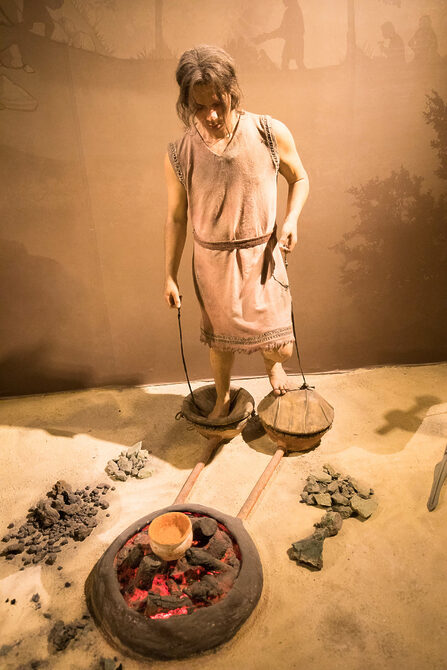
A reconstruction of an ancient furnace used for smelting.
The charcoal was loaded into the furnace and brought to temperature before the copper ore and flux were added. A constant temperature was maintained inside the furnace until the impurities in the ore began to combine with the fluxing agent to form a liquified mass, known as slag, on the surface. Meanwhile, copper metal began form into nuggets at the bottom of the furnace. Early attempts at copper smelting were never able to sustain temperatures hot enough to fully separate the copper from the slag. Thus the slag was allowed to cool before it was broken apart with hammers so that the copper ‘nuggets’ could be extracted from it.

A piece of slag from an ancient smelting site on Cyprus. This slag came from a much hotter furnace than the kind used on Site 39. In this case, the liquified slag has completely separated from the copper which would have accumulated as a solid mass at the bottom of the furnace. A hole was “tapped” in the bottom of the furnace so that the copper could be poured from the furnace into a mold, thus forming a solid copper ingot. One can see in the background a thick layer of slag that accumulated from centuries of smelting. Our word “copper” comes from the name of this copper-rich island.
Muhly, James D.
“Beno Rothenberg and the Chronology of Copper Smelting at Timna,” in Mining for Ancient Copper, Essays in Memory of Beno Rothenberg, edited by Erez Ben-Yosef.
University Park, Pennsylvania: Eisenbrauns, 2018.
Rothenberg, B.
Were these King Solomon’s Mines? : Excavations in the Timna Valley.
New York: Stein and Day, 1972.
Rothenberg, B, R.F. Tylecote.
Chalcolithic Copper Smelting.
London: Institute for Archaeo-Metallurgical Studies, 1978. Link
Thesiger, Wilfred.
Arabian Sands.
Great Britain: Penguin House, 2007.