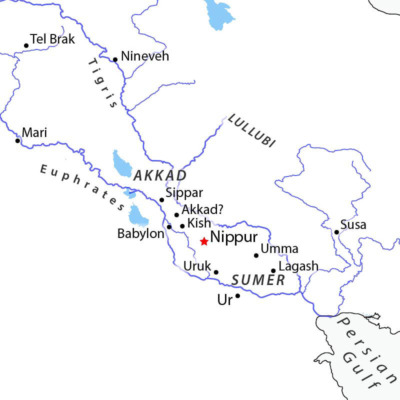
The Barton Cylinder was found at Nippur during excavations conducted in the city in 1889. Nippur was the religious capital of Sumer, the city of Enlil, and home to the largest archive of Sumerian texts ever discovered (of which we will have more to say later). The cylinder preserves one of the earliest known Sumerian cosmogonies. The first part describes a sacred marriage between An and Ki, heaven and earth. Their union—described euphemistically as “shouting”—brought forth the cosmos.
On that remote day, until that remote day, it was indeed; in that remote night, until that remote night, it was indeed; in that remote year, until that remote year, it was indeed. Then a gale was really blowing unceasingly, there were really flashes of lightning continuously. Near the sanctuary of Nippur a gale was then really blowing unceasingly, there were really flashes of lighting continuously. An/heaven is shouting together with Ki/earth; Ki/earth is shouting together with An/heaven… [7 lines missing]1Lisman 2013, 70-71
Lisman notes that the Sumerians accepted certain things as having always existed and therefore in no need of an explanation.
All texts from the third millennium report the presence, in a distant past, of an and ki. Cosmogony starts with the presence of an-ki, but no indication is given of the origin of this unity: an and ki are just there… It is obvious that the presence of the three or four (if the abzu is included) main domains of the cosmos has been accepted without any creation story. 2Lisman 2013, 70-71
In this instance, An and Ki are not gods per se, but the elemental forces of nature which have always existed. The world is not the creation of God but the emanation of One, an-ki, combining within itself both male and female aspects.
Ninhursag and Abzu
In the next section of the Barton Cylinder, the goddess Ninhursag “Queen of the Mountain” takes the place of Ki (“Earth”). She is also referred to as the Queen of Heaven while the fertilizing seed of An is described as the “Exalted Divine River.” The latter should probably be understood as the underworld river, the apsu, which is also described metaphorically as a mus-gir snake.3Lisman 2013, 160
With the true, great Queen of heaven, the older sister of Enlil, Ninhursag, with the true, great Queen of heaven, the older sister of Enlil, Ninḫursaĝ, he has had intercourse; he has kissed her; the seed for a set of septuplets he has poured into her womb. Earth chatted cheer with the mus-gir snake: Exalted Divine River, your small things have brought along water; in the canals, the god of the river… (30-31)
The male and female septuplets which arose from the union of An and Ki/Ninhursag produced offspring of their own, each generation of the gods representing some new aspect of nature, so that it can be said that all living things contain a bit of the original divine essence.
Lisman, J. W.
Cosmogony, Theogony and Anthropogeny in Sumerian Texts. Band 409 vols.
: Alter Orient und Altes Testament , 2013.