
also known as Mount Nemrut, overlooking the upper reaches of the Euphrates.
In the late 1800’s a German road engineer employed by the Ottoman Turks named Charles Sester reported seeing colossal stone men seated on thrones perched on a remote mountain peak in the central ranges of the Taurus mountains. His report was met with some skepticism, but as it turned out he was the first European to look upon the tomb of King Antiochus I Theos, ruler of the small mountain kingdom of Commagene. The name is derived from the Greek pronunciation of Kummuhu which can be traced back to the Hittites of the Late Bronze Age.
The presence of Rome in the eastern part of Anatolia first began to be felt when Lucius Cornelius Scipio defeated the Seleucid king, Antiochus III, at the Battle of Magnesia in 190 BC. However, Roman control over Asia Minor was severely tested when Mithridates VI, king of Pontus, led the cities of Asia Minor in open revolt against Rome. This culminated in the massacre of tens of thousands of Romans living in cities across Asia Minor in what has been called the ‘Asiatic Vespers’ (89-88 BC). Plutarch puts the number of murdered Romans at 120,000. In response, Rome sent Lucius Licinius Lucullus to make war against Mithridates and his ally, the Armenian king, Tigranes the Great. Lucullus proved an effective, if unpopular, general who succeeded in pushing Mithridates out of Asia Minor. A series of mutinies gave Pompey the needed pretext to have Lucullus recalled from the field. Furthermore, the Roman senate passed the lex Manilius into law which gave Pompey a free hand to make war on any of Rome’s enemies in the East. Many historians see the passing of this bill as the beginning of the end of the Roman Republic. Although it was intended as an emergency measure in response to a perceived threat, it gave too much power to the commander in the field—a precedent that was later exploited by Julius Caesar.
It was towards the conclusion of this tumultuous period that Antiochus I Theos (86 – 38 BC) inherited from his father the small mountain kingdom of Commagene. He seems to have been an astute ruler who understood where the wind blew—from Rome. Rather than enlarge the boundaries of his kingdom, he embarked on a building program. One of the most impressive monuments constructed by Antiochus I Theos was Nimrud Dagh.

The tomb of Antiochus I Theos (86 – 38 BC) as seen from a neighboring mound where the queens of Commagene were buried.

Looking east towards the upper reaches of the Euphrates River.

The Tomb
The cone covering the tomb was comprised of approximately 300,000 metric tons of rubble. Remarkably, the burial chamber has not yet been discovered but it is presumably located somewhere under the rubble.
Seated statues of the chief gods of Commagene were placed in front of the mound, facing east towards the rising sun. A text inscribed on the back of the thrones informs us as to the identity of the seated gods. It is interesting to note that the names of the Commagene deities combine the names of both Greek and Persian deities.

The heads have fallen off over the centuries. From left to right: King Antiochos I Theos, Tyche, Zeus-Oromasdes, Apollo-Mithras, Artagnes-Hercules-Ares. It is noteworthy that Antiochus I Theos was deemed worthy of sitting with the rest of the gods on the mountain.
The seated statue of the chief god, Zeus-Oromasdes, is slightly larger than the others. He wears a high tiara in the Persian fashion but his facial features and beard betray Greek influence. The chief god of the Greeks, Zeus, was identified with the Persian god Oromasdes (Ahura Mazda). This practice of “translating” the name of a god from one culture to another was common in the ancient world. The Greek historian, Plutarch (46-116 AD) explains,
Nor do we think of the gods as different gods among different peoples, or as barbarian gods and Greek gods, nor as southern and northern gods; but, just as the sun and the moon and the heavens and the earth and the sea are common to all, but are called by different names by different peoples, so there have arisen among different peoples… different honors and appellations. (Plutarch, Isis and Osiris, 5.66)
Just as people share in common the sun and moon, earth and sky, they also share the same gods even though they call them by different names. The practice among Greek and Roman writers of equating of the deities of one culture with those of another is known as interpretatio graeca. It was made possible by the fact that both cultures believed that the gods were ultimately aspects or powers of nature. As Henri Frankfort notes in his study of Egyptian religion, “polytheism is sustained by man’s experience of a universe alive from end to end. Powers confront man wherever he moves…”1Frankfort 1961, 4 Thus the sun god of one people could readily be identified with the sun god of another. Monotheists could not make this leap since they believe that God is separate from nature and the Creator of it.


gaze towards the rising and setting sun.
Sun Worship
Much of the religious symbolism found at Nemrud Dagh is related to sun worship. The Persians associated Mithra and Oromasdes (Ahura Mazda) with the sun or the sun’s light. The gods seated on their thrones high above the headwaters of the Euphrates fix their gaze towards the rising sun. Although no longer visible, they held in their right hand a bundle of twigs, known as the barsom, except for Heracles, who held a club instead. A good example of the the barsom can be seen at the British Museum where two golden figures from the Oxus Treasure are shown holding bundles of twigs. The barsom was an integral part of Persian religious ritual although its exact function is unknown.
There is a passing reference to the barsom in the book of Ezekiel when the prophet sees in a vision the elders of Israel standing with their backs to the temple, facing the sun. “Look at them,” the prophet exclaims, “each of them holding a twig to their nose!” (Ezek. 8:17)
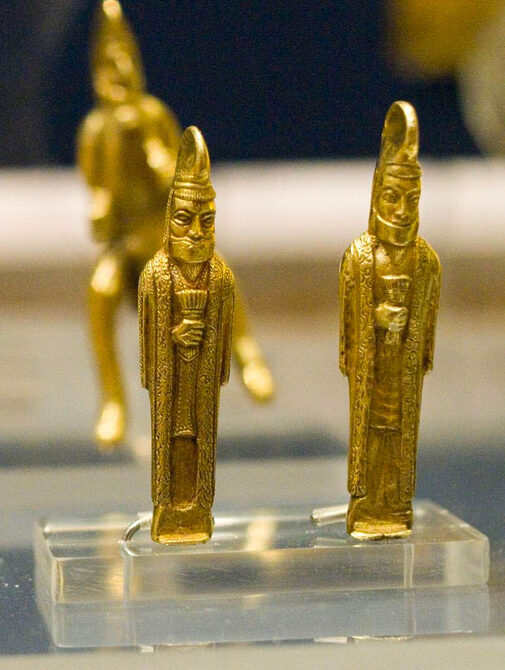
from the Oxus Treasure. The priest are holding bundles of twigs called barsom.
The Lion Horoscope
King Antiochus I referred to his tomb as a hierothesion which means “holy dwelling place” in Greek. He portrayed himself on his coins and inscriptions as a manifestation of Zeus Oromasdes. Thus the king took his place next to the gods on Nemrud Dagh. The status of the king in Commagene is perhaps best illustrated by a famous stone sculpture, found on Nemrud Dagh, of a striding lion with nineteen stars distributed across his body and three planets above his back. An inscription identifies the planets as: Mars, Mercury and Jupiter. Hanging beneath the neck of the lion is a sliver of the new moon.

The sculpture was found on Nimrud Dagh.
This was clearly intended to be a picture of the night sky. But which night sky? What date? It must be a night when Mars, Mercury and Jupiter are in the constellation Leo and the new moon is visible beneath Regulus, the brightest star in the constellation Leo (and one of the brightest stars in the night sky). Researchers have suggested a number of possible dates for this conjunction of stars, planets, and moon. One good candidate is July 7, 62 BC. This day must have marked an important event in the reign of Antiochus I, perhaps his coronation.2See discussion in Goell 1996 This lion relief is the earliest known instance of a Greek horoscope. Its message is clear: the king was destined for his throne. It was written in the stars.

The Nomos Inscription
The throne backs of the seated gods were carved with a long inscription, written in the first person by Antiochus I. Here is how it begins:
I have come to believe that, for mankind, of all good things piety is both the most secure possession and also the sweetest enjoyment. The Nomos Inscription
This statement could almost be mistaken for one of the Proverbs in the Bible although it may be asked what exactly does the king mean by ‘piety’? Unfortunately, Antiochus does not elaborate any further on the subject except to command that appropriate sacrifices be made to the gods at the proper time. In addition to the traditional sacrifices, the king adds several new ones to the list. For example, on the 16th of each month the priests were to make sacrifices in honor of his birth. They were also to celebrate the king’s coronation on the 10th of each month. And once a year the people were to celebrate an annual festival for “the gods and myself” on Nemrud Dagh.

The inscription was written on the backs of the thrones.
During the annual festival the priests were to dress in “fine Persian attire,” they were to place crowns of gold on the heads of the seated gods, and they were to offer sacrifice to all of the gods and heroes in that place.
And whoever, in the long time to come, takes over this reign as king or dynast, may he, if he observes this law and guards my honor, enjoy, through my intercession, the favor of the deified ancestors and all the gods. But if he, in his folly of mind, undertakes measures contrary to the honor of the gods, may he, even without my curse, suffer the full wrath of the gods. The Nomos Inscription
Contrary to Antiochus’ expectations, the kingdom of Commagene did not long survive his death in 38 BC. In 17 AD the emperor Tiberius made Commagene into a Roman Province. And a new emperor cult took the place of the old one—that of Caesar Augustus!


made by the Antiochus I Theos engraved on stone.

upon which sacrifices were to be made “to all the gods and heroes.”
Barton, T.
Ancient astrology.
London, New York: Routledge, 1994. Link
Frankfort, Henri.
Ancient Egyptian Religion.
New York, Evanston, London: Harper & Row, 1961.
Goell, Theresa, H G Bachmann , D. H. Sanders.
The Hierothesion of Antiochus I of Commagene: Results of the American Excavations Directed by Theresa B. Goell.
Winona Lake, Ind.: Eisenbrauns, 1996. Link
Pelikan, J.
The Emergence of the Catholic Tradition (100-600).
Chicago: University of Chicago Press, 1971. Link