Significant changes may be observed in the pottery of the EB IV-MB I compared to preceding periods. The black and red burnished pottery of the EB III was replaced by pottery with a light yellowish-green fabric, and a sandy texture. The body of the vessel was often made by hand except for its rim, which was turned on a wheel. The rim and the body were allowed to get leather-hard before they were melded together on the wheel.1Amiran 1970, 80 Fingermarks are often visible inside the vessel where the two parts of the vessel were blended together. Evidently, these pots were produced by potters who were still somewhat unfamiliar with the potter’s wheel. Most of the vessels are undecorated or the decoration is limited to a band of parallel or wavy incisions on their shoulder, made with a 3 to 5-fingered comb. The two most important types of vessels found in the shaft tombs are bowls with beaded rims and amphoriskoi—a jar with two handles on the neck (from Greek. amphi “on both sides”, and phoreus “carrier”).
Characteristics2Amiran 1970, 80; Dever 1973
- gritty, sandy texture
- red-slipped (early examples) or light greenish grey (late examples)
- unburnished
- vessels often do not have handles, or they have small loop handles
- baggy shapes with no shoulders
- four-spouted lamps
- incised wavy line between two horizontal lines
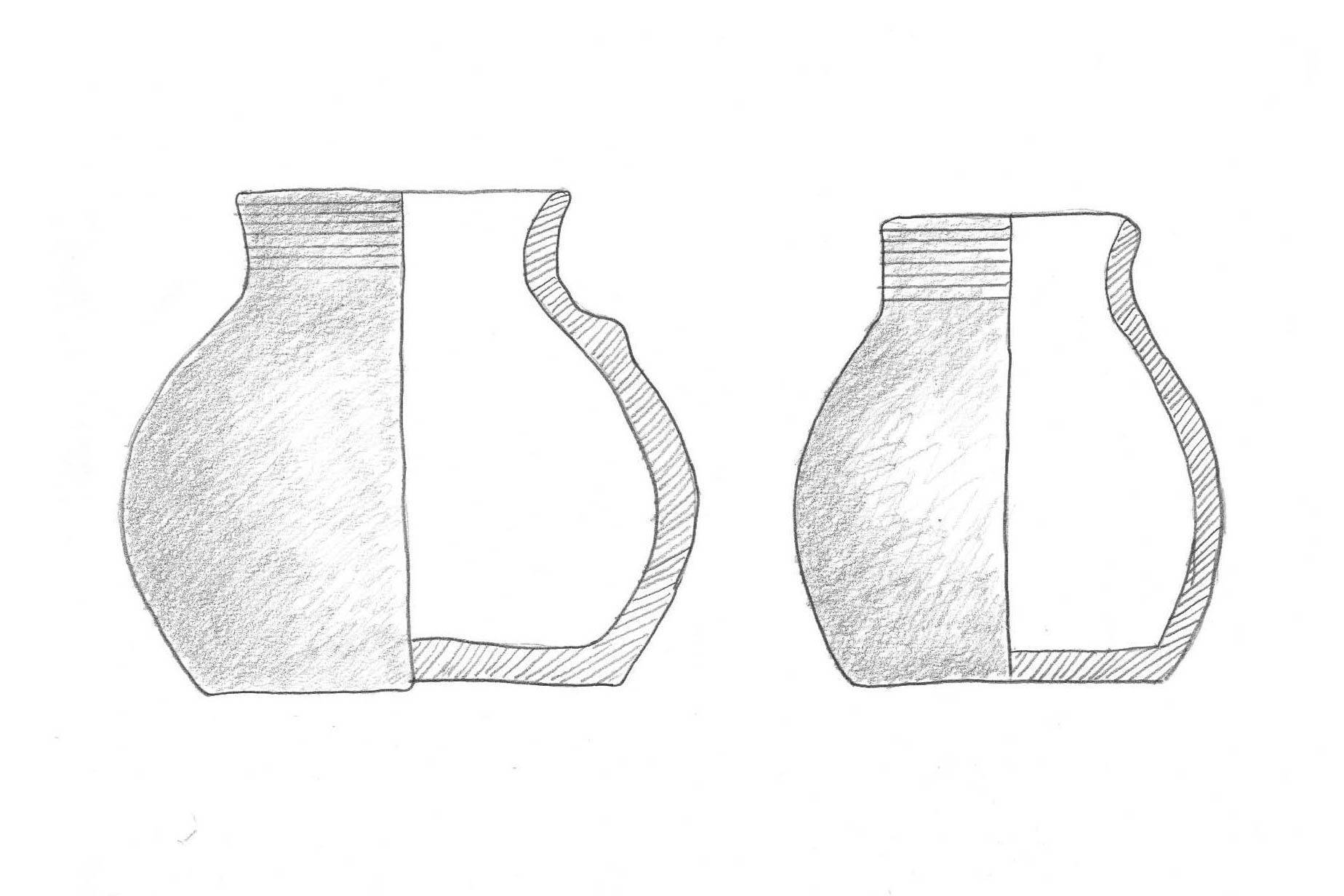
with band-combed rim. From Bab edh–Dhra (left) and Jericho (right).
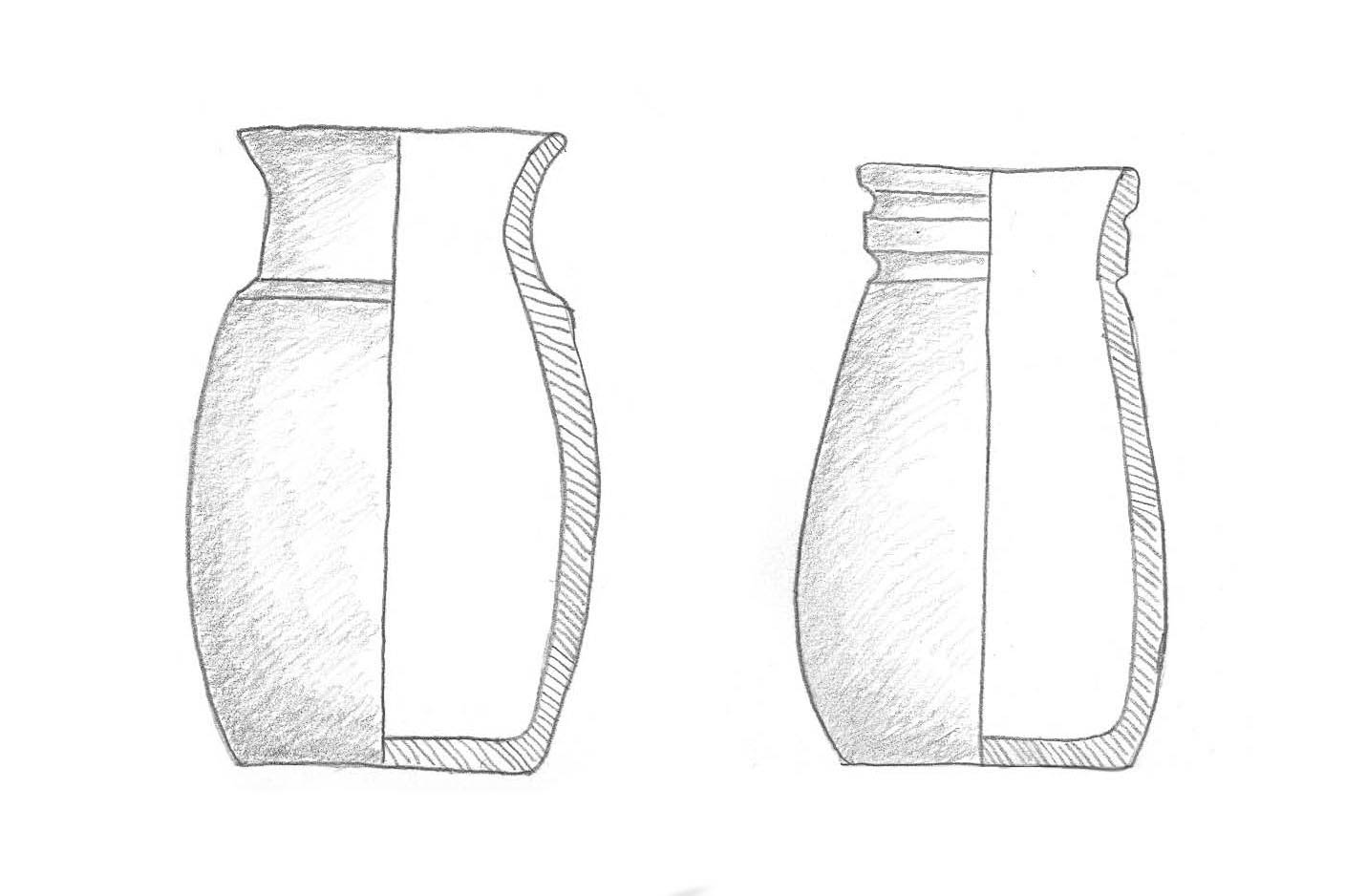
with hard shoulder (left) or grooved rim (right). The pronounced shoulder (left) was created when the wheel-turned rim was attached to the hand-made body. From Bab edh-Dhra (left) and Jebel Qa’aqir (right). Both places are located in the Transjordan.

with knob (left) or band-combed wavy decoration (right). From Bab edh-Dhra.
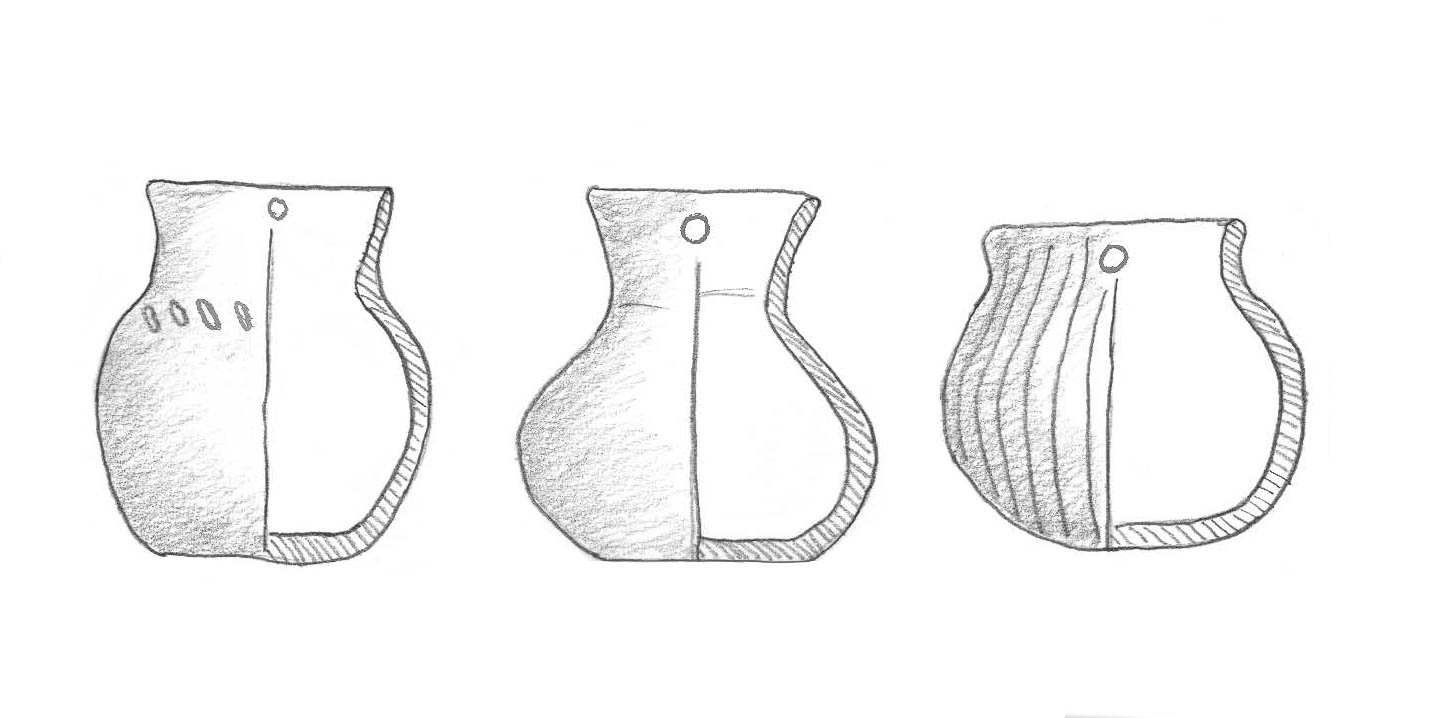
from the Jebel Qa’aqir in the Transjordan (left and middle)
and Jericho (right).
Early examples of this type of pottery were sometimes covered with a thick red slip like their EB III predecessors, but were left unburnished and were generally made with thick walls from poorly levigated and poorly fired clay. Later examples are a light greenish-grey color and are usually better fired.3Dever 1973, 53 Particularly noteworthy are the four spouted lamps which first begin to appear during this period.


The pottery tends to be plain or decorated with grooved lines made with a comb. Some vessels are red-slipped (Lachish, Cemetery 2000) but later examples are almost always a light grayish-green color. Note the four-spouted lamp at bottom.
ARC/British MuseumMegiddo Grey Black Ware
A particular type of shaft tomb was found at Megiddo which produced some unique vessels that do not fit the pattern described above. The shaft tombs are larger and more finely cut, with several chambers branching off of a central chamber that was accessed via a vertical shaft.
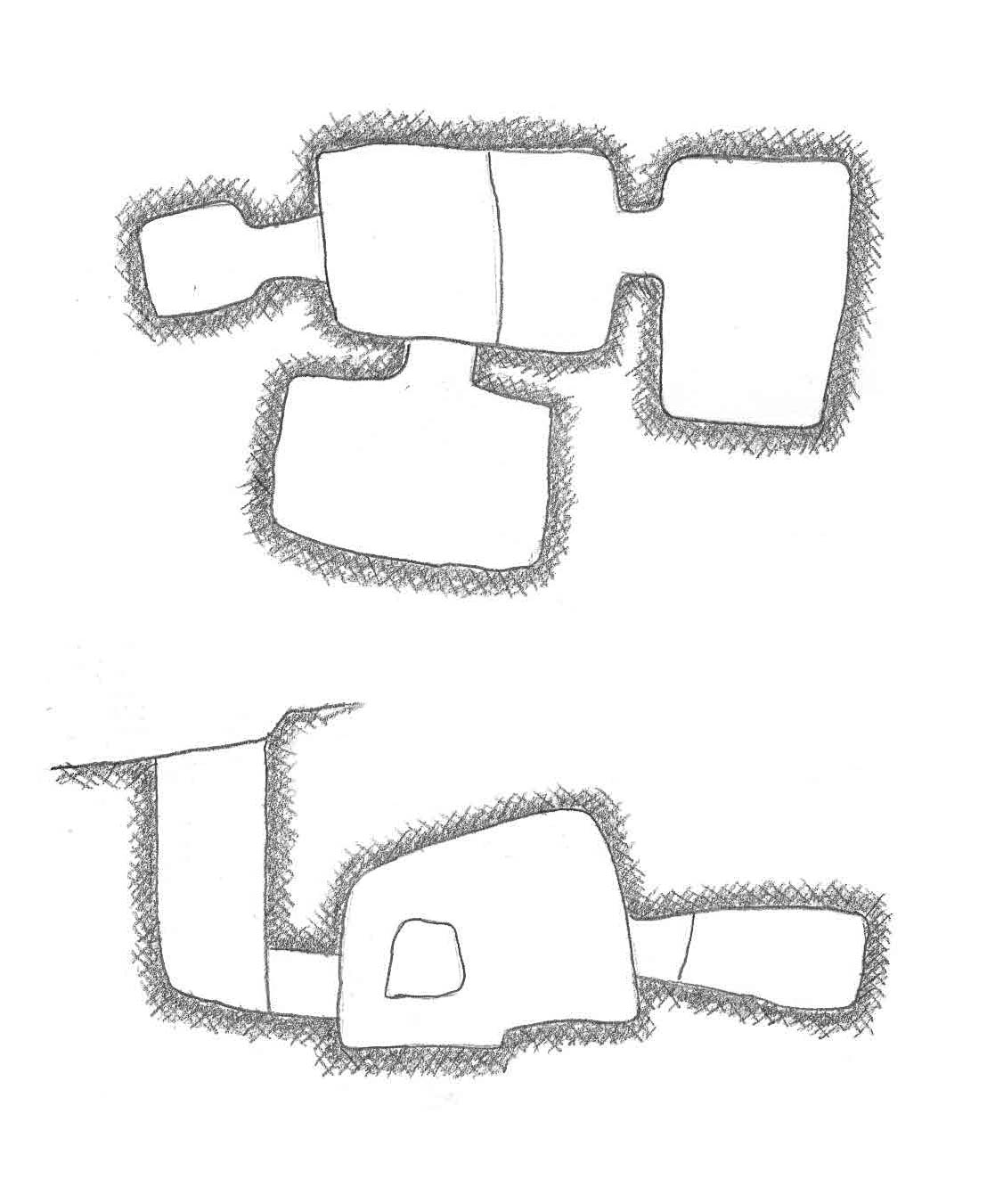
EB IV – MB I
One of the unique vessels found in these shaft tombs was a grey teapot made entirely on the wheel and well fired as proven by the metallic ring it makes when struck. Ruth Amiran thought these vessels should date to the EB IV–MB I while noting also their affinity with pottery of the following period (MB IIA).4Amiran 1970

Teapot with typical wavy line decoration between two horizontal bands. From Megiddo shaft tomb 989D2.
“Rilled-rim” Bowls
A final type of pottery characteristic for this period is a large, shallow bowl with a “rilled” rim. They are found primarily in stratified deposits (where people live) rather than in tombs.5Dever 1973, 45 The elaborate rims of these bowls were produced on a wheel and then attached to the body of the bowl, which continued to be made by hand. Dever notes that these rilled-rim bowls are “among the most useful diagnostic forms for EB IV-MB I.”6Dever 1973, 45 As you may recall, similar bowls were found at Ebla where they belong to the Mardikh IIB1-2 horizon.

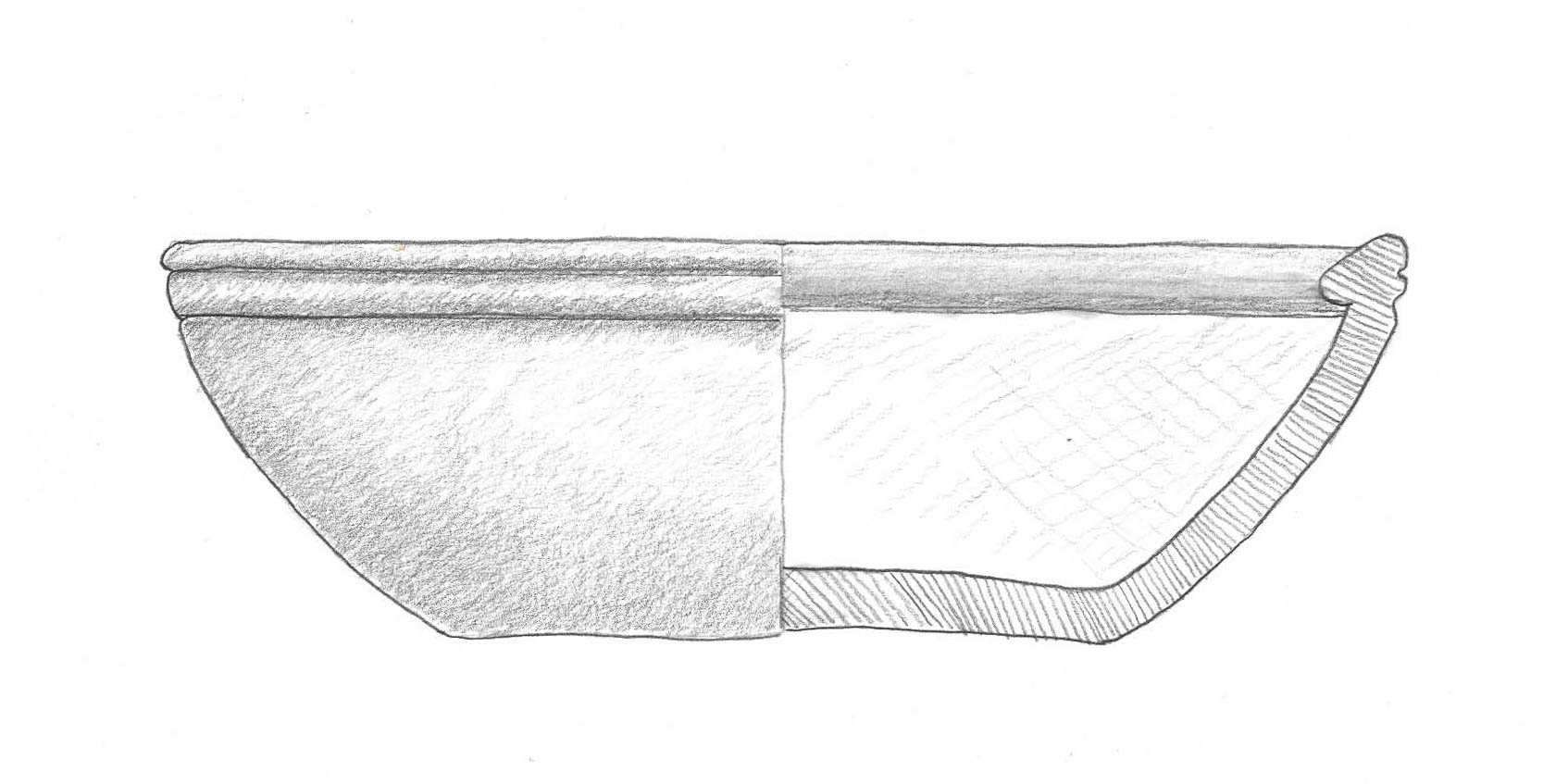
These large, deep bowls have a diameter of 12-15 inches. The “rilled-rim” of the vessel on the right is a diagnostic form that disappears from the southern Levant by the end of the EBIV—MB I period.
Amiran, R.
Ancient Pottery of the Holy Land; from its Beginnings in the Neolithic Period to the end of the Iron Age.
New Brunswick, N.J.: Rutgers University Press, 1970.
Dever, William. “The EB IV-MB I Horizon in Transjordan and Southern Palestine.” Bulletin of the American Schools of Oriental Research, no. 210 (1973): 37–63. Link
Kenyon, Kathleen.
Amorites and Canaanites.
London: Oxford University Press, 1966.