
Churns from Horvat Beter in southern Israel.
Another distinctive vessel produced by the Ghassulian culture was the barrel-shaped pottery churn. Its end loops were used to hang it from the ceiling. The vessel was filled with milk and rocked vigorously back and forth until the water separated from the milk fat, a process that can take anywhere from forty minutes to two hours depending on the milk source.1Goat, sheep, and cow’s milk may all be processed into butter. It takes at least six pounds of goats milk to make one pound of butter. It takes half as much sheep’s milk to make the same amount. Source: Iranica Online The milk fat was then removed from the churn and kneaded until it assumed the consistency of butter. An optional final step involved heating the butter until all of the remaining moisture was boiled away, thus producing a clear oil known as clarified butter or ghee. This rich source of protein may be stored for up to a year.

This relief from the Temple of Ninhursag at Tell al-‘Ubaid, (near Ur) shows a Sumerian style of churn which took the form of a large round vessel that was rocked on the ground. The goddess Ninhursag, whose name means “Lady of the Mountain,” was associated with the production of milk. The relief dates to c. 2500 BC.
Adults probably did not drink fresh milk regularly in ancient times although there is evidence that milk was given to children. An Eighteenth Dynasty text from Egypt records an allotment of milk for sixty children. The milk was provided by three cows, fifty-two goats and nine she-asses.2Darby et al 1977, pg 764 as cited in McCormick 2012 More often, the milk was churned into butter or curdled, filtered, and pressed into “curds,” a type of soft cheese. Alternatively, the milk could be fermented and made into yogurt. To this day the bedouin carry leather skins filled with a watery, very sour yogurt called kefir made from goats milk.

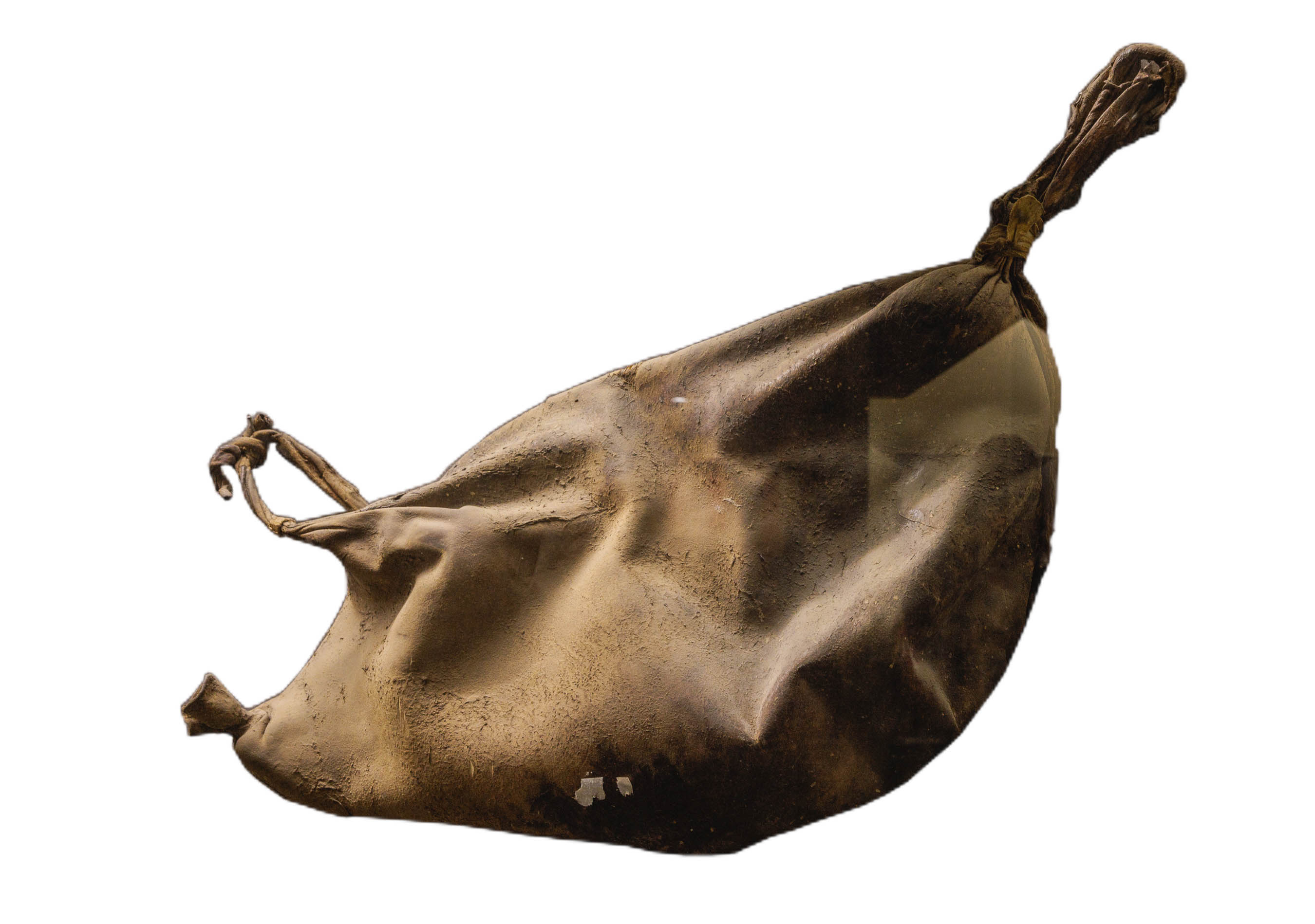
The churn made of pottery (3rd millennium BC) and the other from goat skins (2nd millennium AD), each had their advantages; the goatskin being more suitable for nomadic groups on the move. Both styles of churn are very ancient, and both were used until recent times.
Remarkably, a churn used by the herding cultures of Eastern Turkey (now on display in a heritage museum in Van, Turkey) looks remarkably similar to the churns used by the Ghassulians.3“In all probability” a fragment of a “Ghassulian-style” churn was found in the Amuq Valley in Phase E. Braidwood 1960, 512


A churn hanging from the ceiling of a heritage house in Van, eastern Turkey.
Braidwood, Robert J, Linda S. Braidwood.
Excavations in the Plain of Antioch I, The Earlier Assemblages Phases A-J.
Chicago, Illinoi: The University of Chicago Press, 1960. Link
McCormick, F. “Cows, Milk and Religion: The Use of Dairy Produce in Early Societies.” Anthropozoologica 47, no. 2 (2012): 101-113. Link