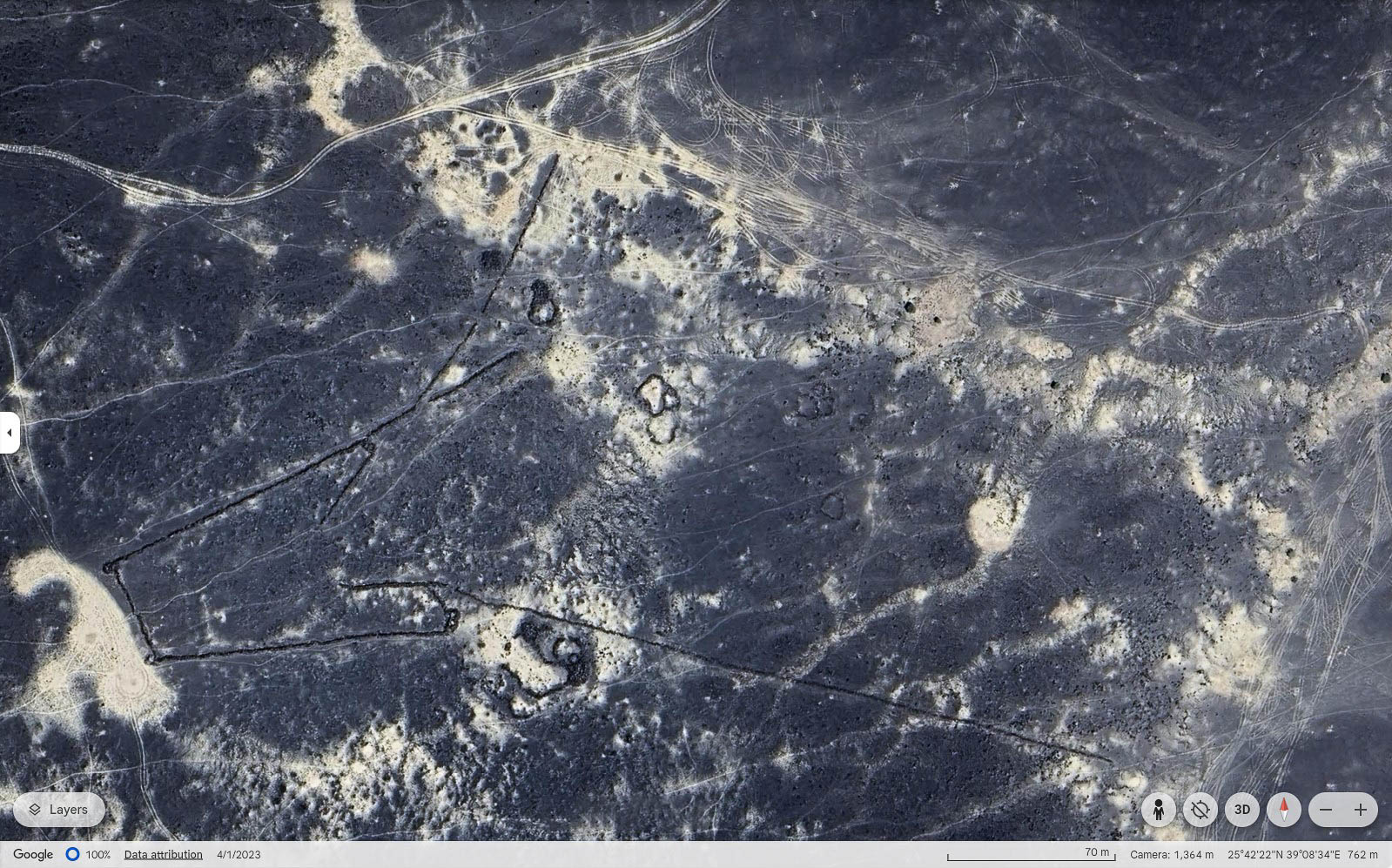
Huge structures constructed in the basalt deserts of Jordan, Syria and Arabia were first spotted by RAF pilots during WWI.
In his book, Looking for Dilmun, Geoffrey Bibby observed that the vast salt flats (Arabic. sabkha) which he encountered in the interior of Arabia were actually dried up lake beds which must have regularly filled with water in the past. During the course of several surveys in the region, Bibby and his team found campsites, settlements, and even an ancient city situated next to these salt flats. The name of the city is Thaj. Located in the middle of the desert approximately 60 miles off the eastern coast of Arabia, excavations at Thaj were conducted by D. T. Potts. The settled area is estimated to have covered 5 square miles although the walled portion of the city was only a fraction of this, measuring approximately 680 yards in either direction.1Potts 1984, 24-25 The walls of the citadel measure approximately 12 feet thick and are made of finely-cut limestone blocks. As noted previously, the city abuts a large sabkha which still occasionally fills with water. Potts argues that Thaj should be identified with the famous caravan city of Gherra, often mentioned in classical texts. The pottery recovered from the site, which dates to the Hellenistic period, would seem to confirm this identification.2Bibby notes that the walls of Thaj could clearly be seen from the air, encompassing the city on three sides, but not where the city abutted the sabkah. Bibby wondered whether the walls may, perhaps, have extended beneath the sabkah or whether the sabkah was a permanently filled lake and the walls simply terminated at the lake shore. Bibby would later conduct some preliminary excavations at the site which confirmed that the walls did indeed terminate at the edge of the sabkha, suggesting that it was a permanently filled lake, although I have not seen anyone else mention this. Bibby 1984, 333-338
D. T. Potts explored another group of sabkah located approximately 60 miles southeast of Thaj, in the region of Hofuf. Satellite imagery of the region suggests the sabkha were once connected by a channel, forming what may have been an ancient river.3Potts writes, “Furthermore, it is important to note that a series of sabkhas—salt-lakes which are dry in summer and wet in winter—stretches from Hofuf northeastwards towards the Gulf (Fig. 3), indicating that a fluvial system could have once existed here, of which the sabkhas are the mere residue.” See: Potts 1984, 23 Potts suggests that this ancient channel may have been the lost Arabian river mentioned by the Roman historian, Pliny, in connection with two Arabian cities: Palon and Murannimal.4Pliny the Elder, Natural History, Book VI; cf. Potts 1984, 22-23 He notes also that aerial surveys of the region reveal remnants of ancient canals and irrigation ditches around Hofuf. All of this points to a wetter climate in Arabia during the Hellenistic and Roman periods.
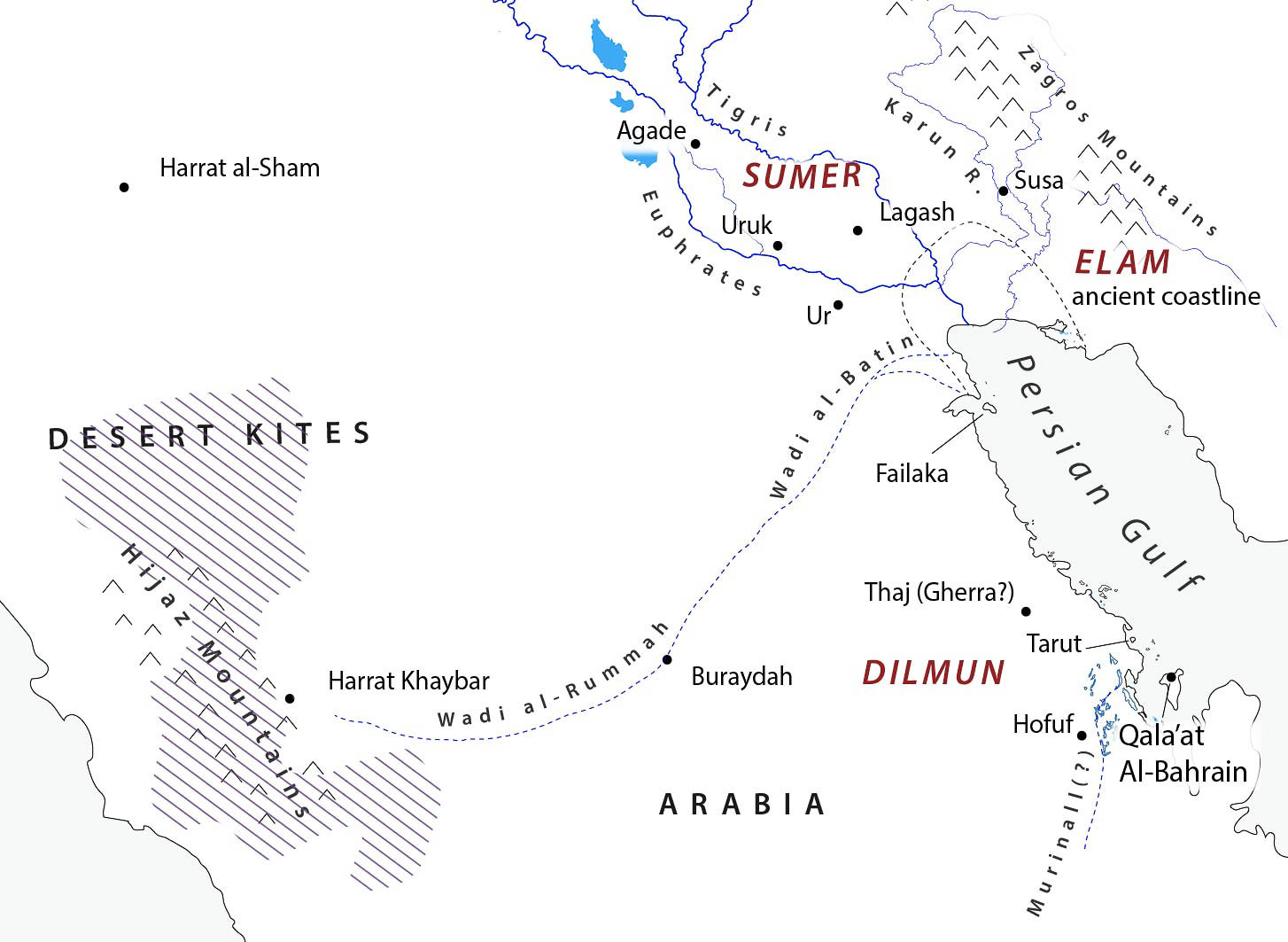
Map showing the possible locations of Thaj, Hofuf and the Murinall.
The Lost River
There is another lost Arabian river, more ancient probably than the ones mentioned in Pliny’s Natural History. NASA scientist and professor at Boston University, Farouk al-Baz, was the first to draw the public’s attention to it. Using newly obtained satellite imagery, al-Baz traced its course across the entire width of the Arabian peninsula, beginning in the Wadi al-Rummah at Harrat Kaybar and ending in the Wadi al-Batin near Kuwait. The age of this river has been estimated to be anywhere from 10,000 to 4,000 years old.
Related to the question of the age of the river are the large number of “desert kites” and settlements located in the Harrat Kaybar region. The desert kite phenomena first became known during WWI when RAF pilots crossing the black basalt desert of eastern Jordan began to notice peculiar stone structures dotting the landscape. These took the form of squares, circles, and even spoked wheels. But the most intriguing of all were the miles long V-shaped walls that traversed the desert like giant kites.
With the advent of satellite imagery, many more desert kites have been found, not just in the eastern desert of Jordan but also in Arabia, the Negev, Turkmenistan, Armenia, and the Sahara. It is now generally agreed that the kites were used to funnel animals, most probably gazelle, into pens where they could easily be picked off with arrows and spears. Many of the kites display a sophisticated design, with carefully crafted funnels, towers and pits. Clearly this was not the haphazard work of survivalists, struggling to find enough calories to stay alive, but the product of a thriving civilization that once inhabited these barren regions.
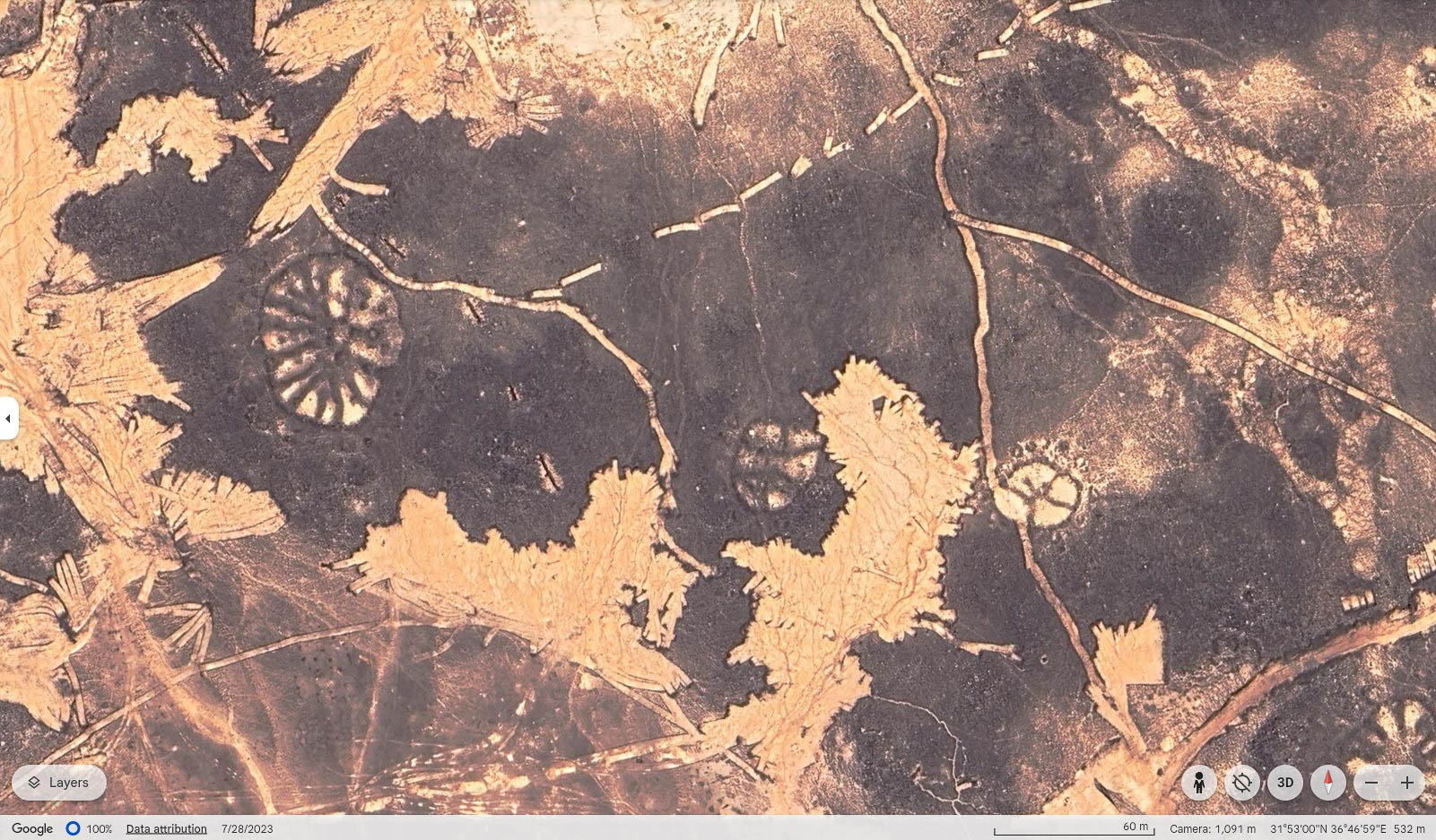

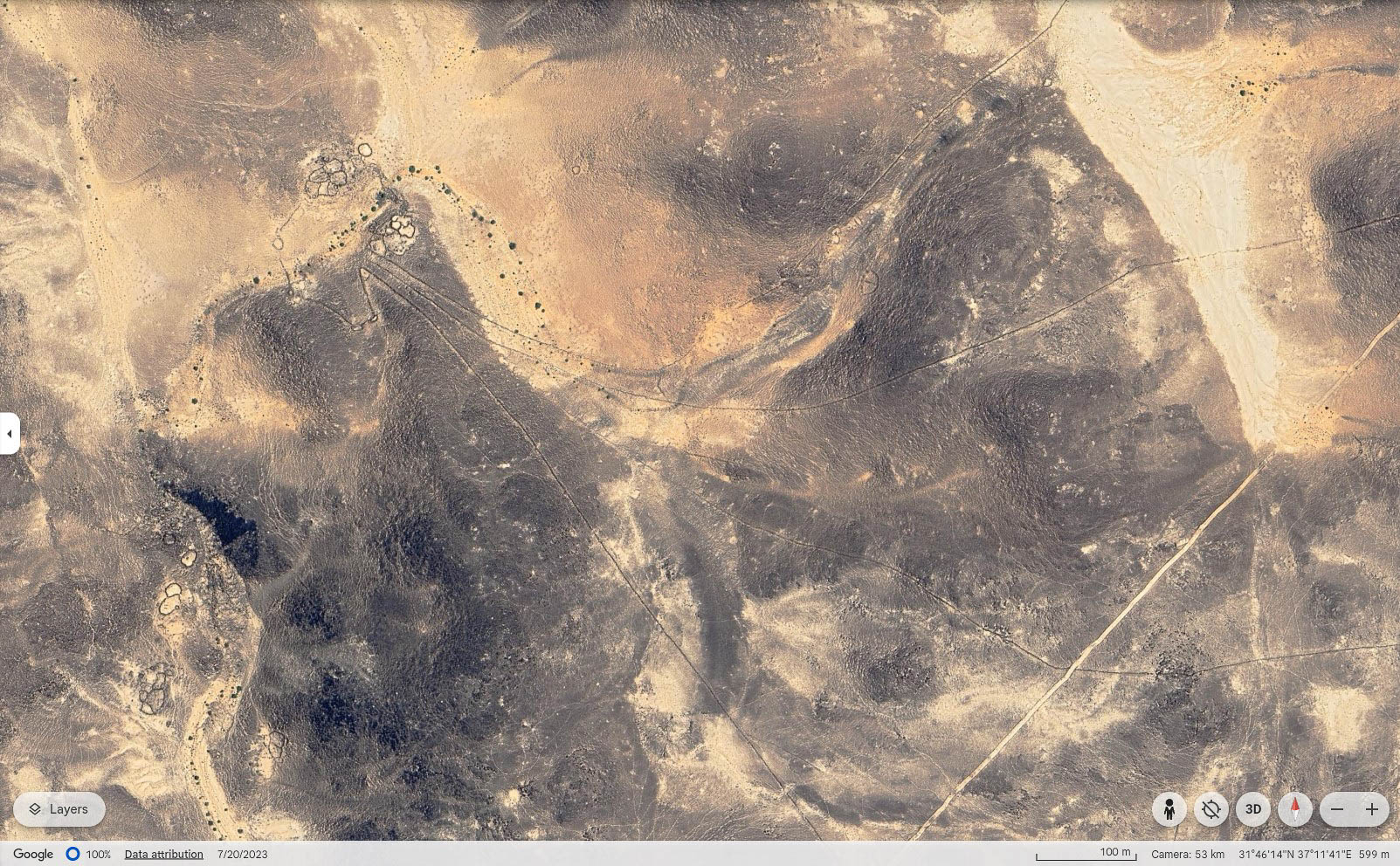
The kites were used to trap animals but the function of the “mustatils” and “wheels” remains a mystery. Thousands of these structures were erected in the desert.
Chronology
The age of the kites has been the subject of considerable debate with dates ranging anywhere from the Mesolithic (c. 9000 BC) to the Early Bronze (c. 2500 BC).5Rock art depicting kites used to trap elk have been found in Norway and here again there is much debate about how old they are, with dates ranging from 7000 years old to 2000 years old! Flint tools and arrowheads found next to several of the star kites in Jordan has led some scholars to assign the kites to the Neolithic period.6Betts and Burke 2005, 74 However, the chronology of the Neolithic is complicated by the fact that “neolithic” hunter-gatherers may have lived next to “early bronze” farming folk. This seems to have been the case, for example, in Bahrain where the Neolithic appears to have persisted well into the Early Bronze period.7Potts writes, “It is possible that the population which used the late “stone age” assemblages mentioned above existed into the mid-third millennium, and that there was no gap in occupation on the island.” Potts 1983, 15-16 Israeli archaeologists excavated two kites in the Negev, one at Kibbutz Samar and another at Har Shahmon, which they dated exclusively to the Early Bronze period (c. 3000 – 1900 BC).8Holzer 2011

Two desert kites at Kibbutz Samar in the Negev.
The most conclusive evidence for the date of the kites comes from Tell Kuran, on the west bank of the Khabur River in Syria. Excavations on the tell revealed a thick deposit of gazelle bones belonging to at least 93 gazelle, and probably many more, since the deposit was never fully excavated.9Zeder et al. 2013, 119 Since many kites have been found within a 10 kilometer radius of Tell Kuran, the gazelle were probably trapped and killed in the kites and then carried to Tell Kuran for butchering. Diagnostic pottery and charcoal samples from the tell led archaeologists to date the deposit of bones to the late 4th millennium BC. They conclude that the desert kite phenomena was not the product of neolithic hunter-gatherers but of early bronze populations.10Zeder et al. 2013, “Datable material associated with kites across the region (either architectural relationships to dated structures or the presence of distinctive lithics or ceramics) uniformly point to the end of the 4th millennium BCE or the Chalcolithic period (6000 years ago) up through the 3rd millennium BCE Early Bronze Age as the primary (if not sole) periods represented.”
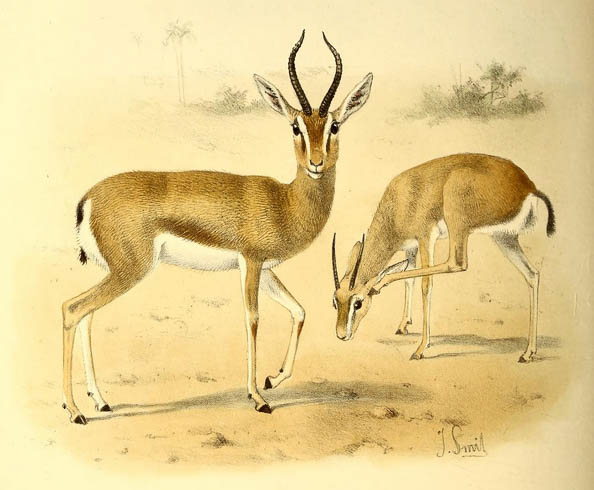
These little gazelle are not “obligate drinkers”; they get all the moisture they need from the leaves of plants.
There is also evidence for the use of kites during the Roman era when a wetter climate likely also prevailed in the region. Tens of thousands of Safaitic inscriptions dating from 1st century BC to 4th century AD have been found in the basalt deserts of North Arabia and Jordan. One of the inscriptions also preserves a picture of a desert kite, showing how it was used to trap animals.

This Safaitic petroglyph, discovered in the eastern basalt desert of Jordan, illustrates how the desert kites were used. Safaitic is thought to be a south Semitic dialect, related to Arabic.
It is often said that hunting pressure led to the extinction of the gazelle on the harra.11Groucutt and Carleton 2021, 8 It is more likely, in my opinion, that the gazelle disappeared as climatic conditions grew more arid towards the end of the Early Bronze period. Today, only the the smallest species of gazelle, the Dorcas and Acacia gazelle, are able to survive in the harra. These species get all of the moisture they need to survive from the leaves of desert plants.12Holzer et al. 2011, 9 However, they are unlikely to have been the species of gazelle which inhabited the harra during the Early Bronze period, but rather the much larger Persian gazelle. Vast herds had to have existed in these regions to justify the time and energy required to build miles long chains of kites across Arabia and Jordan.
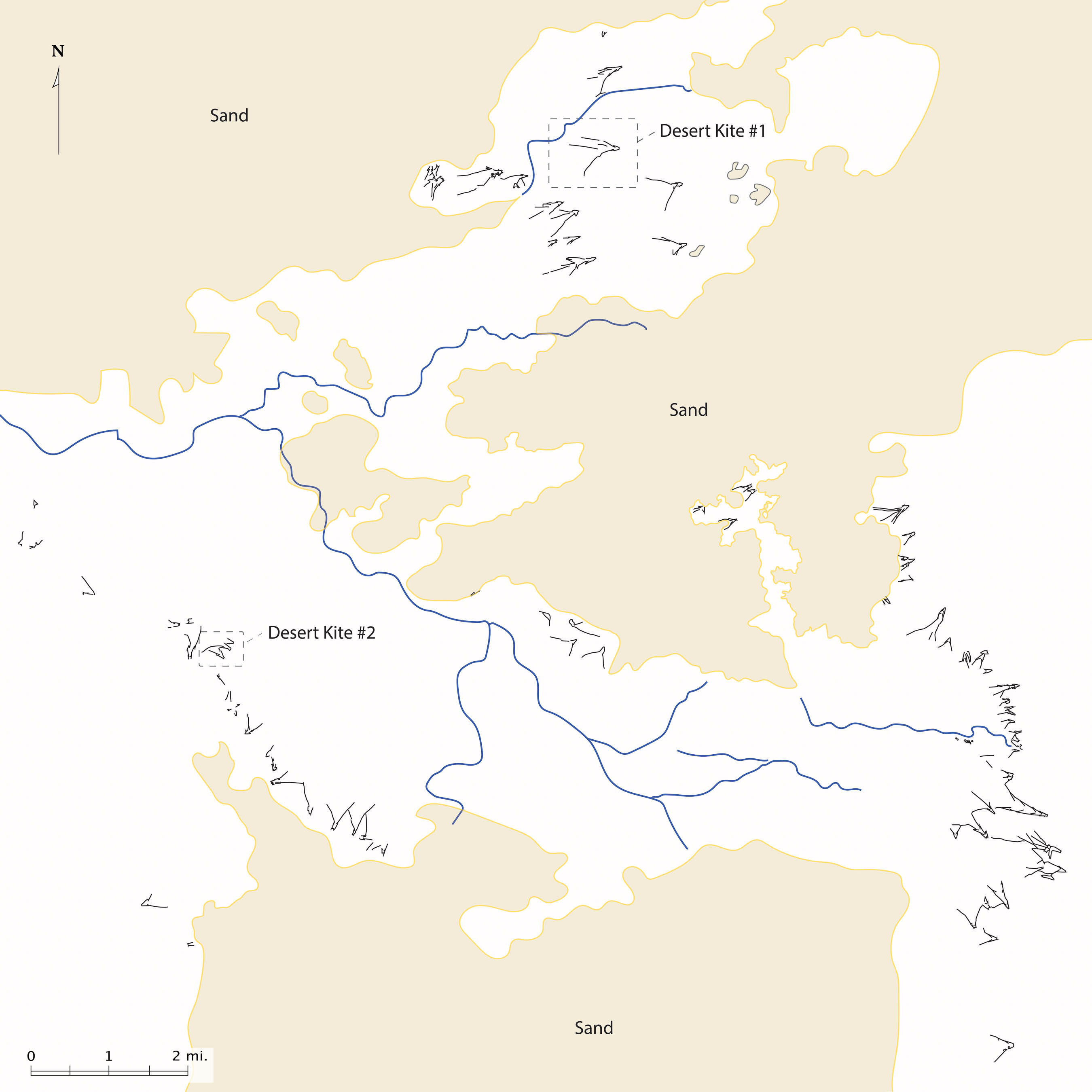
Traced from Google Earth, you can see how blown sand has covered many of the kites, which formed much longer chains than what is visible today. The boxed kites are shown below.
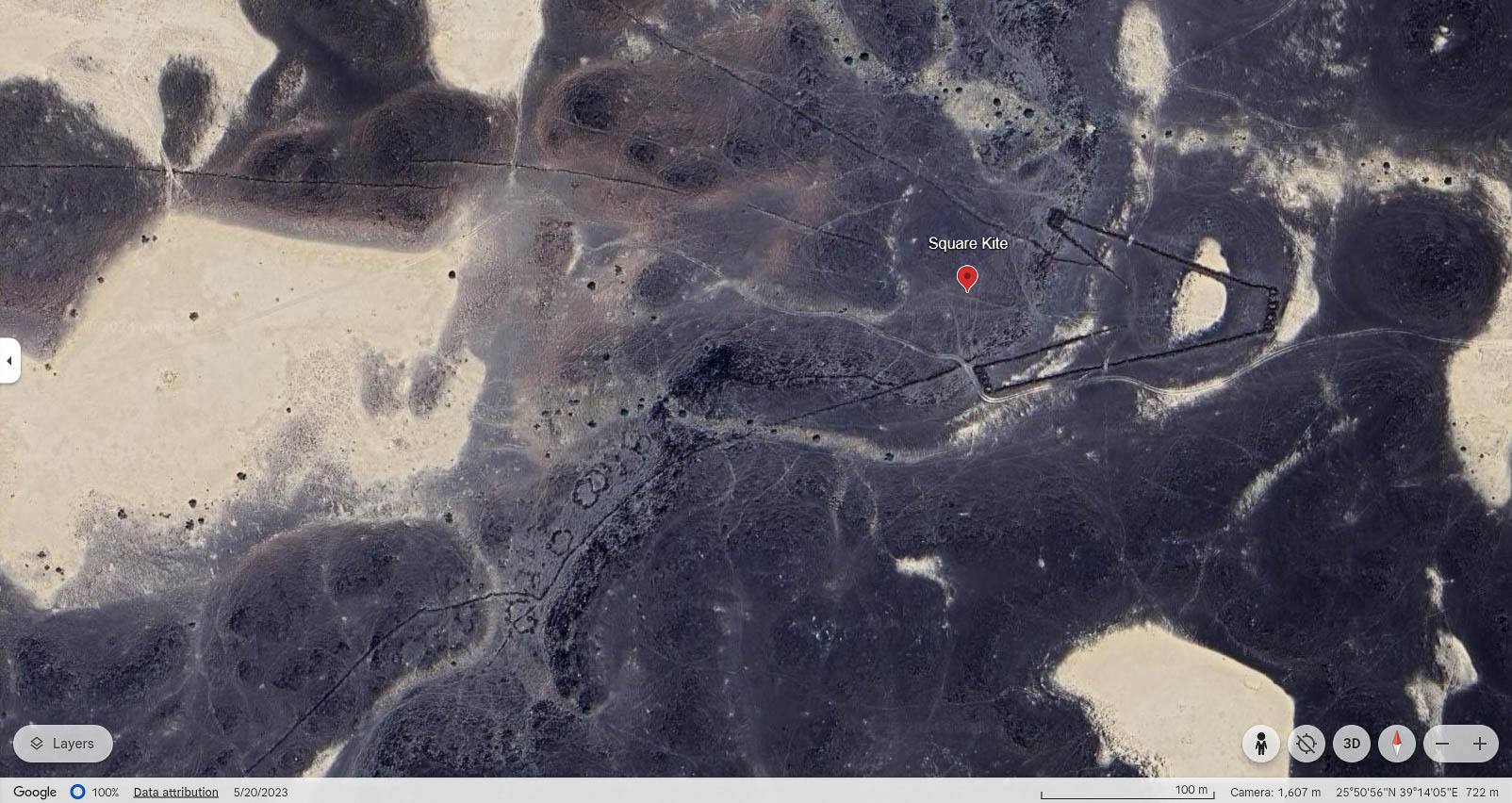
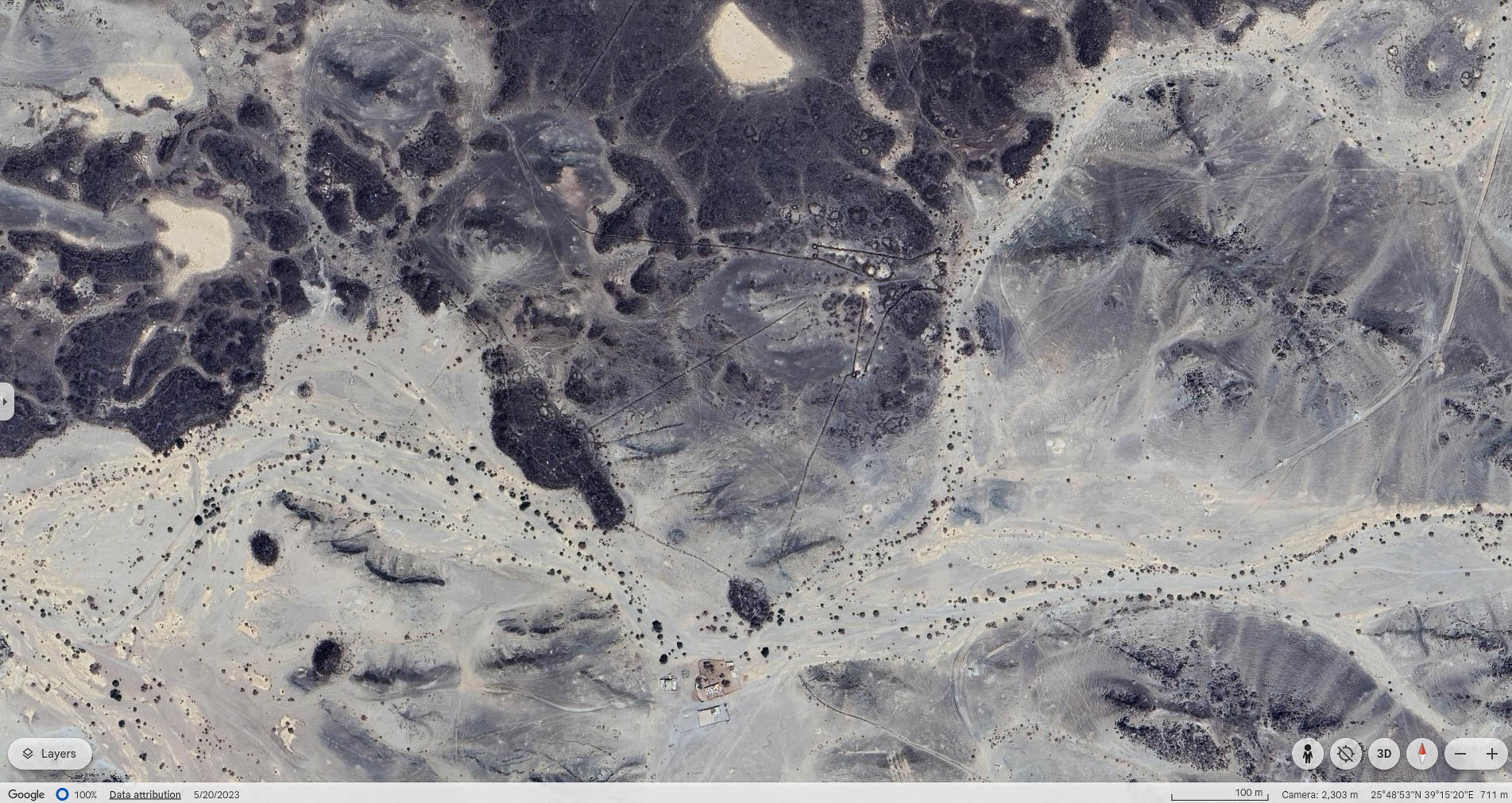
The kites were situated along valleys on the edge of the basalt rock fields, which provided the material needed for their construction.
The Pishon
Let us return for a moment to the ancient Arabian river discovered by Farouk el-Baz. A river of this size would have required wetter climatic conditions in the region. The large number of desert kites in the region also points to savannah like conditions in the region. If these conditions prevailed during the first half of the Early Bronze period, which is likely, then it is reasonable to think that the river which once flowed through the Wadi Rummah and Wadi Al-Batin belongs to this period. It is even possible that the mysterious Pishon River described in Genesis should be identified with this river. 13Kitchen 2003, 428-429 According to Genesis, the river passed through the “whole land of the Havilah which is rich in gold” (Gen. 2:11). Most commentators agree that Havilah should be identified with Arabia.
The Pishon was one of four rivers which are said to have flowed out of Eden or, alternatively, into Eden—either reading is possible.14Speiser 1964 The other rivers named in Genesis are the Tigris, Euphrates, and Gihon.15Gen. 2:10-14 We know where the Tigris and Euphrates are located, while the Gihon should probably be identified with the Karun River in Iran. According to Genesis, this river flowed through the land of Cush; not in Africa, but the land of the Kassites who lived in the mountains of Iran. The Tigris, Euphrates and Karun have their outlet at the head of the Gulf. If the Pishon is identified with the Wadi al-Batin then it too would have entered the gulf near Kuwait.
It is remarkable to find a reference in Genesis to a river in Arabia since any such river would likely have run dry by the end of the Early Bronze period due to increasingly arid condition in the region. This is a topic we will come back to in future entries.
Betts, Alison, David Burke. “Desert Kites in Jordan – a New Appraisal.” Arabian Archaeology and Epigraphy 26 (2015): 74–94.
Bibby, Geoffrey.
Looking for Dilmun.
Great Britain: Penguin, 1984.
Groucutt, Huw S, W. Christopher Carleton. “Mass-kill hunting and Late Quaternary ecology: New insights into the ‘desert kite’ phenomenon in Arabia,.” Journal of Archaeological Science: Reports 37 (2021). Link
Holzer, A, Uzi Avner, Naomi Porat, Liora Horwitz. “Desert kites in the Negev desert and northeast Sinai: Their function, chronology and ecology.” Journal of Arid Environments 74, no. 7 (July 2010): 806-817. Link
Kitchen, Kenneth.
On the Reliability of the Old Testament.
Grand Rapids, MI / Cambridge UK: Wm. B. Eerdmans Publishing Co., 2003.
Potts, Daniel.Dilmun II (1983): 15-19.
Speiser, E. A.
Genesis.
Garden City, N.Y.: Doubleday, 1964.
Zeder, Melinda, Scott Rufolo, Frank Hole, Guy Bar-Oz. “New perspectives on the use of kites in mass-kills of Levantine gazelle: A view from northeastern Syria.” Quaternary International 287 (May 2013): 110–125. Link