
The Palermo Stone is the oldest known king list from Egypt. It was inscribed on a polished basalt stone of which only fragments have been found. The most important piece, pictured above, resides in the Regional Archaeological Museum Antonio Salinas in Palermo, Italy.
The Palermo Stone is the most important Egyptian king list of the Old Kingdom period. Although badly broken, its value to the historian is comparable to the Sumerian King List. It is estimated that the original stone measured approximately six feet long by two feet high and was inscribed front and back with the names of the kings of the first five dynasties of Egypt along with important events from their reigns and the height of the Nile for each year. Unfortunately, only fragments of it have sporadically come to light over the years. The findspot for these fragments is unknown since all of them were purchased on the antiquities market. One of the fragments is in the British Museum and several more in the Cairo Museum, but the largest and most important fragment, measuring approximately 16 inches tall, was purchased in 1859 by a Sicilian lawyer named Ferdinand Guidano. In 1877 the Guidano family presented it to the Palermo Archaeological Museum in Siciliy where it resides to this day.
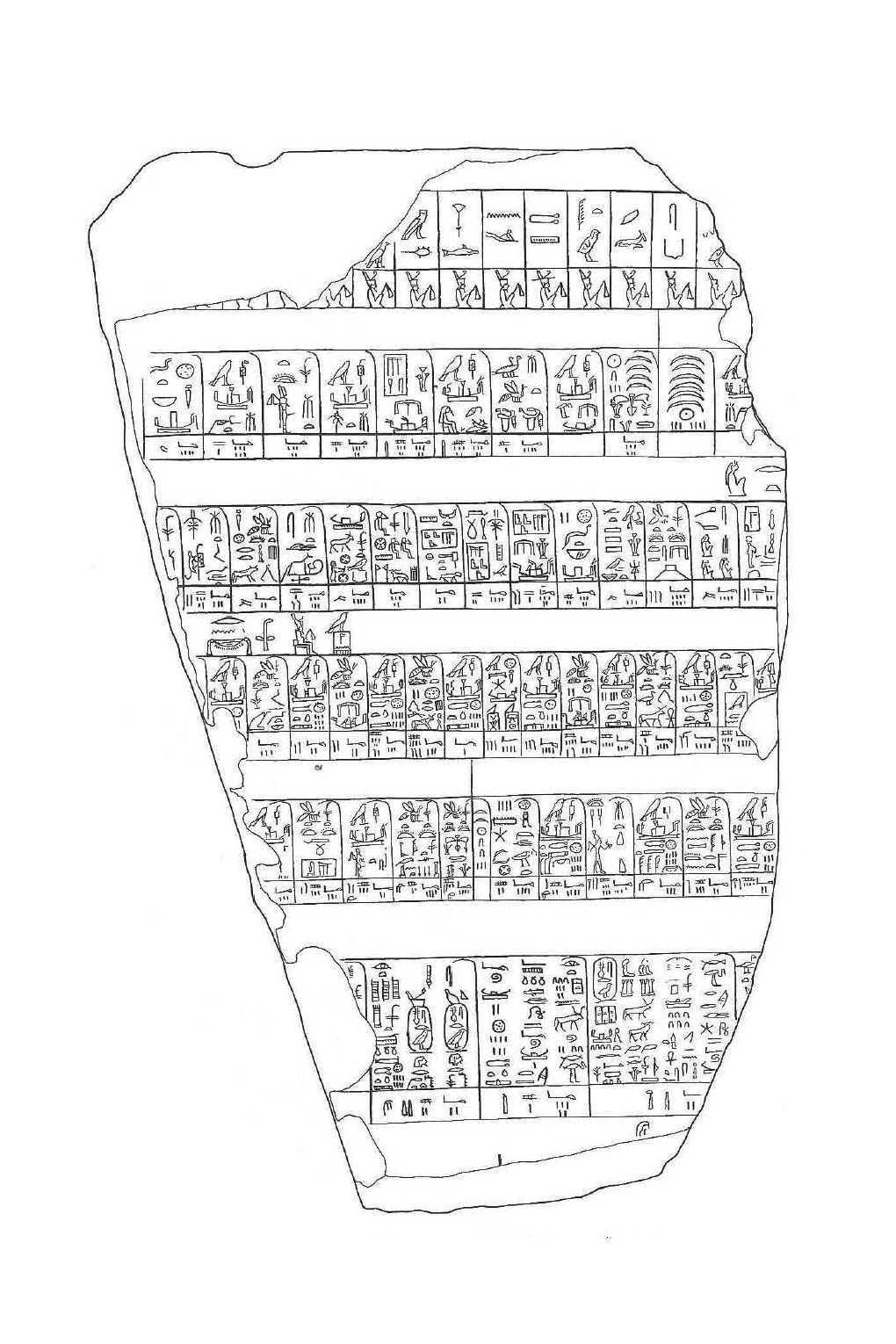

The black basalt stone, carved on both sides, is the most important king list from the Old Kingdom period. Only fragments survive.
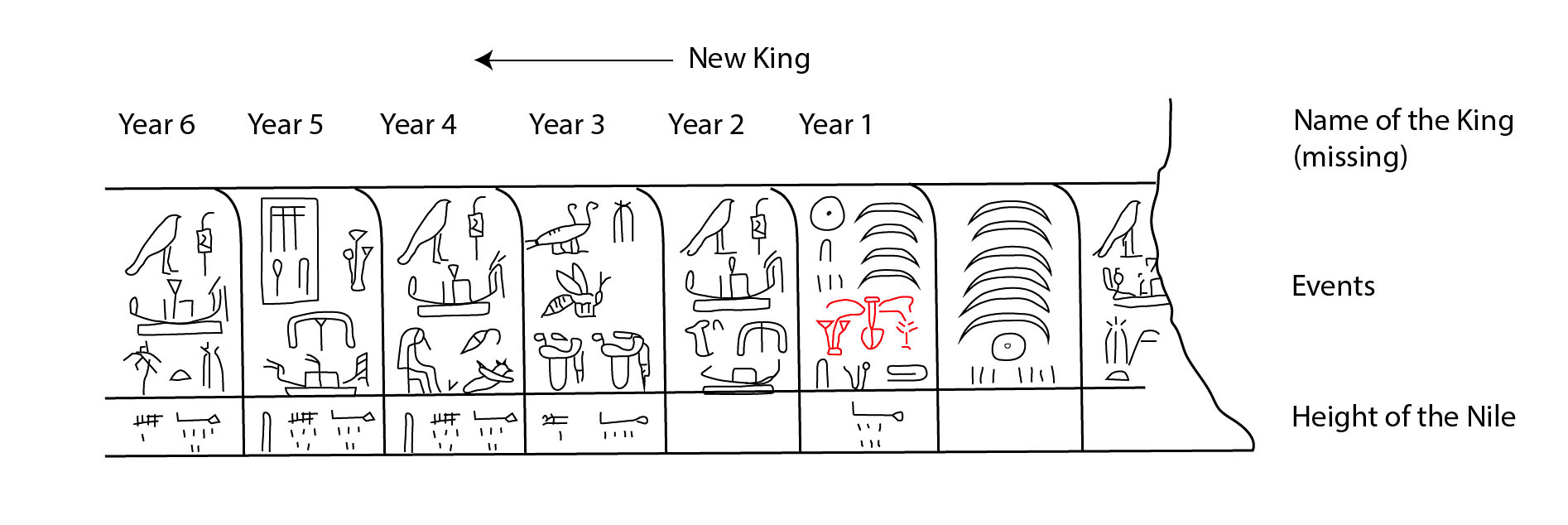
Each row is further divided with the uppermost row displaying the kings name, and then events from his reign, and finally the height of the Nile. The inauguration of a new king is marked in red.
The transition from one king to another was marked by the sema-tawi sign (shown in red in the image above). As you may recall from our study of the diorite Statue of Khafre, the sema-tawi symbol represents the unification of the two lands. The appearance of this symbol on the Palermo Stone marked the coronation of a new king.
The Nile Inundation
The bottom row of each entry of the Palermo Stone recorded the height of the Nile for that year. Based on this measurement, Egyptian officials had a good idea how much food would be grown that year. In the days before the Aswan High Dam (completed in 1970), the cycles of the Nile were to the Egyptian way of life like the changing of the seasons in northern climates. The Nile flowed sluggishly during the summer months while daily temperatures soared to 100 degrees Fahrenheit or more. As the vegetation withered and grain supplies dwindled, the countryside began to look as though it was going to permanently revert back to desert. But come July the Nile River began to pulse with new energy; it rose steadily through August and burst its banks in September or October. During the period of inundation, water levels rose 45 feet on average at Aswan in Upper Egypt and 25 feet in the Nile delta. During the height of the inundation, all that remained above water in the Nile Valley were the villages and temples built on hillocks. In years of extra high inundations, even these were flooded, causing extensive damage.
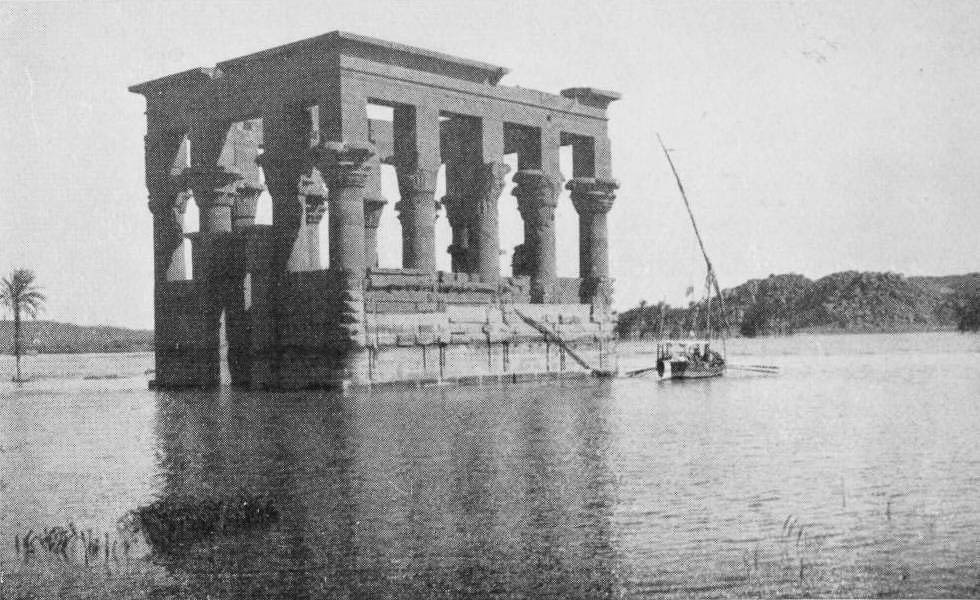

The Nile floods were interrupted when a series of dams were constructed on the Nile and its tributaries in the early 1900’s. The High Dam at Aswan brought the floods to an end upon its completion in 1970.
The black sediment deposited by the Nile each year made the soil of Egypt the most fertile of any nation on earth. Greek myth envisioned life springing forth spontaneously from the dark black earth of Egypt when the morning rays of the sun beat down upon it at the beginning of time.1Wilson 1946, 36 Unfortunately, the Egyptian farmer did not have it so easy. Once the inundation had passed and the river returned to its channel, the farmer had to plow the freshly deposited earth and sow the seed, usually in November. A system of canals were used to carry water to their fields from the Nile or from reservoirs replenished by the floods. A simple crane, known as a shadouf, was used to fill the canals.

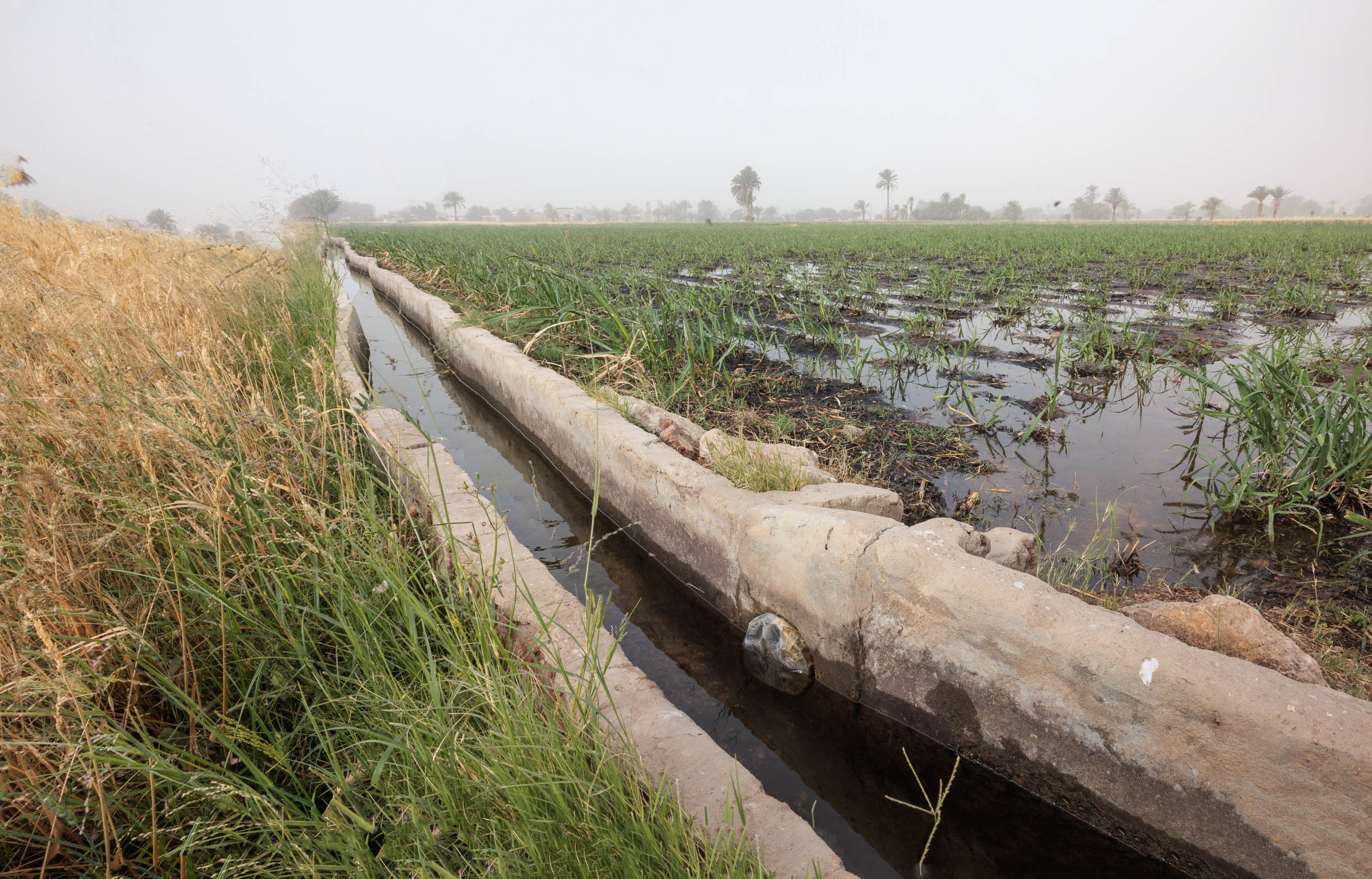
Left: A shadouf used in a European village to lift water from a well. Right: An irrigated field in Egypt. The land had to be carefully graded to ensure water flowed to every part of the field. Water is regulated with a plug in the sidewall of the canal (foreground).
In Egypt harvesttime came in Spring rather than in Autumn as in northern climates. The size of the harvest largely depended upon the amount of land inundated in the months prior. Thus there was a direct correspondence between the height of the floodwaters and the amount of grain that ended up in Egyptian storehouses. The Egyptians knew well ahead of time if they faced feast or famine!
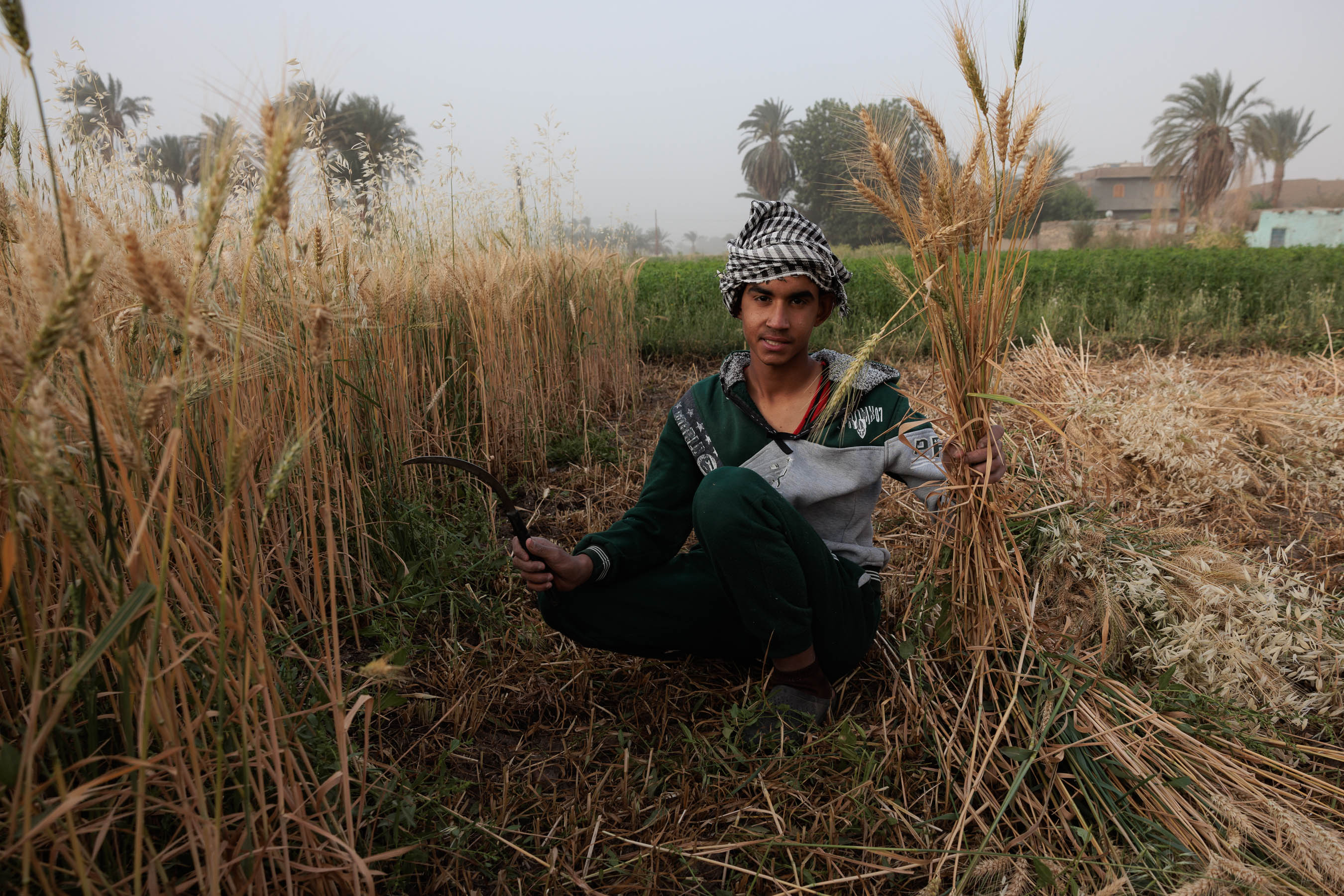

A young man harvesting barley in Egypt with a curved knife.
Hapy
The Jewish philosopher Philo (20 BC – 50 AD) observed the veneration paid by the Egyptians to the Nile.
Their country not being moistened, as other countries, by the rain, but being inundated regularly each year by the overflowing of the river, the Egyptians speak of the Nile as a god, viewing it as emulating the sky, and find there a subject of national pride.”22Hibbs 1985, 130
The god of which Philo speaks was Hapy, usually depicted in Egyptian reliefs as a well nourished man with an extended belly and pendulous breasts, or as a hippopotamus. Although Hapy was the god of the Nile, the water itself was attributed to Nun, the goddess of the subterranean waters. There is no indication that the Egyptians understood the cause of the Nile inundation although their reliefs reveal a fairly accurate knowledge of the place where the Nile originates.
The subject was debated in the Roman era, with the 4th century AD historian, Ammianus Marcellinus, writing pessimistically that the mysterious phenomenon of the Nile inundation would ever be understood.
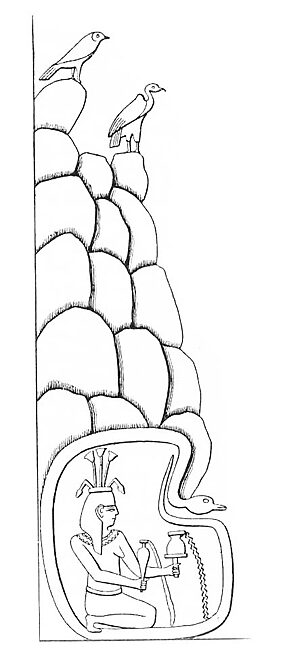
The god of the Nile is shown inside a cave formed by a coiled serpent. He is pouring water out of two vases which represent the two main branches of the Nile, known as the White and Blue Nile, that join together in the Sudan, near Khartoum. The cave is hidden in the mountains surmounted by a buzzard and a hawk. These are, perhaps, the mountains of Ethiopia where the headwaters of the Nile are found.
The origin of the sources of the Nile (so at least I am wont to think) will be unknown also to future ages as it has been up to the present… the poet’s tales and dissenting geographers give varying accounts of this unknown subject. (22.15.4) 3Hibbs 1985, 78
Marcellinus was overly pessimistic on this score. The Greek geographer, Strabo (64 BC – 24 AD), notes that there were travelers reports from Ethiopia which describe the monsoon rains which fell on the mountains there and hypothesized that these might have been the source of the Nile floods.4Hibbs 1985 Thus the source of the Nile flood was known, just not by Marcellinus!
Frankfort, Henri, H. A. Frankfort, John A. Wilson, Thorkild Jacobsen.
The intellectual adventure of ancient man; an essay on speculative thought in the ancient Near East.
Chicago: The University of Chicago press, 1946. Link
Hibbs, V. A.
The Mendes Maze : A Libation Table for the Inundation of the Nile (II-III A.D.).
New York: New York University, 1985.
Kemp, B. J.
Ancient Egypt : Anatomy of a Civilization.
New York: Routledge, 2006. Link
Wilkinson, Toby A. H.
Royal Annals of Ancient Egypt: The Palermo Stone and Its Associated Fragments.
London: Routledge, 2000.