The beginning of the Paleolithic (Old Stone Age) is generally dated to 100,000 B.P. (before present), the Mesolithic to 50,000 B.P., and the Neolithic to 10,000 B.P. These absolute dates are based primarily on thermoluminescence dating, radiocarbon dating, and other types of “geological clocks.” These long centuries of human prehistory generously granted to our ancestors are supposed to have given them sufficient time to figure out new ways of chipping flint and pounding stone. And then around 10,000 years, our forbears took a great leap forward when one of them discovered that they could plant a wild pea and get a hundred in return, rather than spend the day gathering 100 wild peas. Thus the agricultural revolution is supposed to have begun.
The prospect of tens of thousands of years between each new advancement in flint-chipping technology, and the 90,000 plus years it took for our ancestors to plant a pea requires that we ascribe a certain degree of imbecility to our human forefathers. I am not prepared to go this far and prefer, rather, to adopt the skeptical attitude of G. K. Chesterton towards much of what passes for anthropology (see here). The domestication of wild cereals such as barley was undoubtedly an important milestone but when and where it happened is difficult to say. Wild barley has a small kernel, with a thick husk, and a very brittle ‘spike’ which attaches the grain to the ear. Even a slight shaking of a wild barley stalk results in the kernel falling to the ground. Thus even if one were so inclined, there was not much point in gathering sheaves of wild barley. In contrast, the kernel of domesticated barley is fat, its husk is easily removed, while the ‘spike’ holding the grain to the ear is much stronger.1Nissen 1988, 21-22 People gathering wild species of wheat and barley in the mountain valleys of the Fertile Crescent would have tended to select ripe, fat kernels still on the stalk. This likely could have produced the domesticated varieties of cereal grains relatively quickly.

Models of ox-drawn carts, cart wheels, etc have been found at many early bronze sites in Armenia.
Unlike vegetables and fruit, cereals and pulses can be stored for long periods of time. Now it made sense to grow a surplus if one could and technologies such as the ox-drawn cart, plough and sledge did indeed make it possible. The ox-drawn cart, for example, enabled farmers to transport forage for animals, fertilizer to the fields, harvested grain to the granary, etc. And the ox-drawn plough vastly increased the amount of ground that could be cultivated by a single farmer.
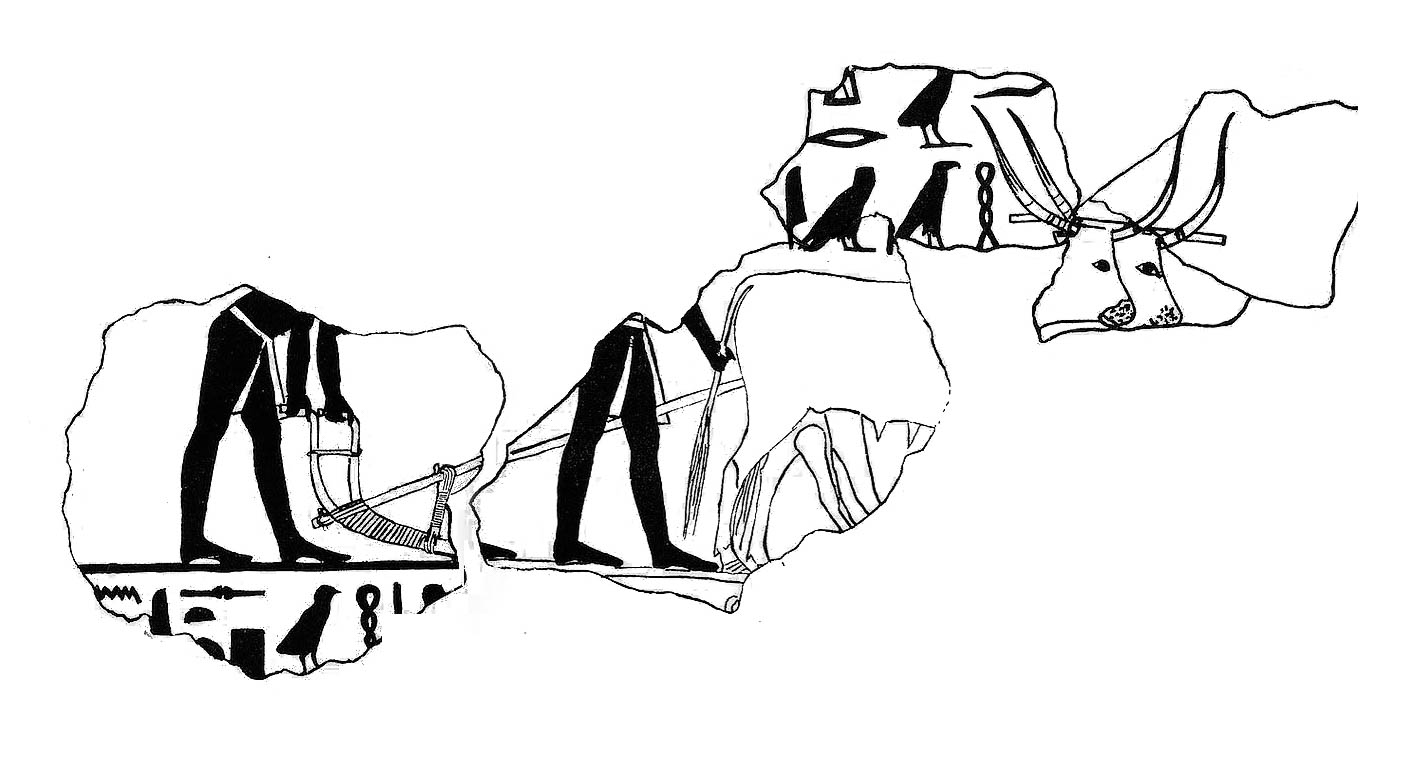
A depiction of an ox-drawn plough from a 12th dynasty tomb in Egypt. Although no-till farming is common today, traditionally, farmers have had to break the ground in order to provide a suitable seed bed for planting. Ploughing introduces oxygen, nutrients, and carbon into the soil and disrupts the growth of weeds.
A study of traditional farms in Iraq from the mid 1900’s shows that an Iraqi household numbering 7 people with an average plot size of 15 acres (one acre = .75 football fields) was capable of growing three times more cereal crop than they needed for their sustenance. Farms owned by absentee landlords farmed by serfs were typically twice as large.2McC. Adams 1964, 15
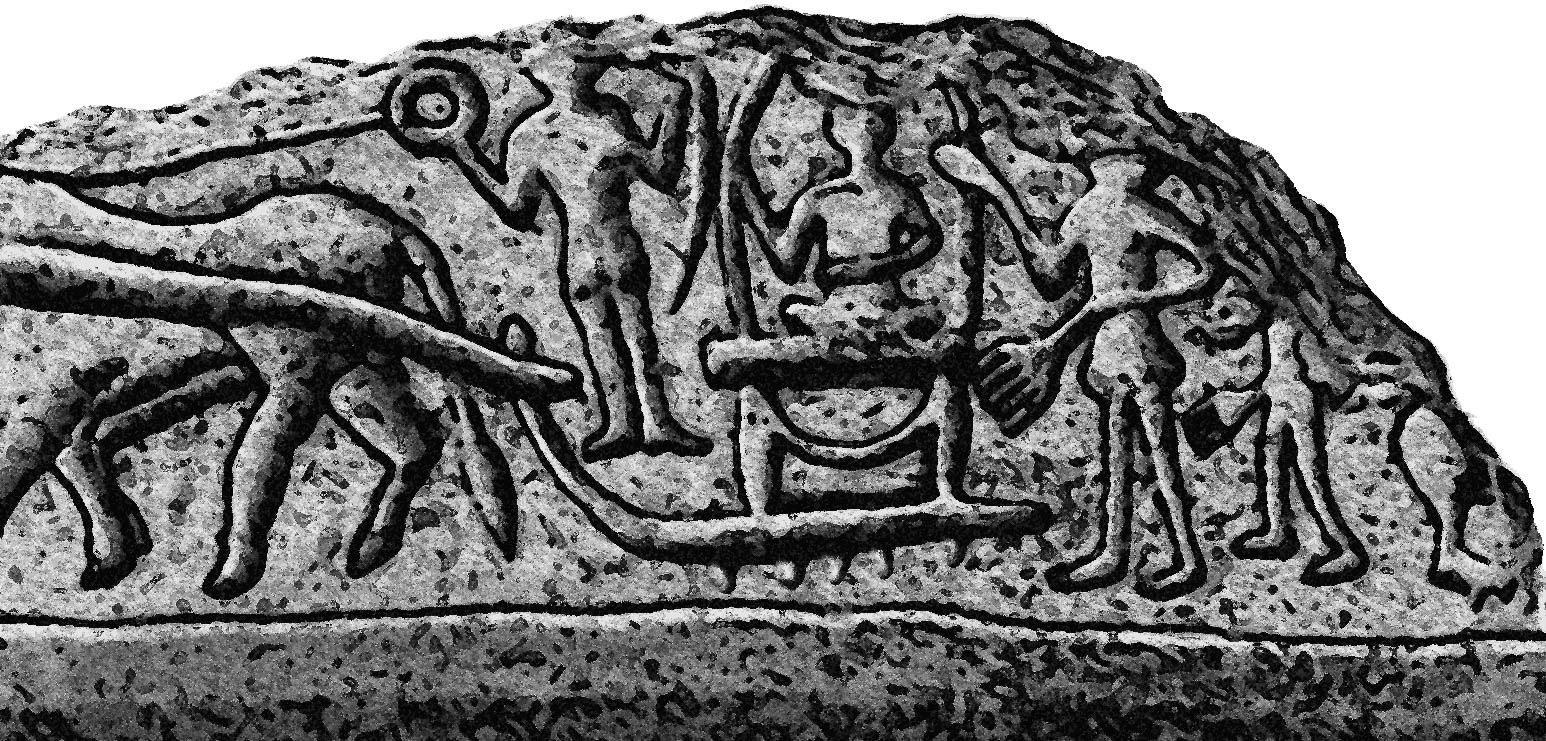
This cylinder seal from Arslantepe dates to the Late Uruk or Jemdet Nasr period. It shows a man holding the reigns of a pair of oxen pulling a threshing sledge. The person sitting on the sledge provided extra weight needed to break the barley husk. Winnowers follow behind with rakes.
The ox was also used to pull a threshing sledge—what was essentially a heavy plank with stones embedded in the bottom of it. The sledge was dragged over the harvested kernels of grain in order to separate the kernel from the husk. After threshing, the grain was tossed with rakes, thus separating the kernel from the chaff. Threshing and winnowing were typically done on hilltops where the wind could blow away the chaff.
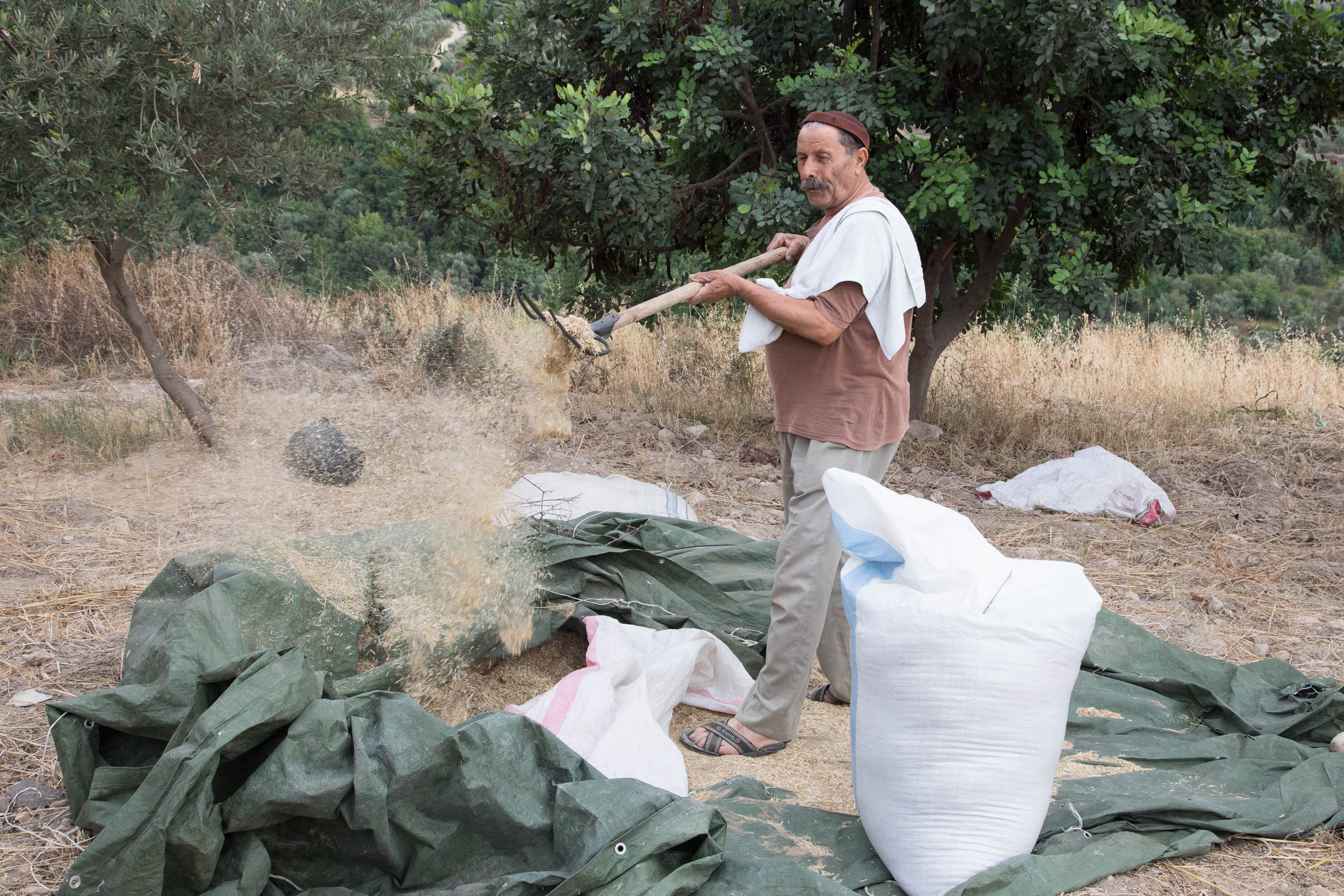
A farmer in Lebanon winnowing grain by forking it into the air. The wind carries the chaff away while the grain kernel falls to the ground.
Grinding
A final step was the grinding of grain into flour. This was traditionally done with basalt stones which could be rolled or pounded. The use of stone grinders to make flour is often said to have produced gritty flour that resulted in premature teeth wear. However, Egyptologist Barry Kemp argued against this view, noting that Egyptians were certainly capable of removing grit from their flour.3Kemp 2006, 166 Although a small detail, the view which ascribes large amounts of stone grit in flour is reflective of the tendency of modern textbooks to view ancient life through too dark a lens.


These basalt tools from the Caucasus were used for pounding and grinding rain.
Farming and Capitalism
Agriculture tends to tie people to the land. A successful farmer must pull weeds, add nutrients and new carbon to the soil, and till the ground. If irrigation is used, then the farmer has also to keep the irrigation channels clear and make sure his fields are properly drained. What is true of cultivated land is even more true of vineyards and orchards, which require an investment of many years before a harvest can be realized. No one willingly invests their time and resources into such an endeavor unless they can reasonably expect to enjoy the harvest. This makes agriculture contingent upon property rights and a certain degree of security. Whether the land be owned by institutions, wealthy nobles, or small freeholders, someone has to take care of it, and for them to do so, it must be worth their while.
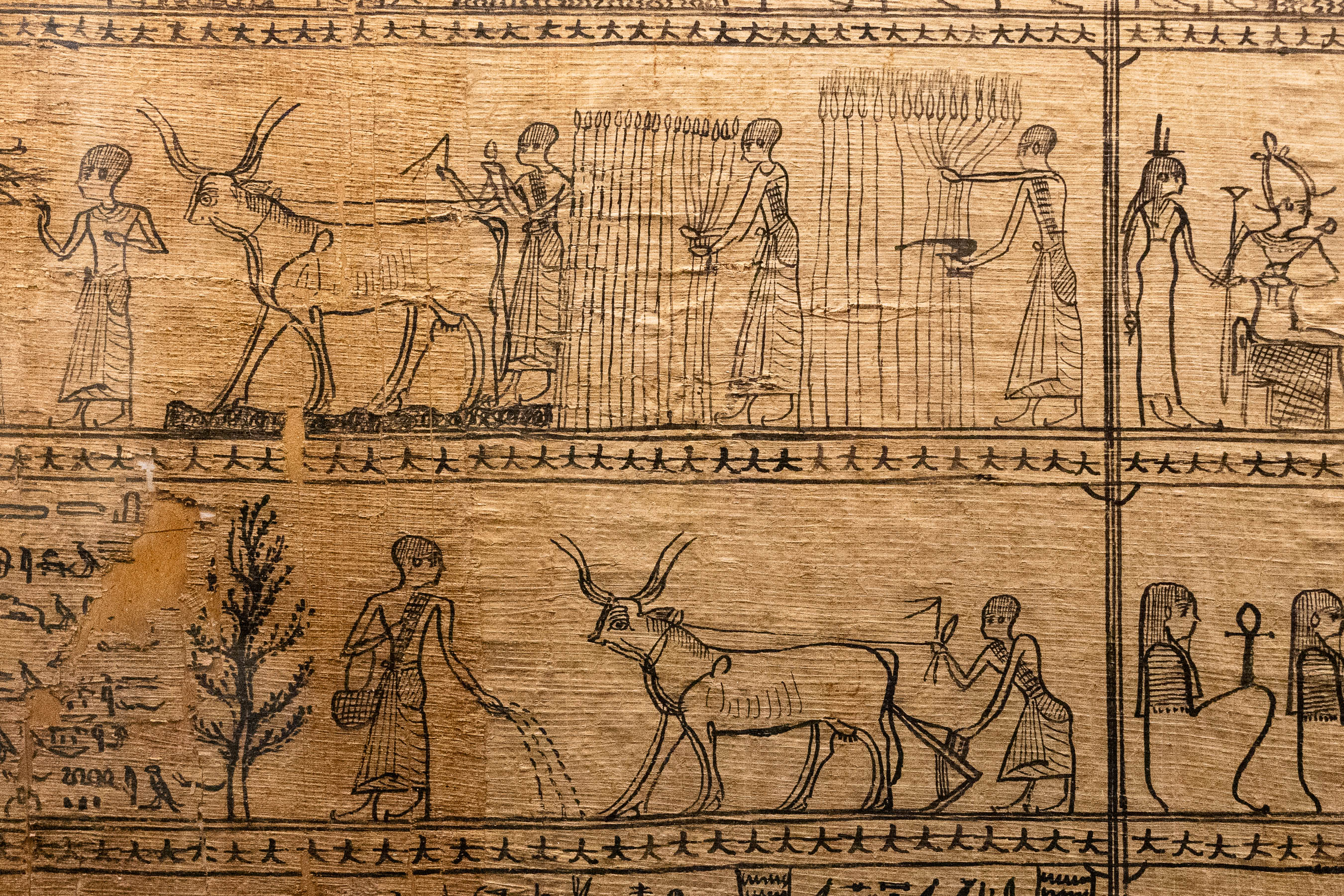

The place in the afterlife where the dead were allowed to enjoy the life they lived on earth. This scene comes from the Book of the Dead of Teruma (2nd century BC).
To settle down on a piece of land—to plant fields, gardens, and orchards, and enjoy their produce—was the ideal life in many cultures. Both the Egyptians and the Romans pictured paradise as wide fields of golden grain. The prophets of the Old Testament looked forward to a day when men would beat their swords into ploughshares and their shields into pruning hooks, and “neither shall they learn war anymore; but they shall sit every man under his vine and under his fig tree, and no one shall make them afraid…” (Mic. 4:3-4 ESV).
Kemp, B. J.
Ancient Egypt : Anatomy of a Civilization.
New York: Routledge, 2006. Link
McC. Adams, Robert.
Land Behind Baghdad: A History of Settlement on the Diyala Plains.
Chicago, Ill: University of Chicago, 1965. Link
Newberry, Percy E.
El Bersheh (Part I) The Tomb of Tehuti-Hetep, edited by G. Willoughby Fraser.
London: Egypt Exploration Fund, 1895. Link